

Why Professional Email Matters for Your Business
Business Email Hosting is a service that lets you create custom email addresses using your own domain name (like alex@yourcompany.com instead of alex@gmail.com). Here's what you need to know:
Key Business Email Hosting Features:
- Custom Domain Email - Use your@businessname.com
- Improved Security - Spam protection, encryption, 2FA
- Professional Storage - 5GB to 50GB+ per mailbox
- Device Sync - Access email on all devices
- Business Tools - Shared calendars, contacts, collaboration
- Migration Support - Transfer existing emails easily
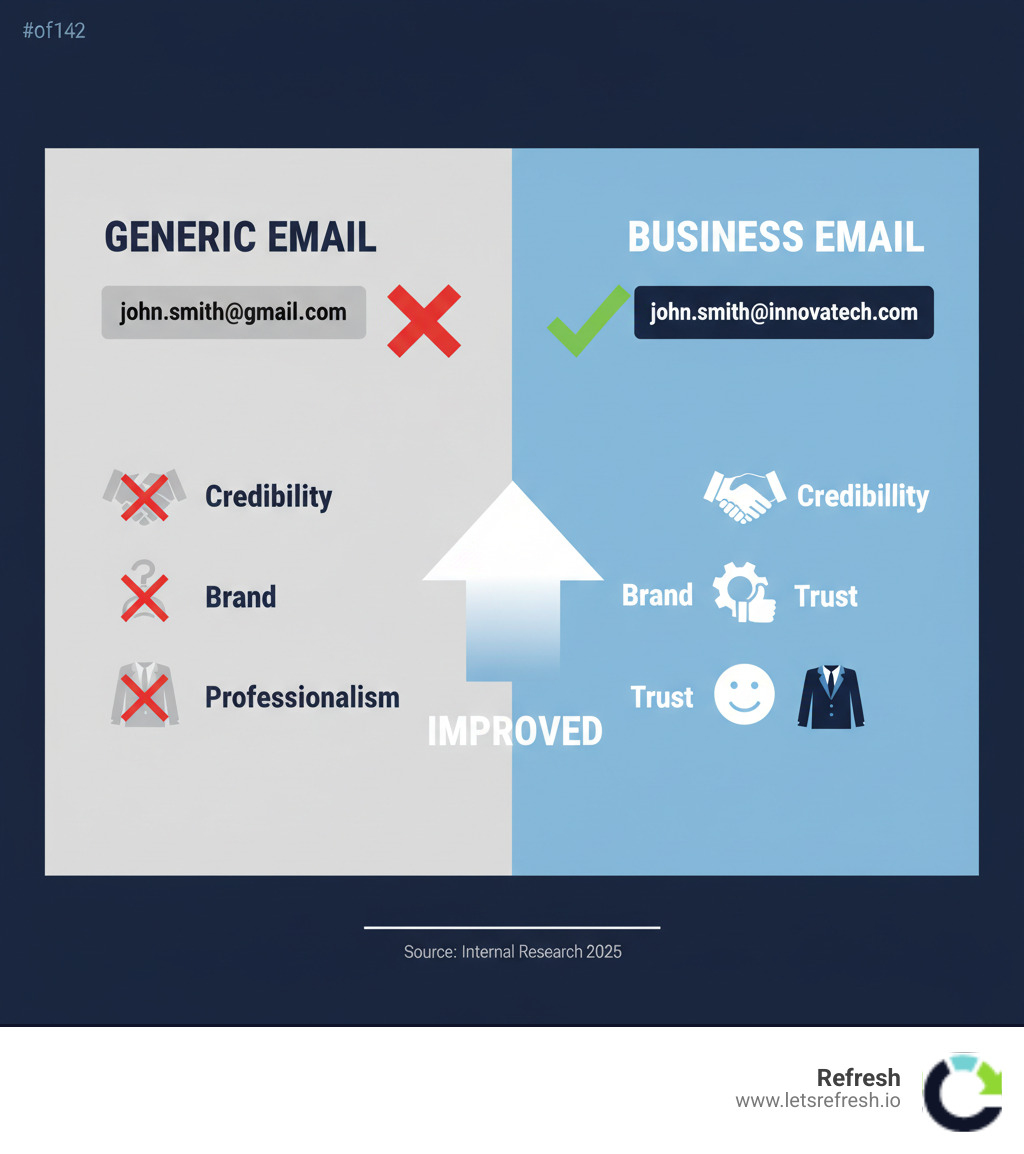
Your email address is often the first impression customers get of your business. Research shows that customers are 9 times more likely to choose a company with a professional email address rather than a generic Gmail or Yahoo account.
Think about it - would you trust a business proposal from "bigdeal2024@hotmail.com" or "sarah@innovatetech.com"? The difference is clear.
Free email services work fine for personal use, but they send the wrong message in business. A custom domain email address builds instant credibility and reinforces your brand with every message you send.
Professional email hosting goes beyond just a custom address. You get advanced security features, reliable uptime guarantees, generous storage, and tools that help your team collaborate better. Plus, you own and control your email data instead of relying on free services that can change their terms anytime.
The difference is simple but powerful - professional email hosting transforms how customers perceive your business while giving you the tools to communicate more effectively.
I'm Alexander Palmiere, and through developing over 200 websites at Refresh Digital Strategy, I've helped countless small businesses upgrade from free email to professional Business Email Hosting solutions. This experience has shown me exactly what features matter most for growing companies and which providers deliver the best value.
Key Features to Compare in Business Email Hosting Providers
Choosing the right Business Email Hosting provider isn't just about picking the cheapest option. After helping hundreds of small businesses make this transition, I've learned that certain features can make or break your email experience.

Let me walk you through the essential features that truly matter for your business.
First, uptime guarantee is non-negotiable. Your email needs to work 24/7 - period. Look for providers offering at least 99.9% uptime. I've seen businesses lose important deals because their email was down at the wrong moment. It's not worth the risk.
Scalability becomes crucial as you grow. Start with three employees? Great. But what happens when you hire five more next year? The best Business Email Hosting providers let you add users and increase storage without headaches or service interruptions.
Mobile compatibility isn't optional anymore. Your team checks email on phones, tablets, and laptops throughout the day. Make sure your provider offers excellent mobile support across iOS, Android, Windows Mobile, Symbian, and Blackberry devices.
Here's something many businesses overlook: email migration support. Moving years of emails, contacts, and calendars sounds terrifying, right? Smart providers offer self-service migration tools or dedicated support to handle the transfer. Some even provide specialized migration assistance to make switching completely painless.
Storage, Security, and Support
Storage needs vary wildly between businesses. Some companies need just 5GB per mailbox, while others require 50GB or more. Think about your team's habits - do they send large files? Keep years of correspondence? Choose accordingly, with options ranging from basic 10GB plans to generous 75GB packages.
Security should keep you up at night - but in a good way. Your business emails contain sensitive client information, financial data, and strategic plans. The right Business Email Hosting provider protects this treasure trove with multiple layers of defense.
Spam and virus protection uses advanced AI-driven filters to keep nasty stuff out of your inbox. Some providers use sophisticated tools like machine learning algorithms that get smarter over time, catching threats that traditional filters miss.
Data encryption ensures your emails stay private both when they're traveling across the internet and when they're stored on servers. Look for SSL encryption and SMTP TLS support as standard features.
Two-factor authentication (2FA) adds a crucial second layer of security. Even if someone steals your password, they still need your phone to get in. It's like having two locks on your front door.
Malware protection stops harmful software before it can damage your systems or steal your data. This is especially important for small businesses that might not have dedicated IT security teams.
Customer support can make or break your experience. When your email stops working, you need help fast. Look for 24/7 support through phone, live chat, and ticketing systems. The best providers offer expert support with friendly, knowledgeable teams who actually solve problems.
Collaboration and Productivity Tools
Modern Business Email Hosting goes way beyond simple messaging. The best solutions transform how your team works together.
Shared calendars eliminate those endless "when are you free?" email chains. Everyone can see availability, schedule meetings, and track project deadlines in one place. It's a game-changer for team coordination.
Shared contacts ensure everyone has access to the latest client information. No more asking "what's Sarah's phone number?" or missing opportunities because contact details were outdated.
Task management features let you assign, track, and complete projects right from your email platform. Many providers include shared folders, work schedules, and availability checking tools that streamline communication.
Integration with productivity suites is where things get really powerful. The best Business Email Hosting services connect seamlessly with tools you already use - Microsoft 365 applications like Word, Excel, PowerPoint, and Teams, Google Workspace tools including Gmail, Calendar, and Drive, cloud storage services such as OneDrive and Dropbox, video conferencing platforms like Zoom and Microsoft Teams, CRM systems for contact management, and project management tools for task coordination.
These integrations turn your email into a central hub where your team can create, edit, and share documents without constantly switching between apps.
Technical Protocols and Synchronization
The technical stuff might seem boring, but understanding email protocols helps you make smarter decisions about Business Email Hosting.
POP3 vs. IMAP represents old-school versus modern thinking. POP3 downloads emails to one device and often deletes them from the server. Check email on your computer? It might not show up on your phone. IMAP keeps everything on the server, so you can access emails from any device with perfect synchronization.
For most businesses today, IMAP wins hands down because it allows multiple devices to manage the same mailbox while staying perfectly synced.
But here's where Exchange ActiveSync takes things to the next level. This protocol doesn't just sync emails - it handles calendars, contacts, tasks, and notes in real-time across all your devices. It uses "push" technology, meaning new emails appear instantly without manual refreshing.
Real-time synchronization means your information stays current whether you're on your laptop, smartphone, or tablet. ActiveSync also includes security features to ensure that your private emails stay, well… private.
Device sync and email client compatibility ensure your Business Email Hosting works seamlessly with Outlook, Apple Mail, Thunderbird, or any mobile email app. The best providers make sure everything just works, regardless of what devices your team prefers.
Comparing Business Email Hosting Options
Shopping for Business Email Hosting can feel overwhelming with so many options out there. When I work with clients at Refresh, I always tell them to start with two simple questions: "What's your budget?" and "How does your team actually use email?"
The answers to these questions will guide you toward the right solution faster than any feature comparison chart.

Most Business Email Hosting providers use per-user pricing - you pay a monthly fee for each email account your team needs. This makes budgeting straightforward since costs grow with your team. A typical small business might pay anywhere from $3 to $12 per user per month, depending on features and storage.
Some providers offer tiered plans instead. These bundle a set number of mailboxes with total storage limits. You might see a "Starter" plan with 5 accounts and 25GB total storage, or a "Professional" plan with unlimited accounts and 100GB storage.
Here's a tip from experience: always check renewal rates. That amazing first-year discount might disappear when it's time to renew. I've seen businesses get sticker shock when their email costs double in year two. Read the fine print and budget for the long-term price, not just the introductory offer.
Bundled vs. Standalone Business Email Hosting
One of the biggest decisions you'll face is whether to bundle your email with web hosting or go with a dedicated email provider.
Bundled with web hosting is often the simpler choice for new businesses. You get your website and email under one roof, which means one bill and one support team to deal with. Many web hosting plans include professional email for the first year, making it an attractive starting point for entrepreneurs.
The downside? Bundled email services often have limitations. Storage might be tight, security features basic, and collaboration tools minimal. If your team sends lots of attachments or relies heavily on shared calendars, you might outgrow a bundled solution quickly.
Standalone email options are built specifically for email. They typically offer more storage, better security, advanced collaboration features, and superior reliability. The trade-off is higher cost and another vendor to manage.
Think about it this way: if email is just something you need to check occasionally, bundled works great. But if email is how your business runs - client communications, project coordination, file sharing - then investing in a specialized Business Email Hosting service makes sense.
For more guidance on this decision, check out our detailed comparison in Best Email and Website Hosting for Small Business.
The Refresh Advantage: Data Privacy and Hosting
Here's something that keeps me up at night (in a good way): data privacy. Where your email lives matters more than most business owners realize.
At Refresh, we strongly recommend locally-hosted servers for Canadian businesses. When your email is hosted in Canada, it's protected by Canadian privacy laws - some of the strongest in the world. This isn't just legal jargon; it's real protection for your business communications.
Data sovereignty means your sensitive emails, client information, and business plans stay under Canadian legal protection. Foreign governments can't just demand access to your data without going through proper Canadian legal channels. As one privacy expert puts it, hosting email servers in Canada ensures your data is safe from foreign government legislation that might grant access to inboxes without consent.
This compliance with Canadian privacy standards isn't just nice to have - it's essential for maintaining customer trust. When clients know their information is protected by robust Canadian privacy laws, they feel more confident sharing sensitive details with your business.
Protection from foreign legislation is particularly important in today's digital landscape. Different countries have different rules about data access, and some are far less protective of business privacy than others.
For Canadian businesses, choosing email hosting with Canadian servers isn't just about compliance - it's about peace of mind. You can focus on growing your business instead of worrying about data security. Learn why your email should be hosted in Canada for more insights on this important topic.
Setting Up and Migrating Your Professional Email
Setting up your Business Email Hosting doesn't have to feel like rocket science. I'll walk you through the process step-by-step, and trust me - it's more straightforward than you might think.
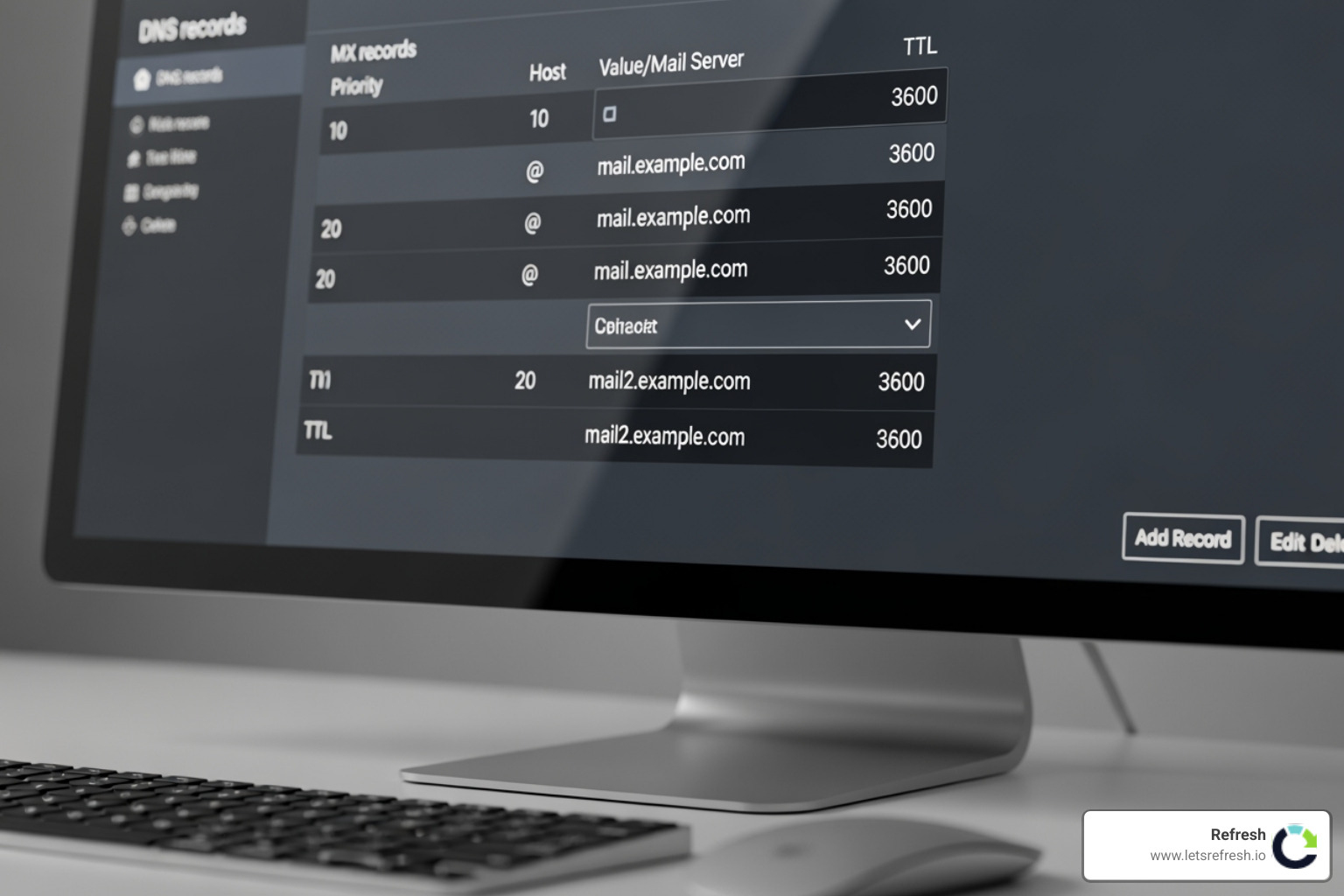
The first step involves DNS configuration. Think of DNS (Domain Name System) as the internet's address book - it tells the world where to find your website and, more importantly for us, where to deliver your emails.
Your Business Email Hosting provider will give you specific records to add to your domain's DNS settings. Don't worry - they'll provide clear instructions, and most domain registrars make this process pretty user-friendly these days.
The star of the show here are your MX records (Mail Exchange records). These little pieces of code tell other email servers exactly which server should handle emails for your domain. Get these wrong, and your emails will bounce around the internet like a lost package. Get them right, and emails flow smoothly to your inbox.
Your provider will also give you SPF (Sender Policy Framework) and DKIM (DomainKeys Identified Mail) records. These help prove that emails from your domain are legitimate, which keeps them out of spam folders. Tools like MXtoolbox can help you verify everything is working correctly.
Once your DNS is configured (usually takes a few hours to propagate worldwide), you're ready for the next step: bringing over your existing emails.
This is where migration tools become your best friend. Most quality Business Email Hosting providers offer automated tools that can transfer your old emails, contacts, and calendars from your previous service. Some providers even offer hands-on migration support, walking you through the entire process.
The beauty of modern migration tools is that they handle the heavy lifting. You don't need to manually forward thousands of emails or recreate your contact lists from scratch.
The Benefits of a Custom Domain Name
Let's talk about why switching to a custom domain email address is one of the smartest moves you can make for your business. It's simple, but the impact is huge.
Every email you send becomes a brand reinforcement opportunity. Instead of advertising Gmail or Yahoo with addresses like "yourname@gmail.com," you're showcasing your own business with "yourname@yourbusiness.com." That's free marketing with every message you send.
The customer trust factor is massive too. We've all gotten emails from businesses using free email addresses, and let's be honest - it doesn't inspire confidence. A custom domain email tells customers you're serious about your business and invested in presenting yourself professionally.
Research consistently shows that customers are far more likely to engage with businesses that use professional email addresses. It's a simple credibility marker that can make or break a first impression.
Your professional email also becomes a powerful marketing tool working 24/7. Every email signature, every correspondence, every automated message reinforces your brand and drives people back to your website. It's subtle but incredibly effective.
The connection between your email address and your online presence creates a cohesive brand experience. When customers see your email, they immediately associate it with your website and business. This consistency builds recognition and trust over time.
Learn how Business Email can help your business and find more about What is a Domain Name for Beginners and Why It Matters to understand the full impact of professional email on your business success.
Frequently Asked Questions about Business Email
Let me answer the questions we hear most often from small business owners considering Business Email Hosting. These come up in nearly every consultation, so you're definitely not alone if you're wondering about these topics.
What's the main difference between free email and paid business email?
The gap between free and professional email is much wider than most people realize. It goes way beyond just having your company name in the email address.
Credibility is the big one. When a potential client sees an email from "sarah@innovativedesigns.com" versus "sarahdesigns2024@gmail.com," their first impression changes instantly. The professional address signals that you're serious about your business and willing to invest in quality tools.
Ownership matters more than you might think. With free email, you're essentially borrowing space on someone else's platform. They can change rules, scan your messages for advertising data, or even shut down your account with little warning. With Business Email Hosting, you own your email data and control how it's managed.
The advanced security features alone justify the cost. Professional services offer sophisticated spam filtering, virus protection, encryption, and two-factor authentication. Free services provide basic protection, but it's rarely enough for business communications containing sensitive information.
Customer support becomes crucial when something goes wrong. Try getting help from a free email provider when your account gets hacked or emails stop working. With paid Business Email Hosting, you get real human support available when you need it most.
Finally, there are no ads cluttering your interface or appearing in your communications. This keeps your email environment clean and professional, without distractions that can undermine your credibility.
What is Exchange ActiveSync and is it better than IMAP?
Think of Exchange ActiveSync as the premium version of email synchronization. While IMAP does a good job keeping your emails in sync across devices, ActiveSync takes it several steps further.
The magic happens with real-time sync. Instead of your phone checking for new emails every few minutes, ActiveSync uses push technology to instantly deliver new messages, calendar updates, and contact changes to all your devices the moment they arrive. It's like having a personal assistant who immediately updates every device you own.
Unlike IMAP, which focuses mainly on emails, ActiveSync handles your entire communication ecosystem - email, calendars, contacts, and even tasks. This comprehensive approach means your team's shared calendar stays perfectly synchronized whether someone adds a meeting from their laptop or phone.
For business collaboration benefits, this is transformative. Everyone stays on the same page without delays or version conflicts. When your sales manager updates a client's contact information on their phone, it instantly appears on everyone else's devices.
Is it superior to IMAP for multi-device users? Absolutely. While IMAP works well for basic email sync, ActiveSync provides the seamless, immediate, and comprehensive synchronization that modern businesses need to stay productive and coordinated.
How does business email hosting protect against spam and phishing?
Professional Business Email Hosting providers treat security like a full-time job, because for them, it is. The protection goes far beyond what you'll find with free services.
Advanced filters form the first line of defense. These aren't simple keyword blockers - they're sophisticated systems that analyze sender reputation, message patterns, and suspicious behaviors. The filters learn and adapt constantly, getting smarter with each attempted attack.
Many providers now use AI-driven defense systems that can spot new types of threats before they become widespread problems. This predictive approach means your inbox stays clean even as cybercriminals develop new tactics.
Blacklist mitigation happens behind the scenes, where security teams maintain databases of known malicious senders and automatically block their messages. At the same time, they work to ensure legitimate emails from your business partners and clients never get incorrectly filtered.
Sender authentication protocols like SPF and DKIM verify that emails actually come from where they claim to come from. This dramatically reduces successful phishing attempts, because the system can detect when someone tries to impersonate a trusted sender.
These improved security protocols work together to create multiple layers of protection. Even if one layer misses something, the others catch it. This comprehensive approach gives your business the security it needs without requiring you to become a cybersecurity expert.
Conclusion: Making the Right Choice for Your Small Business
After helping hundreds of small businesses steer their digital change, I've seen how the right Business Email Hosting choice can transform a company's professional image and day-to-day operations. It's not just about getting email addresses - it's about building the foundation for how your business communicates with the world.
The benefits we've covered throughout this guide really do add up. You get instant credibility that makes customers take you seriously from the first email. The robust security features - including spam protection, malware filtering, and two-factor authentication - keep your business safe from the growing number of cyber threats targeting small companies.
Your team gains access to reliable uptime and scalable storage that grows alongside your business. No more worrying about hitting storage limits or explaining to clients why your email was down. The collaboration tools like shared calendars and contacts turn your email system into a productivity hub that helps everyone work better together.
Real-time synchronization through protocols like Exchange ActiveSync means your team stays connected whether they're in the office, at home, or traveling. And when something goes wrong, you have dedicated customer support to help - not just a generic help center.
Perhaps most importantly, especially for Canadian businesses, you get ownership and control of your data. When your email is hosted on Canadian servers, you benefit from our strong privacy laws and protection from foreign legislation that might otherwise compromise your business communications.
Aligning your choice with your business needs means looking beyond just the monthly cost. Consider where your company is heading in the next few years. Will you be hiring more staff? Do you handle sensitive client information? Are you planning to expand your online presence? The answers to these questions should guide your decision.
The long-term value of professional email hosting far outweighs the small monthly investment. Think about it - every email you send becomes a marketing opportunity, every interaction builds trust, and every day your business runs more smoothly because your communication tools actually work.
At Refresh, we've built our digital strategy around helping small businesses make smart, sustainable choices. We know that when you get the fundamentals right - like professional email hosting - everything else becomes easier.
Ready to take the next step? We're here to help you find the perfect solution that fits your business perfectly.
Find the Best Email and Website Hosting for Your Small Business


.avif)