
Why Marketing for Small Business is Your Growth Engine
Marketing for small business is how you attract customers, build your brand, and drive revenue, even on a tight budget. An effective strategy includes defining your target audience and USP, building a digital presence, engaging customers, and tracking performance. A good starting point is investing 3-5% of your revenue in marketing.
You don't need a massive budget to compete. With 42% of Americans using social media to find small businesses and email marketing delivering an estimated $36 return for every $1 invested, what you need is a clear strategy that combines the right tactics for your specific audience and goals.
Many small business owners feel overwhelmed by marketing, but the businesses that thrive are the ones that treat it as a measurable investment, not an expense.
I'm Alexander Palmiere, founder and CEO of Refresh Digital Strategy. We've successfully launched over 200 websites for small to medium-sized businesses, helping them boost their online visibility and establish strong digital footprints that drive real growth.
Step 1: Build Your Foundational Marketing Plan
Every great journey starts with a map, and for your business, that map is your marketing plan. It's a strategic roadmap that turns your business goals into actionable steps for connecting with customers and driving sales. Key steps in effective marketing for small business include researching opportunities, identifying your target market, developing a unique proposition, and choosing your marketing channels.
A solid plan describes the actions you'll take to persuade customers to buy. Every small business should have a clear marketing plan and budget, often drawing from the information in your initial business plan. This ensures your efforts are targeted, efficient, and measurable. For a deeper dive, Learn what to include in your marketing plan with this easy guide from the Small Business Administration (SBA). A strong marketing plan is also a critical component of The Importance of a Strong Digital Strategy for Small to Medium-Sized Businesses.
Define Your Target Audience and USP
First, know who you're talking to. Defining your target audience with precision is essential. Market research provides insights into customer thinking and buying patterns. We segment customers based on geography (e.g., Pittsburgh, Cleveland, or Charlotte), demographics, behavior, and lifestyle/values.
To define your ideal customer, ask what their biggest pain points are and how your product or service solves them. This helps map their customer journey. Since 66% of customers expect companies to understand their unique needs, this step is crucial. Plus, 37% of Americans buy from small businesses for a more personal experience. For a detailed guide, explore Crafting Your Ideal Customer: A Guide to Developing a Buyer Persona for Small Businesses.
Next, determine what makes you special—your Unique Selling Proposition (USP). This is the core reason customers choose you over competitors. Your USP should focus on benefits, not just features, showing how your offer aligns with customer values. Learn more about how to Determine your unique value proposition.
Establish a Strong Brand Identity
Your brand is the emotional connection you build with customers. It conveys who you are, what you stand for, and the value you deliver. A strong brand identity includes:
- Brand Voice and Tone: This dictates how you communicate. Is your voice playful or formal? Consistency is key. Determine what voice and tone will work for your business.
- Logo Design and Visual Guidelines: Your logo, colors, and fonts make your brand instantly recognizable.
- Brand Mission and Promise: These statements clarify your goals and set customer expectations.
For expert help, consider partnering with a Small Business Branding Agency like Refresh.
Set a Realistic Marketing Budget

View marketing spending as an investment that drives sales. A general rule is to spend 3-5% of your annual turnover on marketing. New or high-growth businesses may need to allocate more to build awareness.
The average business spends 1.08% of its revenues on advertising, according to a Small Business Trends report, but this varies by industry (retailers ~4%, restaurants ~1.93%). Your budget should account for website development, SEO, branding, advertising, and sponsorships. Critically, track your costs against the revenue they generate to ensure a positive Return on Investment (ROI) and identify what's working. For more on optimizing your spending, explore how to Maximize Marketing ROI.
Step 2: Dominate the Digital Landscape: Online Marketing for Small Business
A strong digital presence is essential for marketing for small business. Digital marketing is often more affordable and efficient than traditional methods, allowing you to launch and adjust campaigns quickly based on real-time data.
Digital marketing expands your reach, connecting you with customers across town or across the country. Whether you're a brick-and-mortar shop or fully online, people need to find you. Building a robust Small Business Online Presence is the foundation for growth.
Build a Professional Business Website
Your website is your digital storefront and often the first impression of your business. A professional site must be user-friendly, feature a mobile-first design, be ADA compliant for accessibility, and have fast loading speeds. Errors, broken links, and outdated content can cost you valuable traffic.

Choosing the right platform is key, which is why we often recommend Webflow. It allows us to build stunning, high-performing websites customized for small business needs. Webflow provides complete control over design and functionality, ensuring your site is beautiful, fast, and optimized for search engines. Understanding Why is Web Hosting Important for a Small Business? and exploring Webflow vs Other Platforms: Why Webflow is the Preferred Choice for Your Business will provide more context.
A well-designed website builds credibility and serves as the central hub for all your marketing efforts.
The Role of SEO and Content in Marketing for Small Business
Once your website is live, Search Engine Optimization (SEO) and content marketing help people find it. SEO improves your site to rank higher in search results, which is critical since ranking first on the first page of search results earns approximately 29% of users' clicks.
A strong SEO strategy starts with keyword research to find the terms your audience uses. On-page SEO then optimizes your site's content to match those keywords. For businesses in specific areas like Pittsburgh or Cleveland, local SEO is vital. This includes optimizing your Google Business Profile to appear in local searches and on Google Maps.
Creating valuable content through blogging positions you as an expert and builds trust. Answering common questions or sharing industry insights improves search rankings and keeps readers engaged. Earning backlinks from other reputable sites further boosts your authority and rankings.
SEO is a cost-effective strategy for marketing for small business. To learn more, check out our Small Business SEO Ultimate Guide and find Why Your Business Needs a Blog: The Untapped Potential of Blogging.
Leverage Social Media and Email Marketing
Social media and email marketing connect you directly with your audience. With 42% of Americans using social media to find small businesses, a presence on these platforms matters. However, focus on one or two platforms where your target audience spends their time. A B2B service might use LinkedIn, while a boutique could thrive on Instagram.
Post valuable, shareable content regularly and use a content calendar to stay consistent. Our Social Media Management services can help you develop a calendar and grow your following.
Email marketing remains a top channel, with 64% of small businesses using it. It's highly cost-effective, with an estimated $36 return for every $1 invested. Effective email campaigns are personalized, mobile-optimized, concise, and automated with sequences for new subscribers, promotions, and inactive customers.
Use Paid Online Advertising
Paid online advertising accelerates your visibility and delivers faster results than organic methods alone.
- Pay-Per-Click (PPC) advertising places your ads at the top of search results, and you pay only when someone clicks. It's an efficient way to reach users actively searching for your services. Learn more about How Pay-Per-Click (PPC) Advertising Works.
- Social media ads on platforms like Facebook and Instagram offer powerful targeting. You can start with a small budget ($5-$20) to boost top-performing posts to specific audiences.
- Retargeting and remarketing re-engage people who have already shown interest in your business by serving them ads or sending email reminders.
- Influencer marketing with micro or nano-influencers can provide authentic engagement and targeted local reach without a massive price tag.
For more insights, explore our guide on Digital Ad Campaigns for SMB.
Step 3: Expand Your Reach with Community and Local Marketing
While digital marketing is powerful, connecting face-to-face in communities like Pittsburgh, Cleveland, and Charlotte builds lasting relationships. Traditional and local marketing tactics help you become a familiar, trusted presence, and networking and collaborating with other businesses can help you build awareness.
These interactions create opportunities for word-of-mouth promotion—one of the most valuable forms of marketing. Experiential marketing, like workshops or pop-up shops, creates memorable, positive experiences that customers want to share.
Engage with Your Local Community
Getting involved in your local community is smart marketing that builds trust and visibility.
- Join the Chamber of Commerce: Access networking events and connect with other local business owners.
- Sponsor Local Events: Sponsoring a youth team or community festival shows you're invested in the community's success.
- Host Workshops: Position yourself as an expert and give potential customers a experience of your offerings.
- Use Pop-up Shops: Meet customers at farmers markets or street fairs to showcase products and make personal connections.
- Partner with Local Businesses: Cross-promote with non-competing businesses to reach new audiences and strengthen the local economy.
For additional support, Contact your local SBA branch for assistance. And ensure you're visible online to local customers with our Local SEO Services for Small Business.
Low-Cost Marketing for Small Business
Effective marketing for small business requires creativity and consistency, not a massive budget. Here are some powerful, low-cost tactics:
- Referral Programs: Offer small incentives to satisfied customers who recommend you to their friends.
- User-Generated Content: Encourage customers to post photos or share experiences using a branded hashtag. Run a giveaway to build buzz.
- Google Business Profile Optimization: Claim and completely fill out your free profile. This is often the first thing local customers see. Learn Why Google My Business is Essential for Your Company's Growth.
- Community Networking: Attend local business mixers and community events to build relationships that lead to referrals and partnerships.
- Business Cards: A well-designed physical or digital card makes it easy for new contacts to remember you.
- Perfect Your Elevator Pitch: Being able to explain what you do in under 90 seconds makes every conversation count.
- Systematic Reviews and Testimonials: Create a simple process to request reviews and showcase them on your website and social media.
- Local Co-marketing: Partner with non-competing businesses on joint promotions to amplify everyone's reach.
- Limited-Time Offers: Create urgency with a short-term discount to convert interested prospects into customers.
- Small Social Media Boosts: Use a small budget ($5-$20) to boost your best posts to a targeted local audience.
For more budget-friendly strategies, explore our collection of Affordable Marketing Ideas.
Step 4: Nurture and Analyze for Sustainable Growth

Effective marketing doesn't stop at launch. It requires continuous relationship-building and careful analysis to turn quick wins into sustainable growth. This ongoing cycle of tracking, reviewing, and adjusting is key to long-term success in marketing for small business.
Nurture Customer Loyalty and Encourage Repeat Business
Retaining existing customers is often cheaper than acquiring new ones. As a small business, you have an advantage: 37% of Americans buy from small businesses for a more personal experience. A NerdWallet survey found that 30% are willing to wait longer and pay more for products from small businesses.
Here are ways to keep customers coming back:
- Start a referral program: Encourage happy customers to refer friends by offering a small thank-you.
- Offer loyalty rewards: Show appreciation to repeat customers with a points system, special discounts, or early access to new products.
- Provide exceptional customer service: Nurture loyalty with friendly communication, follow-ups, and by always keeping your promises.
- Use personalized communication: Use customer names in emails or suggest products based on past purchases to make a big difference.
Monitor and Review Your Marketing Success
"If you can't measure it, you can't improve it." This is especially true for marketing for small business. Set SMART goals (Specific, Measurable, Achievable, Relevant, Time-bound) and regularly review your marketing plan to ensure a good return on investment (ROI).
Here are key tools and metrics to track success:
- Google Analytics: This essential tool shows who visits your site, where they come from, and how they behave. Create a Google Analytics account to start gathering data.
- Social media analytics: Built-in platform tools help you track engagement, reach, and follower growth. For deeper insights, use specialized Social Media Analytics Tools.
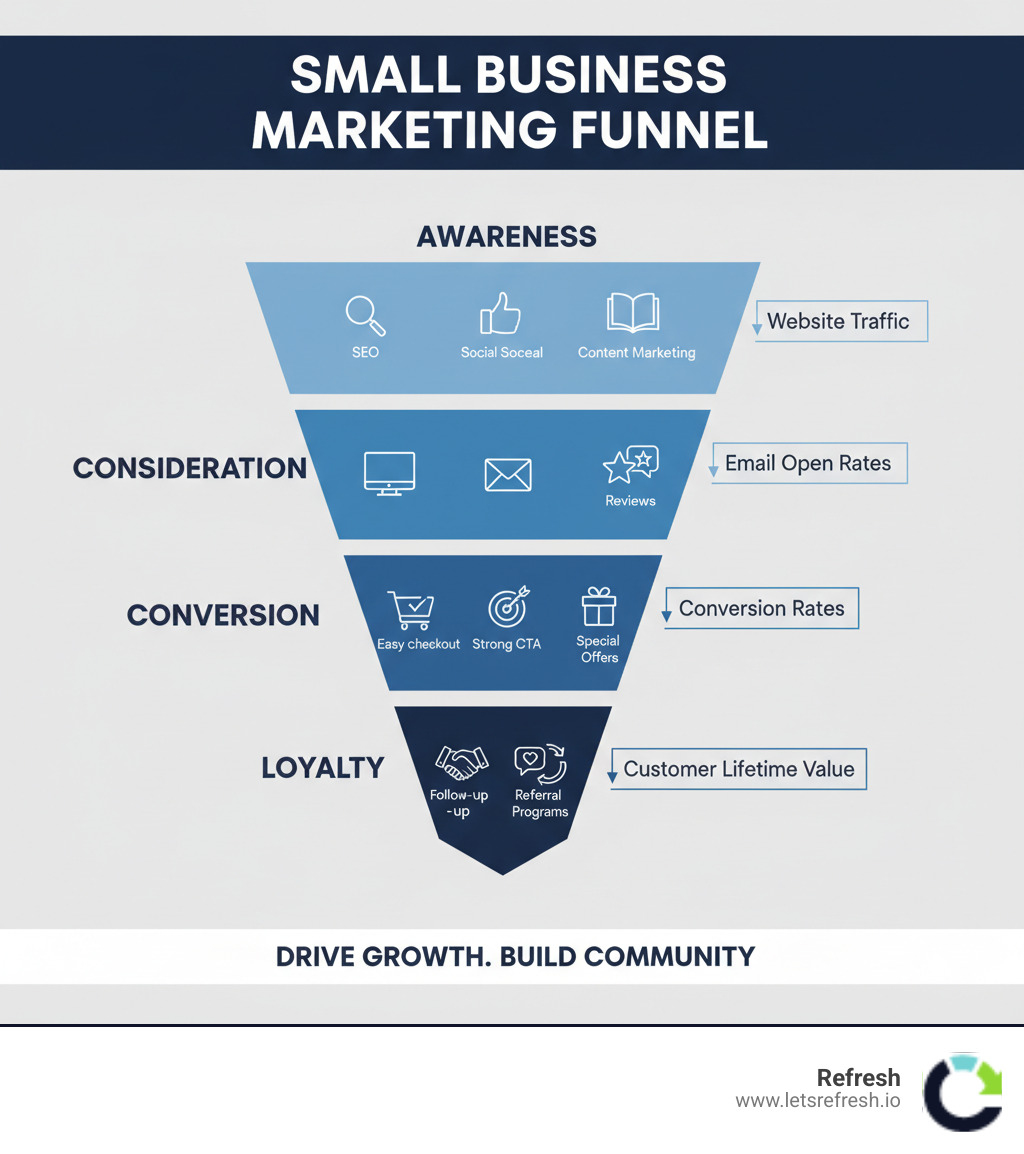
- Conversion rates: The percentage of people who take a desired action (e.g., make a purchase).
- Customer Acquisition Cost (CAC): How much you spend to get each new customer.
- Customer Lifetime Value (CLV): An estimate of the total revenue a customer will generate over time.
Tracking these numbers helps you understand your audience and make smarter decisions.
Leverage Customer Reviews and Testimonials
Customer reviews and testimonials are powerful because they build trust and provide social proof. Think of them as modern word-of-mouth.
Here’s how to make the most of them:
- Make it easy to request reviews: After a positive experience, ask for a review via email, text, or a QR code on a receipt.
- Respond to all feedback: Always reply to reviews, both positive and negative. A professional response to criticism shows you care and can turn a bad experience around.
- Showcase your testimonials: Feature positive comments prominently on your website, social media, and in marketing materials to build credibility. Our own Case Studies are a great example of how we highlight client successes.
Frequently Asked Questions about Small Business Marketing
It's natural to have questions when diving into marketing for small business. Here are answers to some of the most common ones.
How much should a small business spend on marketing?
View marketing as a vital investment in your growth. A general guideline is to allocate 3-5% of your annual turnover to marketing. New or high-growth businesses may need to invest more upfront. A Small Business Trends report noted the average is 1.08% of revenue, but this varies by industry (retailers ~4%). The key is to prioritize tactics with the best return on investment (ROI).
What are the most effective marketing channels for a small business?
The "most effective" channels depend on your business, audience, and industry. However, a strong online presence is crucial for modern marketing for small business. This includes a professional website (we prefer Webflow), a focus on local SEO to capture nearby customers in areas like Pittsburgh or Charlotte, email marketing, and activity on the social media platforms where your customers spend their time.
How long does it take to see results from marketing?
The timeline for results varies by channel. Paid advertising (PPC, social ads) can generate clicks and conversions within days or weeks. However, foundational strategies like SEO and content marketing are long-term efforts. They typically take 4-6 months or longer to build momentum and deliver significant, sustainable ROI. Consistency is the key to compounding your efforts over time for powerful organic growth.
Conclusion
We've covered a lot of ground on creating an effective marketing for small business strategy. While it can seem like a big undertaking, breaking it down makes it achievable. Think of it as building a growth engine for your business, piece by piece.
We've covered building a foundational marketing plan, shining in the digital landscape with a professional Webflow website, and nurturing customer relationships through loyalty programs and community engagement.
The secret to lasting success is continuous improvement. By constantly monitoring your efforts, analyzing what works, and adapting your strategies, you ensure your marketing engine runs smoothly and pushes you forward.
If you need an expert co-pilot for this journey, we're here to help. For a winning digital strategy or a high-performance Webflow website, consider partnering with a specialized agency like Refresh. Explore our SEO services today and let's start growing your business.


.avif)