
The Search Landscape Is Shifting — And Most Businesses Are Missing It
Generative engine optimization (GEO) is the practice of structuring your content so that AI-powered search tools — like Google AI Overviews, ChatGPT, and Perplexity — cite your website when composing their answers.
Here's a quick breakdown:
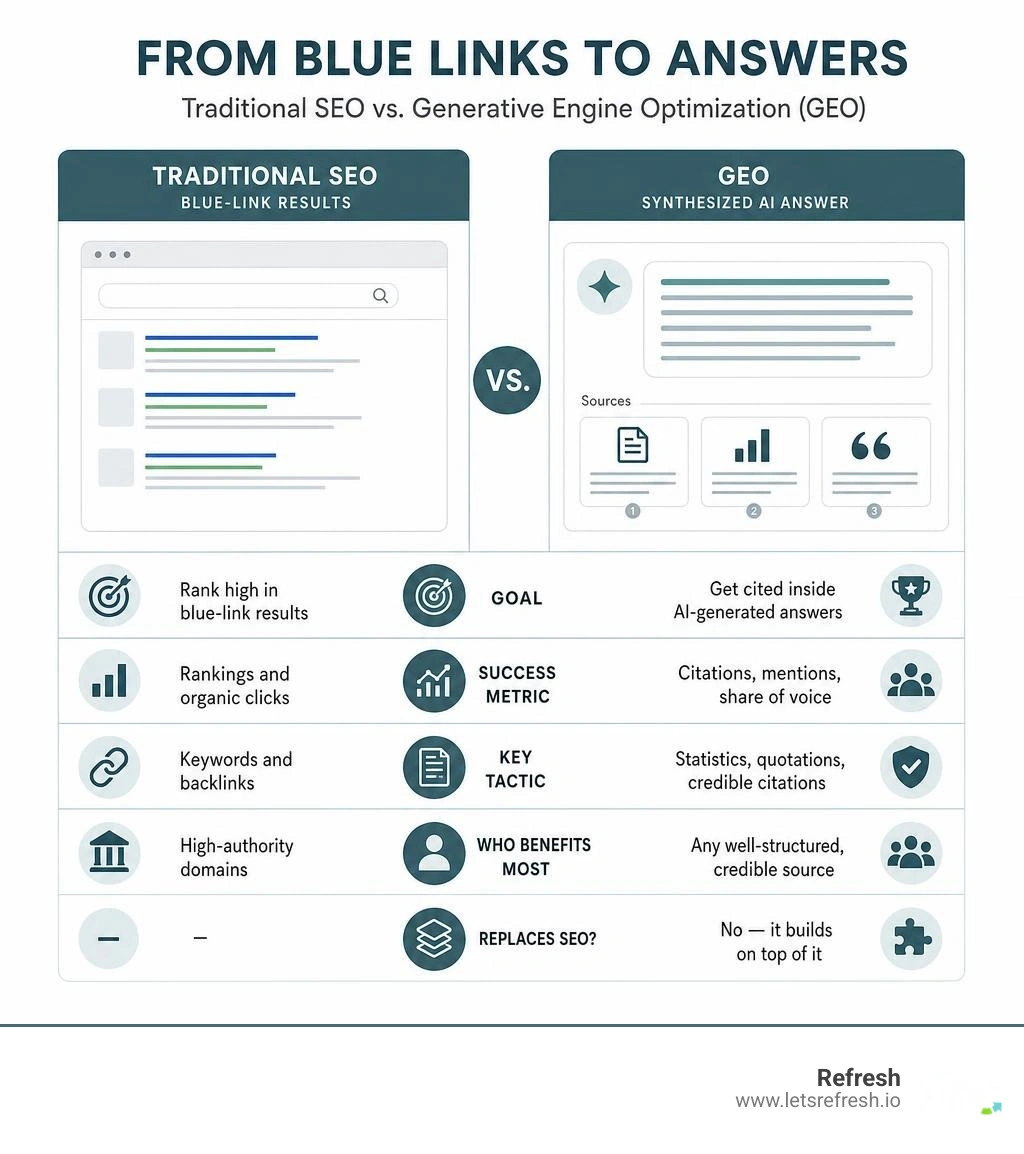
| Traditional SEO | Generative Engine Optimization | |
|---|---|---|
| Goal | Rank high in blue-link results | Get cited inside AI-generated answers |
| Success metric | Rankings and organic clicks | Citations, mentions, share of voice |
| Key tactic | Keywords and backlinks | Statistics, quotations, credible citations |
| Who benefits most | High-authority domains | Any well-structured, credible source |
| Replaces SEO? | — | No — it builds on top of it |
More people are skipping the list of links entirely. They're asking AI tools a question and trusting the answer they get back. Google's AI Overviews now appear in roughly 16% of all searches. ChatGPT surpassed 900 million weekly users as of early 2026. Perplexity, Claude, and Gemini are growing fast too.
For a startup trying to get found online, that's a big deal. If your content isn't structured to be cited by these tools, you're invisible to a growing share of your audience — no matter how well you rank on page one.
Research published at KDD 2024 found that the right GEO strategies can boost a website's visibility in AI-generated responses by up to 40%. Even lower-ranked websites saw dramatic gains. That's not a small edge — that's a fundamental shift in how visibility works online.
I'm Alexander Palmiere, Founder and CEO of Refresh Digital Strategy, where I've helped over 200 businesses build smarter digital strategies — including adapting to the rise of generative engine optimization. In this guide, I'll walk you through exactly what GEO is, how it works, and what you can do right now to show up in the answers your customers are already reading.
What is Generative Engine Optimization (GEO)?

To put it simply, generative engine optimization is the art and science of making your brand’s content "AI-friendly." Unlike traditional search engines that point users to a list of external URLs, generative engines synthesize information from multiple sources to construct a single, cohesive response.
If you want to understand the SEO digital marketing meaning in today's landscape, you have to look beyond simple keyword matching. AI engines do not care how many times you repeat a specific phrase. Instead, they optimize for semantic relevance, authority, and factual completeness.
When a user asks a conversational search query like, "What is the best CRM for a small service business in Cleveland?", a generative engine won't just list websites. It will crawl the web, extract relevant passages, compile a comparison table, and cite the sources it used to build that table. If your business is mentioned across credible platforms and your website is structured correctly, you become one of those prized inline citations. As we outline in our guide on What Is Generative Engine Optimization (GEO)? | SparkBlog, the goal is to shift your focus from simply winning clicks to winning brand mentions and citations within these synthesized answers.
Overlapping Terms: AEO, AIO, and LLMO
Because this field is evolving so rapidly in 2026, you will often hear several overlapping terms used interchangeably. However, they do have slight differences:
- Answer Engine Optimization (AEO): This term actually predates modern generative AI. It originally referred to optimizing content for voice search assistants (like Alexa or Siri) and Google's featured snippets. It focuses on providing direct, concise answers to specific questions.
- Artificial Intelligence Optimization (AIO): A broad, catch-all marketing term used to describe any optimization work that touches AI tools, including content generation, AI-driven paid ads, and search visibility.
- Large Language Model Optimization (LLMO): A highly technical term focused on optimizing content specifically so that LLMs (like GPT-4, Gemini, or Claude) can easily parse, digest, and reference it during training or real-time retrieval.
Currently, there is no formal academic consensus separating these terms. However, "Generative Engine Optimization" (GEO) has emerged as the most widely accepted and academically grounded term, largely due to pioneering research from Princeton and other top institutions.
How Generative Engine Optimization Differs from Traditional SEO
The fundamental difference lies in how information is packaged and delivered to the user. Traditional SEO is built around the concept of "blue links." You optimize a page to rank in positions 1 through 10, hoping a user clicks your link to find their answer.
With GEO, the search engine is the answer. The AI reads your page, extracts the most valuable nuggets, and presents them directly to the user. Because of this, traditional tactics like keyword density are not just obsolete—they can actively hurt you. In fact, academic testing has shown that keyword stuffing can cause a 10% drop in visibility on platforms like Perplexity.ai.
Instead, generative engines reward semantic depth, structured facts, and unambiguous entity relationships. If you want to build an effective SEO strategy for small business, you must transition from writing for algorithms to writing highly structured, authoritative, and easily extractable content. For a deeper look into this transition, check out Generative Engine Optimization (GEO): The New Frontier for ....
How Generative Engines Retrieve and Cite Sources

To optimize for generative search, we first need to understand how these systems work under the hood. They do not simply generate answers out of thin air (which leads to hallucinations). Instead, they use a process called Retrieval-Augmented Generation (RAG) to ground their answers in real-world, indexed data.
For businesses looking to partner with SEO optimization companies, verifying that your partner understands the technical RAG pipeline is the first step to ensuring your long-term search visibility.
The Mechanics of Retrieval-Augmented Generation (RAG) and Query Fan-Out
The RAG process happens in a matter of milliseconds when a user enters a prompt:
- Query Fan-Out: When a user types a complex query, the generative engine doesn't just run a single search. It performs a "query fan-out," breaking the main prompt down into multiple concurrent sub-queries to gather a broad base of information.
- Retrieval: The engine queries its index (or partners with a traditional search index like Google or Bing) to pull the most relevant live documents.
- Extraction: Instead of reading entire pages, the AI extracts self-contained passages, facts, and entities from those retrieved documents.
- Synthesis: The LLM synthesizes these extracted passages into a natural-language response, adding inline citations back to the source URLs.
Because generative engines rely heavily on extracting self-contained passages, your content must be written in a way that makes sense even when read completely out of context.
Measuring Visibility with Generative Engine Optimization Metrics
How do you track success when traditional rankings no longer apply? In the academic paper GEO: Generative Engine Optimization, researchers introduced several new metrics to measure a website's presence in AI search results:
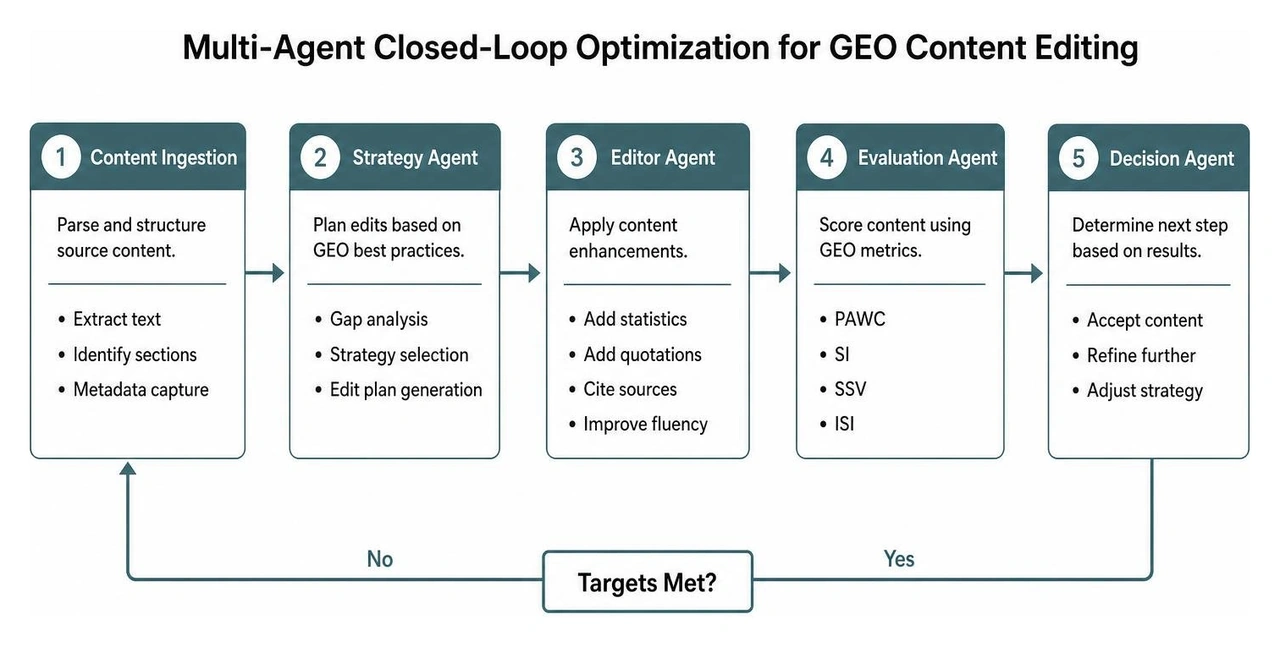
- Position-Adjusted Word Count (PAWC): This metric measures how many words the AI engine uses to describe or quote your source, adjusted by how early your citation appears in the response. The earlier and more detailed your mention, the higher your score.
- Subjective Impression (SI): A multi-faceted metric that evaluates how authoritative, helpful, and unique your cited information is within the overall response.
- Surface Semantic Visibility (SSV): This measures how prominently your brand name or URL is displayed to the user (e.g., in inline citations, footnotes, or interactive cards).
- Intrinsic Semantic Impact (ISI): This tracks how much your content actually influenced the core meaning and structure of the AI's final response.
Researchers have even built advanced open-source frameworks like Wu-beining/MAGEO to help developers and advanced marketers simulate these metrics and run closed-loop optimizations on their content before publishing.
Proven Strategies to Boost Your AI Search Visibility
Now that we know how these systems retrieve and evaluate information, let's look at the exact strategies that can help your brand get cited. Whether you are running a service business or optimizing SEO for local business, these tactics are highly effective.
Content-Level Enhancements: Citations, Quotations, and Statistics
Academic and real-world testing has revealed that specific content adjustments can dramatically increase your chances of being cited by AI engines:
- Statistics Addition (+34% to +37% Visibility Boost): Generative engines love hard numbers. Adding quantitative data and structured statistics to your claims makes your content highly attractive to AI crawlers. In real-world testing on Perplexity.ai, adding statistics showed up to a 37% improvement in Subjective Impression.
- Quotation Addition (+22% to +41% Visibility Boost): Including direct quotes from verified, authoritative sources or internal experts increases the perceived credibility of your page. In Perplexity testing, adding quotations achieved a 22% relative improvement over baseline content.
- Cite Sources (+29% to +115% Visibility Boost): Ironically, citing other high-authority sources within your own content makes AI engines trust you more. This strategy led to a massive 115.1% increase in visibility for websites that were originally ranked fifth in standard search results.
- Fluency Optimization & Easy-to-Understand Language (+15% to +30% Boost): Simplifying your writing and ensuring high grammatical fluency makes it easier for LLMs to parse and reuse your text.
- The Power of Combination (+5.5% Extra Boost): Combining multiple strategies—such as pairing fluency optimization with statistics—outperforms any single strategy by more than 5.5%.
Technical Foundations and Platform-Specific Optimization
While content is king, technical crawlability is the baseline. If AI bots cannot access your site, you won't get cited. At Refresh, Webflow is our preferred development platform because its clean, semantic code and native server-side rendering make it incredibly easy for AI search crawlers to navigate.
To ensure your site is technically optimized for GEO, follow this checklist:
- Configure Your Robots.txt: Ensure you aren't accidentally blocking the key AI search crawlers. Allow bots like
GPTBot,OAI-SearchBot,Claude-User,Claude-SearchBot,Google-Extended, andPerplexityBot. - Deploy Schema Markup: Implement comprehensive Schema.org structured data. Use
Organization,Product,LocalBusiness,FAQPage, andHowToschemas. This builds an explicit "entity graph" that AI engines reference to verify your claims. - Structure Content in Passage-Friendly Blocks: Keep paragraphs short (40–60 words) and ensure they are self-contained. Lead with a direct answer before expanding on the details.
- Create an llms.txt File: For platforms that utilize it, publish a plain-text
llms.txtandllms-full.txtfile in your root directory to act as a clean, markdown-formatted directory of your site's most important resources.
For detailed technical implementation guides, you can explore the resources at Get Cited by AI — Generative Engine Optimization Guides | Licheo.
If you are a business operating in our primary service regions, local technical optimization is even more critical. You can work with specialized local experts to align your traditional and generative search footprints:
- In Pennsylvania, explore Generative Engine Optimization (GEO) Services in Pittsburgh or partner with an established Pittsburgh SEO Company | Trust, Visibility & Growth - Percepture.
- In Ohio, check out specialized AI SEO Services in Cleveland, OH | AEO & GEO Generative Engine ....
- In North Carolina, leverage AI SEO & Generative Engine Optimization in North Carolina or consult with Charlotte AI SEO Services | Jason Shaffer Group (JSG).
Frequently Asked Questions about Generative Engine Optimization
Is GEO replacing traditional SEO?
No, GEO is not replacing traditional SEO—it is an extension of it. Generative engines still rely on search indexes to find the documents they synthesize. If your website has poor technical health, slow load speeds, or isn't indexed by Google or Bing, AI engines will never find it in the first place. Think of traditional SEO as the foundation that gets you into the library, and GEO as the optimization that gets your book opened and quoted by the researcher.
How does Google officially view generative engine optimization?
Google's official guidance states that optimizing for generative AI features is still, at its core, just SEO. Google's AI Overviews rely on their core search ranking and quality systems. Google advises creators to focus on producing highly valuable, non-commodity, "people-first" content rather than trying to game specific AI algorithms. They also provide performance tracking for AI Overviews directly inside Google Search Console, allowing you to monitor your generative visibility alongside standard search metrics.
Can smaller websites benefit from GEO more than established brands?
Yes! This is one of the most exciting aspects of GEO—it acts as a powerful democratizer. In traditional search, massive, high-authority websites often dominate page one simply due to their massive backlink profiles. However, research shows that when all sources are optimized using GEO tactics, the visibility of top-ranked websites actually decreases by 30.3% on average. Because AI engines prioritize factual accuracy, unique perspectives, and clear data over raw domain authority, smaller websites that provide highly optimized, structured answers can easily leapfrog larger competitors and win the primary citation.
Conclusion
The search landscape is changing, but that doesn't mean your business has to lose its digital footprint. By shifting your mindset from keyword density to semantic depth, and from "blue links" to AI citations, you can future-proof your brand for the conversational web.
At Refresh, we specialize in building high-performance Webflow websites and designing long-term digital strategies that perform exceptionally well in both traditional search engines and emerging generative platforms. We don't believe in quick fixes or chasing short-lived algorithm hacks. Instead, we focus on building clean, technically sound, and highly authoritative digital assets that search engines—and human users—trust.
Ready to prepare your brand for the future of AI search? Let's build a digital presence that gets noticed, cited, and trusted. Explore Refresh Digital Strategy Services today and let's start a conversation.


.avif)