
Understanding Website and Email Hosting for Small Business
Website and email hosting for small business involves services that let you host your website and manage professional email addresses at your own domain (e.g., you@yourcompany.com). Small businesses typically benefit from integrated hosting solutions that offer affordability, ease of use, and scalability.
If you're looking for a detailed breakdown and more options, read on below.
Hey, I'm Alexander Palmiere—founder of Refresh Digital Strategy. With over 200 successful business website and email hosting setups under my belt, I help small and midsized companies create effective digital strategies, effortlessly managing their website and email hosting for small business needs.
Simple website and email hosting for small business glossary:
- affordable business hosting small web
- best website hosting services
- why is web hosting important for a small business
For more general background on how web hosting works, you can read the web hosting service overview on Wikipedia.
Why Website and Email Hosting Are Essential for Small Business Success
Today, your customers expect your business to be easy to find and trustworthy online. Having professional website and email hosting for small business isn't just nice to have—it's critical. At Refresh, we've helped hundreds of small businesses transform their digital presence simply by choosing the right hosting solutions.
Did you know that customers are 9 times more likely to choose a business with a professional email address rather than one using a free email service? It sounds surprising, but think about it from your own perspective: If you got an email from "sam@qualitybuilders.com" and another from "sambuilder123@yahoo.com," which would you instinctively trust more? Exactly. A domain-based email instantly signals you're serious about your business.
"When we help small businesses move from generic email to professional domain-based addresses, the feedback is overwhelmingly positive," our team at Refresh notes. "They consistently report higher response rates, better customer engagement, and even more confidence when reaching out to prospects."
And it's not just about first impressions. Reliable website and email hosting provides the strong technical backbone that keeps your business running smoothly. From ensuring your website stays live so customers can find you, to making sure important emails actually reach their inboxes—quality hosting directly supports your bottom line.
The Impact of Professional Email Addresses on Customer Trust
A professional email that matches your company domain isn't just about branding—it actively builds trust in your business. When someone sees "contact@yourbusiness.com," they immediately feel you're credible and established.
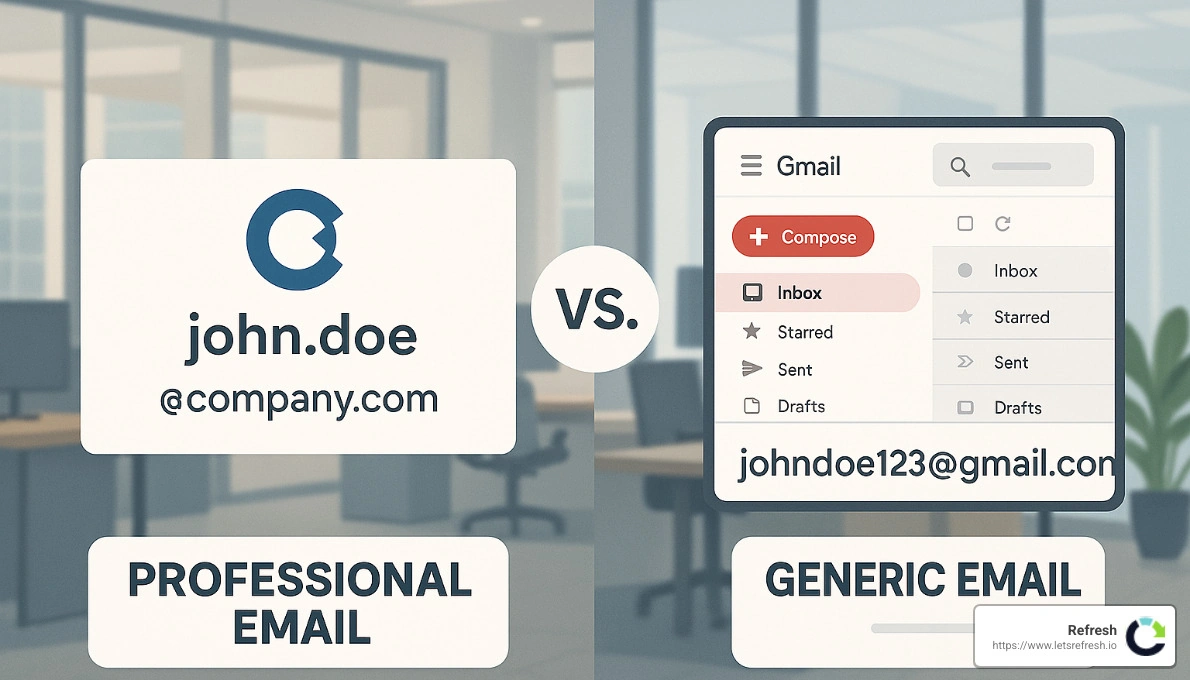
First, domain-based emails confirm you're a legitimate business owner. Customers worry less about scams or fake companies when your email clearly matches your website.
Second, this small detail demonstrates you've made a tangible investment in your business. It's a subtle but powerful indication that you're committed and stable—qualities your customers truly appreciate.
Third, it ensures brand consistency. Matching your email and website domains creates a cohesive feel, making your business memorable and professional in the eyes of your audience.
And finally, professional emails help with spam prevention. Emails from free providers are more often flagged as spam, meaning your important messages might never even reach your customers' inboxes.
One of our small business clients, a boutique consulting firm in Charlotte, NC, shared their experience after switching over: "We saw a 35% increase in email open rates and far more responses to inquiries. Potential clients even mentioned our professional email address as one reason they trusted us more."
They're not alone. At Refresh, we see similar results again and again with our clients in Pittsburgh, Cleveland, Charlotte, and beyond. Your professional email address genuinely impacts your conversion rates and customer trust.
Key Benefits of Integrated Website and Email Hosting
You could host your website and email separately—but why complicate things? Integrated website and email hosting for small business makes your life simpler and saves you headaches (and money).
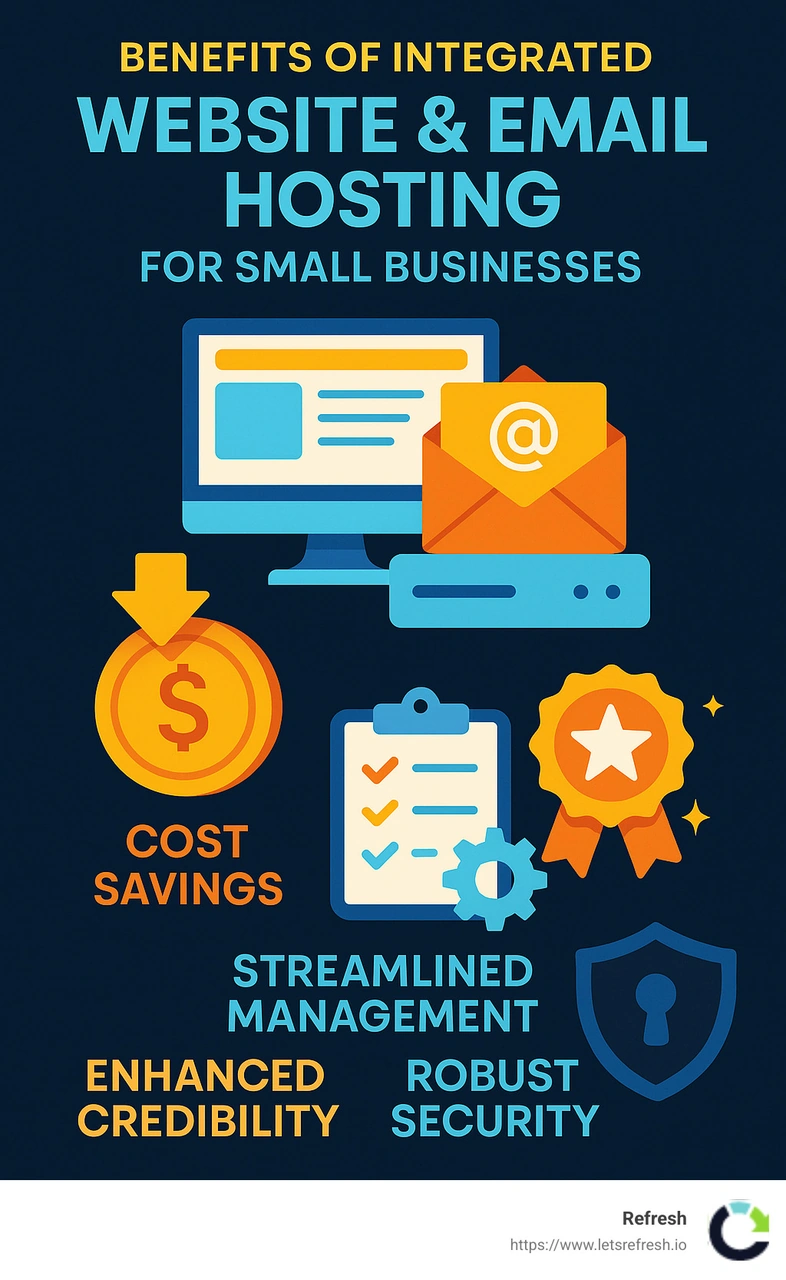
By bundling services, you'll see immediate cost savings. Providers like DreamHost offer very affordable pricing, starting at just $1.67 per mailbox per month (with annual plans). Keeping everything together often means lower overall costs, making integrated hosting a budget-friendly solution.
Another big advantage is streamlined management. With just one dashboard and one login, managing your online presence becomes much simpler. No juggling multiple logins or dashboards—saving you time and stress.
Integrated services also offer better technical compatibility. They're designed to work seamlessly together, avoiding frustrating compatibility problems. Plus, shared infrastructure gives you more consistent uptime, removing that frustrating scenario where your website is working fine but your email goes down.
When problems do arise, integrated hosting means simplified support. You only have one provider to contact—no more finger-pointing between different companies. Issues get resolved faster and more smoothly.
From a security standpoint, integrated hosting is a no-brainer. With built-in security integration, you protect your website and email at the same time, using coordinated safeguards for stronger overall security. Backup processes also become much simpler, with backup coordination across both services, ensuring all data is consistently protected.
One of our Cleveland clients summed it up perfectly: "Having our website and email under one roof cut our IT management time in half. There's no confusion about who to call, and everything gets fixed faster."
If you're ready to simplify your business and boost credibility with integrated solutions, check out our guide on the Best Email and Website Hosting for Small Business.
Top Features to Look for in Small Business Website and Email Hosting
Choosing the right website and email hosting for small business feels a bit like finding the perfect office space—it needs to be reliable, secure, and have all the amenities your team needs to thrive. At Refresh, we've guided countless businesses in Pittsburgh, Cleveland, and Charlotte toward hosting solutions that truly fit their unique needs.
Essential Website Hosting Features
Your website hosting is the foundation of your online presence, and cutting corners here can cost you in the long run. SSL certificates aren't just a nice-to-have anymore—they're essential for security and search rankings. When visitors see that little padlock in their browser, it instantly builds trust. We always recommend hosts that include free SSL certificates as part of their standard packages.
Bandwidth allocation might sound technical, but think of it as the highway that leads customers to your digital doorstep. The wider that highway, the more visitors can reach you simultaneously without slowdowns. Many quality hosts now advertise "unmetered" bandwidth, which gives you breathing room—though remember, no resource is truly unlimited.
A Pittsburgh business owner we work with learned this lesson the hard way: "Our previous host had terrible server reliability. We'd get calls from customers saying our site was down, and it was always at the worst possible times!" That's why we insist on providers with uptime guarantees of 99.9% or better—translating to less than 9 hours of potential downtime per year.
If you're using WordPress, Webflow, or another content management system, your host should offer optimized support for your platform. At Refresh, our Webflow expertise means we can point you toward hosting solutions that work beautifully with this powerful platform.
Backup solutions are like insurance policies you hope never to use—but when you need them, you're incredibly grateful they exist. A client in Charlotte told us, "Having automatic backups saved our business when our site was compromised. Within minutes, we restored to the previous day's version and avoided what could have been days of rebuilding." Look for hosts that store these backups separately from your primary website for added security.
The ability to easily install common applications through one-click installations can save you hours of technical headaches, while mobile optimization ensures the more than half of web visitors who come from phones and tablets have a smooth experience.
Must-Have Email Hosting Capabilities for Small Businesses
Your business email is often the first point of contact with potential customers, and it needs to be as professional and reliable as your in-person handshake. Quality email hosting for small business should feel like having a personal assistant managing your communications.
Effective spam filtering keeps your inbox clean and relevant, while virus protection scans attachments and links to prevent malware from reaching your devices. One small accounting firm we work with estimated they save about two hours per employee each week just from having good spam filtering in place.
Email forwarding capabilities let you create professional addresses like info@yourbusiness.com that route to the right team members, creating a polished impression even for the smallest businesses. Pair this with autoresponders that acknowledge inquiries during off-hours, and customers never feel ignored.
Team collaboration becomes seamless with features like shared calendars for scheduling and mobile access that keeps you connected across all your devices. As one Cleveland retailer put it, "Being able to check emails and confirm appointments from my phone while I'm on the sales floor has been a game-changer for customer service."
For many industries, email archiving isn't just convenient—it's essential. A small law firm in Charlotte emphasized: "The email archiving feature has been invaluable for maintaining client communication records. It's not just about compliance—it's about having a reliable record of all client interactions."
Modern email hosting should also include robust collaboration tools like shared documents and task management, plus generous storage capacity of at least 10GB per user. Microsoft 365 plans raise the bar even higher with up to 50GB of email storage per user, meaning you'll rarely need to delete anything important.
When selecting your website and email hosting for small business, these aren't just technical services—they're the digital infrastructure that supports your entire business operation. Investing in quality hosting now prevents countless headaches down the road.
Comparing Shared vs. Dedicated Hosting Solutions for Small Businesses
Choosing the right website and email hosting for small business can feel a bit like shopping for a car—you need something that fits your current needs but can also handle the journey ahead. Let's break down the two main options in a way that makes sense for your business.
| Feature | Shared Hosting | Dedicated Hosting |
|---|---|---|
| Cost | $3-15/month | $80-500/month |
| Performance | Good for low-traffic sites | Excellent for high-traffic sites |
| Resources | Shared with other websites | Exclusive to your business |
| Security | Basic security features | Improved isolation and custom security |
| Scalability | Limited by shared environment | Highly scalable |
| Technical Control | Limited configuration options | Complete server control |
| Ideal For | Startups, small blogs, local businesses | E-commerce, high-traffic sites, custom applications |
When to Choose Shared Hosting
Think of shared hosting as living in an apartment building. You share resources with neighbors, which keeps costs down, but you might occasionally notice when someone else is using too much of the shared bandwidth.
For many small businesses, shared hosting is the perfect starting point. With prices starting around $3.75 per month from providers like HostGator, it's incredibly budget-friendly. This makes it ideal for startup businesses just establishing their online presence.
If your website sees fewer than 10,000 monthly visitors, you'll likely find shared hosting provides all the performance you need. One of our Cleveland clients, a charming boutique shop, put it perfectly:
"As a small business with a primarily local customer base, shared hosting has been perfect for our needs. Our site loads quickly, our email is reliable, and the cost fits our budget perfectly."
Beyond the cost savings, shared hosting is wonderfully simple from a technical standpoint. The user-friendly control panels make management accessible even if you're not particularly tech-savvy. Plus, the managed services aspect means you don't have to worry about server maintenance, updates, or basic security measures—your provider handles all that for you.
When Dedicated Hosting Makes Sense
Now, dedicated hosting is more like owning your own house. You have complete control over everything, no neighbors to worry about, but it comes with higher costs and more maintenance responsibility.
As your business grows, you might find yourself considering the upgrade to dedicated hosting. This becomes particularly relevant when your website traffic increases substantially. Sites receiving tens of thousands of monthly visitors benefit from dedicated resources that ensure consistent performance even during peak times.
E-commerce operations especially benefit from dedicated hosting. When customers are entering payment information and completing purchases, you need rock-solid reliability and improved security. The improved loading speed can directly impact your bottom line, as one of our Pittsburgh manufacturing clients finded:
"The improved loading speed and reliability have directly impacted our bottom line. Cart abandonment decreased by 23% after we switched to dedicated hosting, which more than pays for the increased cost."
Businesses handling sensitive information benefit from the improved security of not sharing server space with other websites. And if you need custom configurations or specific software installations, dedicated hosting gives you that flexibility.
At Refresh, we often find that growing businesses don't necessarily need to jump straight from shared to dedicated hosting. For many, a middle ground like Virtual Private Server (VPS) hosting provides the perfect stepping stone—more resources than shared hosting but without the full investment of dedicated hosting.
We work closely with businesses in Pittsburgh, Cleveland, and Charlotte to evaluate their specific needs and find the hosting solution that aligns with both their current requirements and future growth plans. Sometimes, that means starting with shared hosting and creating a roadmap for scaling up as your business expands.
The key is finding the balance between performance and budget that works for your specific situation. And remember—your hosting needs will likely evolve as your business grows, so it's always good to plan with flexibility in mind.
Want to learn more about finding the right support for your website? Check out our guide to the Best Website Hosting for Support.
How to Set Up Website and Email Hosting for Your Small Business
Getting your website and email hosting for small business up and running doesn't have to feel like climbing Mount Everest. At Refresh, we've guided hundreds of small businesses in Pittsburgh, Cleveland, and Charlotte through this process, and I promise – you can do this!

Step-by-Step Domain and Hosting Setup
Think of your domain name as your business's digital street address. You want it to be memorable, professional, and easy to find. When we help clients select domain names, we recommend keeping them short, avoiding hyphens, and sticking with .com whenever possible. Run a quick availability check using your hosting provider's domain search tool before getting your heart set on a specific name.
Once you've secured your perfect domain, it's time to create your hosting account. This is where your website files will actually live. Choose a hosting plan that aligns with your business needs – whether that's a budget-friendly shared plan for startups or something more robust if you're expecting significant traffic. When you register, use accurate business information and set up automatic renewals so you never accidentally let your domain expire (trust me, recovering an expired domain can be a nightmare!).
Now comes the slightly technical part – nameserver configuration. Your hosting provider will give you nameserver information (usually looks something like ns1.hostingcompany.com) that you'll need to update at your domain registrar. This essentially connects your domain name to your hosting account. Don't worry if your website isn't immediately available after this step – DNS propagation typically takes 24-48 hours to complete worldwide.
The final technical piece involves setting up your DNS records. This includes MX records that direct email to the correct servers, A records that point your domain to your website's IP address, and TXT records for email authentication. This might sound intimidating, but most hosting providers offer user-friendly interfaces to help you through this process.
A small accounting firm client in Charlotte recently told us: "What seemed overwhelming at first became manageable with Refresh's step-by-step guidance. Having our domain, website, and email all properly configured has given us a level of professionalism that impresses new clients."
Don't forget to verify everything once you're set up! Check that your website is accessible via your domain name, test sending and receiving emails, and confirm your SSL certificate is working properly (you'll see a padlock icon in the browser address bar).
For more detailed guidance, check out our article on Best Website Hosting Services.
Creating Professional Email Accounts for Your Team
Now for the fun part – setting up those professional email addresses that will make your business shine!
First, establish consistent naming conventions for your team. Will you use firstname@yourdomain.com or firstinitial.lastname@yourdomain.com? Whatever you choose, consistency is key. Create a simple style guide so everyone follows the same format, and consider how you'll handle name changes due to marriage or other life events.
Don't forget to set up department addresses like info@, support@, and sales@. These role-based addresses create a professional impression and ensure customer inquiries reach the right people even as your team changes over time. You can configure these to forward to specific team members or to distribution lists for addresses that should reach multiple people.
Once your email accounts are created, you'll need to configure them in your preferred email clients. Whether your team uses Outlook, Apple Mail, Gmail, or something else, be sure to use IMAP settings rather than POP3 so emails synchronize across all devices. This means if someone reads an email on their phone, it will show as read on their computer too.
Mobile access is crucial in today's business environment. Help your team set up their email accounts on their smartphones and tablets, configure appropriate notification settings, and ensure basic security measures like screen locks are in place. This keeps everyone connected while maintaining security.
Create professional email signatures that include each person's name, title, and contact information, along with your company logo and social media links. Consistent signatures across your team reinforce your brand with every email sent.
Speaking of security, don't skip setting up two-factor authentication for all accounts, establishing strong password requirements, and considering a team password manager. Email security isn't just about protecting your communications – it's about protecting your entire business.
"The department email addresses have been game-changers for our customer service," shared a retail client in Pittsburgh. "Even as staff changes, customers always reach the right person through our consistent contact points like support@ and orders@."
Setting up your website and email hosting for small business might take a few hours of focused work, but the professional impression and seamless operations you'll gain are well worth the effort. And remember, if you'd rather focus on running your business instead of configuring DNS records, our team at Refresh is always here to help!
Security Considerations for Small Business Website and Email Hosting
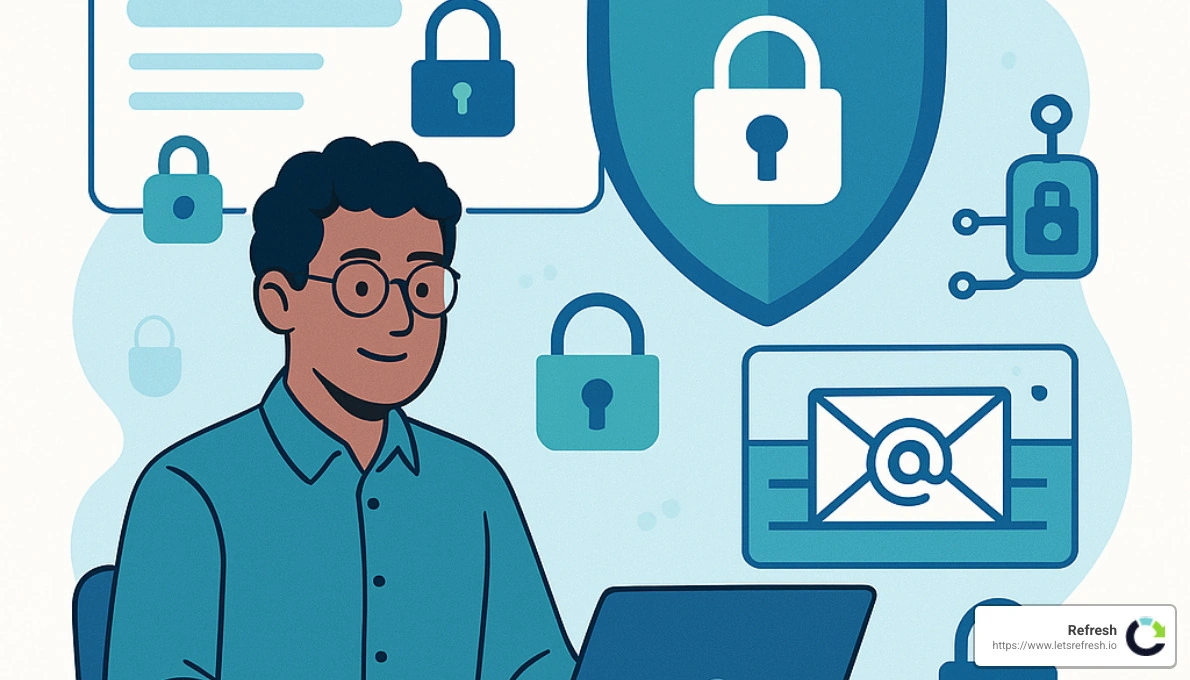
When it comes to website and email hosting for small business, security isn't just a technical checkbox—it's the foundation of your digital trust. The statistics are eye-opening: 90% of all online threats originate through email attachments. This single fact underscores why protecting your business online presence requires thoughtful attention.
Website Security Best Practices
Your website is often the first impression customers have of your business. At Refresh, we've seen how proper security measures not only protect your data but also build customer confidence.
SSL implementation is no longer optional—it's expected. When visitors see that padlock icon in their browser, it signals that your site can be trusted. Make sure all your pages use HTTPS, with automatic redirects from any old HTTP links. Many hosting providers now offer auto-renewal for SSL certificates, removing one more thing from your to-do list.
Regular updates form the backbone of website security. Think of your website like a house—you wouldn't leave known holes in your roof, would you? Similarly, outdated plugins or CMS versions are like open windows for digital intruders. We recommend setting a monthly calendar reminder to check for and apply updates.
Firewall protection acts as your digital security guard. A good Web Application Firewall (WAF) filters out suspicious traffic before it ever reaches your site. One of our Pittsburgh clients saw attempted attacks drop by 87% after implementing a proper firewall—most threats were automatically blocked before they could cause any harm.
Strong passwords might seem obvious, but they remain critically important. We still regularly see businesses using "admin123" or similar easily-guessed combinations. Your website's admin password should be treated with the same care as your business bank account.
Beyond these fundamentals, security plugins provide an additional layer of protection, especially for content management systems like WordPress. Vulnerability scanning helps identify weaknesses before they can be exploited, and access limitations ensure only authorized team members can make changes to your site.
As one Cleveland client in financial services told us: "After implementing these security measures with Refresh's guidance, we've had zero security incidents in two years. The peace of mind alone is worth the investment."
Email Security Essentials for Small Businesses
Email remains the number one pathway for cyberattacks against small businesses. Your website and email hosting for small business strategy must include robust email security measures.
Two-factor authentication is perhaps the single most effective step you can take to secure your email accounts. It's like having both a key and an alarm code for your house—even if someone gets your password, they still can't get in without that second verification. We strongly recommend using authenticator apps rather than SMS for this second factor, as text messages can be intercepted.
Encryption protocols ensure that your email communications remain private as they travel across the internet. Think of encryption as putting your message in a secure lockbox that only the intended recipient can open. Your hosting provider should support TLS encryption at minimum.
Spam filtering has evolved significantly from the basic junk folders of the past. Modern filters use artificial intelligence to identify suspicious patterns and protect your inbox. One of our Charlotte clients estimated they save about 3 hours per week per employee by not having to sort through spam emails—time better spent serving customers.
Phishing protection has become increasingly important as these attacks grow more sophisticated. Gone are the days of obvious Nigerian prince scams—today's phishing emails can be incredibly convincing. We recommend regular team training sessions with simulated phishing attempts to keep everyone's guard up.
Attachment scanning, secure password policies, and ongoing employee training round out a comprehensive email security approach. As our security specialist at Refresh often says, "Email security isn't just IT—it's business continuity. For small businesses, a single successful phishing attack can be devastating financially and reputationally."
The most effective security approaches balance protection with practicality. At Refresh, we've helped businesses across Pittsburgh, Cleveland, and Charlotte implement security measures that protect both their website and email systems without creating frustrating obstacles to daily operations.
After all, security solutions that are too cumbersome often get bypassed by well-meaning employees looking for efficiency. The best security is effective and nearly invisible—it protects your business while allowing your team to focus on what they do best.
Want to learn more about keeping your business secure online? Check out our guide on Managed Web Hosting Service for additional insights.
Frequently Asked Questions about Website and Email Hosting for Small Business
At Refresh, we've helped countless small businesses steer website and email hosting for small business. Along the way, we've found that our clients in Pittsburgh, Cleveland, Charlotte, and beyond often have similar questions and concerns. To save you from scratching your head (and Googling late at night), we've put together clear answers to some of the most common questions below.
How Much Does Website and Email Hosting Typically Cost for Small Businesses?
Ah, the classic budget question! Hosting costs vary quite a bit depending on your needs and the service level you choose. Here's a helpful breakdown:
For website hosting, small businesses typically choose from three main options:
- Shared hosting: This is the most affordable, usually ranging from $3-$15 per month. It's a great starter option for lower-traffic websites.
- VPS hosting: If your business is growing and you need a bit more power and performance, Virtual Private Server (VPS) hosting runs between $20-$80 monthly.
- Dedicated hosting: Need plenty of horsepower for larger online stores or high-traffic sites? Dedicated hosting provides an entire server just for your business—but it comes at a steeper price of $80-$500+ per month.
Email hosting prices also vary based on service quality and features:
- Basic email hosting: Usually about $1-$5 per user per month.
- Premium business email: Typically costs between $5-$20 per user per month, providing more storage (up to 50GB per mailbox), collaboration tools, and security features.
To save money—and simplify things—many providers offer bundled pricing when you sign up for both website and email hosting together. Bundled solutions often provide significant savings compared to purchasing separately.
When thinking about cost, don't just go for the cheapest plan. Trust us, we've seen plenty of clients regret bargain-bin hosting after experiencing constant downtime or poor support. Instead, balance cost with the service's value, including important factors like uptime guarantees, security features, storage and bandwidth, customer support quality, and solid backup and recovery options.
Also, keep in mind that annual billing often comes with significant savings—typically 20%-40% cheaper than monthly payments. While it means paying more upfront, it's usually a very smart way to save money in the long run.
One of our Cleveland clients—a restaurant owner—shared this insight: "We initially went for the cheapest option available, but after dealing with constant downtime and nonexistent support, we upgraded slightly. It barely cost more, and now our website and email run smoothly."
Can I Migrate My Existing Website and Emails to a New Hosting Provider?
Absolutely—and rest assured, it's usually easier than it sounds! Most reliable hosting providers offer helpful migration services or intuitive tools to simplify the transition.
Here's the general flow of a migration:
- Sign up with your new hosting provider.
- Let them know you want to migrate (they’ll often handle the heavy lifting for free or at a minimal fee).
- Provide access info to your existing hosting account so the new provider can move your data.
- Wait 24-72 hours for the migration to complete (usually quicker).
- Check your site and email thoroughly before updating any DNS settings to direct visitors to the new host.
With proper planning, downtime should be minimal or even nonexistent. You'll want to test everything carefully before going live—make sure your web pages load properly, all features work correctly, emails send and receive without issues, past messages transferred correctly, and that your mobile setup works smoothly.
To get ready, back up everything—your website files, databases, and your email archives (if possible). Document passwords, configurations, and settings, so you can double-check everything once you're migrated.
One boutique owner in Charlotte was nervous about migration at first but had this experience: "Honestly, I expected chaos. But Refresh walked me through everything, and our new hosting provider took care of it seamlessly. We didn't lose a single email or miss a beat."
Should Small Businesses Bundle Their Website and Email Hosting Services?
For most small businesses, bundling website and email hosting makes a lot of sense—and usually saves time, money, and headaches.
First off, having everything under one roof simplifies your life tremendously. Instead of juggling multiple providers, logins, and billing cycles, you manage everything from a single, user-friendly control panel. You'll have just one team to contact for support, which means quicker resolution of problems and fewer headaches.
Bundling typically also saves you money—hosting providers often include email hosting as part of their website hosting packages or offer bundled discounts that can be 15%-30% cheaper than purchasing separately.
Beyond cost savings and convenience, bundled services are specifically designed to work together smoothly. This means fewer technical headaches and better compatibility between your website and email. For example, forms submitted on your website are much less likely to experience email delivery hiccups when everything is hosted together.
At Refresh, we usually recommend bundled solutions because we've seen how much they simplify life for small business owners. However, we understand that every business is unique, and sometimes separate providers might be needed for specialized features or industry requirements.
A Pittsburgh law firm we worked with summed it up perfectly: "We used to get the runaround—our former hosting providers always blamed each other. Now, with our website and email hosting bundled, we have one point of contact. Issues get solved quickly and painlessly."
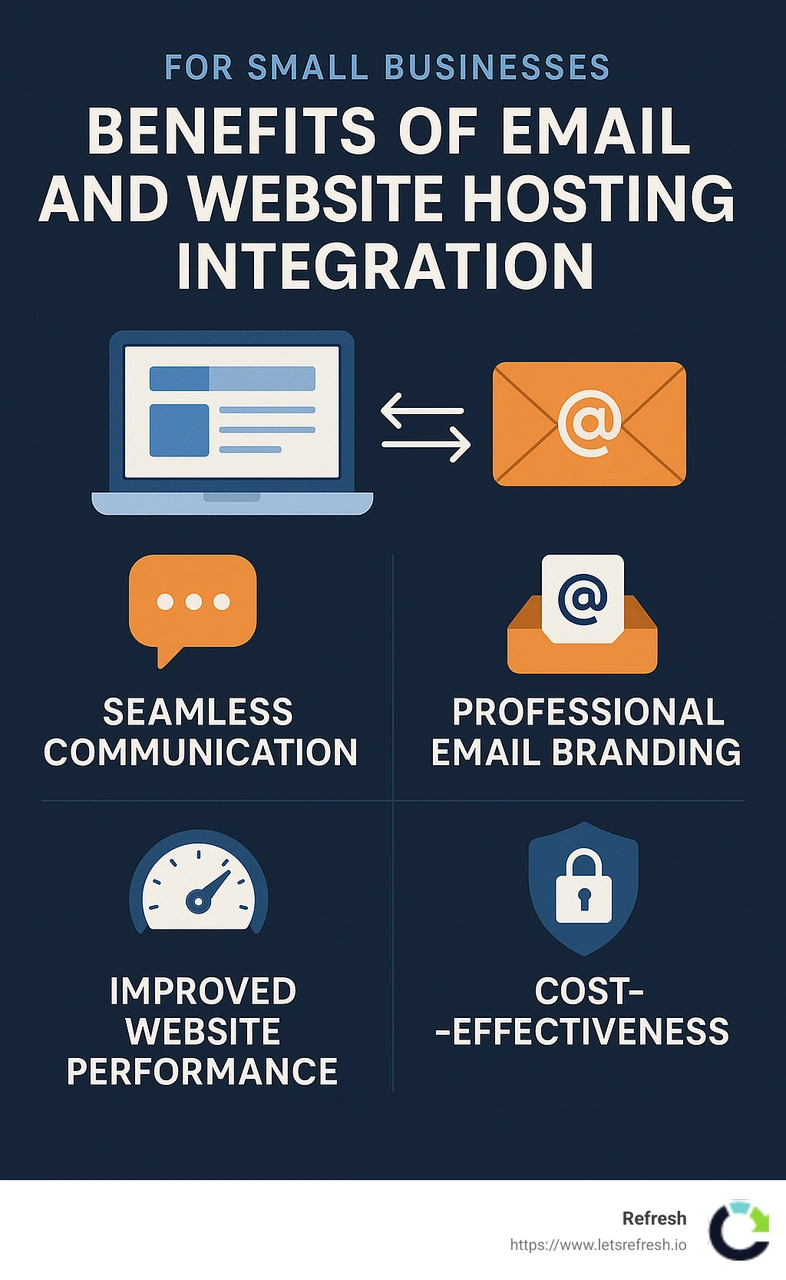
Conclusion
Let's take a moment to reflect on what we've covered about website and email hosting for small business. It's so much more than just a technical checkbox on your business to-do list—it's a cornerstone of your company's professional image and day-to-day operations.
Throughout this guide, we've seen how the right hosting solutions build customer trust, make your life easier, and keep your business secure. The numbers don't lie: customers are 9 times more likely to choose businesses with professional email addresses. And with 90% of online threats sneaking in through email, solid security isn't optional anymore—it's essential.
Here at Refresh, we've helped hundreds of small and mid-sized businesses across Pittsburgh, Cleveland, and Charlotte find hosting solutions that fit them like a glove. We don't believe in one-size-fits-all approaches. Instead, we take the time to understand what makes your business tick, then recommend hosting options that balance performance, security, and cost in a way that makes sense for you.
Whether you're just opening your doors or looking to upgrade your digital home, the foundation you build with your hosting can make or break your online success. Think about it—when a potential customer gets an email from sarah@yourcompany.com instead of sarah85@gmail.com, they immediately sense professionalism and legitimacy. And when your website loads quickly and reliably, day or night, you're always open for business.
Your hosting needs will likely change as your business grows. Many of our clients start with simple shared hosting (perfect for launching without breaking the bank), but eventually move up to VPS or dedicated hosting as their traffic increases and their needs become more complex. That's natural—and we're here to help you make that transition smoothly when the time comes.
If you're feeling ready to level up your business's online presence with professional website and email hosting for small business solutions, we'd love to chat. Our team at Refresh specializes in creating seamless digital experiences that help small businesses stand tall against bigger competitors.
Drop by Refresh to explore our full range of digital marketing and Webflow website development services, or reach out directly to discuss what your business needs to thrive online. We're real people who love helping businesses like yours succeed—and we can't wait to see what we'll build together.


.avif)