Turn Your Static Site Into a Lead-Generating System
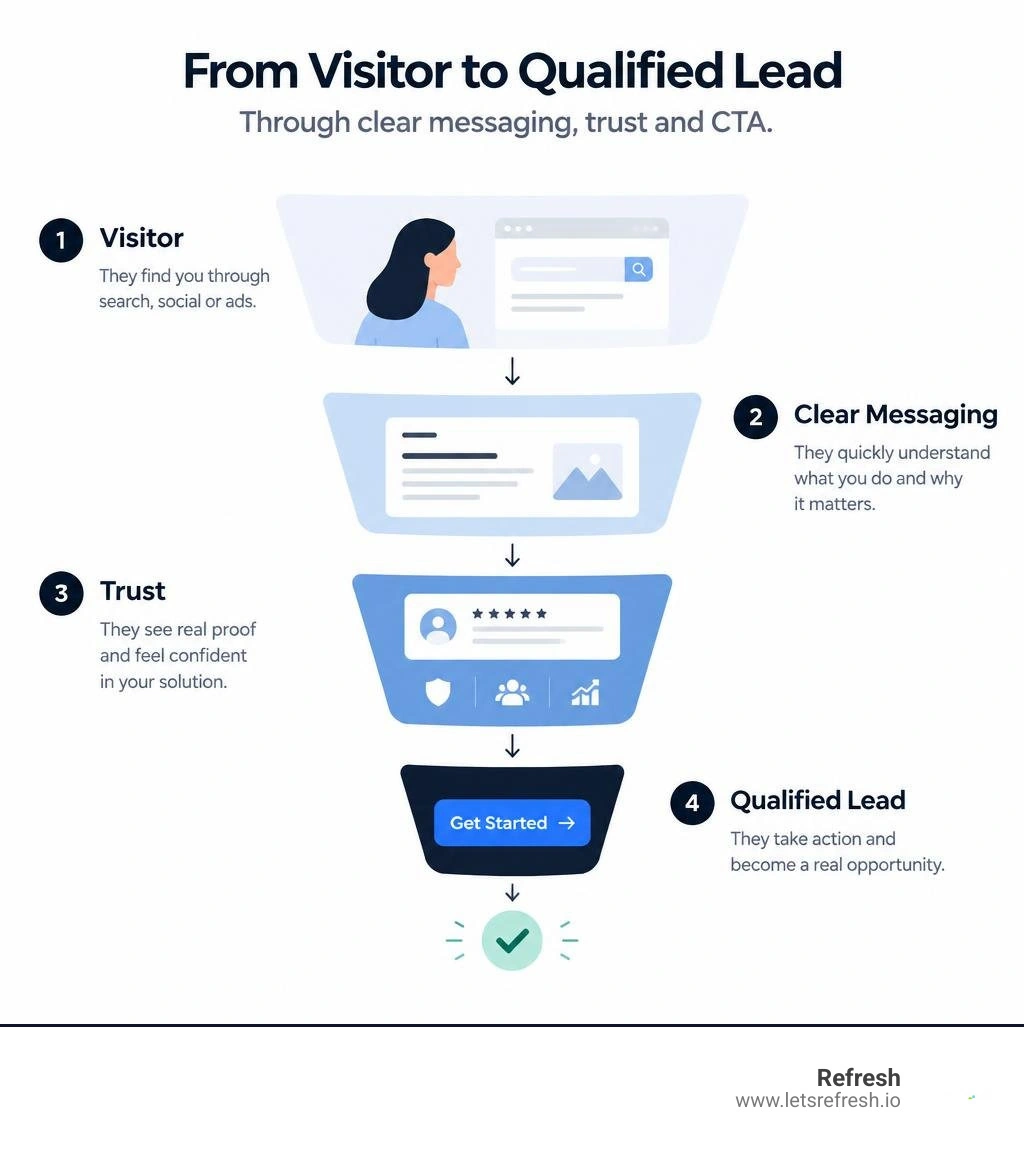
A conversion focused redesign turns an outdated website into a clear path from first visit to qualified lead. Start by choosing one primary action for each key page, such as booking a demo or requesting a proposal. Then simplify navigation, make the value proposition obvious, add credible proof near calls to action, and remove friction from forms and mobile journeys.
For a growth-stage startup, this matters because more traffic is not always the answer. If visitors cannot quickly understand what you do, why it matters, and what to do next, paid campaigns and SEO efforts will produce less return. A fast, mobile-first Webflow site with focused messaging can help your existing traffic create more pipeline.
A redesign should not be a new coat of paint. It should be a measurable improvement to user experience, trust, search visibility, and lead flow. Working with a dedicated website redesign agency for a comprehensive web redesign service or tailored small business website redesign services ensures your digital channels directly generate revenue.
I am Alexander Palmiere, Founder and CEO of Refresh, where our team has launched more than 200 websites for growing businesses. We apply conversion focused redesign principles across Webflow development, SEO, brand strategy, and digital marketing to help companies turn their websites into dependable growth assets.
What Is a Conversion Focused Redesign and Why Does It Matter?
Many business owners treat a website redesign like redecorating a living room: they pick trendy color palettes, add animations, swap out imagery, and call it a day. While visual appeal is important, an aesthetic overhaul without structural strategy rarely moves the needle on business revenue.
A conversion-focused overhaul fundamentally restructures your digital presence to guide prospective buyers systematically toward specific business outcomes. Instead of asking, "Does this look modern?", a strategic rebuild asks, "Does this element clarify our value, reduce cognitive hesitation, and guide the visitor to take action?"
The business impact of this distinction is substantial. Research from Forrester demonstrates that an intentional, well-executed user experience redesign can increase conversion rates by up to 200%. When approximately 75% of consumers judge a company's credibility based solely on its website design, and 94% cite poor design choices as a primary driver of distrust, your website serves as the ultimate benchmark of your brand's authority.
To establish sustainable pipeline growth, our business website redesign guide emphasizes shifting away from subjective design opinions toward measurable, user-centric architecture.
| Evaluation Metric | Surface-Level Visual Refresh | Conversion-Focused Redesign |
|---|---|---|
| Primary Objective | Modernize look, update brand colors, match visual trends | Turn visitors into qualified leads, demos, and paying customers |
| Development Platform | Often built on rigid, plugin-heavy legacy CMS platforms | Built on clean, high-performance platforms like Webflow |
| Decision Driver | Internal stakeholder taste and subjective artistic preferences | Quantitative data, user testing, heatmaps, and behavioral psychology |
| Information Architecture | Unchanged or reorganized based on internal company hierarchy | Streamlined around customer pain points and conversion journeys |
| Measurable ROI | Minimal direct impact on revenue or lead acquisition costs | Lower acquisition costs, higher conversion rates, and increased pipeline |
Identifying the Telltale Signs Your Website Isn’t Converting
If your website feels like a digital brochure that requires endless maintenance while delivering flatline revenue, your design is working against your commercial goals. Recognizing the friction points in your current site architecture is the first step toward reclaiming lost pipeline.
Common symptoms of an underperforming website include:
- Elevated Bounce Rates on High-Traffic Pages: Visitors arrive via organic search or paid advertising but depart within seconds without navigating further.
- Ambiguous Calls-to-Action (CTAs): Using generic labels like "Submit," "Learn More," or competing buttons that split user attention. Studies show that clear, value-oriented CTAs can convert up to 202% better than generic options.
- Excessive Navigation Options: Menu dropdowns featuring dozens of nested links cause decision paralysis. Hick’s Law proves that excessive choices directly depress conversion velocity.
- Severe Mobile Drop-off: Mobile devices generate over 60% of all global web traffic. If mobile users experience misaligned forms, unclickable buttons, or slow layouts, lead capture drops.
- Missing Trust Architecture: Lacking verifiable client proof, certifications, security seals, and clear contact information directly adjacent to action points.
If your marketing team struggles with these friction points, exploring proven methods to drive more leads will reveal how minor interface corrections yield major compounding gains.
Planning Your Conversion Focused Redesign Strategy
A strategic redesign requires a structured framework that bridges user intent with commercial objectives. The foundation begins with deep audience research, mapping exact buyer stages, and conducting thorough technical audits before writing a single line of copy or building a wireframe.
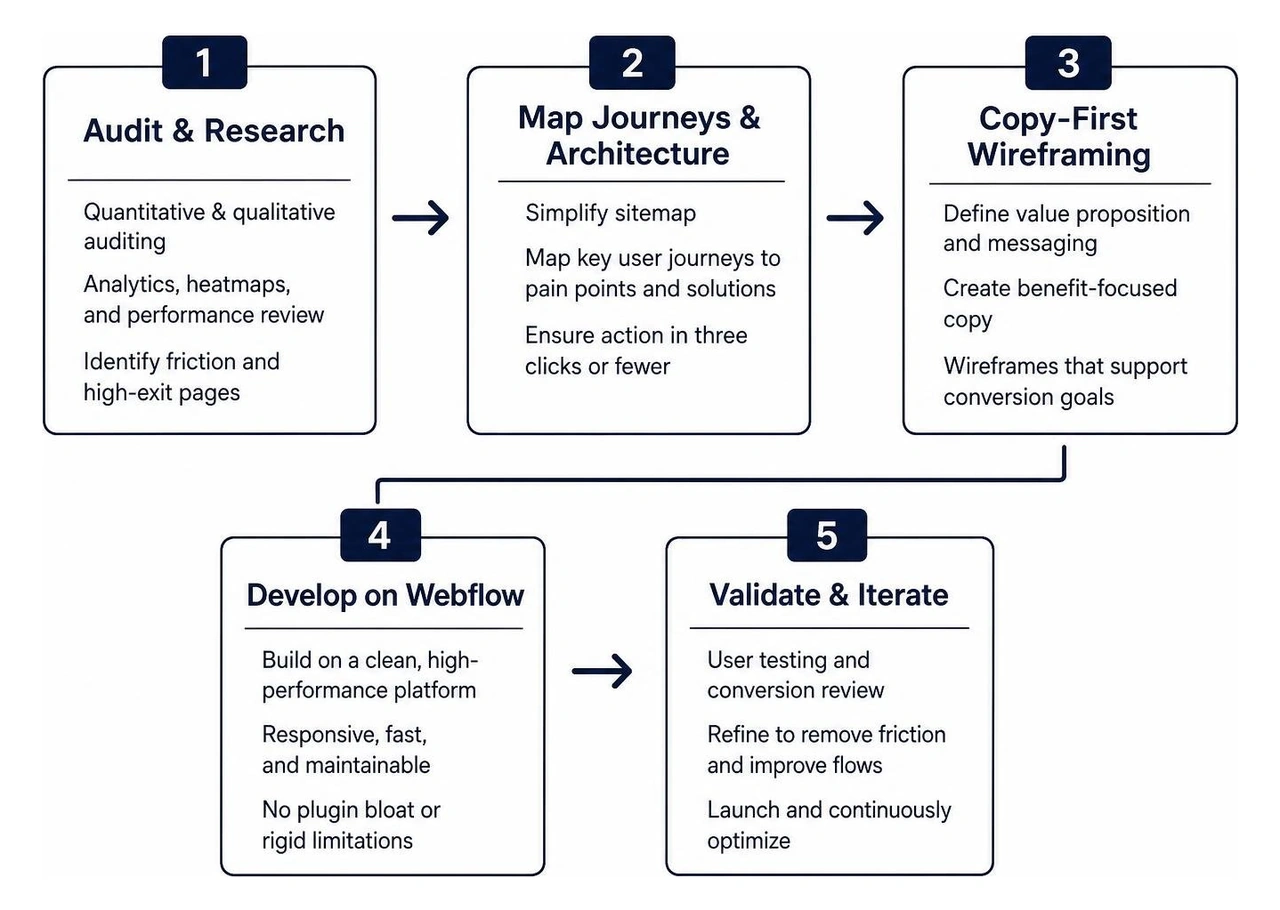
- Quantitative & Qualitative Auditing: Review analytics to discover high-exit URLs, examine heatmaps to observe cursor hesitation, and assess technical performance scores.
- User Journey & Architecture Mapping: Simplify your sitemap. Every critical user journey should bring visitors to an action point within three clicks or fewer.
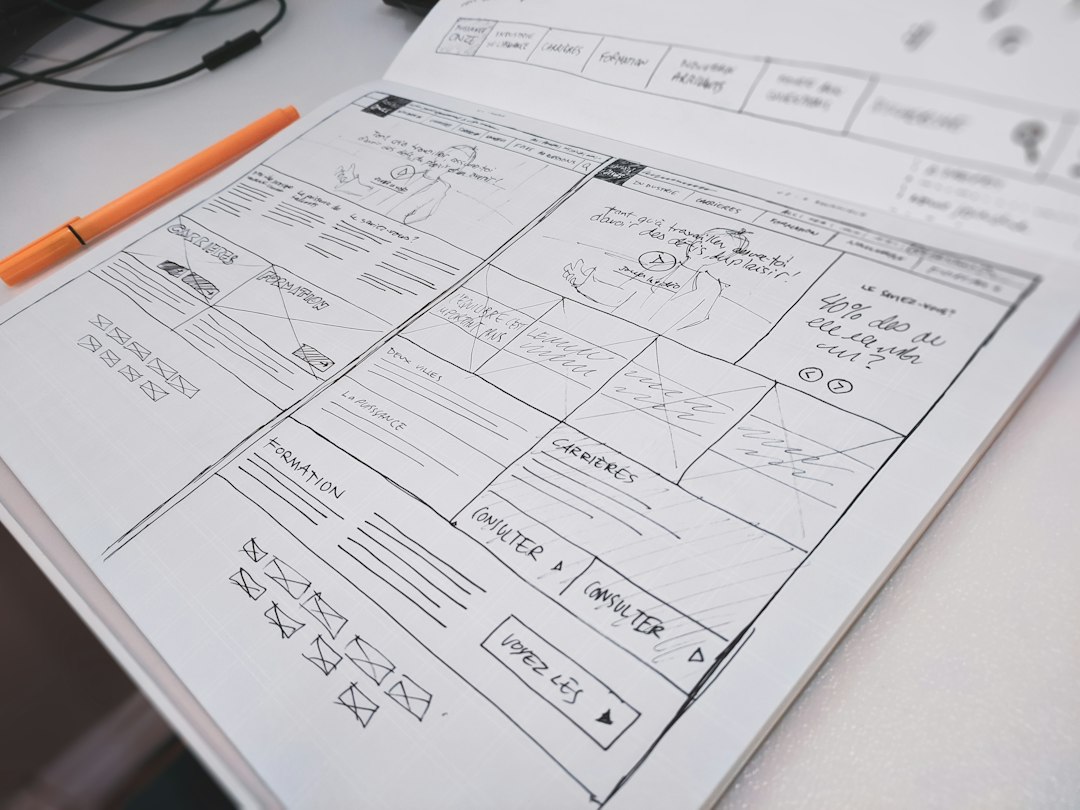
- Copy-First Wireframing: Visual elements must support your messaging, not constrain it. Drafting compelling, benefit-focused value propositions before visual layouts prevents design bloat.
- High-Performance Development: Building on modern platforms like Webflow guarantees clean code semantics, responsive breakpoints, and ultra-fast page speeds without third-party plugin drag.
- Validation and Iteration: Review conversion funnels through iterative user testing to eliminate friction before going live.
Reviewing actionable ways to increase website conversions helps your team spot and eliminate common conversion leaks throughout the wireframing stage.
Core UX and UI Principles That Turn Visitors into Qualified Leads
Turning passive traffic into commercial pipeline demands absolute clarity across every visual component. The human brain processes visual hierarchy in milliseconds, meaning your page layout must communicate value instantly.
- Establish a Dominant Visual Hierarchy: Use sizing, font weights, and selective contrast so the eye naturally scans headlines, absorbs proof, and settles on the CTA.
- Embrace Strategic Whitespace: Clutter is the primary enemy of conversion. Generous whitespace isolates key value propositions, reduces cognitive overload, and makes interfaces feel premium and trustworthy.
- High-Contrast, Action-Oriented Buttons: Primary conversion buttons must feature strong contrast against the background canvas. Replace vague button copy with immediate value indicators (e.g., "Get My Custom Audit" instead of "Submit").
- The "Rule of One": Each dedicated page should target one primary action. When multiple competing goals fight for real estate, visitors choose none.
- Form Simplification: Every added form field reduces submission rates. Reducing input fields down to the bare essentials (often name, work email, and company) reliably boosts completion. A famous case study showed Expedia recovered $12 million in annual profit simply by deleting a single non-essential "Company" field.
Consolidating multi-product entry points and removing visual noise from a site's navigation consistently sparks measurable lifts in demo requests and form completions, a pattern seen across many enterprise software redesigns.
Applying Behavioral Psychology to Eliminate User Hesitation
Effective UI design uses ethical behavioral psychology to resolve buyer hesitation at critical decision points:
- Social Proof and Authority Bias: 92% of buyers trust peer recommendations over standard marketing copy. Display relevant client logos, verifiable star ratings, and concise video testimonials directly beside submission forms to reassure prospects.
- Loss Aversion: Highlight the tangible cost of inaction or the risks of maintaining the status quo, showing buyers how your solution protects their time and resources.
- The Zeigarnik Effect: Multi-step forms that incorporate visual progress bars encourage users to complete an action once they have taken the initial step.
- Anchoring Principles: When presenting service tiers or packages, lead with your most comprehensive offering to establish an anchor of value, making standard packages feel more accessible.
Mobile-First Layouts and Speed Optimization on Webflow
Designing for a desktop monitor first and shrinking elements for mobile viewports is a recipe for lost revenue. Mobile-first design requires structuring core value messaging, thumb-zone CTA buttons, and sticky navigation specifically for 375px viewports.
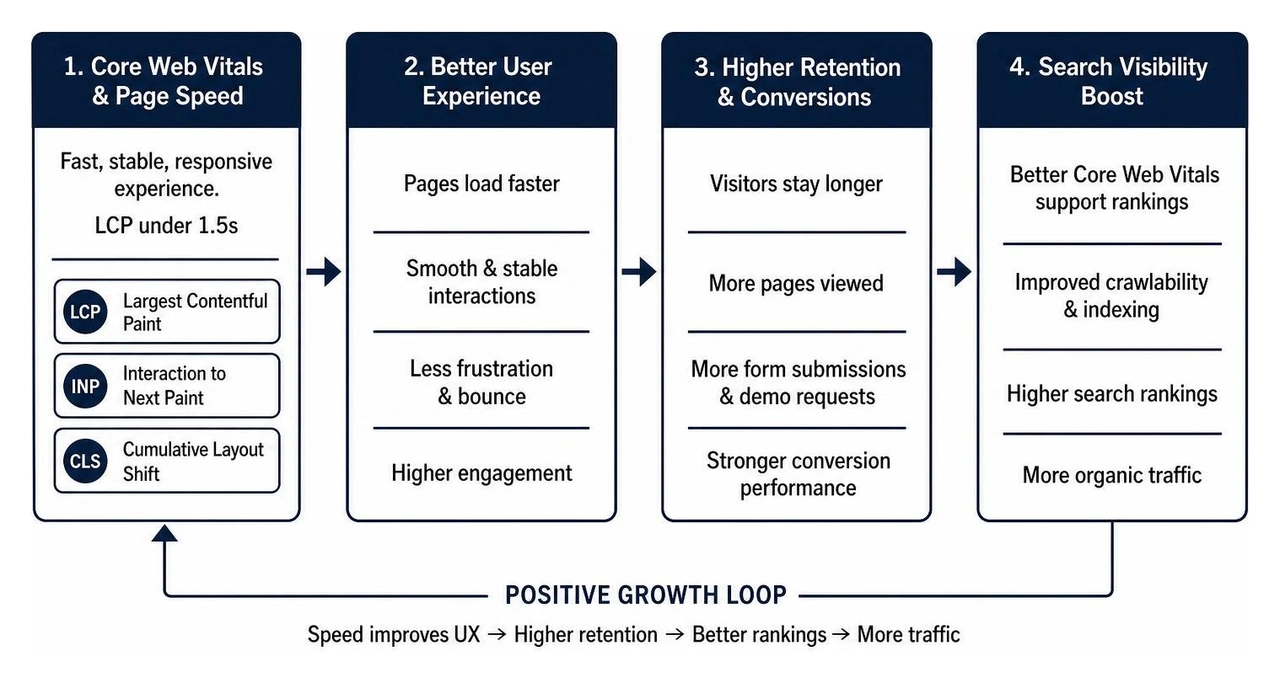
Performance engineering is directly tied to revenue. Data indicates a one-second page load delay generates a 7% loss in conversions, while 53% of mobile visits are abandoned if a page takes longer than three seconds to render. By developing natively in Webflow, clean semantic code, automated WebP image delivery, and optimized CSS asset delivery allow your site to hit green Core Web Vitals thresholds and keep Largest Contentful Paint (LCP) under 1.5 seconds.
Organizations executing sophisticated service offerings can apply our tailored B2B website redesign best practices to harmonize mobile responsiveness with complex sales cycles.
Aligning SEO and Generative Engine Optimization with Conversion Architecture
Driving high volumes of traffic is only profitable when your site architecture transforms visitors into pipeline. Simultaneously, building a high-converting site provides little value if search engines and AI engines cannot discover or parse your content.
Aligning conversion structure with organic search and Generative Engine Optimization (GEO) ensures that search bots and AI answer engines index, summarize, and reference your business as the definitive authority in your industry.

Generative Engine Optimization (GEO) focuses on structuring technical content, FAQ entities, transparent data tables, and direct answers so AI engines reference your brand in conversational answers. When search engines observe strong user signals—such as high time-on-page, deep scroll engagement, and low bounce rates—they reward your site with superior keyword visibility.
Balancing User Experience Signals and Search Rankings
A successful redesign avoids keyword stuffing and clumsy legacy SEO practices in favor of clear information architecture that serves both human readers and search crawlers:
- Intent-Matched Content Hierarchies: Build pages around exact commercial intent. Pair descriptive H1, H2, and H3 headers with concise answer blocks so users and generative algorithms find value within seconds.
- Internal Link Distribution: Connect your high-authority educational assets to commercial conversion pages through descriptive, contextual anchors.
- Structured Schema Data: Implement comprehensive Organization, Service, and FAQ schemas to help AI search engines parse your solutions and display rich search snippets.
- Frictionless Scannability: Break complex technical concepts into digestible bullet lists, highlighted takeaway boxes, and informative media.
Measuring Success After a Conversion Focused Redesign
Once your site launches, validate your return on investment by tracking core quantitative and qualitative metrics across your sales pipeline:
- Macro Conversion Rate: The percentage of total site visitors who complete your primary commercial goal (e.g., demo booked, proposal requested).
- Cost Per Acquisition (CPA): As conversion efficiency doubles, your blended customer acquisition costs decline across both organic channels and paid ad spend.
- Average Contract/Order Value: Grouping solutions strategically and using clear pricing tiers frequently increases initial deal sizes.
- Lighthouse Performance & Core Web Vitals: Tracking continuous LCP, First Input Delay (FID), and Cumulative Layout Shift (CLS) scores across mobile and desktop.
- Session Replay & Heatmap Analysis: Watching qualitative session replays reveals whether visitors scan the intended visual hierarchy or experience hesitation at checkout fields.
Documented industry data shows that focused UX restructuring yields extraordinary revenue results by aligning speed optimization, SEO, and user flow to dramatically multiply qualified inquiries. Civic infrastructure projects like the Beaver Avenue Two-Way Conversion | EngagePgh prove that simplifying directional pathways resolves bottlenecks in physical spaces just as effectively as in digital layouts.
Frequently Asked Questions About Redesigning for Conversions
How long does a strategic website redesign take to implement?
A complete, conversion-focused website redesign typically takes between 6 to 12 weeks from initial research to deployment. This timeline covers audience discovery, technical SEO audits, copy-first wireframing, Webflow development, cross-browser QA, and 301 redirect mapping.
To plan your budget and operational scope accurately, consult our breakdown on the cost for website redesign.
Will redesigning my site hurt existing search engine rankings?
When handled with strict technical migration protocols, a redesign will protect and improve your organic search rankings. Rank drops during a rebuild typically happen when teams change URL paths without setting up 1-to-1 301 redirects, delete high-ranking content, or introduce code bloat.
By preserving URL structures, matching meta entities, improving Core Web Vitals, and implementing clean Webflow code, search engines quickly reward the updated site with higher rankings thanks to improved user engagement.
Can modern aesthetics alone improve website conversion rates?
No. A clean, contemporary design creates initial visual credibility, but aesthetics alone cannot guide a user to make a buying decision.
If your modern-looking website suffers from unclear messaging, buried CTA buttons, complicated forms, or slow mobile performance, visitors will still leave without converting. True conversion gains come from aligning clear value propositions, behavioral psychology, and technical performance.
Conclusion
A static website that only acts as an online business card is an expensive missed opportunity. By executing a conversion-focused redesign built around clear visual hierarchy, frictionless user journeys, high-performance Webflow engineering, and Generative Engine Optimization, you turn your digital presence into an automated pipeline engine.
At Refresh, our team specializes in building high-performing Webflow websites, strategic SEO architectures, and brand identities for ambitious businesses across Pittsburgh, PA, Cleveland, OH, and Charlotte, NC. We believe that your website should be your hardest-working sales asset, generating qualified leads day after day.

Ready to eliminate conversion bottlenecks and scale your inbound pipeline? Explore how our team can help you build an optimized digital foundation when you partner with top-tier website redesign services.


.avif)