
Estimate Your Website Redesign Cost Before You Commit
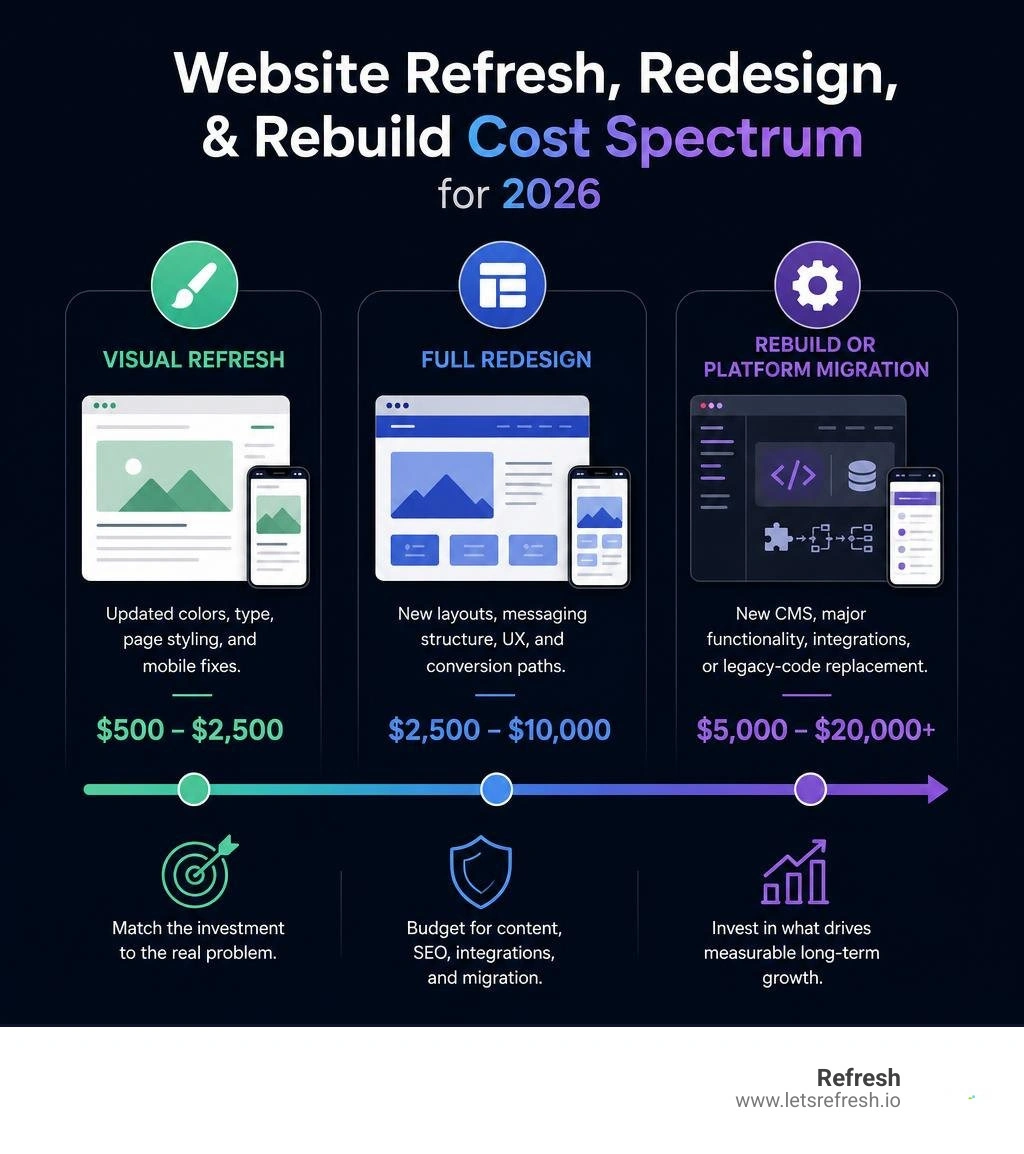
In 2026, the cost for website redesign usually falls into three levels:
- Visual refresh: $500 to $2,500 for updated colors, type, page styling, and mobile fixes.
- Full redesign: $2,500 to $10,000 for new layouts, messaging structure, UX, and conversion paths.
- Rebuild or platform migration: $5,000 to $20,000+ for a new CMS, major functionality, integrations, or legacy-code replacement.
Start by identifying the real problem. If your site has solid content and technology but looks dated, a refresh may be enough. If visitors struggle to understand your product or convert, plan for a structural redesign. If the platform limits growth, a Webflow rebuild or migration may deliver better long-term value.
Budget beyond design, too. Content review, SEO protection, integrations, and stakeholder feedback can make a redesign cost about 15% more than a comparable new build. Protecting URLs, metadata, internal links, and redirects is especially important: poor migration work can sharply reduce organic traffic.
I am Alexander Palmiere, Founder and CEO of Refresh Digital Strategy, where our team has launched more than 200 websites for growing businesses. This guide draws on that experience to help founders estimate the right cost for website redesign and invest in work that supports measurable growth.
Cost for website redesign terminology:
Average Cost for Website Redesign in 2026: Breakdown by Project Scope
Estimating an accurate budget begins with diagnosing the exact scale of intervention your site requires. Many business owners assume all redesigns are created equal, yet modifying CSS stylesheets requires a completely different resource allocation than refactoring an entire database architecture. In 2026, industry benchmarks documented by the Website Redesign Cost 2026: $2K-$50K+ [Breakdown] show that redesign investments span a wide spectrum based directly on functional complexity and platform constraints.
| Redesign Tier | Typical Price Range | Average Timeline | Core Deliverables | Ideal Business Scenario |
|---|---|---|---|---|
| Visual Refresh | $500 – $2,500 | 1 – 3 Weeks | Typography, color palettes, spacing adjustments, CSS cleanup | Brand identity update, functional platform, minor styling decay |
| Full Structural Redesign | $2,500 – $10,000 | 4 – 8 Weeks | Information architecture, custom wireframes, conversion funnel overhaul, responsive UI | High bounce rates, confusing user journeys, low lead conversion |
| Rebuild & Platform Migration | $5,000 – $20,000+ | 8 – 16 Weeks | CMS replatforming (e.g., to Webflow), schema migration, API integration, legacy code removal | Outdated tech stack, sluggish load speeds, unmaintainable backend |
Matching your budget to the proper tier avoids two common pitfalls: overpaying for structural changes when you only need surface-level refinement, or underfunding a project that requires deep infrastructure modernization.
Visual Refresh ($500 to $2,500)
A visual refresh represents the lightest scope of work. It is designed for businesses whose underlying platform, technical infrastructure, and page layouts are fundamentally sound, but whose aesthetic presentation feels dated.
During a visual refresh, the underlying page hierarchy remains mostly untouched. Instead, designers and front-end developers execute targeted updates to typography scales, global color palettes, button styles, and photographic assets. This level of service often pairs with a broader branding refresh for websites, ensuring visual touchpoints align with modern standards without altering URL structures or backend functionality. Turnaround is rapid, typically requiring one to three weeks, making it a cost-effective way to modernize a digital storefront.
Full Structural Redesign ($2,500 to $10,000)
A full structural redesign goes deeper by restructuring the user experience (UX) and user interface (UI) on your existing content management system. This process is necessary when your website looks acceptable on the surface but suffers from structural bottlenecks—such as confusing navigation menus, cluttered product pages, or weak conversion paths that depress sales.
This tier involves user research, sitemap restructuring, wireframing, and custom responsive layouts designed to increase conversion rates. As detailed in our small business website redesign guide, a structural redesign redefines how prospective customers navigate your value proposition, transforming passive traffic into qualified pipeline leads. Because it reshapes the underlying templates and page funnels, execution generally spans one to two months.
Platform Migration and Rebuild ($5,000 to $20,000+)
When an existing CMS restricts administrative flexibility, burdens your team with technical debt, or fails Core Web Vitals, a complete platform rebuild becomes necessary. Moving an expanding company from an unmaintainable legacy framework to an intuitive, visually driven platform like Webflow allows marketing teams to publish without engineering bottlenecks.
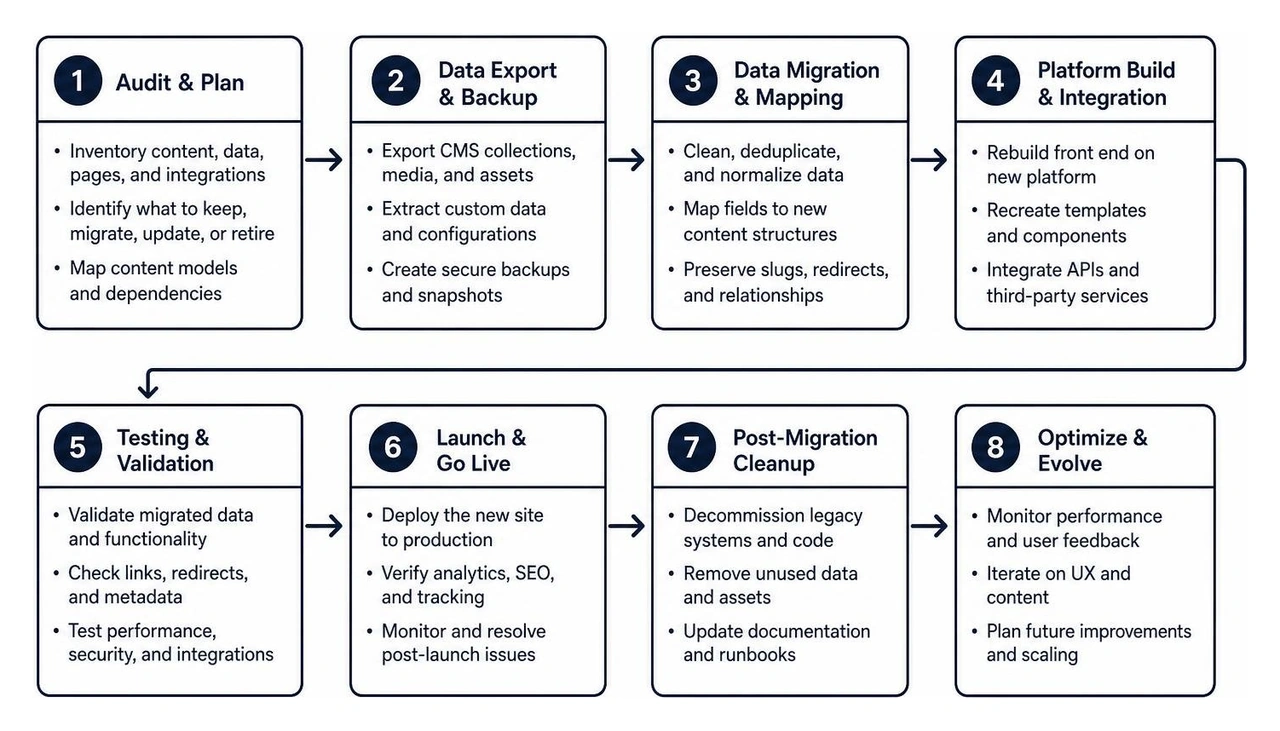
A full rebuild involves auditing every database record, exporting dynamic CMS collections, restructuring canonical hierarchies, mapping API endpoints, and rebuilding the front end with clean semantic code. For high-growth organizations requiring sophisticated lead routing, a dedicated b2b website redesign rebuild ensures enterprise-grade security, lightning-fast rendering, and complete autonomy over future page publishing.
Why Redesigns Often Cost More Than Building from Scratch
A common budget illusion is the belief that remodeling an existing website should cost less than starting from a blank canvas. In practice, website redesigns frequently cost roughly 15% more than greenfield developments of identical size.

When developing a brand-new website, engineers write clean markup on an empty slate without historical constraints. In contrast, redesigning an established site requires excavating legacy systems, untangling third-party scripts, and safely handling historical data.
Factors That Drive Up the Total Cost for Website Redesign
Several underlying operational demands contribute to the expanded scope of a redesign project:
- Comprehensive Content Auditing: Over a 4-to-5-year lifespan, websites accumulate duplicate landing pages, abandoned draft posts, and obsolete product sheets. Auditing hundreds of URLs to decide what to keep, prune, or consolidate adds $500 to $3,000 in professional labor.
- Legacy Technical Debt: Removing deprecated JavaScript libraries, obsolete tracking pixels, and messy CSS overrides without breaking existing layouts requires methodical debugging.
- Stakeholder Alignment and Change Management: Existing websites have entrenched internal workflows. Aligning sales, executive, and product teams on updated conversion funnels demands dedicated discovery sessions and strategic iteration.
Engaging an experienced web redesign service ensures these technical intricacies are addressed early, preventing scope expansion midway through development.
SEO Preservation and Traffic Protection Costs
The most critical hidden risk of a redesign is the accidental destruction of organic visibility. If a development team alters URL permalinks, drops header tags, or strips structured schema markup without implementing proper redirects, search engines will lose track of your domain authority. A botched relaunch can eliminate 60% to 80% of organic traffic overnight.
Safeguarding your hard-won search equity requires dedicated budget allocation—typically between $500 and $2,000—specifically for technical search preservation. The best website redesign services 2026 build these SEO protections directly into their quality assurance protocols to ensure rankings and Generative Engine Optimization (GEO) parameters remain intact after launch.
Agency vs Freelancer Pricing Comparison
When commissioning a redesign, your choice of implementation partner directly influences both capital outlay and project management overhead.
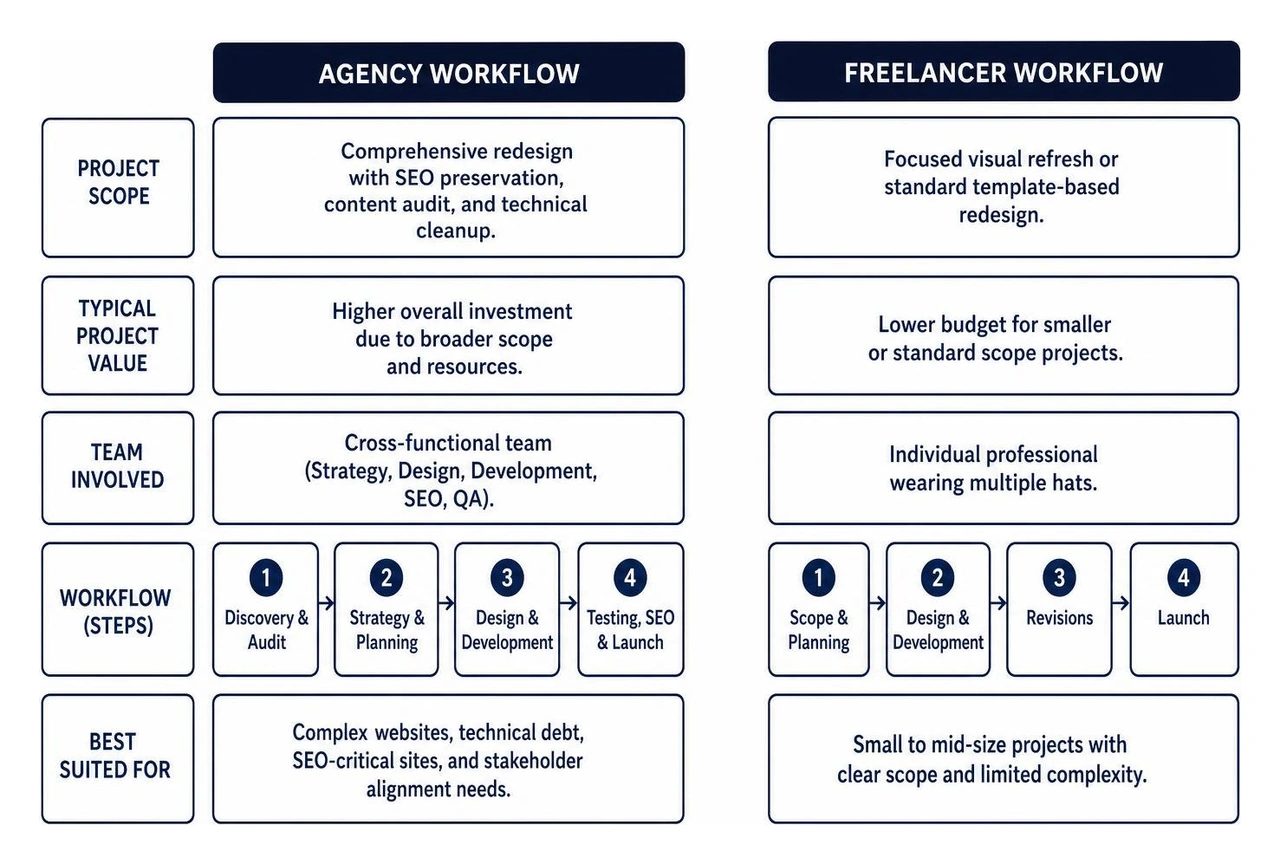
Choosing between an independent contractor and a full-service web redesign company depends on the technical complexity of your build and your internal team's bandwidth.
Freelancer Rates and Trade-offs
Experienced independent freelancers typically charge between $50 and $150 per hour. For focused visual refreshes ($1,500 to $4,000) or standard template-based redesigns ($3,000 to $10,000), a skilled freelancer provides an agile, budget-friendly partnership.
However, solo practitioners present distinct operational constraints:
- Narrow Skill Bandwidth: A designer who excels at visual aesthetics may lack deep expertise in technical search preservation, custom JavaScript integrations, or conversion copywriting.
- Resource Bottlenecks: If a solo developer takes on multiple clients simultaneously, your project timeline may experience delays during critical launch phases.
- Limited Post-Launch Support: Freelancers frequently shift attention to new contracts once initial milestones conclude, leaving you without dedicated ongoing maintenance.
Agency Pricing and Multi-Disciplinary Value
Digital agencies typically charge two to four times the rate of individual freelancers, with visual refreshes starting at $4,000 to $10,000, full custom redesigns spanning $8,000 to $25,000, and complex platform migrations ranging from $15,000 to $50,000+.
The higher investment reflects a complete, multi-disciplinary team assigned to your brand. When working with an established website redesign agency, your investment covers:
- Dedicated project managers who maintain rigid delivery milestones.
- Dedicated UX researchers and UI visual designers crafting custom component libraries.
- Specialized Webflow developers writing clean semantic markup.
- SEO strategists executing 301 redirect mapping, metadata verification, and Generative Engine Optimization protocols.
- Quality assurance engineers running cross-browser, cross-device, and Core Web Vitals performance benchmarks.
Calculating ROI and Strategic Budget Optimization
A website redesign should be evaluated as a revenue-generating business asset rather than an operational expense. A properly planned structural overhaul routinely elevates sitewide conversion rates by 15% to 40% by eliminating usability friction and clarifying brand positioning.
To calculate your payback period, evaluate how incremental conversion gains translate to recurring monthly revenue:
$$\text{Monthly Revenue Increase} = \text{Current Monthly Revenue} \times \text{Expected Conversion Lift Percentage}$$
$$\text{Payback Period (Months)} = \frac{\text{Total Redesign Investment}}{\text{Monthly Revenue Increase}}$$
For example, if your business currently generates $10,000 per month in inbound lead value or direct digital sales, a conservative 20% conversion improvement generates an additional $2,000 per month. A comprehensive $10,000 redesign investment completely pays for itself within five months, delivering pure margin expansion thereafter.
When planning to redesign business website assets, tracking these metrics ensures your capital outlay ties directly to measurable commercial returns.
How to Reduce Your Cost for Website Redesign Without Sacrificing Quality
If your budget is constrained, deliberate planning can substantially reduce total project hours without compromising end-product quality:
- Audit and Finalize Content Early: Content delays are the primary cause of budget overruns. Auditing, writing, and approving all page copy, headshots, and product imagery prior to development saves thousands in developer idle time.
- Leverage Modular Design Systems: Rather than requesting completely unique layout geometry for every individual subpage, have your team build a reusable, modular component system in Webflow. This cuts build hours while ensuring brand consistency.
- Phase the Feature Rollout: Launch your core conversion funnels first during Phase 1. Secondary features—such as custom interactive calculators or resource libraries—can be deployed during subsequent sprints as budget permits.
- Utilize AI-Assisted Development Workflows: Modern engineering teams leverage artificial intelligence for rapid boilerplate generation, automated quality assurance testing, and initial CSS scripting, lowering technical labor costs.
Exploring a targeted web revamp that prioritizes high-impact pages allows you to capture rapid conversion gains while managing upfront capital expenditure.
Frequently Asked Questions About Redesign Costs
How much does a basic visual refresh cost compared to a full rebuild?
A visual refresh generally costs between $500 and $2,500 when working on an existing, stable platform. It focuses exclusively on cosmetic enhancements like typography, brand colors, button styles, and basic mobile responsiveness, wrapping up within one to three weeks. In contrast, a comprehensive platform rebuild ranges from $5,000 to $20,000+, requiring eight to sixteen weeks to migrate databases, establish new CMS architectures, build custom integrations, and configure redirection pathways.
Why does platform migration add 30% to 50% to the total price?
Platform migration requires extensive back-end data engineering beyond visual design. Developers must export legacy databases, clean up messy historical formatting, map custom fields to the new CMS, re-establish API connections with third-party software (such as CRMs and email providers), and build comprehensive 1-to-1 301 redirect tables to prevent 404 errors and protect search visibility.
How does AI-assisted development impact web redesign pricing in 2026?
AI-assisted coding and testing tools have reduced the labor hours required for boilerplate development, routine script debugging, and responsive testing across devices. This allows development teams to execute complex rebuilds faster and at lower price points than in past years, shifting agency focus toward high-value UX strategy, messaging clarity, and conversion architecture.
Conclusion
A successful website redesign is an investment in your company's commercial growth. By diagnosing whether your site needs a cosmetic refresh, a structural UX redesign, or a full Webflow rebuild, you can allocate capital effectively while protecting existing search rankings. To explore the complete redesign roadmap and plan your upcoming digital transition, review our website redesign services ultimate guide.


.avif)