

Why Your Website Needs a Web Revamp
A web revamp is a strategic overhaul of your website that transforms its foundation—code, structure, design, navigation, and content—to better serve your business goals and user needs. Unlike a simple refresh (which updates colors or fonts), a revamp addresses deeper issues like poor user experience, declining metrics, and outdated functionality.
Key reasons to consider a web revamp:
- Your website looks outdated compared to competitors
- Bounce rates are high and conversions are low
- Pages load slowly or don't work on mobile devices
- Your brand has evolved but your site hasn't caught up
- Security vulnerabilities put your business at risk
- You're losing traffic and search rankings
The stakes are high. 75% of visitors judge your credibility based on how your content is presented. Poor user experience cost businesses $1.42 trillion in lost sales. If your website isn't meeting expectations, you're not just missing opportunities—you're actively pushing potential customers away.
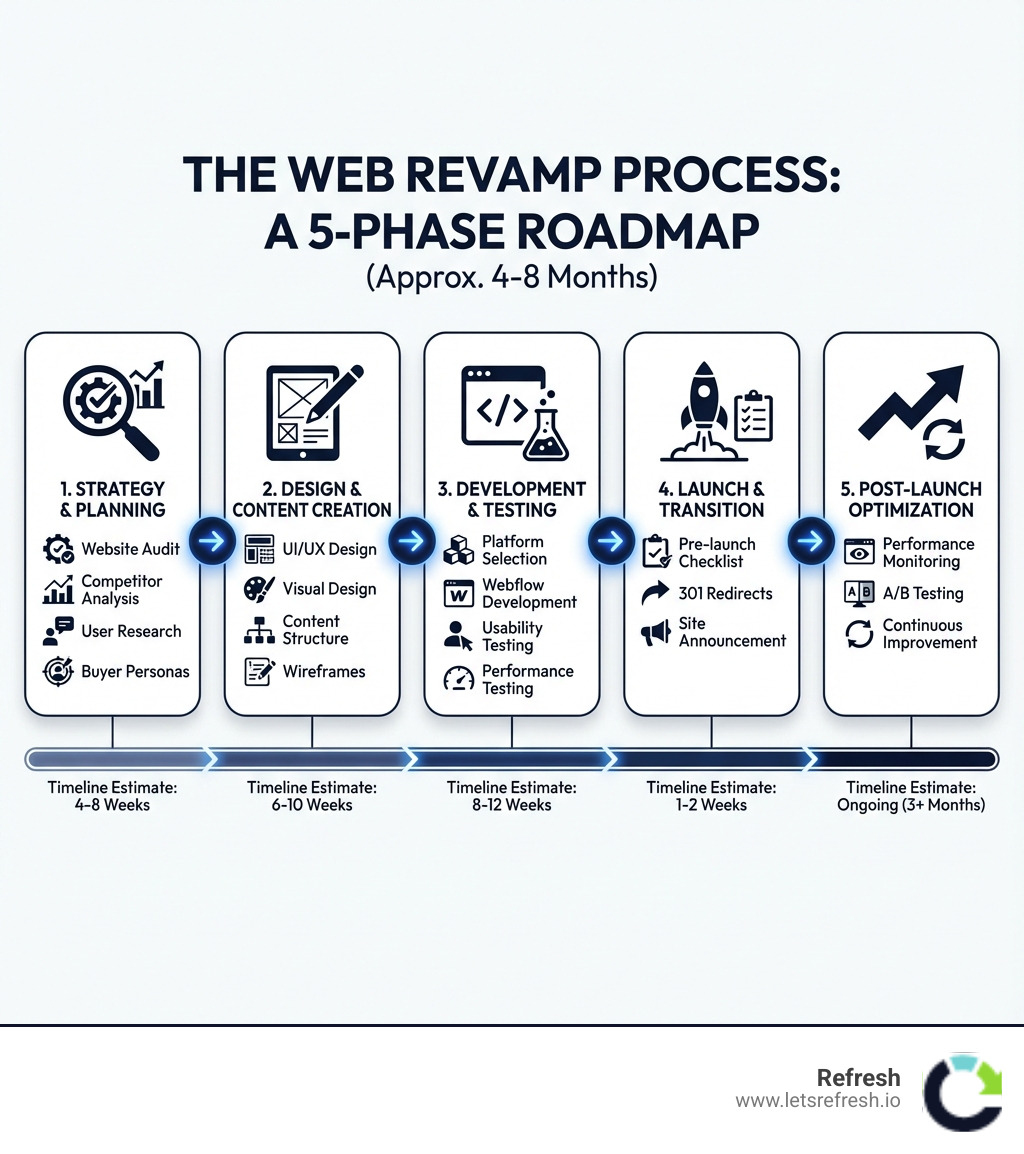
A strategic web revamp can fix these problems. It improves user experience, improves conversion rates, boosts SEO rankings, and gives your brand the digital presence it deserves. The process typically takes 4-8 months and involves five key phases: strategy and planning, design and content creation, development and testing, launch and transition, and post-launch optimization.
I'm Alexander Palmiere, founder and CEO of Refresh Digital Strategy, where I've successfully developed and launched over 200 websites for small to medium-sized businesses. Throughout my career, I've guided countless companies through the web revamp process, helping them transform underperforming sites into powerful growth engines. Below, I'll walk you through exactly how to approach your own website change.
Web revamp basics:
Is It Time for a Website Makeover?
Before diving headfirst into a web revamp, it's crucial to understand if your website truly needs a significant overhaul or if a simpler refresh will suffice. We often see businesses struggling with websites that are just not cutting it anymore. The digital landscape evolves rapidly, and what worked last year might be holding you back today.
Let's look at the key indicators that signal it's time for a more profound change.
Key Indicators Your Website Needs a Revamp
Your website is your 24/7 salesperson, and if it's not performing, it's costing you. Here are the tell-tale signs that it's time for a web revamp:
- High Bounce Rate: If visitors are leaving your site after viewing just one page, it's a strong indicator they're not finding what they expected or are having trouble navigating. A low conversion rate might suggest your site isn’t clear enough or is hard to use. We need to figure out why people are leaving and fix it.
- Low Conversion Rates: Your website might attract traffic, but if those visitors aren't converting into leads or sales, something is broken in the user journey. As we've seen, businesses lost $1.42 trillion in sales due to poor user experience (UX). We don't want you to leave money on the table!
- Slow Page Speed: In today's world, patience is a virtue few possess, especially online. If your site is slow, people might leave before they even see anything. This isn't just annoying for users; it also harms your search engine rankings. We understand the need for a Fast Loading Website and prioritize this in our redesigns.
- Not Mobile-Friendly: With the majority of internet traffic coming from mobile devices, a non-responsive site is a major blocker. Google predominantly puts mobile sites first when deciding how to rank pages, so if your site isn't optimized for smaller screens, you're at a significant disadvantage. We prioritize a Mobile-First Design Strategy: Designing for Small Screens and Big Impact.
- User Complaints: Are you or your team constantly fielding complaints about how the website functions, or how difficult it is to find information? User feedback is invaluable; it points directly to areas needing improvement.
- Doesn't Reflect Your Current Brand: Brands evolve. If your mission, values, or target audience have shifted, your website needs to reflect these changes. An outdated design can give the impression that your business isn't keeping up with current trends or industry standards, impacting credibility. 75% of visitors decide if a website is credible based on how the content is presented.
- Security Vulnerabilities: Is your website running on outdated software or showing signs of security weaknesses? An insecure website puts your data and your users' data at risk, severely damaging trust and potentially leading to costly breaches.
If any of these sound familiar, it's time to consider a comprehensive Maximizing Website Performance: Tips and Best Practices.
Revamp vs. Refresh: Understanding the Difference
It's easy to confuse a web revamp with a simple website refresh. While both aim to improve your online presence, their scope and impact are vastly different.
Website Revamp: Think of a web revamp as a complete home renovation. It involves significant changes to the code, structure, visuals, navigation, and content. It's a strategic overhaul that transforms your website's foundation to serve business goals and user needs better. This means new functionality, a re-evaluation of your information architecture, and often, a new underlying technology. This is what we focus on when we Redesign Business Website.
Website Refresh: This is more like redecorating a room. A refresh updates visual elements and minor user experience improvements to align with your current brand identity. This could mean changing color palettes, updating typography, swapping out images, or making small UI tweaks. It's about polishing what's already there, not rebuilding it from the ground up.
| Feature | Website Revamp | Website Refresh |
|---|---|---|
| Scope | Significant changes to code, structure, visuals, navigation, and content | Minor updates to visual elements and small UX improvements |
| Goal | Transform foundation to meet new business goals and user needs | Align with current brand identity and aesthetic trends |
| Timeline | Typically 4-8 months (can be longer for complex sites) | Weeks to a couple of months |
| Examples | New CMS, re-architected site map, new functionalities, comprehensive brand update | Changing color scheme, updating fonts, new hero images, minor UI tweaks |
The 5-Phase Web Revamp Process
A successful web revamp is a carefully planned journey, not a spontaneous sprint. At Refresh, we follow a structured, five-phase process to ensure every aspect of your new website is strategic, effective, and aligned with your business objectives.
Phase 1: Strategy and Planning
This foundational phase is all about understanding where you are, where you want to go, and how we'll get there. It's the blueprint for your entire web revamp.
- Website Audit: We start by conducting a thorough audit of your current website. This isn't just a look-see; it's a deep dive into its technical performance, user behavior, conversion metrics, and UX elements. We analyze everything from page load times and mobile responsiveness to bounce rates and traffic sources. This helps us identify what's working, what's broken, and where the biggest opportunities for improvement lie.
- Competitor Analysis: We then look at what your competitors in Pittsburgh, Cleveland, and Charlotte are doing. We examine their design, website navigation, content, and marketing strategies. This isn't about copying; it's about understanding industry trends, identifying content gaps, and defining what makes your business unique. These insights help us ensure your web revamp meets (or even overtakes!) the competition.
- User Research: We believe your customers hold the key to a successful redesign. We conduct user research by analyzing customer support tickets, tracking user paths, performing usability testing, and mapping user journeys. This helps us understand your audience's preferences, pain points, and how they consume information.
- Buyer Personas: Based on our user research, we create detailed buyer personas. These fictional, generalized representations of your ideal customers guide every design and content decision. Knowing who we're talking to helps us craft text that addresses their questions and guides them through their journey. You can even use tools to help create one or several personas that you want to target.
- Timeline and Budget: Finally, we establish a clear project plan, outlining the scope, timeline, resources, and budget. We aim for transparency, unlike the 63% of marketers who had no idea how much their website redesign cost. We aim to define specific, measurable goals (SMART goals) and identify key metrics to track success. This comprehensive plan ensures everyone is on the same page and the project stays on track. For a deeper dive into strategy, check out How to Develop a Website Redesign Strategy That Guarantees Results and our insights on B2B Website Redesign.
Phase 2: Design and Content Creation
With a solid strategy in place, we move into bringing your new website to life. This phase focuses on the aesthetic appeal, user interaction, and persuasive messaging that will define your web revamp.
- UI/UX Design: User Interface (UI) and User Experience (UX) are the cornerstones of modern web design. We prioritize creating intuitive navigation, clear calls-to-action (CTAs), and seamless user flows. We want your visitors to find what they need effortlessly and enjoy their time on your site. Poor UX can lead to significant financial losses, so we take this very seriously.
- Visual Design: This is where your brand personality shines through. We decide on typography, color schemes, imagery, and graphics that convey your brand's look and feel. Color is accountable for 85% of conversion, so this is no minor detail! We create a website layout that not only looks good but also converts. For branding guidance, explore our Branding and Logo Design Agency services.
- Content Structure and Information Architecture: Content is king, but without a clear castle, it's lost. We establish a logical structure for your site content, organizing topics, web pages, and blogs. Information architecture helps users easily find what they’re looking for and improves overall navigation.
- Sitemap and Wireframes: We start by building a sitemap, which acts as the backbone of your website, mapping out all pages and their connections. Then, we create wireframes – the "skeleton" of your pages. These low-fidelity layouts show the placement of each element (shapes, text, images, forms) and help us test different layout ideas quickly and cost-effectively, ensuring your content fits the design.
- Accessibility (WCAG): An accessible website is a usable website for everyone, including those with disabilities. We adhere to Web Content Accessibility Guidelines (WCAG) to ensure your new site is inclusive, broadening your reach and mitigating potential legal issues. This includes fair contrast between text and background, proper alt text for images, and keyboard navigation.
- Content Strategy: We develop an audience-led content strategy, ensuring your copy is less about you and more about your users and their needs. We update existing high-performing content, create new text for identified gaps, and ensure all content aligns with the customer journey, providing answers to their questions and guiding them through their purchase cycle.
Phase 3: Development and Testing
Once the design is approved, our developers roll up their sleeves to build your new website. This phase is about translating our beautiful designs into a functional, robust, and lightning-fast online experience.
- Platform Selection: We often recommend Webflow for its flexibility, visual development capabilities, and robust hosting infrastructure. As a Webflow Development Company, we find it streamlines the design-to-development handoff and offers excellent performance.
- Webflow Development: Our expert team builds your site using Webflow, focusing on clean code, responsive design, and seamless integration of all features. This ensures your site looks and performs flawlessly across all devices and browsers.
- Front-End and Back-End Integration: We ensure the user-facing parts (front-end) and the server-side logic (back-end) work in perfect harmony. This includes integrating databases, third-party tools, and any custom functionalities required for your business.
- Usability Testing: We never skip the testing step! We conduct rigorous usability testing with real users to assess navigation, functionality, responsiveness, and overall experience. This helps us identify and iron out any issues before launch.
- Cross-Browser Testing: Your website needs to look and perform consistently across different web browsers (Chrome, Firefox, Safari, Edge). We carefully test for compatibility to ensure a smooth experience for all visitors.
- Performance Testing: Speed is critical. We optimize your site for Fast Loading Website performance, using tools like Wix’s Site Speed Dashboard or Google's PageSpeed Insights to check and improve loading times. We compress images, optimize code, and leverage efficient hosting to deliver a snappy experience.
Phase 4: Launch and Transition
The moment of truth! Launching a redesigned website requires careful coordination to ensure a smooth transition and minimize any disruption to your business.
- Pre-Launch Checklist: We follow a comprehensive checklist to ensure every detail is covered: all content is in place, links are working, forms are functional, and SEO elements are optimized.
- Phased Rollout: For larger or more complex sites, we might recommend a phased rollout. This allows us to monitor the new design under normal conditions with a smaller segment of users before a full public announcement, minimizing risk.
- 301 Redirect Strategy: This is critical for SEO. If any of your page URLs are changing, we implement 301 redirects. This tells search engines (and users) that the old page has permanently moved to a new location, preserving your SEO value and preventing 404 errors. You can find helpful information on redirects on the Google Help page.
- Announcing the New Site: Once launched, we help you share your fresh new design with the world! This can include social media announcements, email newsletters, and updates to your Google Business Profile for your locations in Pittsburgh, Cleveland, and Charlotte.
- Submitting Sitemap to Google: We submit your updated sitemap to Google Search Console, helping search engines find and index your new pages quickly and efficiently.
Phase 5: Post-Launch Monitoring and Optimization
A website is never truly "finished." The digital world is constantly changing, and your website should evolve with it. Our work doesn't stop at launch; it enters a new phase of continuous improvement.
- Performance Monitoring: We continuously monitor key performance indicators (KPIs) like page views, bounce rate, time spent on site, and conversion rates. This helps us understand how users are interacting with the new site.
- Analytics Tracking: We use robust analytics tools to track user behavior, traffic sources, and conversion funnels. This data provides invaluable insights into what's working and what could be improved.
- User Feedback Collection: We encourage and collect user feedback through various channels. This direct input helps us identify any unexpected issues or areas where the user experience could be improved.
- A/B Testing: We conduct A/B tests to compare different versions of pages or elements to see which performs better. This data-driven approach allows us to make informed decisions for ongoing optimization, boosting conversion rates and improving user experience.
- Continuous Optimization: Based on monitoring, analytics, and feedback, we make iterative adjustments to your website. This might involve tweaking content, refining UI elements, or improving technical aspects. This proactive approach ensures your website remains relevant, performs optimally, and continues to drive business growth. For comprehensive digital marketing support, explore our Digital Marketing Company services.
SEO and Your Web Revamp: Protecting Your Rankings
A web revamp is a golden opportunity to boost your search engine optimization (SEO), but it also carries risks if not handled correctly. Our goal is to maintain or improve your search rankings throughout the process.
- SEO Audit: Before we begin, we conduct a thorough SEO audit of your existing site. This identifies your current rankings, valuable keywords, and any existing technical SEO issues. We want to preserve your "link juice" and authority.
- Keyword Strategy: We refine your keyword strategy to align with your new content and business goals. This ensures your new site targets the right audience and ranks for relevant search queries in Pittsburgh, Cleveland, and Charlotte.
- On-Page SEO: Every new page and piece of content is optimized for on-page SEO. This includes using keywords naturally in titles, headings, and body text, crafting compelling meta descriptions, and optimizing images with alt text.
- Technical SEO: We ensure the new site's technical foundation is solid. This includes optimizing site speed, ensuring mobile-friendliness, and structuring your site for easy crawling and indexing by search engines.
- Content Migration: If you're moving or updating content, we carefully plan the migration to avoid losing valuable indexed pages. This means identifying high-performing content to repurpose, update, or remove.
- 301 Redirects: As mentioned, 301 redirects are paramount. Any old URLs that change must be permanently redirected to their new counterparts. Neglecting this step can lead to 404 errors, frustrated users, and a significant drop in search rankings. It's a critical step in preserving your SEO authority.
- Link Building Continuity: We assess your existing backlinks and ensure that any changes don't negatively impact these valuable connections. Our aim is to safeguard your search engine rankings and even improve them. For service-based businesses, this is particularly important for SEO for Service-Based Business.
Common Pitfalls to Avoid
Even with the best intentions, a web revamp can go awry if certain pitfalls aren't avoided. We've seen it all, and we're here to help you steer clear.
- Scope Creep: This happens when the project's scope continuously expands beyond its initial definition. It can lead to budget overruns, missed deadlines, and frustration. Clear planning and communication are our best defenses.
- Neglecting SEO: Thinking of SEO as an afterthought is a recipe for disaster. A beautiful new site that no one can find is like a hidden gem. Integrate SEO from day one to maintain and improve search visibility.
- Ignoring User Data: Making decisions based on "gut feelings" rather than actual user behavior is a huge mistake. Data from your current site and user research should drive your redesign choices.
- Poor Communication: A web revamp involves many moving parts and stakeholders. Lack of clear, consistent communication between your team and ours can lead to misunderstandings and delays. We prioritize transparent communication every step of the way.
- Unrealistic Budget or Timeline: A web revamp is a significant investment of time and resources. Unrealistic expectations can lead to disappointment. We work with you to set achievable goals and timelines.
- Forgetting Mobile-First Design: In today's mobile-dominated world, designing for desktop first is outdated. We always prioritize a Mobile-First Design Strategy: Designing for Small Screens and Big Impact to ensure your site performs optimally on all devices.
Frequently Asked Questions about Website Revamps
We often get asked similar questions about the web revamp process. Here are some of the most common ones:
How long does a website revamp typically take?
The average time for a web revamp can range from four to eight months. However, this is heavily influenced by several factors:
- Project Complexity: A simple informational site will take less time than a large e-commerce platform with custom integrations.
- Team Size: The number of designers, developers, and content creators involved can affect the pace.
- Scope of Work: A full overhaul, including new content and functionality, naturally takes longer than a visual refresh.
- Client Responsiveness: Timely feedback and content delivery from your end are crucial for keeping the project on schedule.
How much does a website revamp cost?
The cost of a web revamp varies widely, much like the cost of building a house. It depends entirely on the scope and complexity of the project. We've seen that 63% of marketers had no idea how much their website redesign cost, leading to frustration. We aim for transparency from the outset.
Key factors influencing cost include:
- Project Scope: A complete overhaul with custom features will be more expensive than a template-based redesign.
- DIY vs. Agency: Hiring a professional agency like Refresh, with specialized expertise in Pittsburgh, Cleveland, and Charlotte, will typically involve a higher investment than a DIY approach, but it often yields superior, more strategic results.
- Platform Choice: While Webflow offers excellent value and efficiency for us, other platforms or custom coding can impact the budget.
- Ongoing Maintenance: Don't forget to budget for post-launch monitoring, updates, and potential future optimizations.
How does a web revamp impact my existing content?
Your content is a valuable asset, and a web revamp is an excellent opportunity to optimize it. Here's how it typically impacts existing content:
- Content Audit: We begin with a thorough content audit to identify all existing content, assess its quality, relevance, and performance.
- Repurpose High-Performing Content: Content that is performing well can often be updated, optimized, and integrated into the new site structure.
- Update or Remove Outdated Content: Content that is old, inaccurate, or no longer aligns with your brand will be updated or removed.
- Create New Content for Gaps: Our content strategy will identify any gaps in your current content that need to be filled to support your new website goals and buyer personas.
- Align with New User Journey: All content will be re-evaluated and adjusted to ensure it guides users effectively through the redesigned website and their customer journey.
Conclusion: Your New Website Awaits
A web revamp is more than just a new look; it's a strategic investment in your business's future. It's about aligning your digital presence with your evolving business goals and ensuring you're delivering an exceptional experience to your customers in Pittsburgh, Cleveland, Charlotte, and beyond.
By undertaking a thoughtful and phased approach, you can achieve:
- An improved user experience that keeps visitors engaged.
- Higher conversion rates that turn visitors into valuable leads and customers.
- A stronger, more credible brand identity that resonates with your audience.
- A future-proof website foundation that can grow with your business.
At Refresh, we specialize in guiding small to medium-sized businesses through this entire process, changing underperforming websites into powerful assets. We're passionate about helping you achieve a digital presence that truly reflects your brand and drives your success.
Ready to transform your online presence from drab to fab? Let's refresh your website together.


.avif)