

Why Choosing the Right Website Redesign Partner Matters

Best website redesign services combine strategic thinking, technical expertise, and creative design to transform your online presence into a powerful business growth tool.
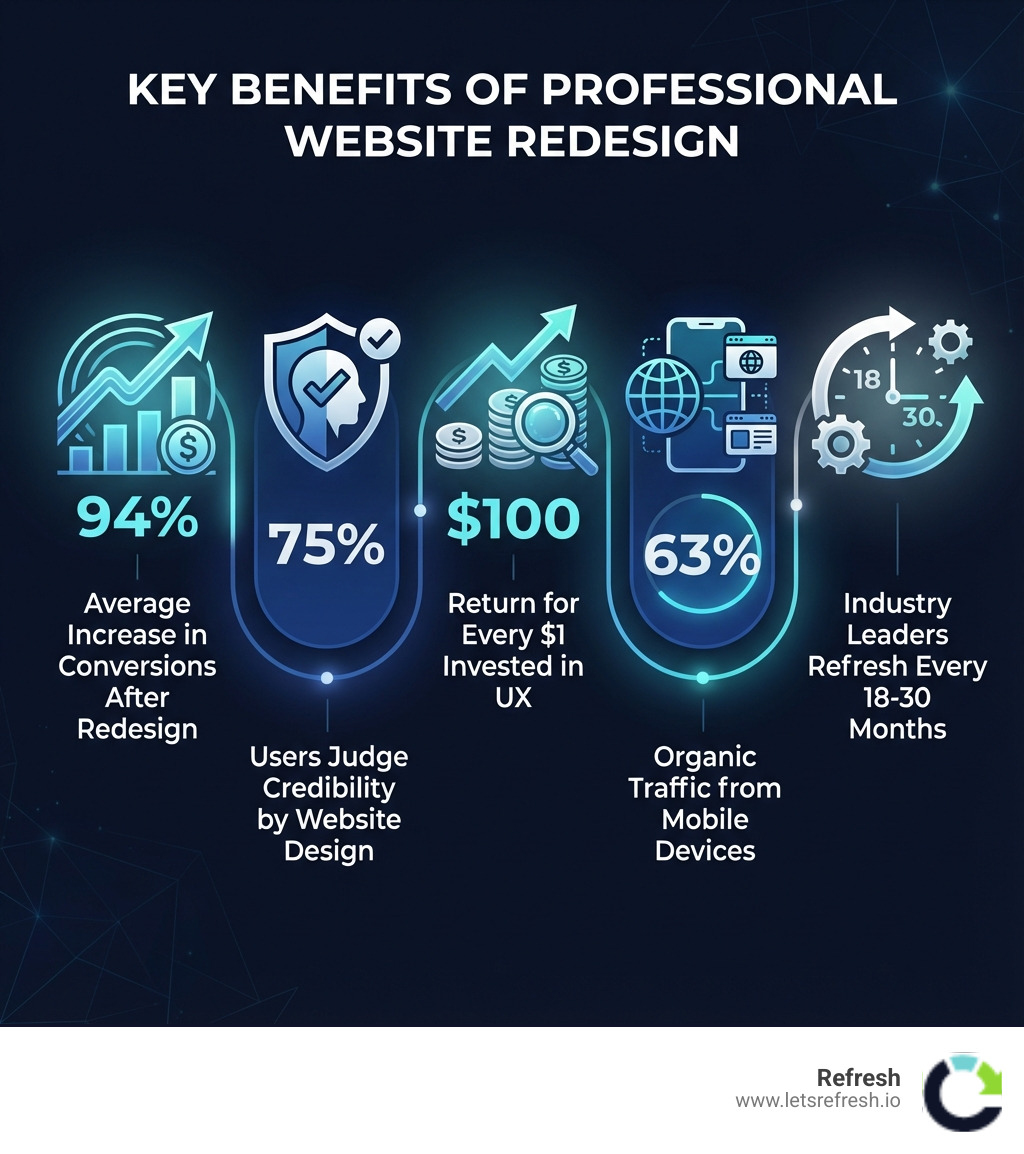
Your website is often the first impression potential customers have of your business. Research shows that 75% of users judge a company’s credibility based on its website design. Even more concerning, 42% of users leave a website due to poor functionality, and 88% will leave if it takes too long to load. These statistics underscore why selecting the right redesign partner isn't just about aesthetics—it's about creating a strategic asset that drives real business growth.
A website redesign done right can dramatically improve your conversion rates, strengthen your brand identity, and improve user experience across all devices. With 63% of organic search traffic now coming from mobile devices, your site needs to work flawlessly everywhere. The good news? Every dollar invested in user experience returns an average of $100—that's a 9,900% ROI.
As Alexander Palmiere, Founder and CEO of Refresh Digital Strategy, I've led over 200 successful website development and redesign projects for small to medium-sized businesses, specializing in identifying the best website redesign services that align with each company's unique growth goals. This guide will walk you through exactly how to evaluate and choose the perfect redesign partner for your business.
Find more about best website redesign services:
Why a Website Redesign is Your Next Big Growth Lever

A strategic website redesign is more than a fresh coat of paint; it's a powerful lever for business growth. Investing in user experience (UX) is one of the smartest decisions you can make, as for every $1 invested in UX, there’s a remarkable return of $100 on average. A redesign builds a digital asset that works tirelessly for your business, attracting new visitors and converting them into loyal customers.
When Is It Time for a Redesign?
Knowing when to refresh your digital storefront is crucial. Industry leaders typically redesign their websites every 18 to 30 months to keep up with the evolving digital landscape. If you notice the following signs, it might be time for a professional website redesign:
- Outdated design: An old-fashioned site erodes trust. Since 75% of users judge a company’s credibility based on its website design, your site must make a strong first impression.
- High bounce rates: If visitors leave immediately, it signals a poor user experience. 42% of users leave a website due to poor functionality, meaning your site isn't meeting their expectations.
- Poor mobile performance: A non-responsive site alienates a significant portion of your audience. With mobile browsing on the rise, your site must be optimized for every screen, as 73% of people will exit a non-responsive website.
- Not generating leads: If your website isn't attracting new business or converting visitors, it’s not fulfilling its potential as a lead-generation tool.
- Company rebranding: As your brand evolves, your website must follow. A redesign ensures your online presence reflects your current identity, which is essential for boosting brand trust.
- Slow page load speed: Online users are impatient. More than 88% will leave a slow-loading site, making speed paramount for user satisfaction and SEO.
- Difficult navigation: Cluttered navigation or a poor content structure deters engagement. If users can't easily find what they're looking for, they'll go elsewhere.
88% of users are less likely to return after a poor website experience. Don't let an underperforming website be the reason potential customers look past your business.
The Core Benefits for Your Business
A thoughtfully executed website redesign offers numerous advantages:
- Improved UX and conversions: A user-centered design eliminates friction points like slow loading times or poor navigation, leading to a significant uplift in conversions. On average, clients see a 94% increase in conversions after a redesign.
- Improved brand perception: A modern, professional design builds credibility and trust. A redesign strengthens your branding by updating your visual identity to align with your market position.
- Increased mobile traffic: With 63% of organic search traffic coming from mobile devices, a responsive design is essential. A mobile-friendly site encourages purchases and repeat visits.
- Better SEO rankings: A redesign allows for optimizing your site's technical foundation, content, and UX—all critical factors for higher Google rankings and increased organic traffic.
- Higher lead generation: By creating smoother user pathways and clear calls-to-action (CTAs), a redesigned website becomes an effective lead generation tool that works 24/7.
Learn more about the transformative power of a website redesign for small businesses and building a strong brand identity.
How to Choose the Best Website Redesign Services for Your Business

Choosing the right partner is a critical decision. You need a strategic partner who understands your business goals and can translate them into a high-performing digital asset. This involves reviewing portfolios, scrutinizing client feedback, and understanding their process and pricing. For businesses in Pittsburgh, Cleveland, and Charlotte, our approach delivers custom solutions that resonate with your local market.
1. Evaluate Their Portfolio and Expertise
An agency's portfolio is the most telling indicator of their capabilities.
- Proven track record: Look for case studies demonstrating clear results, such as increased conversions, improved SEO, or better user engagement.
- Industry specialization: An agency with experience in your industry (e.g., B2B, B2C, e-commerce) will better understand your audience and challenges.
- Design aesthetic: Review their past work to see if their design style—whether innovative, creative, or minimalist—aligns with your brand vision.
- Technical capabilities: Ensure they have expertise in responsive design, custom web applications, and adherence to web standards like those from the World Wide Web Consortium (W3C).
At Refresh, we partner with small to medium-sized businesses, offering the strategic insight and technical expertise to build a powerful engine for growth. See Webflow project examples for inspiration.
2. Check Reviews and Client Testimonials
Client feedback offers invaluable insights into an agency's reliability and quality.
- Credibility and client satisfaction: Seek verified feedback on platforms like Clutch or Google Reviews. High ratings and positive comments are strong indicators.
- Communication style: Reviews can reveal how an agency manages expectations, provides updates, and handles feedback. You want a collaborative partner.
- Case studies: Detailed case studies provide a narrative of how an agency solves challenges and achieves measurable results.
3. Understand Their Process and Communication
A transparent, well-defined process is the backbone of a successful redesign.
- Strategic approach: A top agency begins with a findy phase, delving into your business goals, target audience, and competitive landscape by analyzing user behavior and website analytics.
- Collaborative process: You should be involved at every step. Look for agencies that encourage collaboration and feedback to keep the project aligned with your vision.
- Project management: Inquire about their project management tools. Clear timelines, regular updates, and dedicated project managers are essential for staying on track and on budget.
- Post-launch support: The best partners offer ongoing support, maintenance, and optimization, including team training and performance monitoring.
At Refresh, we pride ourselves on a structured, data-driven approach. Explore Webflow expert support.
4. Discuss Costs and Budgeting
Website redesign costs vary widely, so it's crucial to understand the investment.
- Transparent pricing: Reputable agencies provide detailed proposals with all costs upfront, avoiding hidden fees.
- Project-based vs. retainer models: Consider whether a one-time project fee or an ongoing retainer for support and optimization best suits your needs.
- Website redesign costs: A professional responsive redesign for a small business might range from $2,000 to $9,000, while more complex sites can exceed that.
- Budgeting tips: Focus on the value and potential ROI. A higher upfront investment in a quality redesign can yield greater returns in leads, conversions, and brand equity.
Consider a strategic website redesign an investment, not an expense. The ROI from improved UX, higher conversions, and better SEO can quickly outweigh the initial cost. See affordable small business SEO packages.
Key Components of a High-Impact Website Redesign
A successful website redesign is a strategic overhaul focused on creating a high-performing digital asset. This means incorporating mobile-first design, seamless SEO integration, a robust Content Management System (CMS), and data-driven user journeys.
Website Redesign Services for SEO
Losing SEO rankings is a common fear during a redesign, but with the right partner, a redesign can improve your search visibility. The best website redesign services embed SEO from the start.
- SEO integration: SEO is a foundational element, with keyword research, content optimization, and technical best practices incorporated from the start.
- 301 redirects: Old URLs must be mapped to new ones using 301 redirects to preserve link equity and prevent broken pages.
- On-page optimization: New pages are optimized with relevant meta titles, descriptions, header tags, image alt text, and internal linking.
- Technical SEO audit: A pre-launch audit identifies and resolves technical issues like slow site speed, crawlability, and mobile-friendliness.
- Keyword strategy: Your keyword strategy is revisited to target relevant, high-value search terms for your business in Pittsburgh, Cleveland, or Charlotte.
- Content migration: Existing content is migrated correctly, avoiding duplication and ensuring it remains SEO-friendly.
Learn why SEO is important in a digital marketing strategy.
Choosing the Right CMS: Why We Recommend Webflow
The Content Management System (CMS) is the backbone of your website. While platforms like WordPress are popular, we at Refresh often recommend Webflow for its unparalleled advantages for small to medium-sized businesses.
- Design flexibility: Webflow allows for truly custom designs without code limitations, perfectly reflecting your brand and standing out from templates.
- Security: Webflow is inherently more secure, as it doesn't rely on vulnerable plugins, giving you peace of mind.
- Performance: Built for speed, Webflow's clean code and efficient hosting lead to fast load times, which is crucial for UX and SEO since more than 88% of users will leave a slow site.
- Seamless hosting: Webflow includes robust, global hosting optimized for performance and reliability, simplifying website management.
Why Webflow is the preferred choice for your business lies in its ability to deliver modern, high-performance websites that are easy for clients to manage. Learn more about Webflow hosting.
Essential Services to Look For
When evaluating the best website redesign services, ensure the agency offers a comprehensive suite of solutions:
- UX/UI design: Creating an intuitive user experience (UX) and an aesthetically pleasing interface (UI) through wireframing, prototyping, and user testing. See Webflow UX design.
- Responsive development: Ensuring optimal display and compatibility across all devices, which is non-negotiable in a mobile-first world.
- Content strategy: Auditing existing content, refining messaging, and creating new, SEO-optimized content that resonates with your audience.
- SEO optimization: Integrating technical SEO, on-page optimization, and keyword strategy to boost visibility.
- Conversion rate optimization (CRO): Optimizing site elements to encourage desired actions, like form submissions or purchases.
- Brand strategy: Aligning the redesign with your brand identity, messaging, and market position to strengthen trust.
- Post-launch maintenance: Providing ongoing support, security updates, and performance monitoring to keep your site effective.
The Professional Redesign Process and Measuring Success
A professional website redesign isn't a chaotic sprint; it's a carefully orchestrated process designed to deliver maximum impact. We follow a structured approach to ensure every detail is carefully handled, from initial strategy to post-launch optimization.
| Stage | Description | Key Deliverables |
|---|---|---|
| 1. Findy & Strategy | Research, goal setting, and planning | Project brief, timeline |
| 2. UX/UI Design | Wireframes, mockups, and design concepts | Design prototypes |
| 3. Content Creation | Copywriting, imagery, and asset development | Finalized content |
| 4. Development | Coding and CMS integration | Staging website |
| 5. Testing & Launch | QA, bug fixes, and go-live | Live website |
| 6. Post-Launch Analysis | Performance tracking and optimization | Analytics report |
The Step-by-Step Redesign Journey
Our journey together through a website redesign typically unfolds in these key stages:
- Findy and Planning: This is where we lay the groundwork. We dig deep into your business goals, target audience, and current website performance. We'll analyze existing data from tools like Google Analytics and Hotjar to understand user behavior, identify pain points, and define clear objectives for the redesign. This stage also includes competitive analysis and outlining the project scope and timeline.
- Wireframing and Mockups: Before any coding begins, we create wireframes (skeletal blueprints) and mockups (visual representations) of key pages. This allows us to establish the site's structure, layout, and visual aesthetic, ensuring it aligns with your brand and user experience goals. We'll collaborate closely with you to refine these designs.
- Development and Coding: Once designs are approved, our developers bring them to life. This involves writing clean, efficient code, integrating your chosen CMS (like Webflow), and ensuring the site adheres to modern web standards, including W3C guidelines.
- Content Implementation: We integrate all new and optimized content, including text, images, videos, and other media, ensuring it's strategically placed for both user engagement and SEO.
- Quality Assurance Testing: Before launch, the website undergoes rigorous testing. We check for functionality across all devices and browsers, test page load speeds, ensure mobile responsiveness, verify all links and forms, and conduct a final SEO audit.
- Launch and Deployment: The big day! We carefully deploy your new website, implementing all necessary 301 redirects and monitoring its initial performance to ensure a smooth transition.
Use this website redesign checklist for a smooth process.
How to Measure the ROI of Your New Website
The success of a website redesign isn't just about how it looks; it's about the tangible results it delivers for your business. We believe in data-driven decision-making and clear measurement of success.
- Key performance indicators (KPIs): We establish specific KPIs at the outset, such as increased website traffic, higher conversion rates, reduced bounce rates, longer average session duration, and improved lead quality.
- Google Analytics: This free, powerful tool is indispensable for tracking your website's performance. We use it to monitor user behavior, traffic sources, goal completions, and much more.
- Conversion rate: A primary measure of success. We look for an increase in desired actions, whether that's sales for an e-commerce site or form submissions for a service-based business. A redesign can lead to an uplift of 94% more conversions.
- Bounce rate: A lower bounce rate indicates that users are finding your site more engaging and relevant. We aim to significantly reduce the number of users who leave due to poor functionality or navigation.
- Page load speed: Faster loading times directly correlate with better user experience and improved SEO. We monitor Core Web Vitals and other speed metrics to ensure your site is performing optimally.
- Search engine rankings: We track keyword rankings and organic search traffic to demonstrate improved visibility and authority in search results.
- Lead quality: Beyond just the quantity of leads, we analyze the quality of inquiries generated by the new site, ensuring they align with your ideal customer profile.
By continuously monitoring these metrics, we can not only measure the success of your redesign but also identify further opportunities for optimization and growth, ensuring you maximize your marketing ROI. See tips for maximizing website performance and maximizing marketing ROI.
Frequently Asked Questions about Website Redesign
How much does a website redesign cost?
The cost of a website redesign can vary significantly based on the project's scope, complexity, and the agency you choose. For small to medium-sized businesses, a professional responsive website redesign might typically range from a few thousand dollars to upwards of $20,000 or more for comprehensive, custom solutions. Factors influencing cost include the number of pages, custom functionalities (e.g., e-commerce, integrations), content creation needs, and the level of strategic planning involved. It's crucial to focus on the value and potential return on investment (ROI) rather than just the initial price, as a well-executed redesign can yield substantial long-term benefits.
How long does a website redesign take?
The timeline for a website redesign project depends heavily on its size and complexity. A smaller business website redesign, focusing on a few key pages and a visual refresh, might take 8–16 weeks from findy to launch. Larger, more intricate projects involving extensive content migration, custom development, and complex integrations could take 6 months or even longer. Clear communication, timely feedback from your team, and preparedness with content and assets can significantly help keep the project on schedule.
Will I lose my SEO rankings after a redesign?
This is a common and valid concern, but if handled by experienced professionals, the answer is no—you shouldn't lose your SEO rankings. In fact, a strategic redesign often leads to improved rankings. A reputable service will implement a thorough SEO migration plan, which includes essential steps like:
- 301 redirects: Properly redirecting old URLs to new ones to preserve link equity and prevent broken links.
- Content optimization: Ensuring all new content is SEO-friendly and targets relevant keywords.
- Technical SEO: Improving site speed, mobile-friendliness, and crawlability.
- Schema markup: Implementing structured data to help search engines better understand your content.
By integrating SEO best practices throughout the redesign process, we work to not only retain your existing rankings but also to improve your overall search engine visibility and performance.
Conclusion: Refresh Your Digital Presence for Growth
In today's digital world, your website is your most valuable asset. It's your 24/7 sales assistant, your brand's first impression, and a critical tool for generating leads and driving conversions. A strategic website redesign is not just an update; it's a vital investment in your business’s future, ensuring you remain competitive, relevant, and ready for growth. By partnering with the right team, you can transform your online presence into a powerful, future-proof platform that delivers measurable results.
As a Webflow development company, Refresh specializes in crafting high-performance, user-centric websites for small to medium-sized businesses in Pittsburgh, Cleveland, and Charlotte. We combine strategic thinking, cutting-edge design, and robust development to deliver best website redesign services that align with your unique goals and propel your business forward.
Ready to transform your online presence and open up new opportunities for growth? Let's build your new website together.


.avif)