

Is Your Website Sending the Wrong Message?
A branding refresh for websites is the process of updating your site's visual identity, messaging, and user experience — without scrapping your brand from scratch.
Here's what it typically involves:
| Element | What Changes |
|---|---|
| Visual identity | Colors, typography, logo refinements |
| Messaging | Brand voice, headlines, value proposition |
| UX and layout | Navigation, page structure, accessibility |
| Content | Updated copy, imagery, and page architecture |
| Technical foundation | Performance, SEO, analytics setup |
The short answer: If your website looks or sounds like a different company than the one you run today, it's time for a refresh.
Most businesses hit this wall between years three and five. Your product has evolved. Your audience has shifted. But your website still tells the old story. The result? Prospects land on your site and can't figure out what you do — or why they should care.
That disconnect is more costly than it looks. A blunt piece of feedback from a prospect engineer sums it up well: "This reads like every other AI startup. I can't tell what you do." That kind of confusion kills deals before a conversation even starts.
A well-executed brand refresh fixes this — without the cost, risk, or downtime of a full rebrand.
I'm Alexander Palmiere, Founder and CEO of Refresh Digital Strategy, and I've led branding refreshes for websites across more than 200 projects for growth-stage businesses. In this guide, I'll walk you through exactly how to plan and execute one that protects your brand equity while moving your business forward.
Brand Refresh vs. Rebrand: Preserving Equity While Modernizing
Understanding the difference between a brand refresh and a complete rebrand is the first step toward making a smart investment in your digital presence. While both initiatives improve how your business shows up online, they operate on completely different scales and answer distinct strategic needs.
Think of a brand refresh like giving your website a comprehensive spa day and tailored outfit, whereas a full rebrand is like going in for major reconstructive surgery. A refresh modernizes existing assets, sharpens messaging, and cleans up digital user journeys while maintaining established audience recognition. A complete rebrand, by contrast, throws out the existing foundation to redefine your company name, core mission, underlying positioning, and overall market identity.
| Feature / Dimension | Website Brand Refresh | Complete Rebrand |
|---|---|---|
| Core Objective | Modernize visuals, align copy, and refine user experience | Build a totally new market identity and positioning |
| Brand Equity | Preserves and builds upon built-up equity | Resets recognition; establishes new brand perception |
| Scope of Work | Palette tweaks, typography consolidation, UI/UX polish | Name changes, mission overhaul, full identity replacement |
| Timeline | Typically 6 to 12 weeks | 6 months to 1+ year |
| Risk Level | Low to moderate (preserves SEO and existing recognition) | Higher (requires complete domain/brand migration) |
| Ideal Trigger | Visual aging, minor pivot, scale-up, or messaging drift | M&A, fundamental business pivot, severe brand crisis |
Defining the Refresh Approach
A branding refresh for websites falls along a spectrum ranging from cosmetic polish to a strategic overhaul. A purely cosmetic update involves surface-level tweaks like shifting hex codes, selecting a cleaner secondary font, or replacing stock illustrations with updated graphics. While cosmetic updates make a site look prettier, they rarely drive meaningful business results on their own.
A strategic refresh goes much deeper. It starts by auditing whether your current website accurately reflects who you serve, what problems you solve, and where your business is heading over the next three to five years. Strategic refreshes adjust narrative structures, optimize user journeys, and align visual signals directly with modern Generative Engine Optimization (GEO) standards and conversion rate goals. When working with a specialized Website Rebranding Agency, you establish clear baseline metrics so that every visual adjustment serves a clear commercial purpose.
Balancing Brand Equity and Evolution
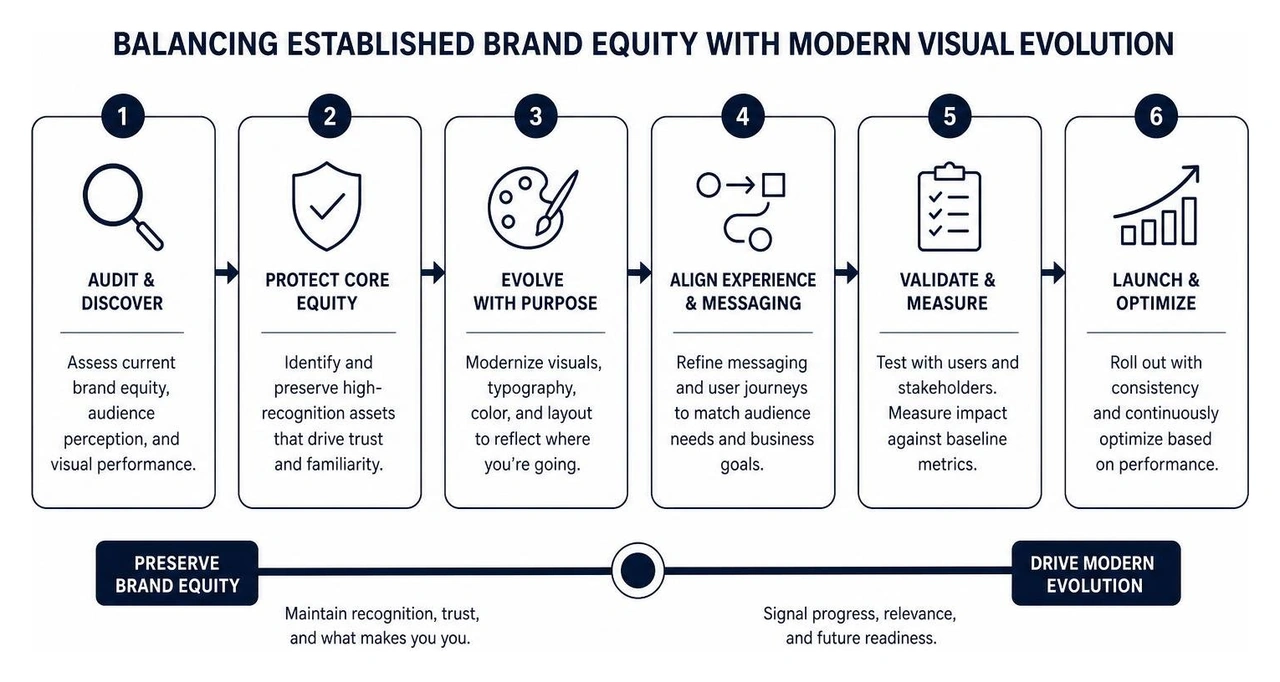
The biggest challenge in updating a digital identity is balancing brand equity with visual evolution. You want your existing customers to instantly recognize you, while simultaneously signaling to new prospects that your business is modern, competitive, and forward-thinking.
A prime real-world example of this balance in action is the global second-hand marketplace Vinted. During the Vinted Brand Identity Refresh, the company preserved its signature handwritten logo to protect massive audience recognition across 20+ international markets. However, they completely evolved surrounding identity elements: darkening base colors to stand out from visual copycats, introducing custom typefaces to replace generic system fonts, and adding tactile ribbon motifs to guide user navigation.
When you preserve high-equity assets—like an iconic mark or signature visual tone—you maintain customer trust while unlocking modern design flexibility.
Core Elements of a Branding Refresh for Websites
Executing a successful branding refresh for websites requires bringing three distinct disciplines together into a cohesive digital system: visual design, strategic copy, and technical user experience.
Signs Your Business Needs a Branding Refresh for Websites
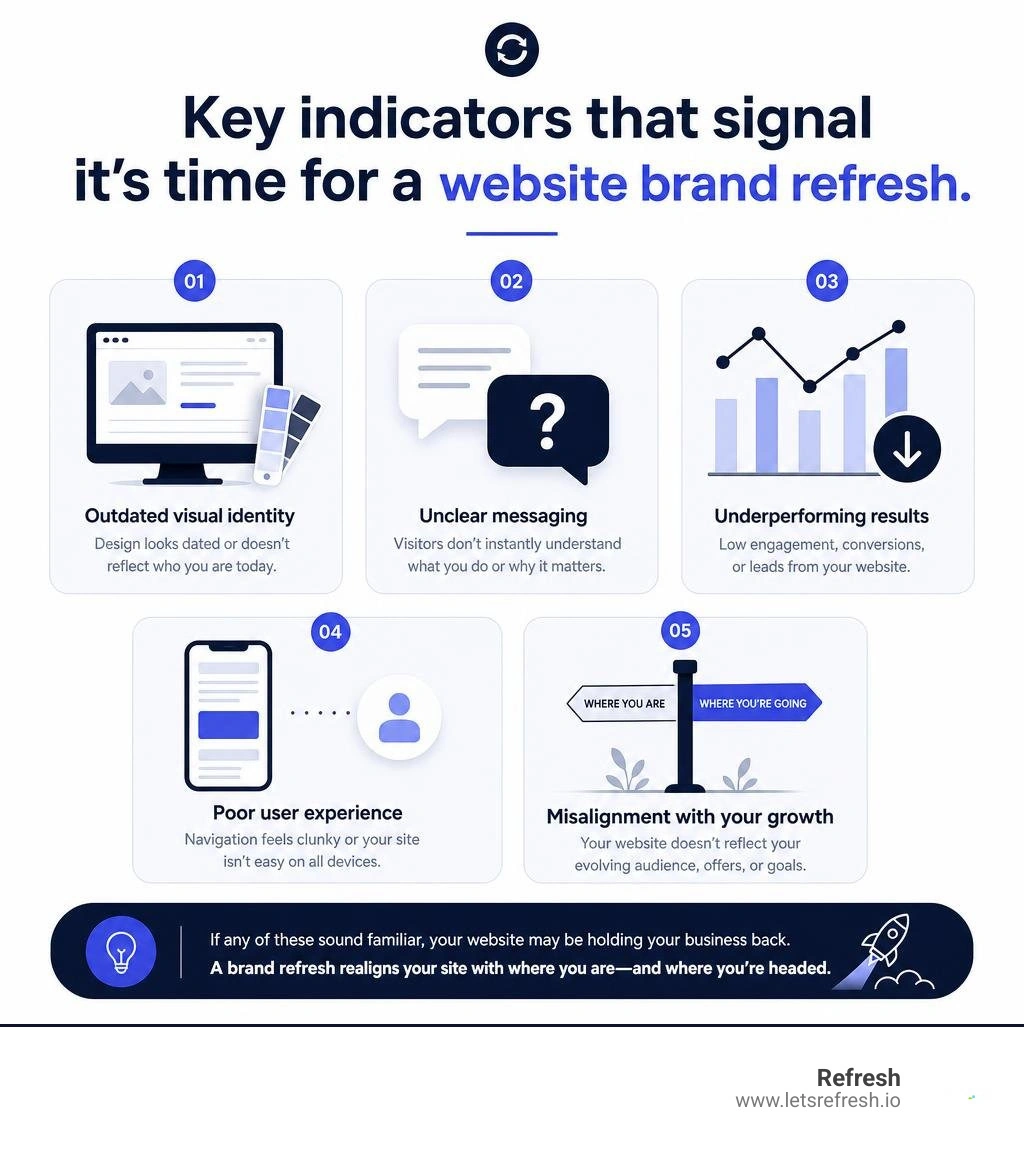
How do you know when your site is due for an upgrade? In our work with growing businesses across Pittsburgh, PA, Cleveland, OH, and Charlotte, NC, we typically see four clear warning signs:
- Visual Outdating and Competitor Homogeneity: Your site relies on design patterns from five years ago (like flat vector illustrations or cluttered accordions) and looks indistinguishable from every competitor in your space.
- Audience Shift and Positioning Drift: You have moved upstream to serve larger enterprise clients, but your digital messaging still speaks to early-stage buyers or local niche segments.
- Declining Engagement and High Bounce Rates: Visitors land on your homepage but exit within seconds because copy lacks visual hierarchy and fails the 5-second clarity test.
- Content Strategy and Structural Debt: You have added dozens of new products, landing pages, or service offerings over time, creating a disjointed navigational maze.
If your team is experiencing these friction points, reviewing a comprehensive guide to B2B Website Redesign strategy will help clarify where your current architecture falls short.
Visual Identity and Messaging Alignment
Visual identity and tone of voice must work in lockstep. A sleek, high-end website layout paired with wordy, jargon-heavy copy creates an immediate psychological disconnect for prospects.
During a website refresh, visual systems should be consolidated. Prune redundant color palettes down to a core monochromatic or grounded base with a single high-contrast accent color to guide user focus toward primary calls to action. Clean up chaotic typography by consolidating down to one or two high-legibility font families with clear typographic clamp scales. For detailed rules on refining core marks and vector guidelines, check out our Company Branding Logo Guide 2026.
UX, Accessibility, and Content Strategy
A fresh coat of paint will not save a website if users cannot navigate it or read its content. User experience (UX), web content accessibility, and content pruning form the structural backbone of every modern web project.
A compelling example of balancing legacy authority with modern usability is seen in the Bon Appétit Website Redesign Case Study. Operating over 1,000 locations nationwide, the company overhauled its 20-year-old digital presence by replacing outdated stock photos with authentic photography, streamlining mobile navigation, and achieving WCAG Level A accessibility compliance—establishing a data-backed foundation for ongoing growth.
Key UX and content updates to prioritize during a refresh include:
- Pruning and Rewriting Copy: Strip pages down to core value propositions. Replace generic claims with verifiable proof points, metric-driven customer tables, and clear outcome-based messaging.
- WCAG Accessibility Compliance: Ensure contrast ratios between text and background elements meet strict WCAG 2.2 accessibility thresholds.
- Streamlined Page Architecture: Eliminate hidden sub-menus and replace low-performing accordions with intuitive grid structures or drawer-based components that let users browse effortlessly across all screen sizes.
Executing a Branding Refresh for Websites: Step-by-Step
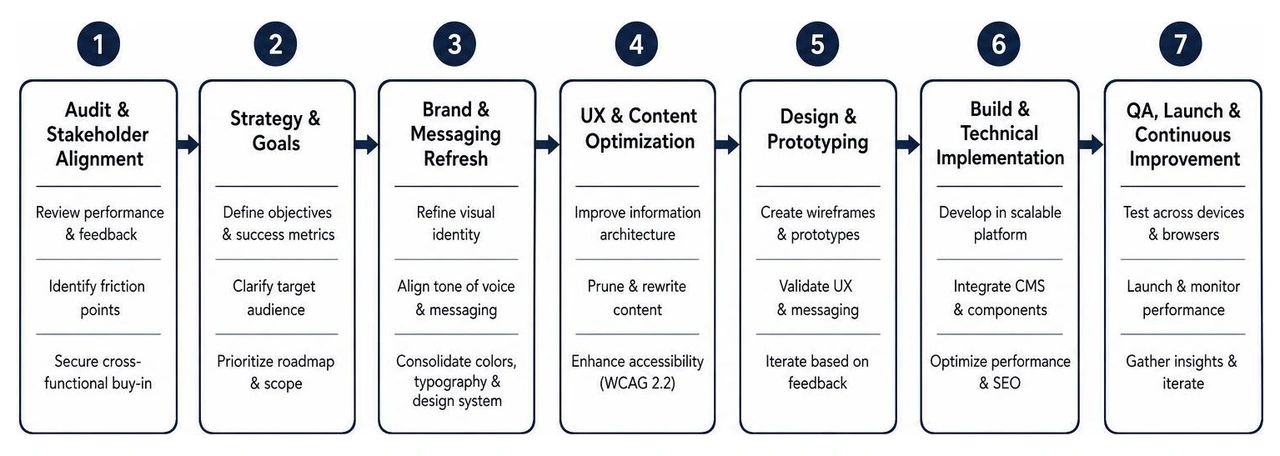
A seamless website refresh relies on a structured, iterative process. Rushing straight into visual design without strategic alignment leads to scope creep, internal friction, and delayed launches.
Strategic Audit and Stakeholder Buy-In
Every successful project begins with strategic alignment. Before opening a design canvas, conduct a thorough content and brand audit. Evaluate top-performing pages, review heatmaps, and analyze prospect feedback to isolate exact friction points.
Gathering cross-functional stakeholder buy-in early prevents last-minute roadblocks. Involve leadership, sales, and customer success teams to capture real prospect objections. When major tech platforms undertake updates—such as outlined when Stripe Spent a Year Redesigning Its Homepage—they evaluate homepage components not as static landing pages, but as dynamic brand manifestos that must represent the company's long-term product trajectory.
Technical Migration in a Branding Refresh for Websites
The technical foundation you choose determines how easily your team can manage and scale your updated website. At Refresh, Webflow is our preferred platform for web design and development. Webflow combines custom, clean front-end code with powerful visual CMS capabilities, enabling fast site speeds, seamless animations, and effortless client editing without developer intervention.

When migrating design systems or publishing refreshed page layouts, protecting your existing search engine visibility is critical:
- 301 Redirect Mapping: Map every legacy URL to its corresponding updated page location to preserve link equity.
- SEO Preservation: Retain high-performing page titles, meta descriptions, and structural H1/H2 tags during copy rewrites.
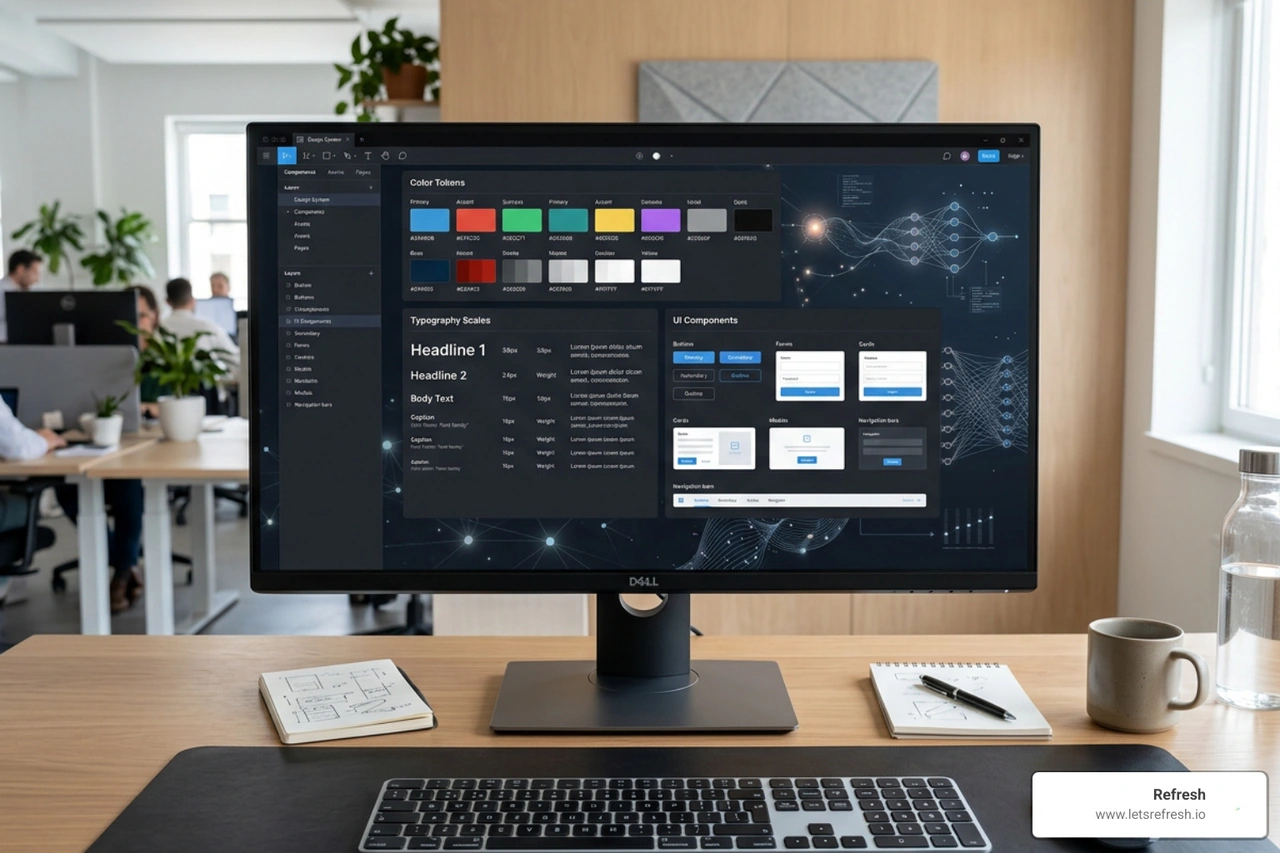
- Design Systems in Webflow: Build scalable class structures and global component libraries (buttons, form inputs, footers) to simplify future content updates.
To explore how custom development frameworks elevate your web presence, review our specialized guides on Custom Webflow Design and Webflow Ux Design.
Measuring ROI and Avoiding Refresh Pitfalls
A branding refresh for websites is an investment that should generate measurable commercial returns, including increased organic traffic, higher conversion rates, and faster sales cycles.
Key Metrics and Performance Indicators
To accurately evaluate the return on investment (ROI) of your website refresh, establish baseline performance metrics prior to launch and track them consistently post-launch:
- Conversion Rate (CR): The percentage of site visitors who complete a key goal (form submission, demo booking, or transaction).
- Average Time on Page: Longer engagement times on product pages indicate that updated positioning and typography are successfully capturing visitor attention.
- Bounce Rate and Scroll Depth: Reductions in immediate bounce rates signal that your hero messaging and visual hierarchy pass the initial visitor clarity test.
- Pipeline Speed: Clearer messaging educates buyers faster, reducing sales call friction and speeding up contract sign-offs.
For a deeper dive into aligning organic search visibility with broader growth goals, explore our overview on Digital Strategy Seo.
Pitfalls to Avoid During Execution
Even seasoned marketing teams can encounter stumbling blocks during a digital update. As highlighted in the FutureAGI Redesign Case Study, software platforms often face messaging disconnects when they look and sound identical to category competitors. During their four-month redesign, the team prunned redundant visual tokens, replaced generic testimonial walls with sortable proof tables, and reworked copy to clearly communicate value to executive decision-makers.
Avoid these common implementation mistakes:
- Rushing Launch Timelines: Delaying launch slightly to perfect UI animations and component responsiveness is far better than shipping a compromised user experience that harms brand equity for years.
- Ignoring Technical SEO: Updating page structures without setting up 301 redirects or updated XML sitemaps can cause sudden drops in organic search rankings.
- Designing for Internal Trends Instead of Users: Avoid chasing fleeting aesthetic trends that sacrifice text legibility, site speed, or logical navigation.
Frequently Asked Questions About Website Brand Refreshes
How long does a website brand refresh usually take?
A typical strategic branding refresh for websites takes between 6 and 12 weeks from initial discovery to final launch. This timeline accounts for baseline audits, stakeholder alignment, messaging development, Webflow engineering, SEO redirect setup, and rigorous cross-browser testing.
Will a website brand refresh affect my SEO rankings?
When managed correctly, a brand refresh will preserve or enhance your organic search rankings. By maintaining URL structures, executing proper 301 redirects, improving mobile responsiveness, and optimizing page load speeds, you send positive quality signals to search engines.
What is the average ROI of updating a website brand?
While ROI varies by industry, companies that align their website messaging and design with customer needs frequently experience significant commercial growth. For instance, global marketplace Vinted achieved a 36% revenue increase in 2024 compared to 2023, alongside a 330% year-on-year surge in net profit following their comprehensive brand identity refresh.
Conclusion
Your website is often the very first touchpoint a prospective customer has with your business. If your site reflects who your company was three years ago rather than who you are today, you are leaving pipeline and revenue on the table.
A strategic branding refresh for websites bridges this gap. By preserving your hard-won brand equity while modernizing your visual identity, copy narrative, and Webflow user experience, you create an authoritative digital platform built for sustainable business growth.
Ready to elevate your online presence with an expert Webflow design partner? Contact Refresh Digital Agency today to discuss how we can transform your website into your most effective sales driver.


.avif)