

What Growing Teams Need From Website Support
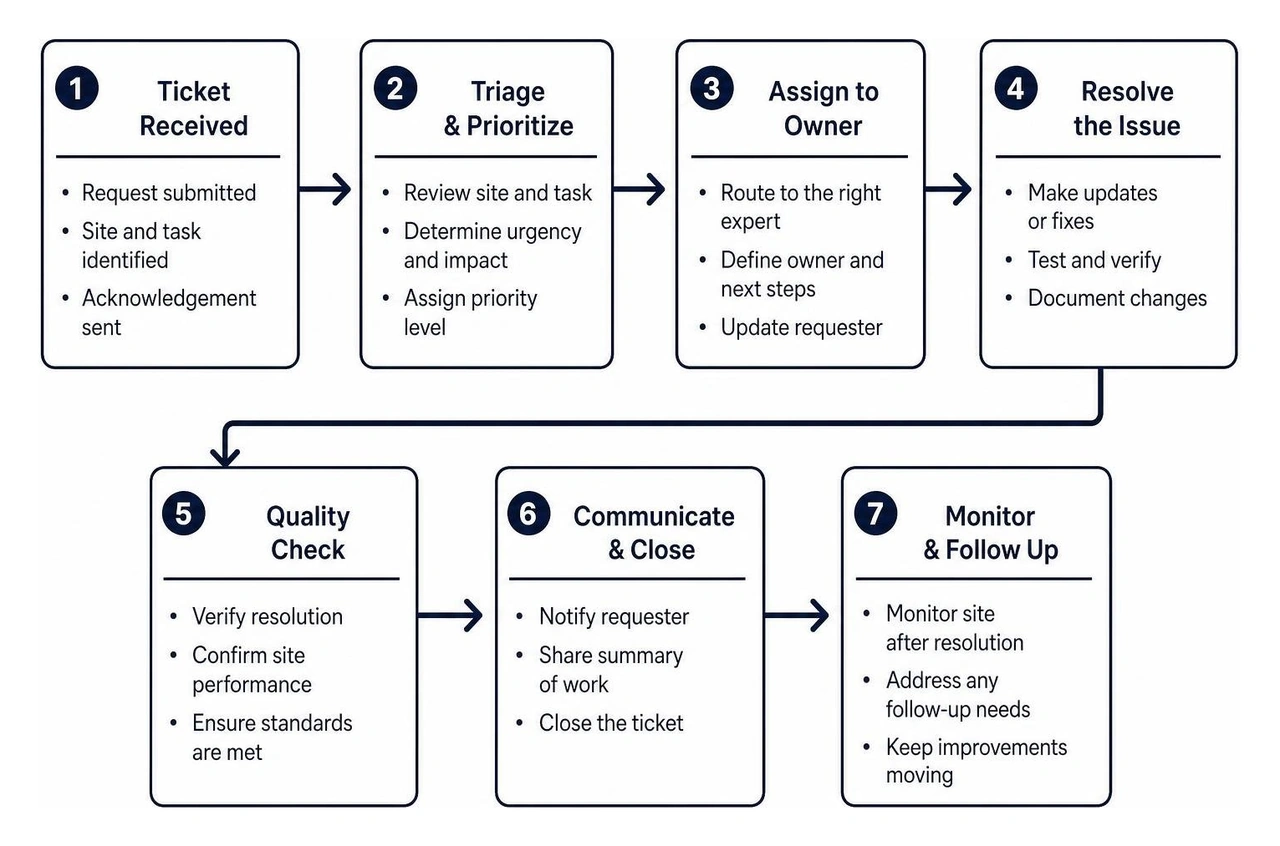
Medium business website support should cover routine updates, security checks, backups, performance, and a clear plan for urgent issues. When outsourcing, choose a provider that defines which sites and tasks it covers, who owns each request, and how quickly it responds. For a growing team, support should also keep content and SEO work moving without pulling staff away from their main jobs.
I'm Alexander Palmiere, founder and CEO of Refresh, where medium business website support is part of helping growing teams improve their Webflow sites and digital strategy. Refresh has launched over 200 websites; the list ahead will help you compare support options and choose a plan that can grow with your business.
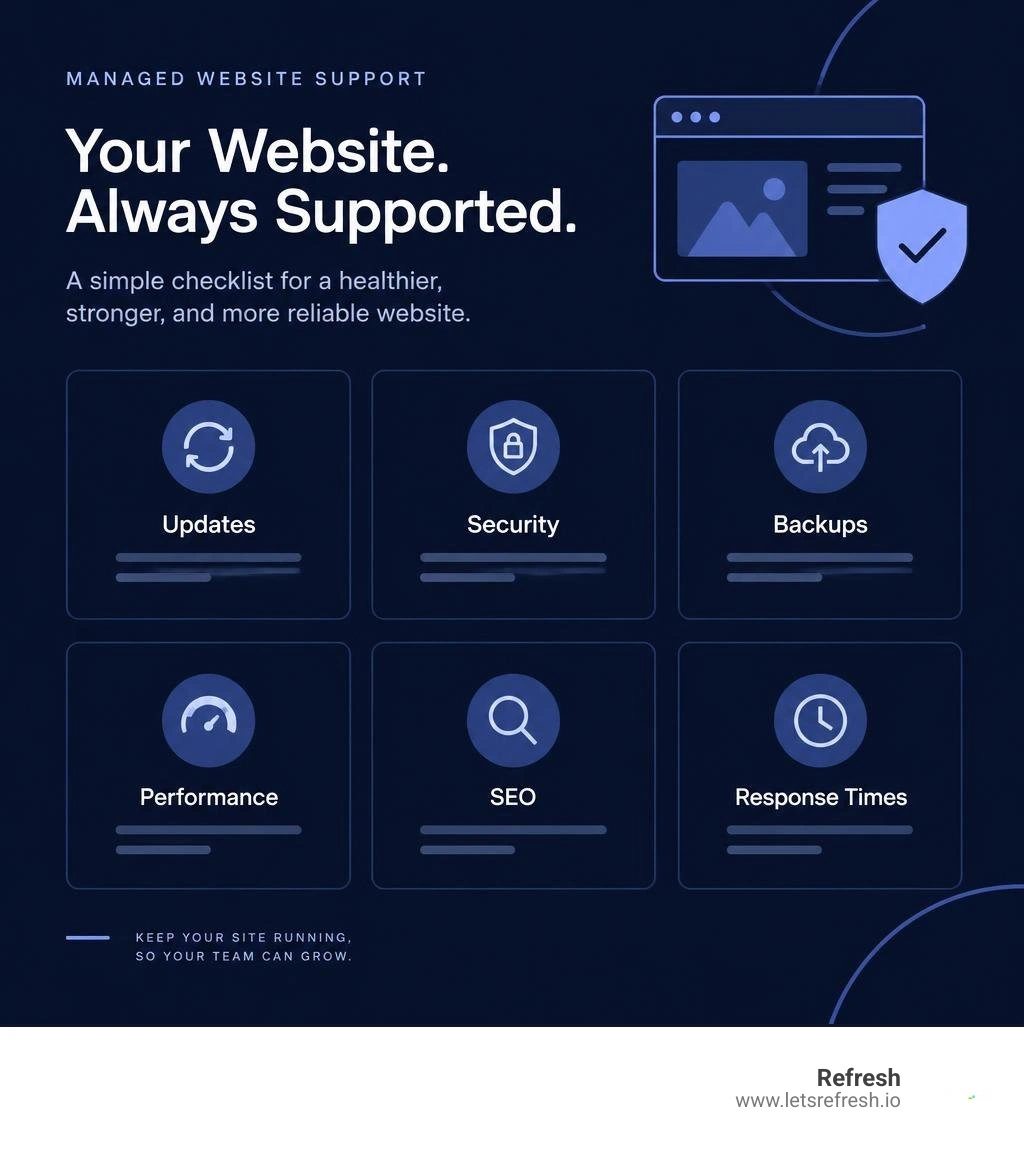
Medium business website support terms simplified:
Core Models for Medium Business Website Support
Mid-market organizations experience a distinct operational challenge: your digital footprint expands rapidly, but hiring a full-scale internal technical department to manage every minor site adjustment creates significant overhead. Scaling operations requires dependable website support services that handle technical debt, visual integrity, and server stability without pulling internal marketing leaders away from core revenue-generating initiatives.
Choosing the correct operational model determines how smoothly your marketing campaigns launch, how secure your customer data remains, and how effectively your infrastructure scales across multiple regional hubs, whether your team operates in Pittsburgh, PA, Cleveland, OH, or Charlotte, NC.
Comparing In-House Teams, Freelancers, and Agency Retainers
Evaluating resource models requires balancing cost predictability, broad skill availability, and overall operational risk.
| Model | Average Annual Cost | Skill Availability & Scope | Availability & Turnaround Risks | Strategic Alignment |
|---|---|---|---|---|
| In-House Developer | $90,000 – $130,000+ (plus benefits & taxes) | Deep knowledge of internal systems, but often limited to a single developer skillset (front-end or back-end). | Single point of failure; vacations, illness, and employee turnover stall workflows. | High daily cultural immersion, but can become isolated from broader industry best practices. |
| Freelancer | $50 – $150 / hour (Ad-hoc billing) | Variable; strong in isolated tasks, but rarely offers comprehensive design, SEO, and advanced infrastructure architecture simultaneously. | High risk of competing priorities; unpredictable turnaround times during emergencies. | Low; usually task-focused rather than focused on long-term commercial goals. |
| Agency Retainer | Predictable monthly retainer tiers | Complete cross-functional team (designers, Webflow engineers, SEO strategists, security specialists). | Guaranteed Service Level Agreements (SLAs), same-day emergency support coverage, and redundant team capacity. | High; consultative partnership focused on continuous business growth and performance tuning. |
Basic Hosting Support vs. Managed Website Retainers
A common misconception among growing businesses is assuming that web hosting support covers complete site maintenance.
- Basic Hosting Support: Standard server providers only guarantee that the physical or virtual server is running. If your database crashes due to a bad script, or a page layout breaks after a template change, standard host support typically directs you to fix your own application-level code. While managed hosting provides essential server-level hardware specs—such as 2 GB RAM, 40 GB NVMe SSD storage, and traffic thresholds up to 75,000 monthly visits—it stops short of hands-on digital asset management. Reviewing our website hosting support complete guide illustrates where server management ends and application care begins.
- Managed Website Retainers: Comprehensive retainers take ownership of the live digital experience. This includes visual styling, custom database collections, third-party software connections, search visibility, conversion flow auditing, and visual quality assurance.
Essential Pillars of Ongoing Website Maintenance
To keep a mid-sized digital asset operating smoothly, ongoing maintenance must address infrastructure, user experience, and search discoverability simultaneously.

Proactive Security, Firewalls, and Disaster Recovery Backups
Mid-market platforms are frequent targets for automated brute-force scripts and malicious attacks. Routine protection requires enterprise-grade standards, including:
- Daily Automated Cloud Backups: Maintaining immutable, off-site restore points so your team can roll back changes instantly in the event of human error or code corruption.
- SSL Certificate Lifecycle Management: Preventing security warning screens and expired encryption handshakes.
- Web Application Firewalls (WAF) & Continuous Scanning: Proactively mitigating DDoS attempts and blocking malicious payloads before they hit your staging or production environments. For broader network resilience standards, teams often reference established IT support standards.
Ongoing Performance Tuning and Technical SEO
Fast-loading websites convert more visitors into qualified pipeline. Performance care requires active optimization:
- Core Web Vitals Monitoring: Continuously analyzing Largest Contentful Paint (LCP), Interaction to Next Paint (INP), and Cumulative Layout Shift (CLS) through ongoing website performance monitoring.
- Generative Engine Optimization (GEO): Structuring site data, schema markup, and authoritative brand entities so AI engines, conversational answer systems, and traditional search crawlers can accurately parse your services.
- Asset Delivery Tuning: Ensuring modern next-gen image compression (such as WebP conversions), caching headers, and clean semantic code distribution.
CMS Updates, Scalable Workflows, and Content Management
Traditional open-source platforms frequently break when plugins conflict or core updates disrupt outdated themes. In contrast, modern teams increasingly build on Webflow to eliminate the endless cycle of patching server vulnerabilities, brittle database tables, and conflicting plugins.
By utilizing visual development environments, marketing teams gain direct control over editorial publishing while preserving strict design systems. Our Webflow maintenance complete guide details how structured collections, global components, and clean CSS architecture streamline regular publishing without engineering friction.
Evaluating Costs and Service Level Agreements
Mid-market support agreements are structured around predictable retainers rather than reactive hourly invoices.
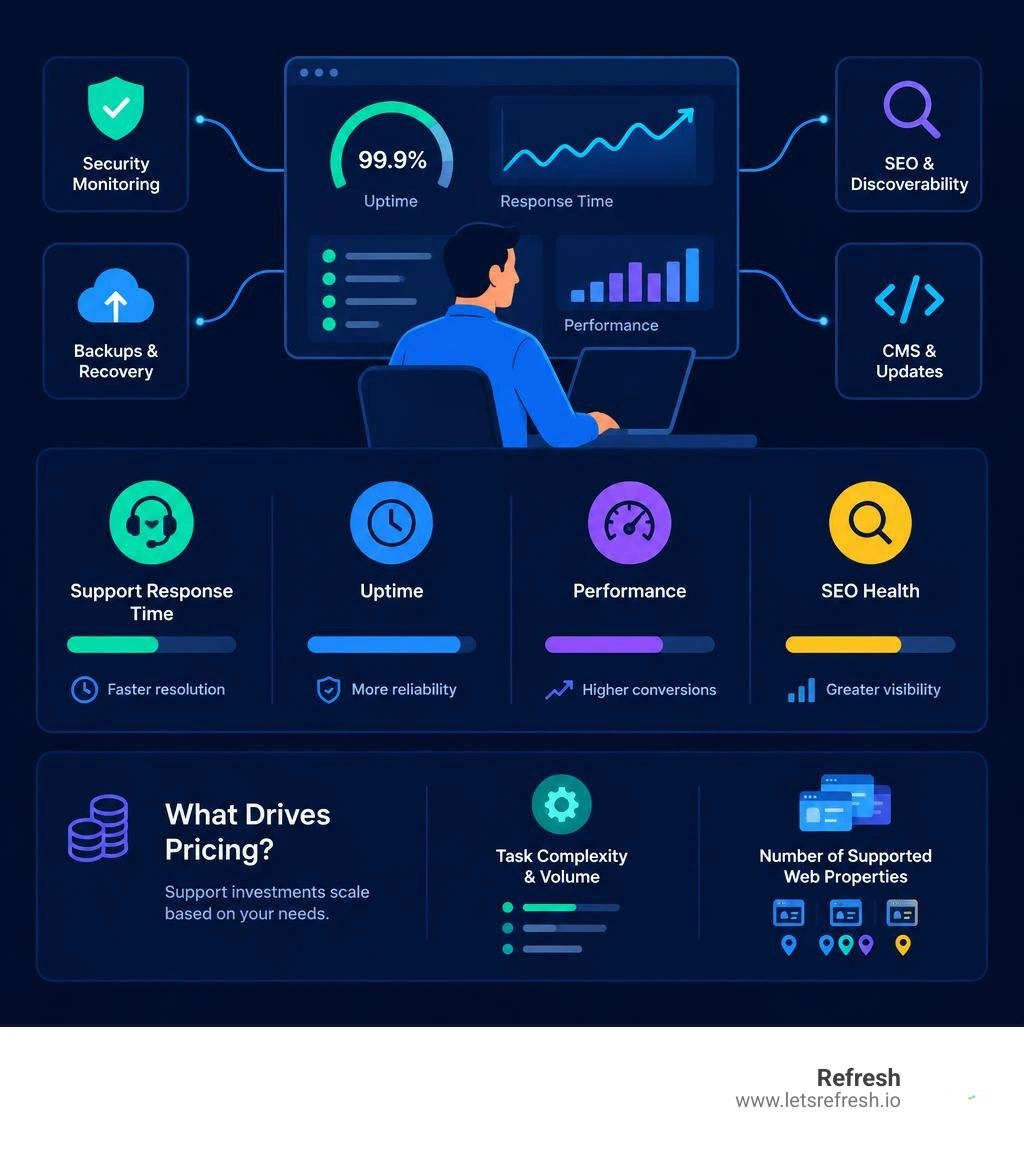
What Drives Pricing in Medium Business Website Support?
Support investments scale based on several operational parameters:
- Task Complexity and Volume: Simple content updates require fewer hours than custom API integrations, webhook automations, or complex e-commerce logic.
- Number of Supported Web Properties: Retainers often cover multi-site ecosystems, such as marketing hubs, localized portals, or regional microsites across Pittsburgh, Cleveland, and Charlotte.
- Turnaround Speed Guarantees: Higher-tier service agreements offer strict SLAs, ensuring priority triage within 2 to 12 hours for routine requests, and immediate intervention for critical incidents.
Emergency Response Times and Downtime Protocols
When an issue affects your site, having documented incident management workflows prevents revenue loss. Effective support plans establish:
- Deterministic Incident Response: Clear priority classifications (P1 Critical Outage vs. P4 Minor Cosmetic Adjustment).
- Staging and Rollback Testing: Every structural update is verified in an isolated staging environment before deployment to production.
- Dedicated Retainer Support: Engaging ongoing Webflow site support ensures your organization has an assigned team of specialists who understand your exact technical architecture when urgent changes are required.
Strategic Growth, Platform Migrations, and Technical Liaisons
As mid-sized companies grow, website support shifts from basic troubleshooting to strategic digital leadership.
Managing Complex Migrations and Webflow Upgrades
Migrating from cumbersome legacy systems to Webflow requires meticulous planning to preserve organic keyword rankings, retain URL redirect equity, and ensure continuous operation.
Our team manages complex technical transitions by following a structured deployment protocol:
- Comprehensive URL Mapping: Documenting every legacy URL to implement 301 redirects and prevent 404 indexing errors.
- SEO & Metadata Auditing: Preserving established title tags, OpenGraph data, heading hierarchies, and structured schema markup.
- DNS and Domain Cutover Coordination: Executing seamless DNS transitions with zero downtime during off-peak hours.
- Cross-Browser & Device Verification: Ensuring responsive visual integrity across modern viewports and operating systems.
- Integration Testing: Verifying CRM connectors, conversion tracking pixels, custom webhooks, and analytics configurations.
Partnering with Webflow expert support gives your organization access to seasoned engineers who manage migrations cleanly while your marketing team stays focused on execution.
Scaling Medium Business Website Support for Growing E-Commerce
Mid-sized commerce and lead-generation operations face shifting technical demands as catalogs and traffic scale:
- Inventory & CRM Synchronization: Ensuring smooth data flow between Webflow e-commerce collections, payment gateways, and backend inventory management tools.
- High-Concurrency Traffic Preparation: Designing lightweight page payloads and leveraging enterprise CDN networks to handle sudden promotional traffic surges without latency.
- Conversion Funnel Optimization: Continually refining checkout user journeys, checkout forms, and user onboarding sequences.
Frequently Asked Questions About Website Support
How quickly should a support team resolve emergency outages?
A dedicated mid-market support partner should provide critical incident response within 1 to 2 hours for severe outages, backed by automated uptime monitors that alert engineers immediately if an endpoint fails to respond.
Why do mid-sized companies need a dedicated technical liaison?
A technical liaison bridges the communication gap between non-technical executive stakeholders, marketing teams, and external software vendors. They translate business goals into precise technical requirements, coordinate cross-platform API integrations, and ensure all digital initiatives align with long-term brand objectives.
What security features are non-negotiable for mid-market sites?
Every mid-sized business site requires automated daily backups, managed SSL certificates, enterprise Web Application Firewalls (WAF), role-based team access controls, and regular audits of third-party script integrations to safeguard user privacy and business continuity.
Conclusion
A modern mid-sized business website is not a static digital brochure—it is your primary growth engine and commercial storefront. Maintaining peak operational performance, rigorous data security, and high search visibility across traditional and Generative Engine Optimization (GEO) landscapes requires consistent, proactive expertise.
Partner with Refresh to access dedicated Webflow support and ensure your digital infrastructure scales smoothly alongside your business.