Why Website Conversions Are the Key to Sustainable Growth
Increase website conversions and you open up the most powerful lever for business growth—turning the traffic you already have into paying customers. Instead of constantly chasing more visitors, focus on converting a higher percentage of the people already landing on your site.
Here's what you need to know to increase website conversions:
- Optimize page speed - Pages that load in under 3 seconds keep visitors engaged
- Simplify your checkout - Enable guest checkout and reduce form fields
- Add social proof - Customer reviews can boost conversions by 270%
- Test your CTAs - Small changes to calls-to-action can drive major results
- Make navigation intuitive - Clear menus and site search help users find what they need
- Provide free shipping - It's the top motivation for 80%+ of online shoppers
- Use scarcity and urgency - Limited-time offers encourage immediate action
- A/B test everything - Data-driven decisions beat guesswork every time
The average eCommerce conversion rate sits between just 2-4%, meaning most businesses are leaving serious money on the table. A conversion rate that climbs from 2% to 3% represents a 50% increase in customers from the same traffic—no additional ad spend required.
The challenge? Most growth-stage founders face outdated websites that weren't built with conversion in mind. Your site might look good, but if it's not performing, you're bleeding potential revenue with every click.
I'm Alexander Palmiere, founder of Refresh Digital Strategy, where we've helped over 200 businesses transform their websites into conversion machines through strategic design, Webflow development, and data-driven optimization to increase website conversions. Our clients consistently see traffic and engagement growth that translates directly to their bottom line.

Increase website conversions helpful reading:
The Foundation: Understanding Your Conversion Landscape
Before we dive into tactics, let's establish a clear understanding of what conversion means for your website. At its core, a conversion is simply when a visitor completes a desired action. In eCommerce, this often means making a purchase, but it can also include other valuable interactions.
According to Google, a conversion rate is "the percentage of total users who take a desired action on a website." For eCommerce businesses, the ultimate goal is typically a sale. So, the eCommerce conversion rate is the percentage of total site visitors who buy something—the ratio of transactions to sessions.
Why is this important? Because your conversion rate is a direct indicator of your website's effectiveness. A higher rate means your marketing efforts are paying off, your website is user-friendly, and your products are appealing. Even a small bump can lead to a significant increase in revenue, maximizing your Marketing ROI.
Defining Your Goals and Value Proposition
Every successful website has a clear purpose, and every conversion strategy starts with defining your goals. These aren't just vague aspirations; they're measurable actions you want visitors to take.
We categorize conversions into two types:
- Macro Conversions: These are your primary business objectives, like a completed purchase on an eCommerce site, a lead form submission for a service business, or a subscription sign-up.
- Micro Conversions: These are smaller actions that indicate a user is moving closer to a macro conversion. Examples include signing up for a newsletter, adding an item to a cart, downloading a resource, or viewing a product video. Optimizing for micro conversions can significantly improve your macro conversion rate.
Once your goals are clear, your next step is to articulate your Unique Selling Point (USP). This is the core reason why a prospect should choose you over a competitor. We recommend summarizing your USP in 10 words or less. This clarity should shine through your headlines, images, and copy. As marketing experiments recommend, "Clarity trumps persuasion, always." If people don't understand what you offer or why it matters, they won't convert.
Analyzing Data and Your Conversion Funnel
To truly increase website conversions, we need to understand our visitors. This involves collecting and analyzing data, not just making assumptions.
- Competitor Analysis: Understanding your competitors helps you see your website through your customers' eyes. What are they doing well? Where are their gaps? This insight can inform your own optimization efforts.
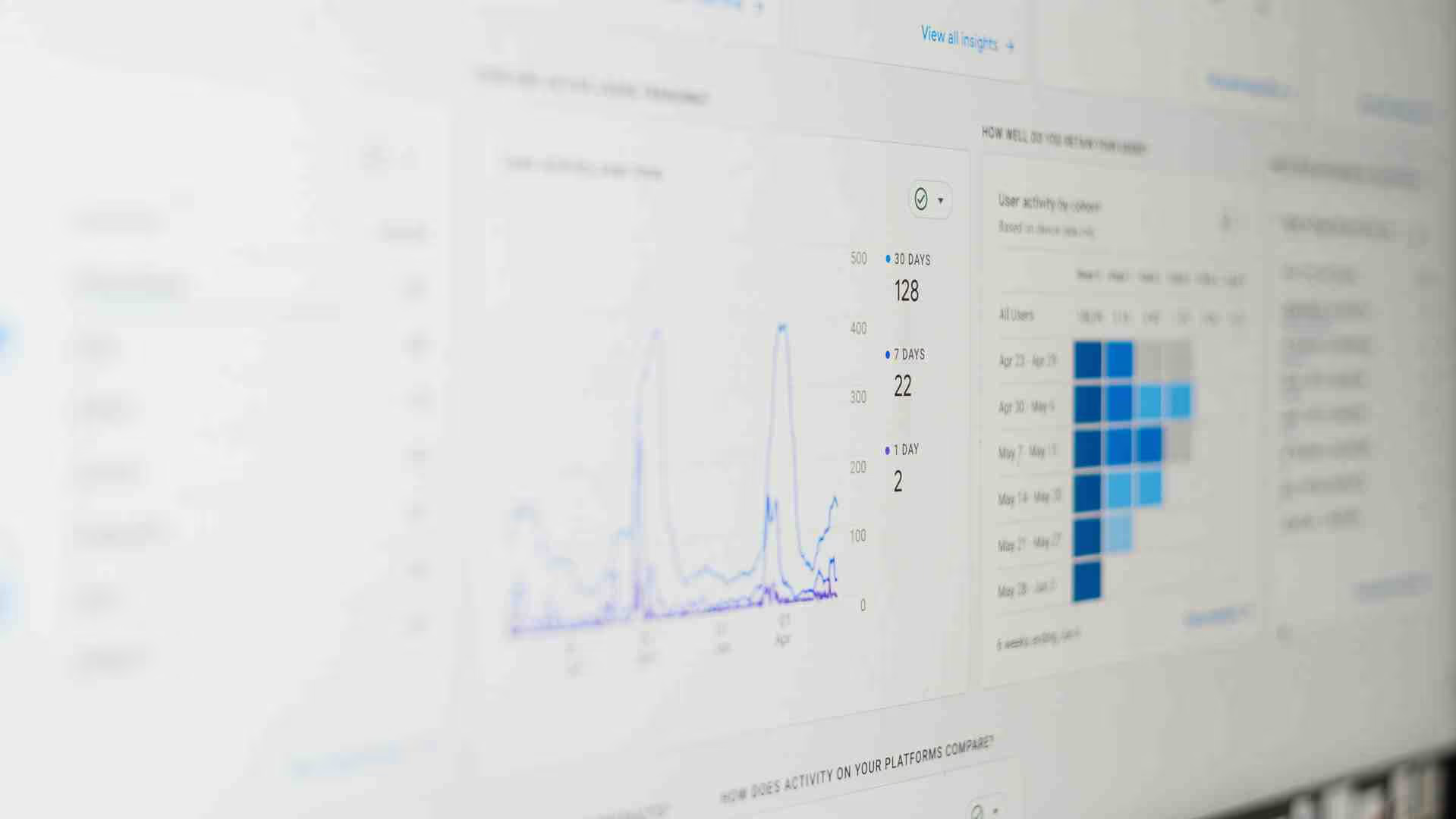
- Conversion Funnel Assessment: Your website has a journey, a "funnel," that users follow. It might start with a landing page, move to a product page, then to the cart, and finally to checkout. Analyzing where users drop off in this journey is critical. Tools like Google Analytics can show you specific bottlenecks.
- User Behavior Insights: Quantitative data from Google Analytics (traffic sources, bounce rates, time on page) tells us what is happening. But to understand why, we need qualitative data. This is where tools like heatmaps and scroll depth reports come in. Heatmap.com, for example, offers eCommerce-focused options to visualize where users click, move their mouse, and how far they scroll on a page. Session recordings can reveal frustrating user experiences, such as broken elements or confusing navigation. Identifying these "friction points" is key to open uping higher conversion rates.
Core Website Elements That Increase Website Conversions

Your website is more than just an online brochure; it's your digital storefront, your sales team, and your customer service representative all rolled into one. To truly increase website conversions, every element must be optimized for user experience, trust, and relevance. This is where a robust and flexible platform like Webflow can make a significant difference, allowing for precise control over design and functionality.
Optimizing for Speed and Mobile Experience
In today's digital world, patience is a virtue few online shoppers possess. Page load time is a critical factor in whether a visitor stays or leaves. According to Google, over half of mobile users will leave a site if it takes more than three seconds to load. We aim for page load times of no longer than four seconds, because even within that range, shorter is always better. Research shows that conversion rates can improve by 17% for every second a website loads faster.
To ensure your website is lightning-fast and helps you Fast Loading Website:
- Image Optimization: Large image files are a common culprit for slow loading. We ensure all images are properly compressed and optimized for web, often utilizing lazy loading for images and videos below the fold.
- Caching: Implementing browser caching helps your site load faster for returning visitors by storing parts of your website locally.
- Webflow Page Speed Optimization: Webflow excels at generating clean, optimized code, which inherently contributes to faster load times. Our expertise in Webflow allows us to fine-tune every aspect for peak performance.
Furthermore, with mobile traffic hovering around 49.78% of all web visits, a seamless mobile experience is non-negotiable. Our Mobile-First Design Strategy: Designing for Small Screens and Big Impact ensures your site looks and performs flawlessly on any device, reducing bounce rates and encouraging conversions.
Simplifying Navigation and Design
A confused user never converts. Your website's navigation and overall design play a pivotal role in guiding visitors towards their desired action.
- Simple Menus & Logical Structure: Clear, intuitive menus with well-defined categories are essential. We ensure your visitors can easily find what they're looking for without feeling overwhelmed. For example, an apparel brand might have simple top menu categories like "New Arrivals," "Women," and "Men," expanding into subcategories only when hovered over.
- Internal Site Search: Visitors who use your internal site search tend to convert at a much higher rate. Why? Because they have high purchase intent. With 69% of shoppers going straight to the search bar, a robust search function is a must.
- Breadcrumbs: These small navigational aids show users their current location within your site structure, preventing them from getting lost and making it easy to return to previous categories.
- Removing Distractions: The Paradox of Choice suggests that too many options can paralyze users, leading them to choose nothing at all. We advocate for clean, minimalist designs that remove unnecessary distractions. Every element on a conversion-focused page should serve a purpose, guiding the user towards the Call-to-Action (CTA). Avoid jargon and keep your copy clear and concise; clarity always wins.
Persuasive Content and Trust-Building Strategies
Once a visitor is engaged, the content on your product pages and throughout your site becomes your most powerful sales tool. It's about more than just describing a product; it's about persuading, informing, and building trust.
How to use compelling copy and multimedia to increase website conversions
High-quality content is non-negotiable for boosting conversions.
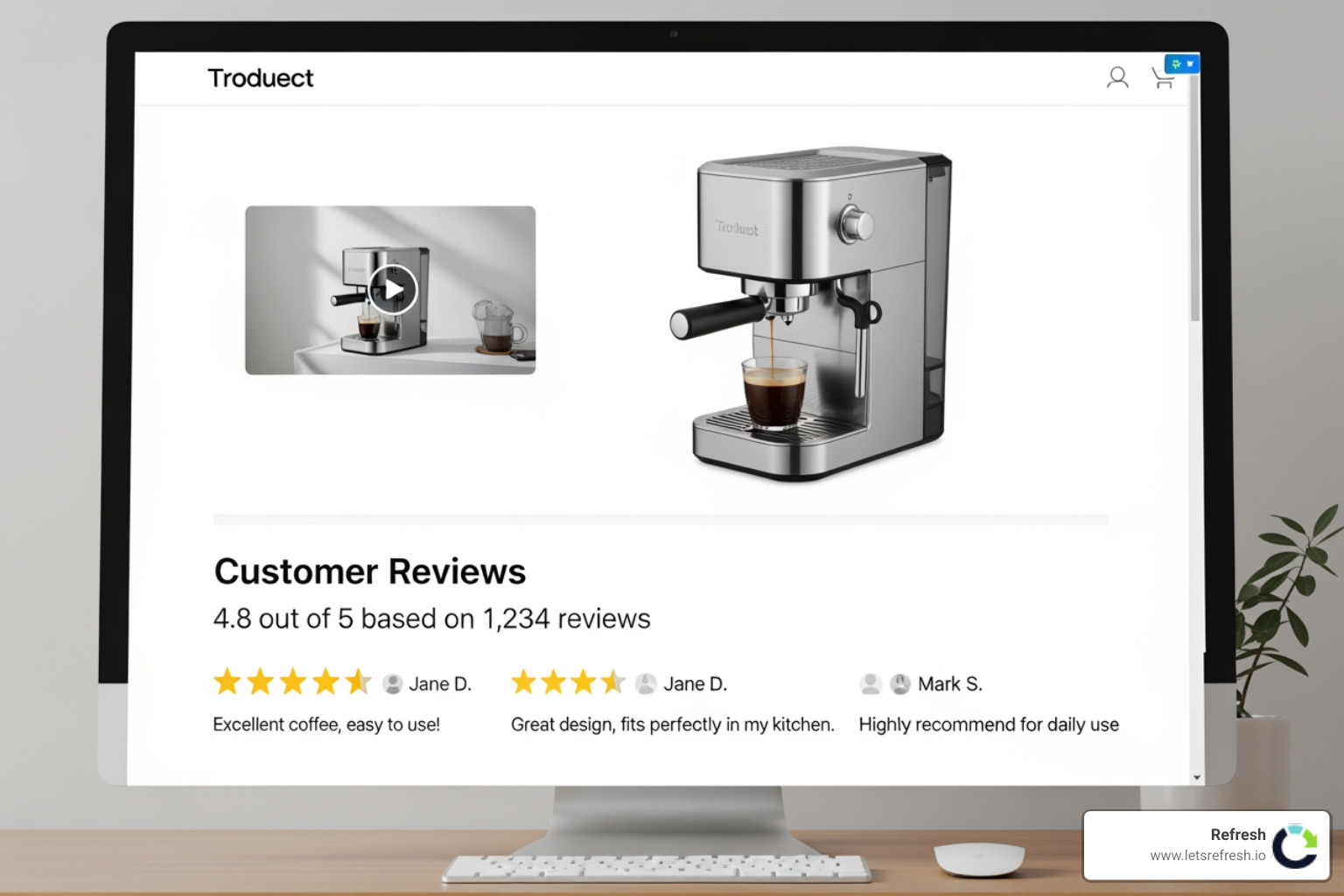
- High-Quality Product Photos: This is your customer's first impression of your product. We recommend using multiple high-resolution images from various angles, close-ups, and even 360-degree views. Showing products in context or on different body types can help customers visualize themselves using it.
- Explainer Videos: Videos bring your products to life, offering a dynamic way to showcase features and benefits. Ensure your videos are detailed, high-quality, and include subtitles for accessibility.
- Persuasive Sales Copy: Your website copy needs to do the selling. Focus on benefits over features, addressing customer pain points and painting a picture of how your product will improve their lives. The headline is particularly crucial; as legendary ad guru David Ogilvy said, "five times as many people read the headline as read the body copy." If your headline doesn't sell, you've lost 80% of your audience. We ensure your copy is clear, compelling, and free of jargon.
- Comprehensive Product Information: Up to 50% of potential sales are lost due to inadequate information. Provide all the details a customer might need, even if they don't read it all. This demonstrates expertise and helps alleviate any doubts. For more on crafting effective content, check out our guide on What is Content Marketing and Why Is It Important for Small Businesses?.
- Call-to-Action (CTA) Placement: Your CTA is the gateway to conversion. Test different placements, copy, and button designs. A/B testing can reveal that rounded CTA buttons receive anywhere from 17% to 55% more clicks than sharp-angled ones. Make your CTAs stand out with contrasting colors and action-oriented language.
Building Unshakeable Trust with Social Proof
In the online world, trust is currency. Without it, visitors are hesitant to share personal information or make a purchase. Social proof is a powerful psychological tool that leverages the actions and opinions of others to build confidence.
- Customer Reviews: Nearly 90% of consumers trust customer reviews as much as a recommendation from a friend. Displaying authentic reviews prominently can significantly impact purchasing decisions. Visitors who interact with a review are 58% more likely to convert. In fact, highlight customer reviews and quotes can increase conversion rates by as much as 270%.
- Testimonials: Beyond star ratings, written or video testimonials from satisfied customers provide powerful endorsements. Testimonials alone can increase conversion rates by 34%.
- User-Generated Content (UGC): Encourage customers to share photos or videos of themselves using your products. UGC can increase conversion rates by as much as 200%, and customers who interact with it are 152% more likely to convert.
- Trust Seals and Security Badges: Displaying security seals, especially during checkout, is vital. One study found that 18% of consumers abandoned a purchase because they didn't trust the site with their credit card info. Signals like SSL certificates or payment processor logos reassure customers.
Driving Action: Checkout, Urgency, and Retention Tactics
Even with a great website and compelling content, visitors can still drop off before completing a purchase. This section focuses on strategies to reduce friction, create a sense of urgency, and encourage repeat business.
Reducing Friction in the Purchasing Process
The checkout process is where many conversions are won or lost. A complicated or confusing checkout is a major conversion killer.
- Guest Checkout: This is non-negotiable. Forcing users to create an account before purchasing is a huge barrier. The story of the "300 million dollar button" famously illustrates how enabling guest checkout can dramatically increase conversions. Let them check out as a guest, and offer the option to register after the purchase.
- Simplified Forms: Long forms are intimidating. 27% of users will bail on a form if it's too long. Only ask for essential information. Reduce the number of fields and consider pre-filling known data.
- One-Page Checkout: Consolidating the checkout process onto a single page can significantly reduce abandonment by making the process feel faster and less overwhelming.
- Multiple Payment Options: Cater to diverse customer preferences. Offer major credit cards, popular digital wallets like PayPal and Apple Pay, and consider Buy Now, Pay Later (BNPL) services. If you don't accept a preferred payment option, customers may abandon their cart.
- Free Shipping Offers: A whopping 50% of consumers who abandoned items in an online shopping cart did so due to extra costs at checkout, such as shipping. Providing free shipping is one of the most effective ways to reduce cart abandonment. Studies show that 80% of US consumers consider free shipping the most popular motivation for purchase. It can also lead customers to spend more per order to meet minimums.
- Clear Returns Policy: Customers want to know they have options if a product doesn't meet their expectations. A clear and reassuring returns policy reduces perceived risk and encourages purchases.
Using Psychology and Automation to Boost Sales
Beyond streamlining the checkout, we can leverage psychological principles and automation to nudge customers towards conversion and foster long-term loyalty.
- Scarcity and Urgency Tactics: These tactics motivate immediate action.
- Genuine Scarcity: "Only 3 left in stock!" or "Offer ends in 24 hours!" can be powerful. The key is authenticity; never fabricate scarcity.
- Limited-Time Offers: Starbucks effectively uses specific timeframes for their buy-one-get-one-free holiday drink offers to create urgency.
- Countdown Timers: Visually reinforce time-sensitive deals.
- Abandoned Cart Emails: More than two-thirds of shoppers abandon their carts before checkout. These are interested prospects! Abandoned cart emails are a highly effective way to re-engage them. We can set up automated sequences using platforms like Klaviyo to remind customers, offer a small incentive, or address common objections.
- Chatbots and Live Chat: Many brands mistakenly think chatbots depersonalize the experience. However, 69% of consumers prefer using chatbots because they quickly answer simple questions. For more complex queries, live chat provides immediate, human support, guiding prospects through their purchase journey and resolving issues in real-time.
- Personalized Experiences: 81% of customers prefer companies that offer a personalized experience. Personalized calls to action are 202% more likely to convert. This can include product recommendations based on browsing history, location-specific content, or customized messaging for returning visitors. Personalization makes your site more relevant and builds trust.
- Subscription Programs: For recurring purchases, subscription models offer convenience to customers and predictable revenue for you. They foster retention by building long-term relationships and offering value beyond a one-time transaction.
The CRO Process: Testing and Continuous Improvement
Conversion Rate Optimization (CRO) isn't a one-time fix; it's an ongoing, iterative process. It requires a commitment to data-driven decision-making and continuous improvement.
How to effectively A/B test to increase website conversions
A/B testing (also known as split testing) is the backbone of CRO. It involves comparing two versions of a webpage or app feature (A and B) to see which one performs better against your conversion goals.
Here's how we approach it:
- Define Your Hypothesis: Before testing, we formulate a clear hypothesis about why a particular change might lead to an improvement. For example: "Changing the CTA copy from 'Learn More' to 'Get Your Quote Now' will increase click-through rates because it speaks directly to the user's immediate need."
- What to Test: Almost anything can be A/B tested! Common elements include:
- Headlines: The most impactful element, as five times as many people read the headline as the body copy.
- Call-to-Action (CTA): Copy, color, size, and placement.
- Page Layout: The arrangement of elements above the fold or throughout the page.
- Images and Videos: Different visuals can evoke different responses.
- Forms: Number of fields, labels, error messages.
- Pricing Models or Offers: The way you present your value.
- Choose the Right Tools: Platforms like Optimizely provide robust A/B testing capabilities, allowing us to run experiments, segment audiences, and analyze results with statistical significance. We use these tools to ensure our findings are reliable.
- Run Tests Until Statistical Significance: It's crucial not to end a test too early. We run tests long enough to gather sufficient data and achieve statistical significance, ensuring the results are not due to random chance.
Common Pitfalls to Avoid in Conversion Optimization
While CRO offers immense potential, there are common traps that can derail your efforts:
- Ignoring Qualitative Data: Relying solely on analytics (quantitative data) tells you what is happening, but not why. Qualitative data (surveys, user interviews, session recordings) provides crucial context and insights into user motivations and frustrations.
- Testing Too Many Elements at Once: If you change multiple things on a page simultaneously, you won't know which specific change caused the improvement (or decline). Test one hypothesis at a time to isolate the impact.
- Not Running Tests Long Enough: Ending a test prematurely can lead to false conclusions. Patience is key to gathering enough data for reliable results.
- Unnecessary Distractions: Clutter on a page, too many pop-ups, or irrelevant information can pull users away from the conversion goal. Keep it clean and focused.
- Overlooking Small Wins: Even minor improvements can compound significantly over time, leading to substantial gains. Celebrate and implement these small victories.
- Listening to the HiPPO: The "Highest Paid Person's Opinion" (HiPPO) can be a dangerous force in CRO. Without data, even the most senior opinion is just an assumption. Effective CRO is based on cold, hard facts, not gut feelings.
Frequently Asked Questions about Increasing Website Conversions
What is a good website conversion rate?
The average eCommerce conversion rate across industry verticals is only between 2% and 4%. However, what's "good" is relative. For businesses in Pittsburgh, PA, Cleveland, OH, or Charlotte, NC, the US average eCommerce conversion rate is around 2.3%, but this can vary wildly. For example, Arts and Crafts might see rates around 3.84-4.07%, while Electrical Tools could be 1.31-2.49%.
Rather than chasing an industry average, we encourage our clients to focus on improving their own conversion rate month-over-month. If your rate is 2% today, and 2.5% next month, that's a good conversion rate for you. Benchmarking against your past performance and your specific industry niche is far more valuable than a generic number.
What's the first thing I should optimize on my website?
While every website is unique, we often recommend starting with your value proposition and headlines. If visitors don't immediately understand what you offer and why it's valuable, they won't stick around. This is a "low-hanging fruit" optimization that can have a massive impact.
Another excellent starting point is to identify pages with high traffic but low conversions. Use your analytics to pinpoint these underperforming pages, as they represent significant missed opportunities. Often, small tweaks to the Call-to-Action (CTA) or clarifying the copy on these pages can yield quick wins.
How can I reduce shopping cart abandonment?
Shopping cart abandonment is a prevalent issue for all websites. Here's our go-to list for tackling it:
- Be Transparent with Costs: Unexpected shipping fees are a top reason for abandonment. Clearly state all costs upfront.
- Offer Free Shipping: This is a major motivator. 80% of US consumers are motivated by free shipping.
- Simplify the Checkout Process: Reduce the number of steps and form fields. The fewer clicks and less typing, the better.
- Enable Guest Checkout: Do not force users to create an account. This is a huge barrier.
- Use Abandoned Cart Recovery Emails: Set up automated emails to remind users about their abandoned items, perhaps offering a small discount or highlighting benefits.
Conclusion
To truly increase website conversions is to transform your digital presence into a powerful growth engine. It’s about understanding your audience, streamlining their journey, building unwavering trust, and continuously refining your approach. From optimizing page speed and simplifying navigation with expert Webflow development, to crafting persuasive content, leveraging social proof, and perfecting your checkout process, every detail matters.
The journey to higher conversion rates is iterative and data-driven. It requires strategic thinking, meticulous testing, and a deep understanding of user behavior. That's where we come in. At Refresh, we specialize in helping small to medium-sized businesses in Pittsburgh, PA, Cleveland, OH, and Charlotte, NC build robust digital strategies that deliver tangible results. We turn your website into a conversion machine, ensuring you not only attract visitors but also convert them into loyal customers.
Ready to stop leaving money on the table and start seeing your website perform at its full potential? Let's work together to boost your online sales. A strong digital strategy is the foundation of your success. Learn more about The Importance of a Strong Digital Strategy for Small to Medium-Sized Businesses.


.avif)