
Why the Best Online Marketing Strategies Are Harder to Choose Than Ever
The best online marketing strategies in 2026 are the ones that compound — building lasting assets like search visibility, email lists, and customer loyalty rather than renting attention through ads alone.
If you're looking for a quick answer, here are the top strategies ranked by impact:
- AI Search Optimization (GEO/AEO) — Get cited in ChatGPT, Perplexity, and Google AI Overviews
- SEO + Conversion-Focused Website — Own your organic traffic and turn visitors into customers
- Email Marketing + First-Party Data — $36–$42 return per dollar spent; the only channel you truly own
- Paid Media (PPC + Paid Social) — Fast results, but requires ongoing spend
- Creator and Influencer Marketing — 69% of consumers trust creator recommendations
- Content Marketing — Fuels every other channel with authority and relevance
- Retention and Lifecycle Marketing — Retaining a customer costs 5–7x less than acquiring a new one
Most businesses try to do all of these at once. That's where things fall apart.
The digital marketing landscape has changed dramatically. AI tools like ChatGPT have crossed 900 million weekly active users. A full 37% of consumers now start their searches in AI platforms rather than Google. And AI-driven traffic to US retail sites rose 393% year over year in Q1 2026 — with those sessions converting at 23 times the rate of standard organic traffic.
At the same time, third-party cookies are disappearing, paid media costs keep climbing, and consumer attention is more fragmented than ever. Doing more isn't the answer. Doing the right things in the right order is.
I'm Alexander Palmiere, Founder and CEO of Refresh Digital Strategy, and over the course of launching more than 200 websites and building digital strategies for growth-stage businesses, I've seen which approaches from the best online marketing strategies actually move the needle — and which ones drain budgets without results. In this guide, I'll walk you through a clear, prioritized framework so you can invest with confidence.
Basic best online marketing strategies terms:
Understanding the Core: Strategy vs. Campaigns and Tactics

Before we dive into specific channels, we must establish a clear distinction that separates thriving brands from those that constantly waste money: the difference between your strategy, your campaigns, and your tactics.
When we consult with small to medium-sized businesses, we often see them mistake a list of tactics for a strategy. "Our strategy is to post three times a week on TikTok and run Google Ads," they might say. But those are actually tactical actions.
Without a unifying strategy, these actions become isolated, expensive experiments. By defining your high-level goals first, you save your team from chasing every shiny new marketing trend.
To design a system that actually produces ROI, we recommend utilizing the 7 Steps to Build a Marketing Strategy That Actually Works in 2026 as a foundational guide. This structured planning workflow aligns your operational actions with real-world business growth.
Defining a Modern Digital Strategy
A modern digital strategy is a comprehensive, long-term plan designed to achieve specific business goals. It defines your core objectives, identifies your ideal target audience (using data-backed buyer personas), maps out your budget allocation, and establishes a clear framework for how you will communicate your unique value proposition (UVP).
Rather than focusing on a single channel, a true strategy acts as a blueprint. It guides your resources and aligns your team. If you are struggling with how to integrate organic visibility into your broader plan, exploring the role of Digital Strategy SEO is an excellent place to start. A strong strategy answers the fundamental questions of what we are trying to achieve, who we are trying to reach, and why it matters to our bottom line.
Why Tactics Fail Without Strategic Alignment
Tactics are the granular, day-to-day actions you execute—such as writing a blog post, adjusting an ad bid, or sending a newsletter. Campaigns are the time-bound, targeted efforts designed to achieve a specific milestone (like a product launch or a seasonal promotion).
When you run tactics without strategic alignment, you risk brand inconsistency, fragmented customer experiences, and massive resource waste. For example, if your high-level strategy is to position your brand as a premium, high-ticket service provider, but your tactical team runs aggressive, discount-heavy ad campaigns, you actively damage your market positioning.
As highlighted in The Ultimate Guide to Internet Marketing: Strategies for Growth in 2026, a successful program is an integrated machine. Your website, organic content, paid campaigns, and email nurturing sequences must work together to guide prospects seamlessly through the buyer's journey.
The Best Online Marketing Strategies for 2026
In 2026, the digital space is divided between "rented attention" and "owned assets." While paid ads can deliver immediate pipeline velocity, they stop working the second you turn off the budget. The best online marketing strategies prioritize compounding assets that grow more valuable over time.
To help you visualize how these channels compare, let's look at how foundational strategies stack up against growth strategies:
| Strategy Type | Core Channels | Time-to-Result | Average ROI / Impact | Best Suited For |
|---|---|---|---|---|
| Foundational | SEO, GEO, AEO, Email, Webflow Website | 3–6 Months (Compounding) | High ($36–$42 per $1 spent on email) | Long-term growth, authority, lead nurturing |
| Growth | PPC, Paid Social, Creator Marketing | 1–2 Weeks (Immediate) | Moderate ($2–$2.80 per $1 spent) | Immediate pipeline, audience scaling, testing |
Implementing the Best Online Marketing Strategies for Search and Email
The search landscape is undergoing its most significant evolution since the invention of the search engine. Traditional Search Engine Optimization (SEO) is no longer just about ranking in Google's blue links. Today, we must optimize for Google's AI Overviews, ChatGPT Search, Perplexity, and Gemini.
This shift has introduced two critical concepts:
- Generative Engine Optimization (GEO): The practice of structuring your content so that Generative AI models cite and recommend your brand. This requires clear, entity-rich phrasing, authoritative topic sentences, and high-quality source signals.
- Answer Engine Optimization (AEO): Optimizing your website's technical structure (such as structured data, schemas, and clean
llms.txtfiles) so conversational AI platforms can easily scrape and understand your data.
Despite these changes, traditional search signals still matter. Research shows that 76.1% of URLs cited in Google AI Overviews also rank in the top 10 of traditional organic search results. If you want to capture this traffic, you need a solid SEO Strategy for Small Business.
Once you capture search traffic, you must move those visitors off of rented platforms and into your owned ecosystem. This is where email marketing and first-party data collection become invaluable. Email continues to outperform every other channel, delivering $36 to $42 for every single dollar spent. By building an opted-in email list, you insulate your business from sudden algorithm updates and ad cost spikes.
Scaling Growth with the Best Online Marketing Strategies in Paid Channels
While search and email build long-term value, paid media serves as the accelerator for your marketing engine. Pay-per-click (PPC) advertising on Google and paid social campaigns on platforms like Meta and LinkedIn allow you to target high-intent buyers with incredible precision.
To get the most out of your ad spend, we recommend combining paid acquisition with creator and influencer marketing. Today's consumers are highly skeptical of corporate ads; in fact, 69% of consumers trust creator recommendations over brand claims, and 75% of buyers use social media to guide their purchasing decisions.
Additionally, video content has become non-negotiable, with 87% of online marketers using video and 39% stating that short-form video generates their highest ROI.
If you want to dive deeper into structuring these paid campaigns for your business stage, check out our SMB Digital Marketing Guide 2026.
Prioritizing and Sequencing Your Marketing Investments
One of the most common mistakes we see is a business trying to build a complex, multi-channel marketing system before they have even optimized their website to convert traffic. If your website is slow, confusing, or poorly designed, driving more traffic to it is simply wasting money.
For small to medium-sized businesses, we highly recommend utilizing Webflow as your primary web platform. Webflow allows us to build highly customized, responsive, and blazing-fast websites that excel at Core Web Vitals—which are essential for both SEO and GEO rankings.
Before launching any ad campaigns, ensure your site is built on a clean Webflow architecture, features prominent calls-to-action (CTAs) above the fold, and is optimized for the more than 60% of web traffic coming from mobile devices.
To help you map out your investment timeline, we use a structured tiered framework.
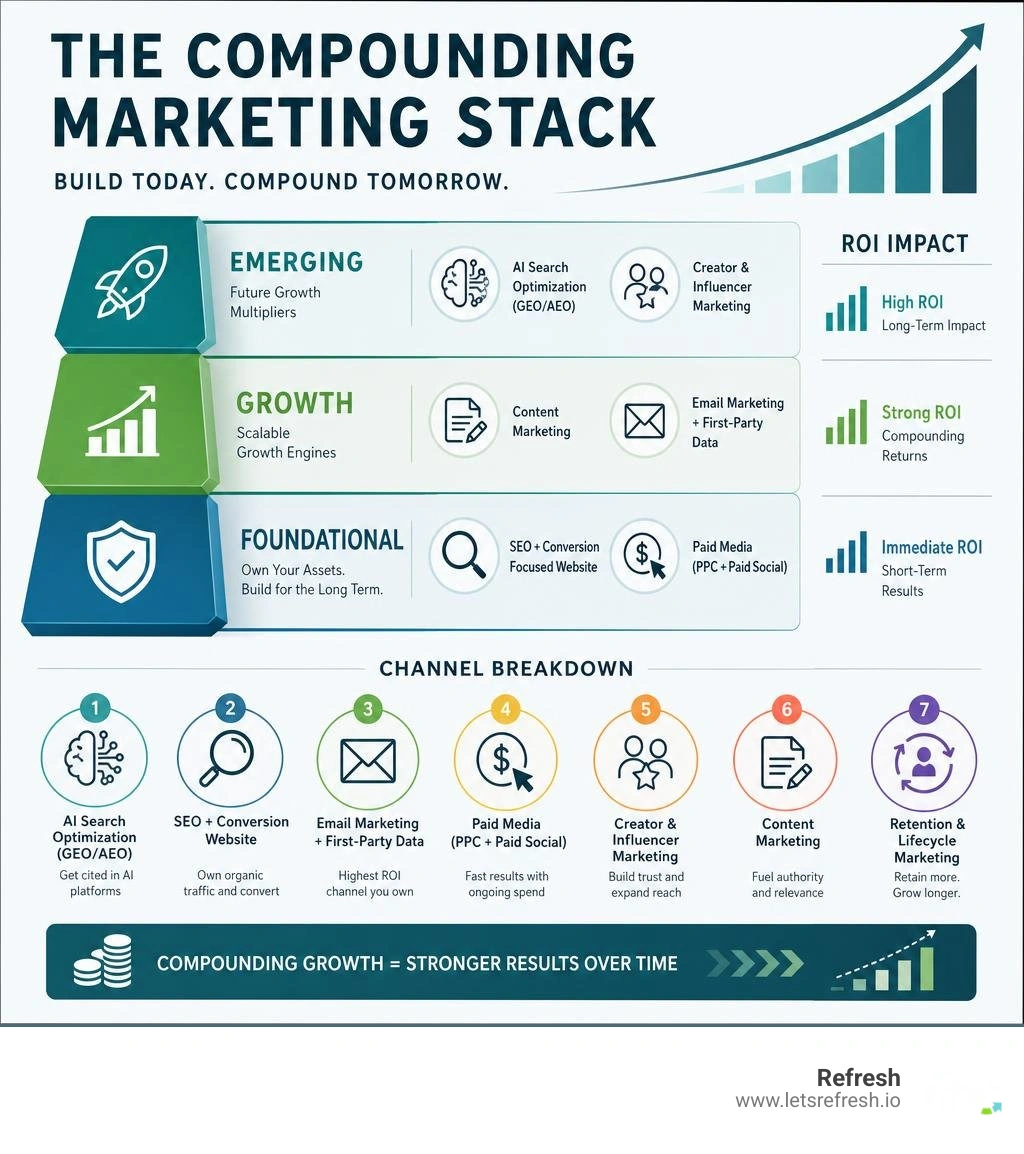
The Compounding Marketing Stack Framework
We break down marketing investments into three distinct layers to ensure sustainable growth:
- The Foundational Layer (Months 1–3): Focus entirely on your owned assets. Build a fast, conversion-focused Webflow website, implement technical SEO, optimize for GEO/AEO, and establish your email capture and automated welcome sequences.
- The Growth Layer (Months 3–6): Once your foundation is converting visitors, layer on paid media (Google Ads, Meta Ads) and launch targeted creator partnerships to drive consistent traffic.
- The Emerging Layer (Months 6+): With stable organic and paid funnels, you can allocate 10–20% of your budget to experimental channels like social commerce, private community building, and immersive AR experiences.
This phased approach prevents you from overextending your budget. For early-stage companies, our Startup Marketing Strategy offers a detailed roadmap for sequencing these investments.
Real-World Brand Success Stories
To understand how these strategies function in the real world, let's look at how established brands execute them:
- Nike: Nike mastered creator marketing by moving away from transactional, one-off celebrity endorsements. Instead, they built long-term partnerships with micro-influencers and community leaders, creating authentic, platform-native content that drove organic advocacy.
- Dove: Dove aligned its entire marketing strategy with real brand values through their "Real Beauty" campaigns. By focusing on social responsibility and customer-centric storytelling rather than direct product pitches, they built an incredibly loyal community that acts as an unpaid sales force.
- MVMT Watches: MVMT scaled from a startup into a massive global brand by leveraging user-generated content (UGC) and paid social. They incentivized their early customers to share high-quality photos of their watches, which MVMT then repurposed into highly profitable social ad campaigns.
Measuring Success and Overcoming Modern Challenges
A marketing strategy is only as good as your ability to measure it. In 2026, relying on "vanity metrics" like social media likes, impressions, or follower counts will lead to poor business decisions. You must focus on metrics that directly impact your bottom line.
To maximize your results, we recommend setting up a unified dashboard that tracks your customer acquisition cost (CAC) alongside your lifetime value (LTV). If you want to build a more robust reporting system, our guide on how to Maximize Marketing ROI breaks down the exact formulas we use to evaluate campaign profitability.
Essential KPIs for Tracking ROI
When evaluating your digital marketing performance, focus on these critical Key Performance Indicators (KPIs):
- Conversion Rate: The percentage of website visitors who complete a desired action (like filling out a form or buying a product).
- Customer Acquisition Cost (CAC): The total marketing and sales spend required to acquire a single new customer.
- Customer Lifetime Value (LTV): The total revenue a customer generates for your business over their entire relationship with you. (An ideal LTV-to-CAC ratio is 3:1 or higher).
- Email Revenue per Send: The direct dollar value generated by your email campaigns.
- AI-Referral Traffic and Citation Frequency: How often conversational AI engines like ChatGPT or Perplexity cite your website as a source.
Navigating Data Privacy and Platform Shifts
The marketing landscape is facing major technical disruptions. The deprecation of third-party cookies by major browsers has made traditional ad retargeting much more difficult and expensive. Additionally, the rise of "zero-click searches"—where Google AI Overviews answer a user's question directly on the search results page—means that traditional organic search clicks are decreasing for informational queries.
To overcome these challenges, you must adapt:
- Focus on First-Party Data: Collect phone numbers and email addresses directly on your website through value-driven resources like guides, webinars, or interactive tools.
- Implement Marketing Automation: With 91% of successful businesses stating that automation is critical, using AI-driven tools to personalize your customer journeys is essential.
- Leverage Tailored Recommendations: 80% of consumers are more likely to buy from brands that provide personalized, tailored messaging.
If you are looking for advanced technical solutions to navigate these privacy shifts, our Digital Marketing Solutions Guide details how to implement server-side tracking and privacy-compliant analytics.
Frequently Asked Questions about Online Marketing
What is the difference between SEO and GEO?
Traditional search engine optimization (SEO) focuses on ranking your website in the standard search results of engines like Google by optimizing for keywords, backlinks, and technical performance.
Generative Engine Optimization (GEO) is the practice of optimizing your content so that Generative AI models (like ChatGPT, Perplexity, and Google AI Overviews) cite and recommend your brand in their conversational answers. While SEO helps you get found by users browsing links, GEO helps you get recommended by AI agents answering direct user prompts.
How long does it take to see results from digital marketing?
The timeline depends heavily on the channel. Paid media channels (like Google PPC and paid social) can show initial traffic and conversion data within the first week of launching.
Organic channels (like traditional SEO, GEO, and content marketing) typically take 4 to 6 months to show significant, compounding results. However, organic strategies build long-term, sustainable assets that continue to drive traffic long after you stop actively investing in them.
Which marketing channel has the highest ROI?
Email marketing consistently delivers the highest return on investment of any digital marketing channel, averaging $36 to $42 for every $1 spent. This is because email is an owned channel where you can communicate directly with an warm, opted-in audience, compared to paid search or social advertising, which require ongoing ad spend to reach cold audiences.
Conclusion
Building and executing the best online marketing strategies is not about doing everything at once. It is about building a focused, integrated system where your website, search visibility, and email marketing work together to turn strangers into loyal customers.
If you are looking for a long-term partner to help you navigate this changing landscape, we are here to help. At Refresh, we specialize in building fast, high-converting Webflow websites and crafting data-driven digital strategies for small to medium-sized businesses. Whether you need expert SEO, hands-on branding, or strategic social media management, our team delivers the clarity and systems you need to grow.
If your business is located in Pennsylvania, Ohio, or North Carolina, we would love to connect. You can explore regional opportunities and local networks through resources like:
- Pittsburgh: Review the Top Digital Marketing Agencies in Pittsburgh - Jul 2026 Rankings or connect with a local expert at the Best Pittsburgh Digital Marketing Agency Near You.
- Cleveland: Browse the Top Digital Marketing Agencies in Cleveland or partner with Cleveland Ohio Digital Marketing Services.
- Charlotte: Consult with A Top Charlotte Digital Marketing Agency | Online Marketing or work with a premier team at the Top Marketing Agency in Charlotte, NC | Market My Market.
Ready to stop renting attention and start building marketing assets that compound? Let's build a strategy that works for your business. Reach out to us at Refresh today to schedule a consultation with our strategy team.


.avif)