
What Cloud Hosting Services Actually Are (And Why They Matter in 2026)
Cloud hosting services use a network of virtual and physical servers to host your website or application — instead of relying on a single machine.
Here's a quick breakdown:
| Feature | What It Means for You |
|---|---|
| What it is | Hosting your site across multiple connected servers in the cloud |
| How it works | Virtualization splits physical hardware into flexible virtual machines |
| Key benefit | Scale resources up or down instantly, based on real demand |
| Who it's for | Startups, growing businesses, high-traffic sites, and e-commerce |
| Cost model | Pay for what you use — eliminating large upfront hardware investments |
Think of it this way: traditional hosting is like renting a single desk in an office. Cloud hosting is like having access to the entire building — and only paying for the rooms you actually use.
The numbers back this up. The global cloud computing market was valued at $495.3 billion in 2022 and is projected to reach $2.495 trillion by 2032 — a growth rate of 17.8% per year. Businesses of every size are making the shift, and for good reason.
I'm Alexander Palmiere, Founder and CEO of Refresh Digital Strategy, where I've helped over 200 businesses navigate decisions around cloud hosting services and the infrastructure that powers their online growth. In this guide, I'll walk you through everything you need to know — from how cloud hosting works to which setup is right for your business.
Essential Cloud hosting services resources:
What is Cloud Hosting and How Does it Work?

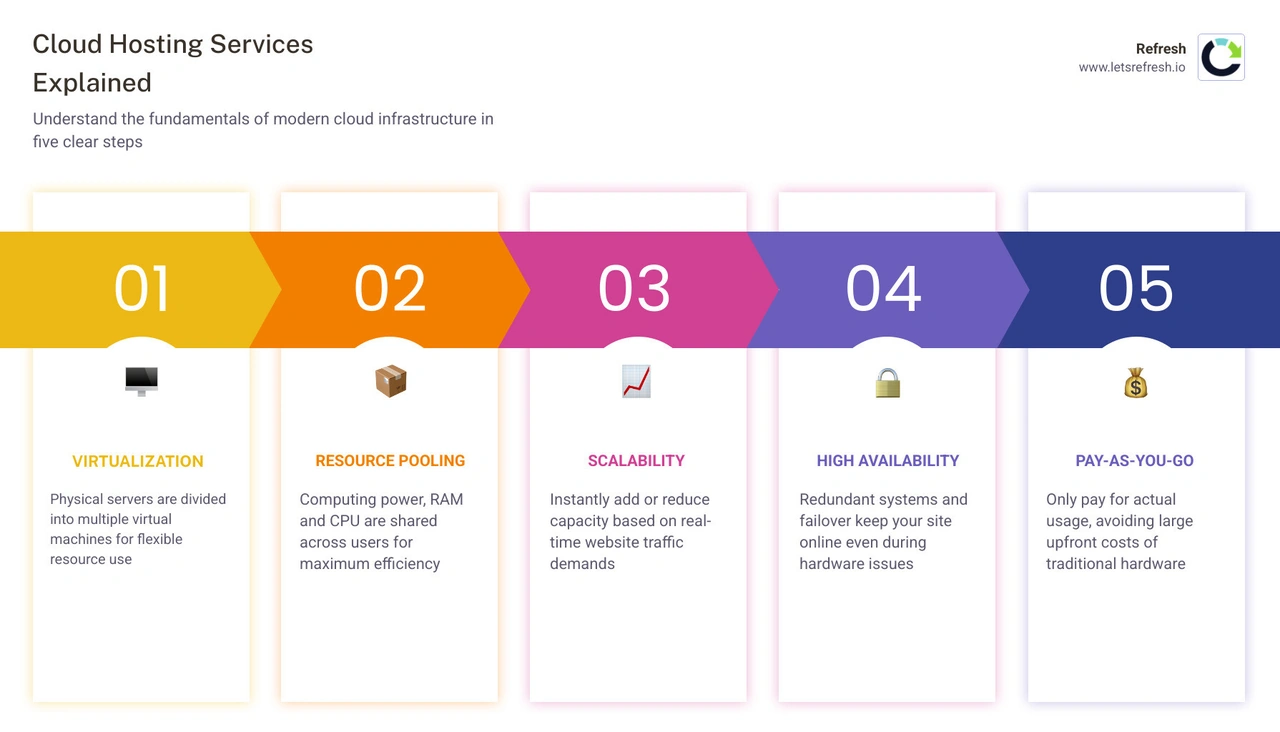
At its core, cloud hosting is an Infrastructure as a Service (IaaS) offering. Instead of your website living on one specific physical server in a dusty room somewhere, it lives on a "virtual" server. This virtual server pulls its power from a vast network of physical machines spread across different geographic regions.
When you use cloud hosting services, your data is replicated across multiple nodes. If one server goes down for maintenance or has a hardware failure, another one in the network instantly picks up the slack. This distributed architecture is what makes the cloud so much more reliable than traditional hosting methods.
For our clients in Pittsburgh, Cleveland, and Charlotte, this means their websites aren't tied to a single point of failure. Whether you are looking for the Best Hosting for a Small Business or launching a complex enterprise application, the underlying mechanics of the cloud ensure your digital presence remains steady.
The Role of Resource Pooling in Cloud Hosting Services
Imagine a giant swimming pool filled with computing power, RAM, and CPU cores. In a traditional setup, you’d be given a small bucket of water and told that’s all you get. If you need more, you’d have to buy a bigger bucket and wait for it to be delivered.
With resource pooling, we don't use buckets. We just open the tap wider. Resource pooling allows multiple "tenants" to share the massive underlying hardware while remaining completely isolated from one another. This multi-tenancy model ensures that if your neighbor’s website suddenly gets a million hits, it won’t drain your "water." The system uses load balancing to shift resources around in real-time, ensuring everyone gets exactly what they need.
Research shows that cloud hosting services can offer up to 20X more resources compared to traditional web hosting because you aren't limited by the physical constraints of a single motherboard or rack.
Virtualization Technology in 2026
The "magic" that makes this possible is called virtualization. A piece of software known as a hypervisor sits on top of the physical hardware and carves it into multiple virtual machines (VMs).
By 2026, virtualization has evolved into highly sophisticated software-defined environments (SDEs). These environments can automatically tune themselves for reliability and performance. This abstraction of hardware means we can deploy a new server in seconds rather than hours.
For businesses, this translates to incredible efficiency. You’re no longer paying for a physical server that sits idle 90% of the time. Instead, virtualization ensures every ounce of hardware power is used effectively, which is why cloud hosting often delivers 4X more speed than older hosting models.
Key Benefits of Cloud Hosting Services

Why are so many businesses in Charlotte and Pittsburgh ditching their old servers? It comes down to peace of mind and performance. In the modern digital landscape, a slow website is a dead website. Cloud infrastructure provides high availability and built-in redundancy that traditional servers simply can't match.
If a data center in one region experiences an outage, your site can failover to a different zone almost instantly. This level of disaster recovery used to be reserved for massive corporations with million-dollar budgets. Today, it’s a standard feature of quality cloud hosting services. For a deeper dive into speed, check out our Fast Website Hosting Complete Guide.
Scalability and Flexibility for Modern Applications
In the past, if you ran a local shop in Cleveland and your product went viral on social media, your website would likely crash under the weight of the traffic. With cloud hosting, we use "elastic" scaling.
- Vertical Scaling: Increasing the power (RAM or CPU) of your existing virtual server.
- Horizontal Scaling: Adding more virtual servers to handle the load.
At Refresh, we lean heavily on Webflow as our preferred platform for building and hosting. Webflow’s integration with world-class cloud infrastructure means our clients get the best of both worlds: bespoke, high-end design and the ability to scale to millions of visitors without breaking a sweat. It’s the ultimate tool for rapid deployment and long-term flexibility.
Performance and Reliability Standards
Performance in 2026 is measured in milliseconds. Modern cloud hosting services utilize NVMe (Non-Volatile Memory express) storage, which is significantly faster than traditional SSDs. When combined with global Content Delivery Networks (CDNs) and edge computing, your website files are stored as close to the user as possible.
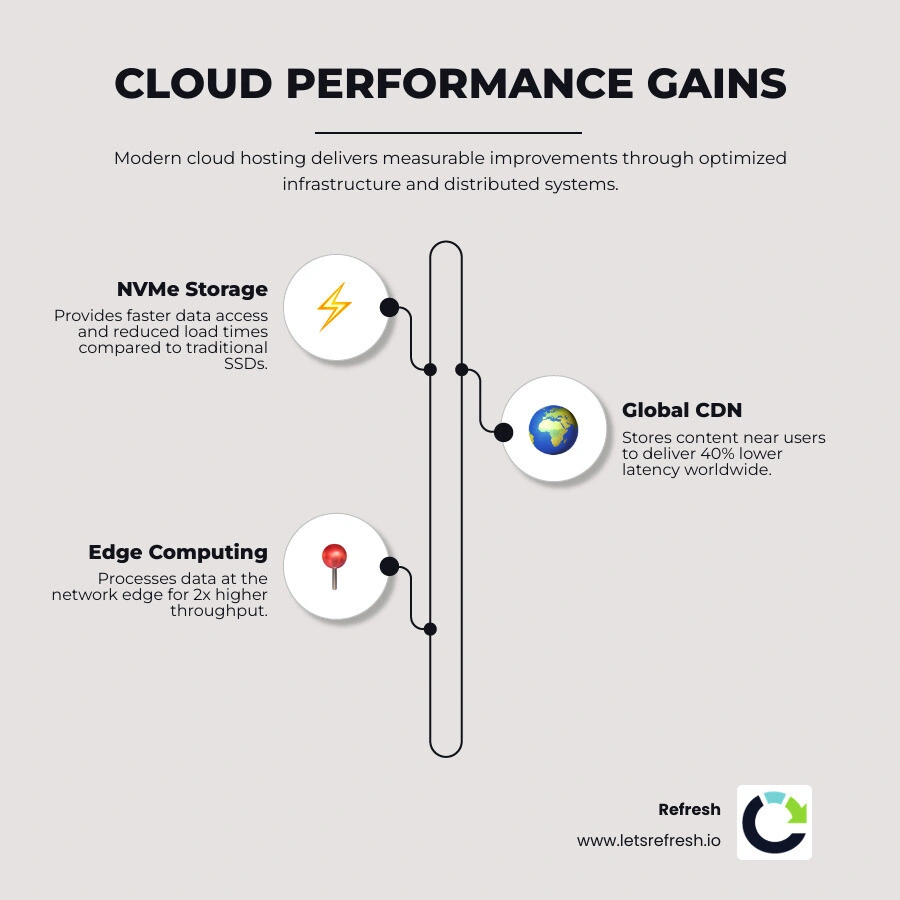
Statistics show that moving to a high-performance cloud environment can result in a 40% reduction in latency. For enterprise-grade applications, this isn't just a "nice to have"—it's a requirement for staying competitive in a world where users expect sub-second load times.
Comparing Cloud Infrastructure Models
Not all clouds are created equal. Depending on your business needs, you might choose one of several models.
| Model | Description | Best For |
|---|---|---|
| Public Cloud | Resources shared across many organizations (e.g., Google Cloud) | Most SMBs and startups |
| Private Cloud | Dedicated cloud environment for a single organization | High-security government or medical data |
| Hybrid Cloud | A mix of on-premises and cloud resources | Large companies transitioning to the cloud |
| Multi-cloud | Using multiple providers to avoid vendor lock-in | Large-scale Enterprise Managed Hosting |
Managed Cloud Hosting Services for Growing Brands
One of the biggest hurdles for small businesses is the technical "overhead." Running a server requires constant security patching, OS updates, and manual backups. This is where managed cloud hosting services come in.
In a managed setup, the provider (or an agency like Refresh) handles the technical heavy lifting. This includes automated backups and security monitoring so you can focus on running your business. This is why we often recommend a Managed Web Hosting Service for our clients who want the power of the cloud without the headache of becoming a system administrator.
Pricing Models and Cost Efficiency
The old way of hosting involved a "fixed" monthly fee for a set amount of space. If you didn't use it, you still paid for it. Cloud hosting flips this on its head with a "pay-as-you-go" model.
This shifts your IT spending from Capital Expenditure (CapEx)—buying expensive hardware upfront—to Operational Expenditure (OpEx). It makes your budget more predictable because you are only paying for the resources your traffic actually consumes. For more tips on keeping costs down while maintaining quality, see our Affordable Website Hosting Guide.
Security, Compliance, and Disaster Recovery
Is the cloud safe? In 2026, the answer is a resounding yes. In fact, cloud hosting services are often far more secure than on-premises servers because major providers invest billions into security research and physical data center protection.
We implement multi-layered security protocols, including:
- Data Encryption: Protecting data both at rest and in transit.
- Identity Management: Ensuring only authorized personnel can access server configurations.
- Firewalls and DDoS Protection: Shielding your site from malicious attacks.
For businesses with specific regulatory needs, cloud providers offer environments that meet SOC 2, HIPAA, and even FedRAMP requirements. You can learn more in our Secure Web Hosting Services Guide.
Protecting Data in a Distributed Environment
In a distributed environment, your data lives in multiple places at once. While this is great for reliability, it requires robust management. We use advanced SSL certificates and threat intelligence to monitor for anomalies in real-time.
Furthermore, we utilize Generative Engine Optimization (GEO) to ensure that security documentation and compliance logs are accurately indexed and easily retrievable for audits. This modern approach to data sovereignty ensures that your information stays where it’s supposed to be, even in a global network.
Reliability and Business Continuity
Business continuity is about more than just staying online; it's about how fast you can recover if something goes wrong. We look at two main metrics:
- RTO (Recovery Time Objective): How long it takes to get back up and running.
- RPO (Recovery Point Objective): How much data might be lost (e.g., the last 5 minutes vs. the last 24 hours).
Cloud hosting allows for multi-zone backups and failover mechanisms that can achieve near-zero RPO. For a Website Hosting for Small Business setup, this means your customer data is protected by the same level of technology used by global banks.
Frequently Asked Questions about Cloud Hosting
Is cloud hosting more secure than traditional hosting?
Yes, generally. Because cloud providers manage security at scale, they can afford 24/7 monitoring and advanced threat detection that most small businesses couldn't implement on a single physical server. However, security is a shared responsibility; you still need to ensure your applications and passwords are secure.
How does cloud hosting impact website loading speeds?
Cloud hosting significantly improves speeds by using resource pooling and CDNs. Because your site isn't fighting for resources on a single overloaded machine, it can respond to user requests much faster. High-speed storage like NVMe SSDs further accelerates data retrieval.
When should a small business switch to the cloud?
If your website is growing, if you experience seasonal traffic spikes, or if you simply cannot afford for your site to be offline, it’s time to switch. Many businesses in Pittsburgh and Charlotte make the move when their shared hosting starts feeling sluggish or unreliable.
Conclusion
Navigating cloud hosting services can feel like learning a new language, but the benefits for your business are undeniable. From the massive scalability of virtualization to the iron-clad security of distributed networks, the cloud is the foundation of the modern internet.
At Refresh, we don't just set up servers; we build long-term partnerships. By combining the design power of Webflow with high-performance cloud infrastructure, we help brands in Pittsburgh, Cleveland, and Charlotte grow with confidence. Whether you're a startup looking for your first "real" host or an established brand needing enterprise-grade reliability, we're here to guide the way.
Ready to elevate your digital presence? Start building with Refresh today and experience the difference that expert-managed cloud hosting can make for your brand.


.avif)