
Why Deciding to Revamp Website Pages Can Transform Your Business
When you revamp website pages instead of scrapping everything and starting over, you can dramatically improve how your business performs online — faster and at a lower cost than a full rebuild.
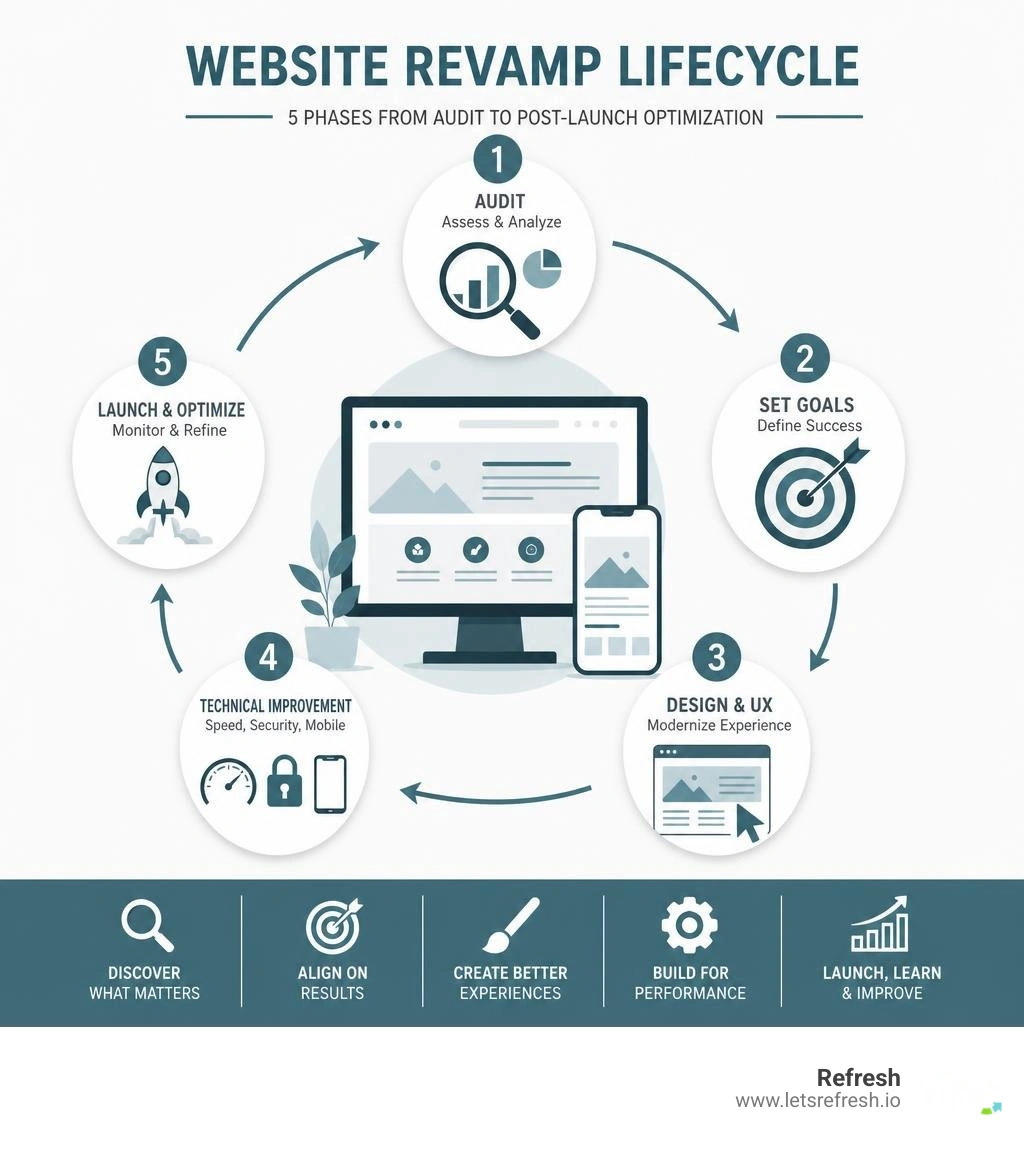
Here's what a website revamp actually involves, in plain terms:
- Audit your current site — identify what's working and what's hurting you
- Set clear goals — more leads, faster load times, better mobile experience
- Update design and UX — modernize visuals, typography, and navigation
- Improve technical performance — page speed, SSL, mobile responsiveness
- Preserve and strengthen SEO — keep rankings intact while improving content structure
- Launch and monitor — track results and optimize after go-live
This guide walks you through each of those steps in a simple, repeatable 5-phase framework.
The stakes are real. According to research from Stanford University, 75% of users judge a company's credibility based on its website design alone. If your site looks outdated, loads slowly, or frustrates visitors on mobile, potential customers are quietly walking away — often straight to a competitor.
For growth-stage businesses especially, an underperforming website isn't just a cosmetic problem. It's a revenue problem.
The good news? You don't always need to tear everything down and start over. A focused revamp — updating the right things in the right order — can deliver significant results without the cost and disruption of a full rebuild.
I'm Alexander Palmiere, Founder and CEO of Refresh Digital Strategy, and over the course of developing and launching more than 200 websites, I've helped countless businesses revamp website experiences that were quietly holding them back. In this guide, I'll share the exact 5-phase process we use to turn underperforming sites into conversion-driving assets.
Handy revamp website terms:
- association website redesign services
- business website redesign services
- small business website redesign services
Why You Should Revamp Website Assets Instead of Starting From Scratch
When businesses notice their online presence slipping, the immediate reaction is often to panic and order a complete ground-up redesign. However, in July 2026, smart brands recognize that a surgical web revamp is frequently the more efficient, cost-effective, and less risky path.
To make the right choice, it helps to understand the spectrum of web updates:
- Website Refresh: This is a light cosmetic lift. Think of it as putting a fresh coat of paint on a house. You might update a few fonts, swap out older hero images, or tweak your brand colors. The underlying layout, page count, and code remain exactly the same.
- Website Revamp: A strategic middle ground. You keep your core content and URL structure intact to protect your hard-earned SEO authority, but you completely transform the visual interface, streamline the user experience (UX), and upgrade the technical infrastructure. It is a deep modernization of how your site looks, feels, and loads.
- Full Redesign: This is a complete demolition and rebuild. You gut the site’s infrastructure, rewrite the entire content strategy, overhaul the branding, and often migrate to a brand-new CMS.
Choosing to Web Revamp your existing assets allows you to bypass the massive time commitment and high costs of a complete teardown. For instance, when municipalities look to modernize, they often face massive structural hurdles. We saw this when the City of Cleveland Launches New Website to better serve its residents with modern interfaces. For a private business, taking a targeted revamp approach means you can launch in weeks rather than the four to eight months required for a full-scale architectural overhaul.
By focusing on a revamp, you preserve the stable backend elements that search engines already trust while aggressively upgrading the visual layout, speed, and mobile responsiveness.
Key Signs It is Time for an Upgrade
How do you know when your site has crossed the line from "perfectly fine" to "quietly killing your business"? Websites don't usually break all at once; instead, they slowly degrade in performance.
Here are the key indicators that it is time to revamp website assets:
1. Outdated Visuals and Branding
If your website looks like it was designed in 2018, your visitors will notice immediately. An outdated design signals to prospective buyers that your business might be lagging in other areas as well. If you have recently updated your logo, brand guidelines, or corporate positioning, but your live site still reflects your old identity, you are creating a disjointed brand experience.
2. Subpar User Experience (UX) and Navigation
If users have to click four or five times just to find your contact info or pricing page, they will leave. Modern web standards require intuitive, flat hierarchies where crucial information is never more than two or three clicks away from the homepage.
3. Declining Conversion and Engagement Metrics
Are your traffic numbers holding steady, but your leads or sales are plummeting? This is a classic sign of a UX bottleneck. When we analyze client sites, we often find that a The Transformative Power of a Website Redesign for Small Businesses lies in its ability to unblock these conversion funnels, turning passive readers into active buyers.
4. Poor Mobile Performance
With more than 60% of global web traffic originating from mobile devices, a "desktop-first" design with a bolted-on mobile layout is no longer acceptable. If your mobile page load times are sluggish or your buttons are too small to tap easily, Google's mobile-first indexing will actively penalize your search rankings.
5. High Bounce Rates and Slow Page Speeds
If your bounce rate has climbed past 50% or 60%, or if your pages take longer than 2.5 seconds to load (the threshold for Google's Largest Contentful Paint metric), users are abandoning your site before it even has a chance to make an impression.
6. Security Vulnerabilities and Tech Debt
If your site is built on an old CMS with dozens of outdated plugins, you are highly vulnerable to security breaches. Getting hacked can cost thousands of dollars in cleanup fees and destroy consumer trust overnight.
The 5-Phase Framework for a Successful Transformation
To execute a website revamp without losing your mind, your budget, or your search rankings, you need a highly structured, repeatable process. At Refresh, we build our client sites on Webflow because it allows us to bridge the gap between design and development seamlessly.
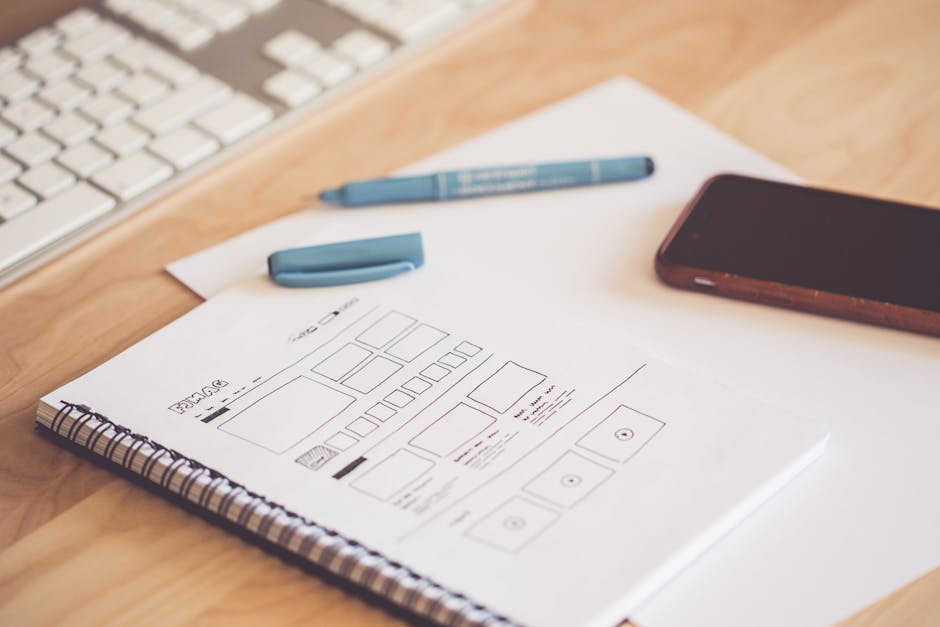
Here is our battle-tested 5-phase framework for transforming your website.
Phase 1: Discovery, Research, and Goal Setting
Before you open a single design tool or touch a line of code, you must understand where your website stands today.
- Audit Your Metrics: Pull up Google Analytics and Google Search Console. Identify your highest-performing pages, your primary traffic sources, and the exact points where users are bouncing.
- Analyze the Competition: Look closely at your direct competitors in markets like Cleveland, Charlotte, or Pittsburgh. What are they doing well? Where are their sites falling short?
- Set SMART Goals: Do not just say, "We want a prettier website." Instead, set specific goals: “We want to reduce our mobile bounce rate by 20% and increase our inbound lead conversion rate by 30% within three months of launch.”
For a deeper dive into establishing these initial benchmarks, explore our Business Website Redesign Guide 2026.
Phase 2: Site Structure and Content Strategy
A beautiful design is useless if your content strategy is broken. In Phase 2, we map out the logical hierarchy of your site.
- Map Your Sitemap: Keep your navigation clean and simple. Group related pages into logical categories.
- Plan Content Migration: Identify which high-performing blog posts and landing pages must be preserved exactly as they are to protect your organic rankings.
- Optimize for GEO (Generative Engine Optimization): As search behavior shifts in 2026, your content must be optimized not just for traditional search engines, but also for AI-powered search engines and LLMs (like ChatGPT, Claude, and Google Gemini). This means structuring your content with clear, direct answers, schema markup, and highly authoritative, context-rich copy.
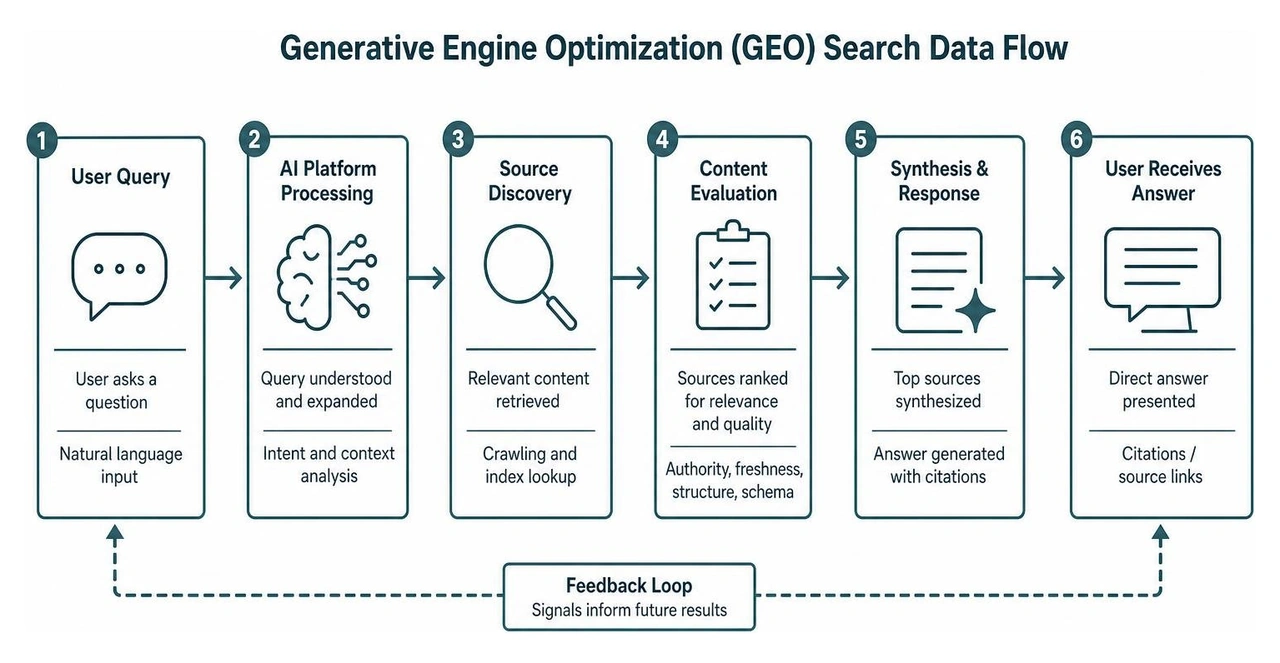
If you are operating in the B2B space, structuring this information correctly is critical for capturing high-intent enterprise leads. Read more about tailoring your content architecture in our guide to B2B Website Redesign.
Phase 3: How to Revamp Website Visuals and UX
With a solid structure in place, we can now focus on the visual layer. This is where your brand truly comes to life.
- Establish a Visual Style Guide: Define your typography scales, modern color systems (such as OKLCH color spaces for vibrant, accessible web colors), and custom iconography.
- Prioritize Accessibility (ADA Compliance): Ensure your color contrast ratios are high enough for easy reading, your fonts are highly legible, and your interactive elements are fully keyboard-navigable.
- Design Mobile-First: Build your layouts starting with the smallest screens first. If your design works beautifully on a smartphone, scaling it up to desktop is simple.
For businesses looking to stand out locally, working with specialized design experts who understand regional market preferences is invaluable. Learn how localized design elements can elevate your brand in our Small Business Website Redesign Guide.
Phase 4: Technical Execution to Revamp Website Code and Speed
This is where the magic happens. We translate design mockups into clean, production-grade code.
- Why We Build on Webflow: Webflow allows us to develop custom, responsive websites with incredibly clean code. It eliminates the need for bulky, security-vulnerable plugins, ensuring your site remains fast and secure.
- Optimize for Speed: Implement lazy loading for images and videos, leverage advanced global CDNs, and ensure your site achieves near-perfect scores on Google's Core Web Vitals.
- Incorporate Smart AI Workflows: We use AI tools to accelerate code optimization, generate clean schema markup, and automate repetitive asset-formatting tasks. This ensures your project moves quickly without sacrificing quality.
If you are based in Ohio, you can find localized development strategies tailored to your market by visiting our resource on Cleveland Website Redesign.
Phase 5: Launch, SEO Preservation, and Post-Launch Optimization
The launch phase is where many DIY revamps fail. If you do not carefully preserve your SEO authority, you can lose 30% to 50% of your search traffic overnight.
- Create a 301 Redirect Map: If any of your page URLs are changing during the revamp, you must map the old URL to the new equivalent. This tells Google exactly where the content has moved and preserves your backlink equity.
- Submit Your XML Sitemap: Immediately after launch, submit your updated sitemap to Google Search Console to encourage rapid re-indexing.
- Post-Launch Monitoring: Run continuous QA tests. Monitor user behavior using heatmaps, track your keyword rankings, and prepare to run A/B testing on your primary CTA buttons to maximize conversions.
For businesses launching in specific metro areas, local optimization is key. Check out our Website Redesign Local Guide to learn how to successfully navigate regional launches.
Cost Considerations, Timeline, and ROI Expectations
A website revamp is an investment, but when compared to a full redesign, it offers a much faster path to profitability. Because you are not rebuilding your entire database or rewriting every single line of copy, you save significantly on both development hours and project management overhead.
| Project Scope | Typical Timeline | Key Focus Areas | Average ROI Window |
|---|---|---|---|
| Website Revamp | 2 to 6 Weeks | Visual facelift, UX stream, speed optimization, mobile responsiveness | 2 to 4 Months |
| Full Redesign | 3 to 6 Months | Structural rebuild, CMS migration, complete content rewrite, new branding | 6 to 12 Months |
By leveraging Webflow's efficient development environment, we can build custom, high-converting websites in a fraction of the time it takes to code a site from scratch. This rapid deployment means you can start capturing new leads and revenue almost immediately. To estimate your project's potential return, read our guide on how to Redesign Business Website assets effectively.
Frequently Asked Questions about Website Revamps
How long does a typical website revamp take?
A targeted website revamp typically takes anywhere from two to six weeks, depending on the number of pages and the complexity of the custom interactions. Because we are focusing on upgrading the visual layer, user experience, and page performance rather than starting from scratch, the timeline is significantly shorter than a full redesign.
Will a website revamp hurt my existing SEO rankings?
Not if it is executed correctly. By keeping your core content structure intact, maintaining your existing URL paths, and implementing a rigorous 13-point 301 redirect map for any URLs that do change, you can protect your search authority. In fact, because search engines favor fast, mobile-friendly sites, most businesses see an organic traffic boost of 30% to 50% within a few months of a revamp.
How can AI tools assist in the website revamp process?
AI tools are incredibly powerful for accelerating the research and development phases. We use AI to analyze large datasets of user behavior, generate structured schema markup for local SEO, and write highly optimized meta descriptions. However, human oversight remains essential to ensure your brand voice is preserved and your code is clean, accessible, and secure.
Conclusion
Your website is the digital front door to your business. If it is slow, hard to navigate on a phone, or visually outdated, you are silently losing customers to competitors who have invested in a modern web experience.
You do not need to spend six months and tens of thousands of dollars rebuilding your digital presence from the ground up. By focusing on a strategic, 5-phase website revamp, you can dramatically improve your user experience, supercharge your page speeds, protect your SEO rankings, and drive more conversions.
At Refresh, we specialize in helping growth-minded businesses build high-performance Webflow websites that serve as long-term marketing engines. We don't just hand over a template and walk away; we focus on building collaborative, long-term partnerships that support your digital growth for years to come.
Ready to transform your online presence? Read our Website Redesign Services Ultimate Guide or get in touch with our team in Pittsburgh, Cleveland, or Charlotte to schedule a comprehensive website review. Let's build something remarkable together.


.avif)