
Why a Digital and Social Media Marketing Strategy Is Your Business's Growth Engine

A strong digital and social media marketing strategy is the difference between posting into the void and building a brand that actually grows. Here's what that looks like in practice:
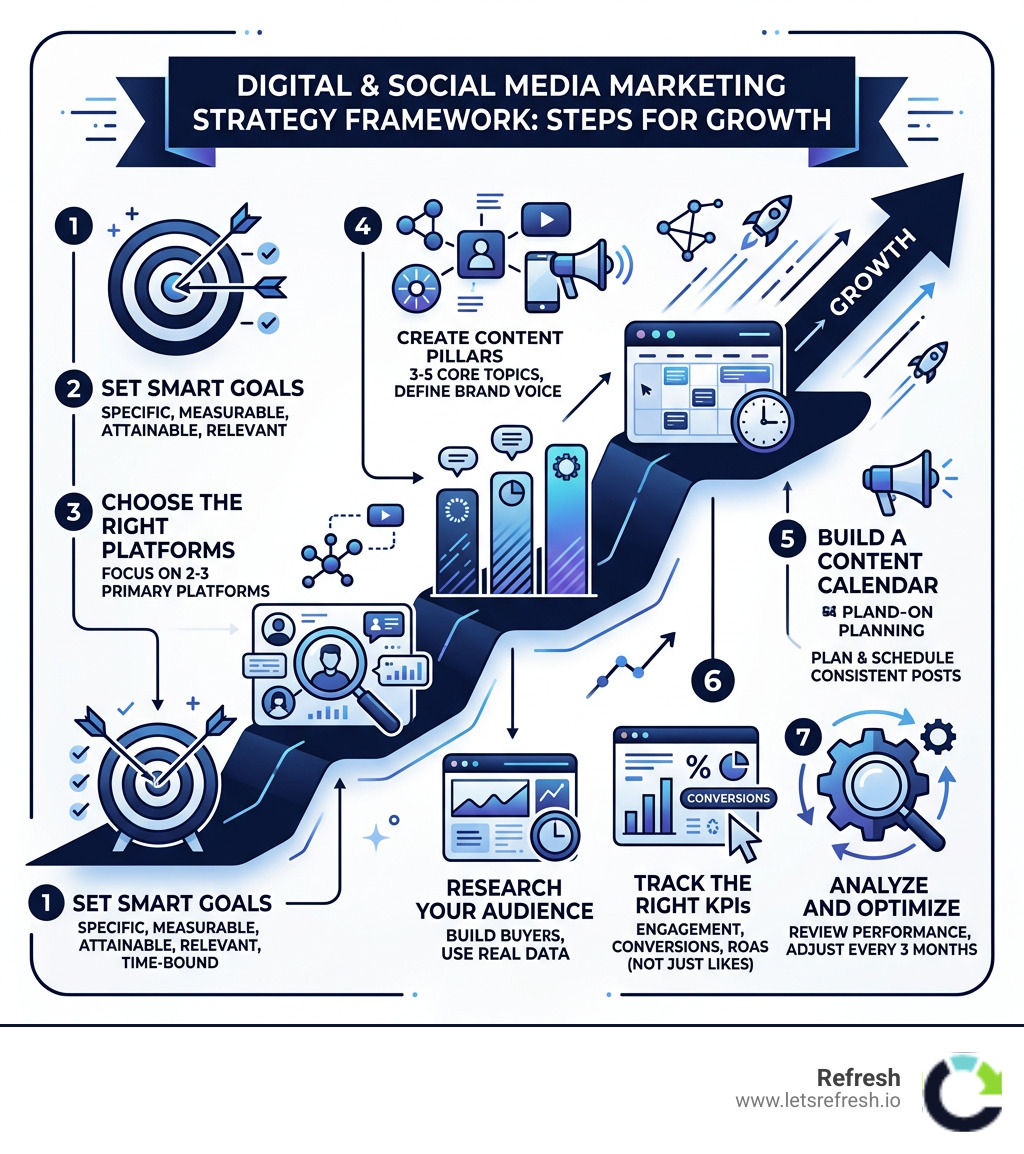
How to build a digital and social media marketing strategy:
- Set SMART goals — specific, measurable, attainable, relevant, and time-bound
- Research your audience — build buyer personas based on real data
- Choose the right platforms — focus on 2-3 where your audience is most active
- Create content pillars — 3-5 core topics that anchor your brand voice
- Build a content calendar — plan and schedule posts consistently
- Track the right KPIs — engagement, conversions, ROAS, not just likes
- Analyze and optimize — review performance and adjust every 3 months
As of April 2025, there are 5.31 billion social media identities worldwide. That's an enormous audience — but size alone means nothing without a plan to reach the right people.
Most founders and marketing teams fall into the same trap: posting regularly, getting some likes, and wondering why revenue isn't moving. The problem isn't effort. It's the absence of a real strategy.
Social media without a strategy is, as one marketer put it, "just creating good-looking content and hoping it will grow the audience." Hope is not a marketing plan.
I'm Alexander Palmiere, Founder and CEO of Refresh Digital Strategy, and over the course of launching 200+ websites and digital campaigns for small and midsized businesses, I've seen how a well-built digital and social media marketing strategy transforms online visibility into measurable growth. In this guide, I'll walk you through exactly how to build one from scratch.
The Foundation of a Digital and Social Media Marketing Strategy
At its core, social media marketing (SMM) is the use of social platforms to build a company’s brand, increase sales, and drive website traffic. But in 2025, it’s much more than a megaphone for promotions. It’s a two-way dialogue. Unlike traditional advertising, which shouts at an audience, a modern digital and social media marketing strategy listens to them.
According to 2025 research by Kepios, social media users now number 5.24 billion globally. This massive connectivity allows us to gather unprecedented levels of customer data. Every like, share, and comment is a data point that helps us refine who we are talking to and what they actually want.
At Refresh, we believe that Digital Strategy Consulting and SEO must work in tandem. Your social presence shouldn't be an island; it should be an extension of your broader digital ecosystem, feeding into your website and your long-term growth goals.
Defining SMM vs Traditional Marketing
The biggest shift from traditional to digital is the move from "one-to-many" broadcasting to "many-to-many" interaction. In the old days, you bought a billboard in Pittsburgh or an ad in a Cleveland newspaper and hoped for the best. Today, we focus on electronic Word of Mouth (eWOM) and social equity.
| Feature | Traditional Marketing | Digital & Social Media Marketing |
|---|---|---|
| Communication | One-way (Static) | Two-way (Interactive) |
| Targeting | Broad/Geographic | Specific/Behavioral |
| Cost | High Entry Barrier | Scalable/Flexible |
| Measurement | Delayed/Estimated | Real-time/Precise |
| Engagement | Passive | Active (Likes, Shares, DMs) |
Social media allows for "earned media"—exposure you get through customer-created reviews, recommendations, and shares. This is far more powerful than a paid ad because it carries the weight of peer trust.
Why Structure Matters for SMBs
For small to medium-sized businesses (SMBs) in cities like Charlotte or Pittsburgh, resources are often tight. You can't afford to waste hours on "cool" content that doesn't convert. A structured Social Media Management plan ensures that every post serves a purpose.
Without structure, you’re prone to "post and pray." Consistency suffers, your brand voice becomes muddled, and you miss out on the compounding returns of long-term growth. A strategy acts as your roadmap, helping you decide which opportunities to say "yes" to and, more importantly, which ones to ignore.

Strategic Planning: Goals, Audience, and Channel Selection
Before you open TikTok or Instagram, you need to know where you're going. Strategy is the path to the mountain peak; tactics are the boots you wear to get there.
Setting SMART Goals for Your Digital and Social Media Marketing Strategy
We see it all the time: a business wants "more followers." But followers don't pay the bills—customers do. Your goals must be SMART:
- Specific: Instead of "get more sales," try "increase website leads from Instagram."
- Measurable: "Increase leads by 20%."
- Attainable: Don't aim for 1 million followers in a month if you have 100 today.
- Relevant: Does this goal actually help your business grow?
- Time-bound: "...over the next six months."
By setting these parameters, you can track Social Media Content Marketing efforts against actual business outcomes like conversion rates and ROI.
Audience Research and Persona Development
You cannot speak to everyone. If you try, you’ll end up speaking to no one. Effective audience research involves looking at demographics (age, location, income) and psychographics (pain points, interests, values).
For example, if your target is the 18 to 34 demographic, you’ll likely find them on Instagram or TikTok. But if you’re a B2B service provider in PA, LinkedIn might be your primary "hero" platform. We use empathy maps to understand what our customers are thinking, feeling, and seeing. This allows us to create content that solves their specific problems rather than just talking about ourselves.
Platform Selection and Content Pillars
You don't need to be everywhere. It is much better to master two platforms than to be mediocre on five.
- Facebook: Still a powerhouse for B2C and community building with over 2.1 billion monthly active users.
- Instagram: The visual storefront. It boasts engagement rates more than three times higher than Facebook's.
- TikTok: The discovery engine. With a 2.5% average engagement rate, it’s where trends are born.
- LinkedIn: The gold standard for B2B networking and professional authority.
Once platforms are chosen, we define content pillars. These are 3-5 core topics your brand will consistently discuss. If you’re a boutique fitness studio in Charlotte, your pillars might be: 1) Workout Tips, 2) Client Success Stories, and 3) Nutrition Education. This keeps your feed focused and recognizable.
Content Excellence and Community Management
"Sticky content" is the goal—content that grabs attention, influences a purchase, and encourages a share. In 2025, this often means short-form video.
The Role of Content Calendars and Scheduling
Consistency is the heartbeat of social media. A social media scheduling tool or a simple publishing calendar allows you to batch your work. Instead of scrambling every morning to think of a post, you can plan a month’s worth of content in one afternoon. This ensures you never miss key dates or seasonal trends relevant to your local market.
We also recommend the 50-30-20 rule:
- 50% Value: Content that educates or entertains.
- 30% Curated: Sharing industry news or user-generated content (UGC).
- 20% Promotional: Directly selling your services or products.
Effective Social Media Engagement Strategies also require active community management. If someone comments on your post, reply! Treat your DMs like a sales channel. A quick, helpful response can be the difference between a bounced visitor and a loyal customer.
Competitive Analysis and Finding Gaps
Don't operate in a vacuum. Use tools like the Facebook Ad Library to see what your competitors are running. Look at their most successful posts—not to copy them, but to find content gaps. Are they failing to answer a specific customer question? Is their tone too corporate? This is your opportunity to differentiate your brand and offer a unique point of view.
Measuring Success and Integrating Digital Tactics
If you can't measure it, you can't improve it. We move away from vanity metrics (likes and follows) and focus on value metrics.
Integrating Social with SEO and Webflow Development
At Refresh, we specialize in Webflow because it allows for superior Digital Strategy SEO. Your social media should drive traffic back to a high-converting website.
We also focus on Generative Engine Optimization (GEO). As AI-driven search engines become more common, they look for "brand signals" across the web. If your brand is frequently mentioned and engaged with on social media, AI models are more likely to recommend you as an authoritative source. Social media content, when indexed properly, supports your overall SEO Digital Marketing Content Strategy.
Leveraging AI and Automation in Your Digital and Social Media Marketing Strategy
AI is no longer a luxury; it’s a necessity for scaling. We use AI for:
- Predictive Analytics: Identifying which types of content are likely to perform best.
- Content Scaling: Turning one long-form blog post into ten social media clips.
- Social Listening: Monitoring the web for mentions of your brand or industry keywords in real-time.
By staying on top of Social Media Management Trends, we help our clients in Pittsburgh, Cleveland, and Charlotte stay ahead of the curve without needing a massive internal team.
Frequently Asked Questions about SMM
How long does it take to see results from a social media campaign?
While you might see initial engagement within weeks, a truly optimized digital and social media marketing strategy typically takes 3 to 6 months to show meaningful traction. This period allows for testing different content formats, refining your audience targeting, and building the trust necessary for conversions.
What are the most common mistakes SMBs make in digital marketing?
The most frequent errors include obsessing over vanity metrics (likes) instead of ROI, inconsistent posting schedules, and ignoring direct messages (DMs). However, the biggest mistake is a lack of a central strategy, leading to "random acts of marketing" that don't align with business goals.
How does social media impact Generative Engine Optimization (GEO)?
Social media provides the "social proof" and "authority signals" that AI search engines crave. By consistently producing high-quality, expert-led content on social platforms, you increase your brand's visibility in AI-generated search results, making your business more discoverable during the AI discovery phase.
Conclusion
Building a digital and social media marketing strategy from zero to hero doesn't happen overnight, but with a structured approach, it is entirely achievable for any small or medium-sized business. It requires a shift from tactical posting to strategic thinking—focusing on the right platforms, the right goals, and the right data.
At Refresh, we don't just provide services; we build long-term partnerships. Whether you need expert Webflow development, a comprehensive SEO overhaul, or dedicated social media management, we are here to help you navigate the complexities of the digital landscape in Pittsburgh, Cleveland, and Charlotte.
Ready to stop guessing and start growing? Let’s build something great together. Visit us at https://www.letsrefresh.io/ to start your journey.


.avif)