
Why Different Online Marketing Strategies Define Who Wins in 2026
The different online marketing strategies available today give businesses more ways than ever to reach customers — but also more ways to waste budget on the wrong channels.
Here's a quick overview of the main strategies:
| Strategy | Primary Goal | Best For |
|---|---|---|
| SEO & Content Marketing | Long-term organic traffic | Brand authority, service discovery |
| Paid Search (PPC) | High-intent traffic, fast results | New campaigns, launches |
| Social Media Ads | Demand generation, retargeting | Visual brands, broad audiences |
| Email & SMS Marketing | Retention, follow-up | Repeat engagement, loyalty |
| Influencer & UGC Marketing | Trust building, social proof | Community-driven brands |
| Social Commerce | In-platform engagement | Gen Z and Millennial audiences |
| Omnichannel Marketing | Unified customer experience | Scaling brands, high LTV focus |
Digital buying journeys now span search, social, email, mobile, and AI-assisted discovery, so the bar for a good online experience keeps rising.
Yet most businesses don't have a traffic problem. They have a strategy problem. The average marketer now engages customers across 10 different channels — but without a clear plan connecting those channels, it's expensive noise.
I'm Alexander Palmiere, Founder and CEO of Refresh Digital Strategy, and I've helped over 200 businesses cut through that noise by building focused, data-driven digital marketing strategies. In the sections below, I'll walk you through each core strategy so you can build a channel mix that actually drives growth.
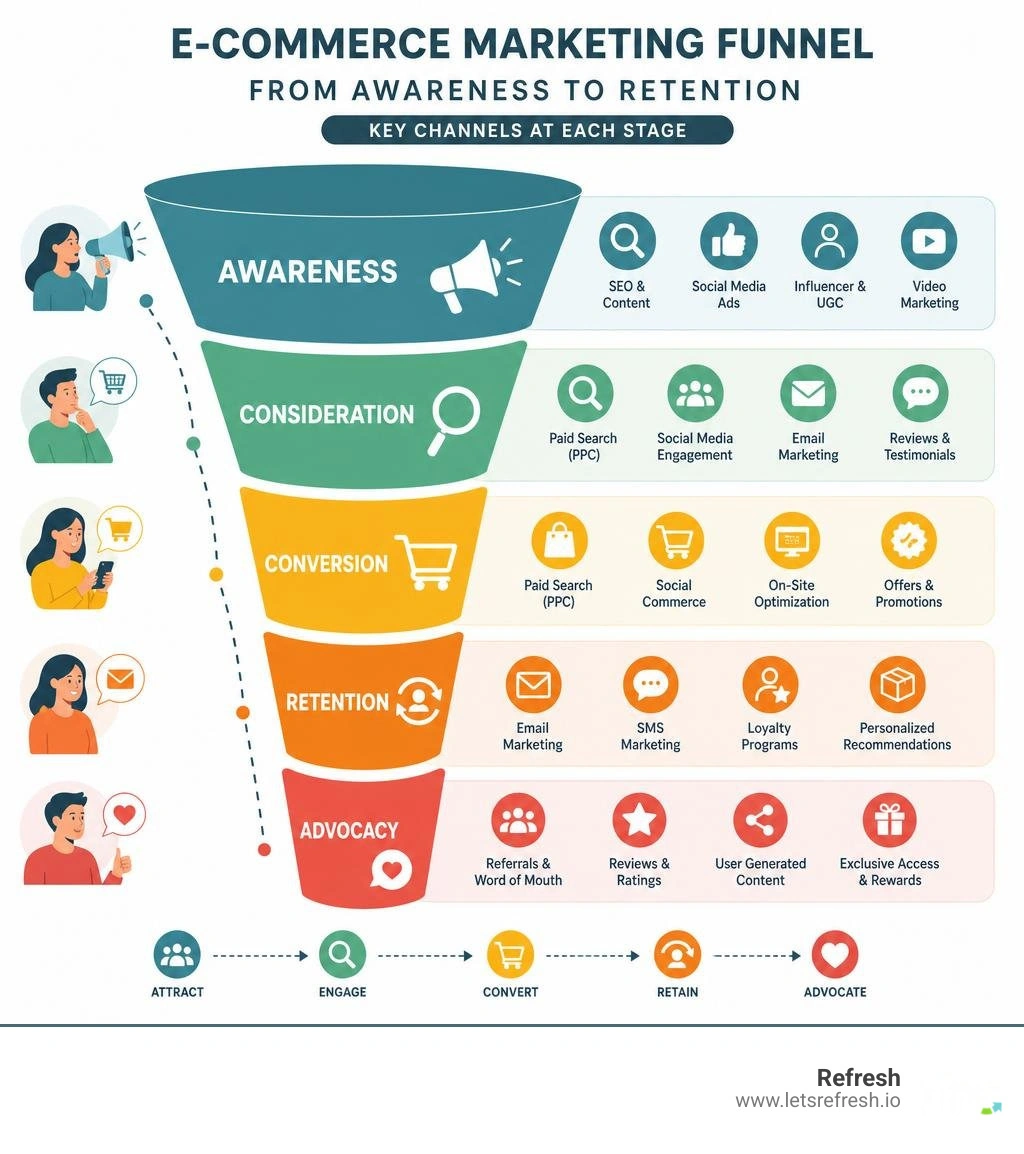
Quick different online marketing strategies definitions:
Understanding the Digital Marketing Landscape in 2026
The digital marketing landscape of 2026 has evolved into a space where traditional, unsegmented tactics no longer work. Competition for consumer attention has reached an all-time high, and brands need a connected strategy to stand out.
This boom, however, comes with a major catch: rising Customer Acquisition Costs (CAC). Across many industries, average CAC has climbed sharply since 2020. This means that relying purely on paid ads to buy your way to profitability is a risky approach. First-conversion profitability is increasingly rare, making customer retention and lifetime value (LTV) the real cornerstones of sustainable growth.
To build a true competitive advantage, we must focus heavily on first-party data collection. As third-party tracking continues to degrade, capturing data directly from your audience—through interactive elements, direct accounts, form fills, and engagement history—is the only way to power accurate targeting and personalization.
At the same time, mobile devices now drive a major share of online traffic. Yet mobile traffic often converts at a lower rate than desktop traffic. This conversion gap is almost always caused by poor mobile optimization and slow load times. Even small delays in mobile load speed can reduce conversion rates.
This is why we champion Webflow solutions for our clients. Webflow’s clean, semantic code and fast performance provide the foundation necessary to build lightning-fast mobile experiences. By combining high-speed development with a robust first-party data strategy, brands can capture high-intent mobile visitors before they bounce to a competitor.
Analyzing Different Online Marketing Strategies

To scale profitably, you cannot treat your marketing efforts as isolated experiments. Successful brands understand that their channel mix must function as a unified, multi-channel journey. The average customer journey in 2026 spans multiple touchpoints before a decision is made. A prospect might discover a brand via a video on social media, read a detailed comparison guide on a blog, click a search ad, and finally convert after receiving a personalized email flow.
When we design a marketing plan, we use the 70/20/10 budget allocation framework to balance predictable returns with innovation:
- 70% of the budget goes to proven, high-performing channels with established ROAS, such as core search campaigns or high-performing email flows.
- 20% of the budget is allocated to scaling and testing channels that show strong potential, such as targeted influencer collaborations or new search campaigns.
- 10% of the budget is reserved for purely experimental campaigns, such as testing emerging platforms or highly creative interactive content.
By structuring your budget this way, you protect your baseline revenue while systematically searching for new growth engines.
However, scaling your budget is completely useless if you are pouring traffic into a leaky bucket. This is where Conversion Rate Optimization (CRO) and our Digital Advertising Solutions come into play. Many brands make the mistake of spending thousands of dollars to acquire new traffic while their website’s conversion rate hovers at a dismal 1%.
If you can lift your conversion rate from 1.5% to 2.5%, you will experience a staggering 67% increase in revenue without spending an extra dollar on advertising. CRO isn't just about changing button colors; it is about analyzing user behavior, streamlining navigation, and stripping away every piece of friction between discovery and conversion.
Organic Channels: The Foundation of Different Online Marketing Strategies
Organic channels represent the compounding machine of your digital presence. While paid ads stop delivering traffic the second you stop paying, organic search engine optimization and content marketing build a durable, lower-cost layer of traffic that grows over time.
To win at organic search in 2026, you must optimize for both traditional search engines and modern AI search assistants. This means your pages must feature clean, descriptive URLs, structured schema markup, and high-quality, naturally integrated keywords. We specialize in building custom, search-optimized architectures to ensure search engines can easily crawl and index your site.
Content marketing is the perfect vehicle to target keywords that do not fit naturally on standard service or landing pages. For example, a brand can create highly informative blog posts targeting comparison, pricing, and problem-aware searches. This captures prospects at the educational stage of their journey, builds immediate brand trust, and guides them toward the appropriate next step.
Furthermore, high-performing organic strategies require a solid technical foundation. If you are operating in our local regions, working with a Pittsburgh Local SEO Company Guide or utilizing expert local insights can ensure your site is structured correctly. By focusing on digital strategy seo, you build an organic foundation that lowers your blended CAC and secures long-term market share.
Paid Search and Social Media Advertising
While organic search is a long-term compounding asset, paid search and social media advertising act as the immediate accelerant for your business. When executed correctly, paid channels allow you to capture high-intent searchers and systematically generate new demand.
Google Search and Performance Max (PMax) campaigns remain high-intent channels. However, PMax can be a double-edged sword. Because the system is highly automated, it often reports inflated ROAS by taking credit for branded search queries and retargeting traffic that would have converted anyway. To prevent this, we recommend setting up brand exclusions in your PMax campaigns and focusing heavily on optimizing your campaign inputs, including your landing pages, creative assets, headlines, and descriptions.
On the paid social side, such as Meta, Instagram, and TikTok, the traditional playbook of granular audience targeting has been replaced by algorithmic distribution, such as Meta's Advantage+ campaigns. Today, creative is the primary targeting mechanism. The algorithm analyzes the visual and textual elements of your ad creative and matches it with the users most likely to engage.
This shift means that creative fatigue is your biggest enemy. Brands that win in 2026 produce a steady flow of ad variations, testing different hooks, formats, and angles. To build a balanced paid ad funnel, we recommend structuring your budgets to separate prospecting from retargeting:
- Prospecting (60% of budget): Broad, creative-led campaigns to introduce new audiences to your brand.
- Retargeting (25% of budget): Dynamic ads targeting warm prospects who visited key pages or took meaningful actions.
- Retention (15% of budget): Ads tailored to existing customers to introduce new offers, services, or engagement opportunities.
For a deeper dive into setting up these systems, explore our guide on Social Media Lead Generation and discover how a dedicated Paid Search Advertising Agency can align your campaigns with clear business goals.
Email and Mobile Marketing for Retention
If paid ads are how you acquire a customer, email and mobile marketing are how you build a profitable relationship. Repeat engagement is the lifeblood of long-term profitability, and owned channels like email and SMS provide a strong channel for retention and follow-up.
Unfortunately, many brands suffer from a "personalization misfire." While many marketers use AI to personalize their content, consumers often still receive content that feels generic. True personalization goes far beyond inserting a first-name token into a subject line. It requires behavioral triggers based on real-time customer actions.
To build an efficient retention engine, you should implement automated flows that target high-intent behaviors:
- Browse Follow-Up: A gentle, helpful email sent when a subscriber views a specific service, category, or resource multiple times without taking the next step.
- Interest Alerts: Automated notifications sent when a relevant update, offer, or resource becomes available.
- Dynamic Recovery: A multi-step sequence that moves away from generic discounts and instead focuses on handling common objections and highlighting customer testimonials.
Alongside email, SMS marketing has experienced a major resurgence. Because text messages have high open rates, they should be used as a fast-response complement to your email strategy, rather than a replacement. Use SMS for time-sensitive alerts, such as event reminders, VIP early access, or immediate follow-up prompts.
By focusing on these high-retention tactics, you can dramatically Boost Online Sales and maximize the value of every single customer you acquire.
Building an Omnichannel Strategy with AI and Personalization
Omnichannel marketing is no longer a luxury reserved for giant enterprises; in 2026, it is table stakes for any growing brand. Consumers increasingly expect their favorite brands to deliver highly connected experiences across mobile, web, and social channels. An omnichannel strategy ensures that regardless of where a customer interacts with your brand, the messaging, pricing, and data remain completely unified.
To achieve this level of integration, you must build a unified customer data foundation. When your email marketing platform, website backend, CRM, and ad channels share data in real-time, you can create seamless customer experiences. For example, if a customer completes a conversion on their laptop, they should immediately be excluded from receiving retargeting ads for that exact action on their phone. Instead, they should transition into a relevant follow-up sequence.
AI plays a critical role in orchestrating these complex, multi-channel journeys. Rather than using AI for flashy, superficial gimmicks, high-performing brands use narrow, practical applications:
- Predictive Churn Identification: Analyzing customer engagement patterns to flag accounts that are slipping away, triggering an automatic win-back campaign.
- Dynamic Recommendations: Utilizing machine learning to suggest highly relevant resources, services, or offers based on a visitor's specific browsing and engagement history.
- Automated Forecasting: Predicting regional demand or campaign performance to ensure teams can plan staffing, budgets, and content around likely demand.
By combining a unified data foundation with smart, behavioral personalization, you can turn disconnected touchpoints into a more trusted customer journey.
Integrating Different Online Marketing Strategies into a Unified Funnel
To prevent your marketing tactics from clashing, you must map them to a clear, funnel-based framework. Real customers do not move through a rigid, linear pipeline, but categorizing your strategies by funnel stage ensures you deliver the right message at the exact right moment.
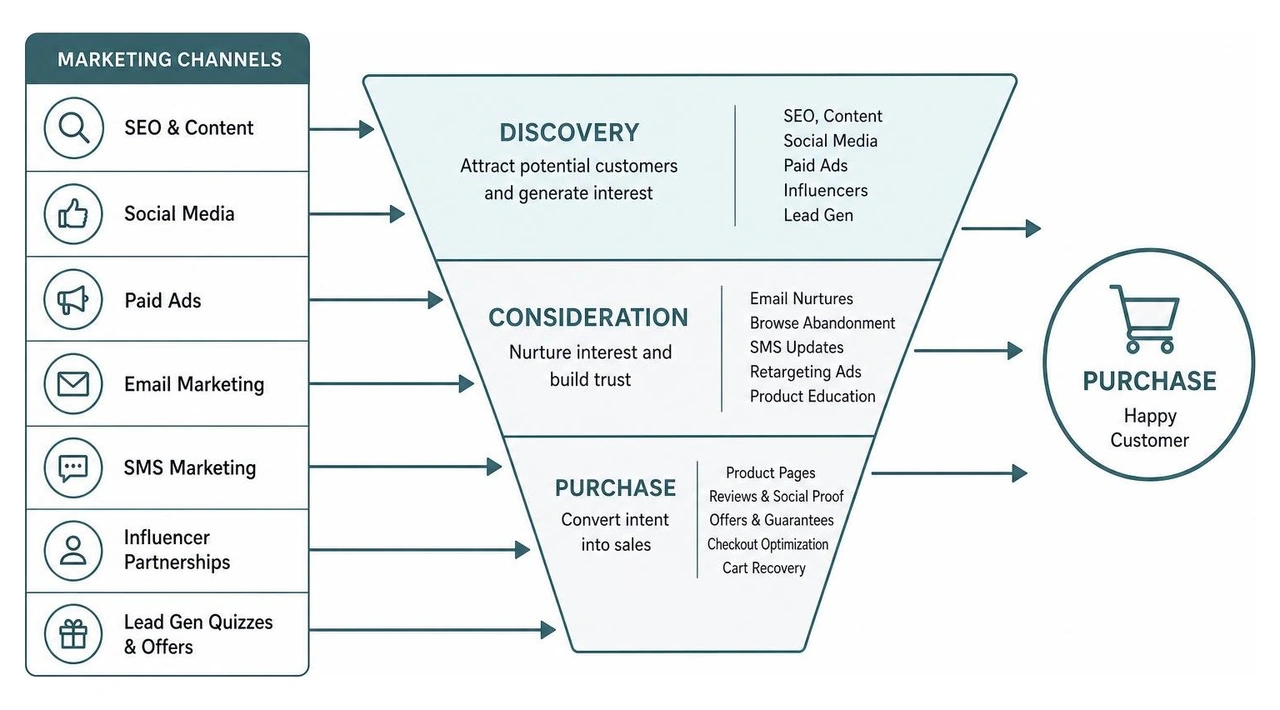
At the Top of the Funnel (ToFu), your primary goal is discovery and lead generation. This is where SEO, content marketing, paid social prospecting, and interactive lead-generation quizzes live. A well-designed quiz allows you to collect valuable first-party preference data from day one, helping you segment your audience before you even send your first email.
In the Middle of the Funnel (MoFu), you focus on nurturing and consideration. Strategies here include browse follow-up emails, SMS updates, and educational retargeting ads that address common questions.
At the Bottom of the Funnel (BoFu), you focus on conversion. This involves showing high-quality customer reviews, highlighting satisfaction guarantees, and optimizing your key pages to eliminate friction. By aligning every tactic with a specific funnel stage, you can systematically Increase Website Conversions and build a predictable, repeatable customer acquisition engine.
Leveraging Social Commerce, UGC, and Influencer Marketing
Social media attention is fast and fleeting. While a viral post can drive a sudden spike in traffic, it rarely builds lasting brand loyalty on its own. To turn social attention into sustainable revenue, you must integrate social discovery with your owned marketing channels.
Social commerce has transformed platforms like Instagram and TikTok from simple discovery channels into more integrated brand discovery and buying environments. Millennial and Gen Z audiences increasingly prefer to complete more of their journey directly inside their favorite messaging and social apps. To capture this demand, brands must set up optimized social storefronts and make discovery as seamless as possible.
User-Generated Content (UGC) and influencer marketing are the cornerstones of building trust online. Many consumers prefer watching videos for discovery, and many trust third-party reviews far more than polished corporate advertising. To leverage this behavior, we recommend:
- Partnering with Micro-Influencers: Collaborating with creators who have highly engaged, niche audiences that align perfectly with your target customer.
- Encouraging Customer UGC: Running post-conversion campaigns that incentivize customers to share their own videos, photos, or testimonials in exchange for loyalty points or future offers.
- Using Social Proof in Email: Integrating real customer reviews and star ratings directly into your promotional email campaigns and follow-up sequences.
By placing authentic social proof at the center of your marketing, you build a community of brand advocates who naturally attract new customers to your brand.
Optimizing Conversion Paths and Reducing Abandonment
The average abandonment rate across digital journeys is high. This means that many prospects who begin the process will leave before completing the desired action.
To recover these near-misses, you must audit your conversion experience and eliminate every unnecessary hurdle. The table below outlines the most common friction points and how to solve them:
| Friction Point | Strategic Solution | Impact |
|---|---|---|
| Unexpected costs or unclear next steps | Display all key details upfront; make the next action obvious | Reduces sudden abandonment |
| Forced account creation | Offer a frictionless guest or low-commitment option where appropriate | Speeds up conversion and prevents user frustration |
| Too many form fields | Simplify forms; support easy mobile completion | Dramatically improves mobile conversion rates |
| Dead-end pages | Replace dead ends with relevant recommendations or next-step CTAs | Keeps high-intent visitors engaged on your site |
By addressing these friction points and pairing them with a highly responsive, multi-step recovery flow, you can turn abandoned journeys into a reliable source of recovered revenue.
Measuring Success: Key Metrics and KPIs
To ensure your marketing plan is actually profitable, you must look beyond vanity metrics like social media likes or platform-reported ROAS. High-performing brands evaluate their performance using a holistic set of financial and operational Key Performance Indicators (KPIs):
- Customer Acquisition Cost (CAC): The total marketing spend divided by the number of new customers acquired. Keep your CAC segmented by channel to see where your ad dollars are most efficient.
- Customer Lifetime Value (LTV): The total net profit a customer generates during their entire relationship with your brand. A healthy, growing business should target an LTV:CAC ratio of 3:1 or higher.
- Marketing Efficiency Ratio (MER): Calculated as total revenue divided by total marketing spend across all channels. MER provides a clear, high-level view of your overall marketing efficiency, bypassing platform attribution errors.
- Contribution Margin After Marketing: The money left over from your revenue after subtracting delivery costs, software costs, transaction fees, and marketing spend. This is the ultimate metric of true business profitability.
By tracking these metrics in a simple, unified dashboard, you can make intelligent scaling decisions based on hard data rather than gut feeling. To learn more about setting up these tracking frameworks, explore our guide on how to Maximize Marketing ROI.
Frequently Asked Questions about Digital Marketing
What is the most common challenge in digital marketing and how do you overcome it?
The most common challenge in digital marketing is the combination of rising Customer Acquisition Costs (CAC) and creative fatigue. As ad platforms become more automated, brands can no longer rely on technical hacks in their ad accounts to win.
To overcome this, you must focus on two areas:
- Creative Volume: Establish a consistent pipeline of new ad variations, including images, short-form videos, and copy angles, to keep the algorithms optimized.
- First-Party Data and Retention: Implement server-side tracking, such as Meta Conversions API and Google Enhanced Conversions, to reduce reliance on cookies, and build robust email and SMS flows to maximize the lifetime value of the customers you already have.
How can small and medium businesses compete with larger players?
Small and medium businesses cannot outspend larger competitors, but they can easily outmaneuver them. Large corporations are often slowed down by complex approval processes, outdated legacy software, and rigid brand guidelines.
As an SMB, you can win by leveraging:
- Niche Targeting: Focus on serving a highly specific, passionate community rather than trying to appeal to everyone.
- Webflow Agility: By utilizing Webflow for your website development, you can design, test, and launch custom landing pages and campaigns in a fraction of the time it takes a large enterprise.
- Personalized Customer Service: Build genuine customer relationships by offering outstanding, personalized support and community engagement.
For a complete blueprint on scaling your brand, check out our SMB Digital Marketing Guide 2026.
What emerging trends should digital marketers adopt in 2026?
The most critical emerging trend is Generative Engine Optimization (GEO). As consumers increasingly use AI search assistants, such as ChatGPT, Claude, and Gemini, to research products, traditional search engine optimization is shifting. Brands must optimize their structured data, service information, and content to ensure they are recommended in AI-generated answers.
Other major trends include:
- Conversational Marketing: Utilizing advanced, AI-powered chatbots to answer questions, recommend resources, and guide users through the decision process in real-time.
- Video-First Engagement: Prioritizing short-form, interactive video content across all channels, from social media to key landing pages.
Conclusion
Mastering the different online marketing strategies requires a careful balance of creative storytelling, technical excellence, and rigorous data analysis. There is no single "magic" channel; instead, sustainable growth comes from building a unified, multi-channel journey that guides prospects seamlessly from discovery to repeat engagement.
At Refresh, we are a digital marketing and Webflow website development agency specializing in helping small to medium-sized businesses grow. We do not believe in short-term marketing hacks or generic, one-size-fits-all campaigns. Instead, we focus on building deep, long-term partnerships, providing expert Webflow support, and designing custom digital strategies that drive real business results.
Whether you are looking to optimize your SEO, launch high-performing paid campaigns, or completely redesign your website, our teams in Pittsburgh, PA, Cleveland, OH, and Charlotte, NC are ready to help.
Are you ready to stop guessing and start scaling? Grow Your Business with Refresh today.


.avif)