
Why Creating a Digital Marketing Strategy Drives Focused Growth
Creating a digital marketing strategy means turning business goals into a clear plan for reaching the right people, on the right channels, with measurable results. For a growth-stage startup, it connects your website, search visibility, content, email, social media, and paid campaigns so they work toward the same outcome: more qualified customers.
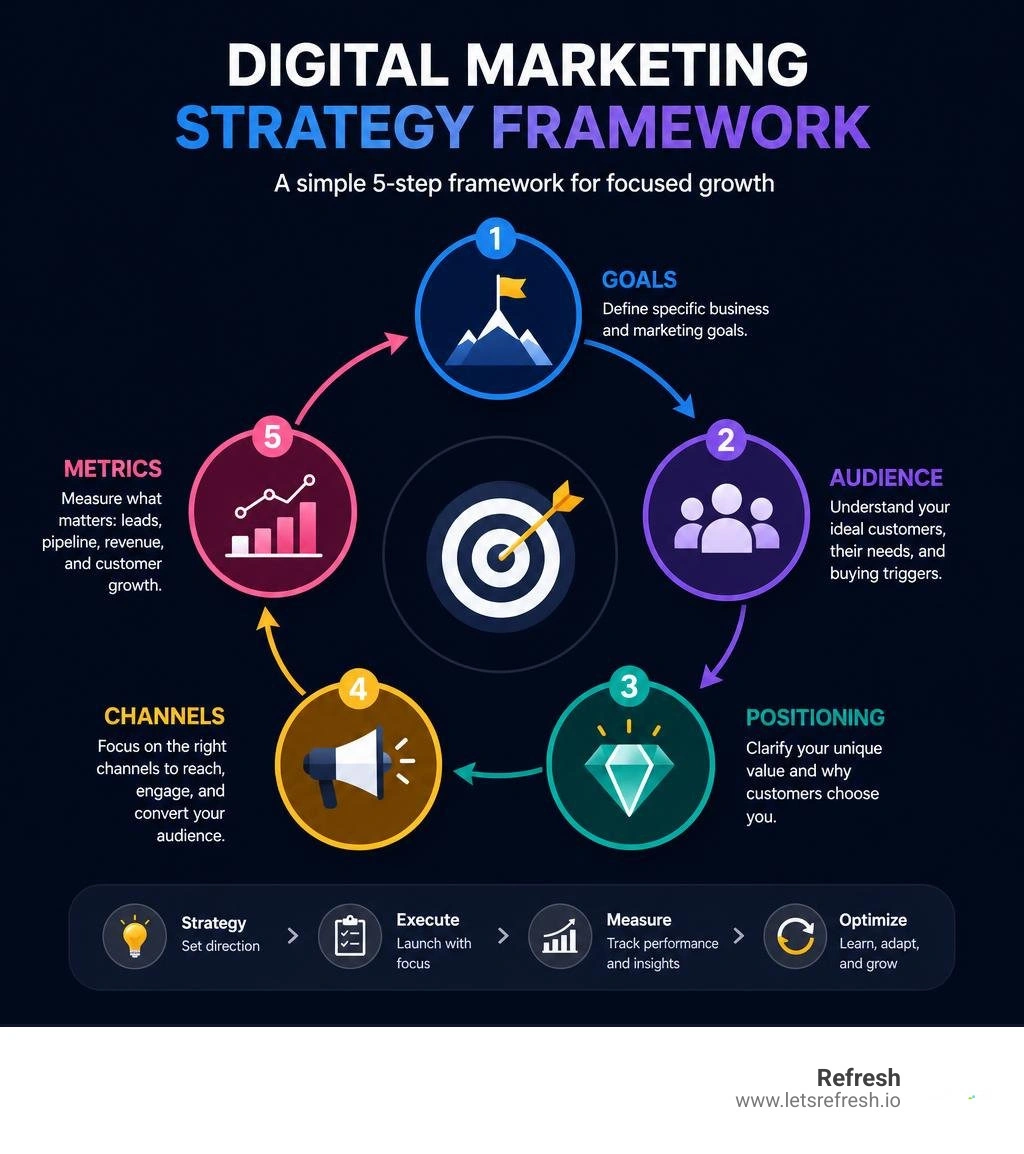
A strong strategy answers these core questions:
- What are we trying to achieve? Set a specific business and marketing goal.
- Who are we trying to reach? Define priority audiences, needs, and buying triggers.
- Why should they choose us? Clarify your value proposition and market position.
- Which channels can reach them effectively? Focus on the few channels that match how buyers research and decide.
- How will we measure progress? Track metrics tied to leads, pipeline, revenue, and customer growth.
This matters because many teams run isolated tactics without a shared direction. A documented strategy gives every campaign, landing page, article, and ad a purpose. It also creates room to adapt as search behavior changes. In 2026, that includes planning for AI search results, zero-click answers, and Generative Engine Optimization (GEO), while still building a fast, clear website - ideally on a flexible platform like Webflow - that converts visitors who do click through.
I am Alexander Palmiere, founder and CEO of Refresh Digital Strategy, where I have helped launch more than 200 websites and build digital foundations for small and midsized businesses. My experience in creating a digital marketing strategy combines Webflow development, SEO, branding, and targeted digital campaigns to help growing companies earn visibility without losing focus on their core operations.
Relevant articles related to creating a digital marketing strategy:
- best online marketing strategies
- digital and social media marketing strategy
- digital marketing expert seo
What Is a Digital Marketing Strategy (And How It Differs From Tactics)?
A digital marketing strategy is a high-level, long-term blueprint designed to achieve specific business goals using online channels. Rather than simply posting on social media or running ad clips, a comprehensive digital marketing strategy outlines why you are taking certain actions, who you are serving, and how your digital presence will generate revenue over time.
Industry data reveals that 49% of organizations do not have a clearly defined digital marketing strategy, while only 17% explicitly document their approach. Without this strategic framework, businesses often suffer from scattered messaging, wasted ad dollars, and fragmented customer journeys. To understand the importance of a strong digital strategy for small to medium sized businesses, we must first distinguish between strategy, campaigns, and tactics.
Strategy vs Campaigns vs Tactics
To build a cohesive digital engine, we must clarify how operational levels fit together across different time horizons:
- Strategy (Long-Term: Months to Years): Strategy defines the overall vision and destination. For instance, expanding market share in mid-market software by positioning your solution as the easiest integration platform.
- Campaigns (Medium-Term: Weeks to Months): Campaigns are focused initiatives designed to achieve specific strategic milestones. An example is launching an executive webinar series targeted at prospective IT directors over a 60-day window.
- Tactics (Short-Term/Immediate): Tactics are the day-to-day actions that power campaigns. Examples include writing weekly search-optimized blog posts, running A/B tests on landing page headline copy, or sending retargeting emails to past event attendees.
When daily tactics align directly with medium-term campaigns and long-term strategy, every dollar spent and hour invested brings measurable compounding growth.
The 4 Essential Pillars of a Modern Strategy
A resilient digital marketing strategy relies on four core pillars:
- Clear Business Goals: Direct alignment between high-level revenue targets and marketing objectives.
- Audience Insights: Data-backed buyer personas built from CRM insights and customer feedback rather than assumptions.
- Resource Planning: Realistic allocation of internal talent, agency support, tech stack resources, and capital.
- Performance Metrics: Funnel-aligned Key Performance Indicators (KPIs) that track progress from initial brand impression to final conversion.
To organize these pillars across channels, we categorize our marketing levers into the Digital Marketing Trifecta: Owned, Earned, and Paid Media.
| Media Category | Definition & Core Assets | Primary Marketing Value | Example Levers |
|---|---|---|---|
| Owned Media | Digital channels and assets completely controlled by your company. | Builds long-term brand equity, organic traffic, and conversion value. | Webflow website, corporate blog, email lists, native social profiles. |
| Earned Media | Organic exposure and brand authority gained through word-of-mouth or third-party validation. | Establishes domain trust, brand authority, and buyer validation. | PR coverage, organic social shares, user reviews, backlink profiles. |
| Paid Media | Promotional channels where you pay directly to display content or drive traffic. | Delivers fast reach, immediate targeted traffic, and testable lead generation. | Search ads (PPC), paid social ads, sponsored newsletters, retargeting. |
Step-by-Step Blueprint for Creating a Digital Marketing Strategy
Developing an effective strategy requires a systematic diagnostic process before launching new tactics. Skipping foundational audits often leads to burning budget on channels that do not fit your buyer's natural research journey.
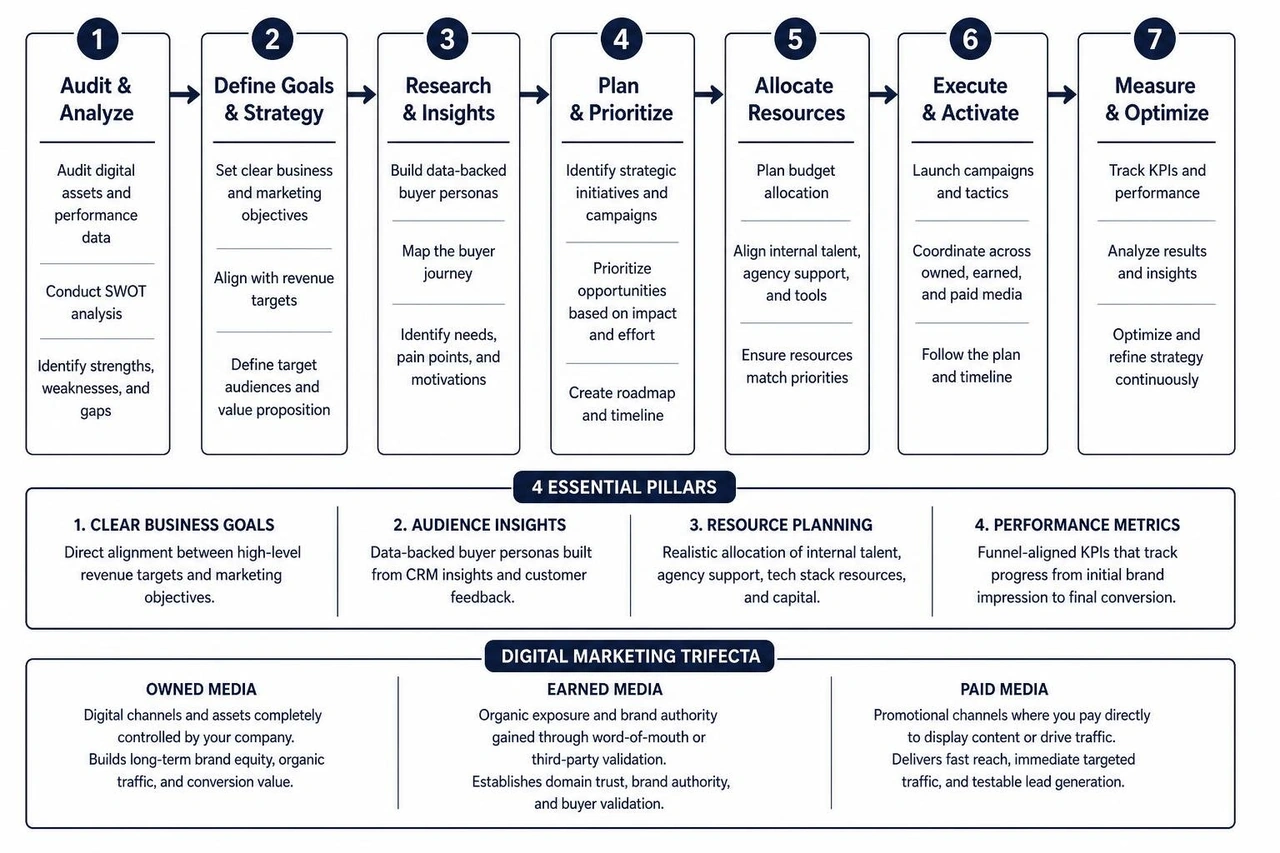
Here is the operational framework we use when creating a digital marketing strategy for growing brands:
1. Conduct a Digital Asset Audit & SWOT Analysis
Begin by auditing 90 days of performance data across your website, analytics platforms, search engine rankings, and ad accounts. Categorize your existing marketing assets and rank active channels as Good, Average, or Poor.
Pair this asset evaluation with a classic SWOT analysis to identify:
- Strengths: High-converting Webflow landing pages, strong search authority, active customer base.
- Weaknesses: Low mobile site speed, outdated branding, lack of gated lead magnet content.
- Opportunities: Emerging search intent keywords, expanding local search presence, automated nurture workflows.
- Threats: Increasing cost-per-click (CPC) rates, aggressive local competitors, shifting search engine answer summaries.
Setting SMART Goals for Creating a Digital Marketing Strategy
General desires like "get more website visitors" or "increase social engagement" make evaluating strategy success impossible. Instead, translate high-level business goals into specific SMART targets (Specific, Measurable, Attainable, Relevant, Timely).
For example, rather than setting a vague objective to grow online leads, structure your marketing goal like this: "Increase qualified inbound leads by 25% over the next two quarters by optimizing core Webflow site pages for high-intent keywords and launching a targeted LinkedIn campaign."
When modeling performance, establish three scenario tiers:
- Conservative Scenario: Achieves a baseline ROI assuming market headwinds or minor campaign delays.
- Realistic Scenario: Meets target revenue projections based on historical conversion performance.
- Aggressive Scenario: Captures accelerated market share if ad campaigns scale efficiently.
Audience Segmentation and Defining Value Propositions
Standard marketing messages addressed to broad audiences rarely resonate. Effective strategies divide audiences into distinct segments based on demographics, firmographics, buying behaviors, and core pain points.
Once segments are identified, construct buyer personas based on sales call records, customer interviews, and review mining. Give each persona an actionable profile detailing their daily responsibilities, objections, and buying triggers.
To turn persona insights into conversion-oriented content, analyze your brand using the 3 C's Framework:
- Consumer Analysis: What urgent problem is your target buyer trying to solve right now?
- Competitor Analysis: What value claims are competitors making, and where are the gaps in their service or positioning?
- Company Analysis: What unique operational capability or specialized expertise sets your brand apart?
Synthesize these findings into a practical value positioning statement using this formula:
"For [target market segment] who experience [specific pain point], [Your Brand Name] is the premier solution that delivers [key outcome], unlike [main alternative] because [verifiable reason to believe]."
Selecting Channels When Creating a Digital Marketing Strategy
Small and medium-sized businesses do not need to appear on every digital platform simultaneously. Instead, choose 1 to 3 primary acquisition channels aligned with how your prospective buyers evaluate solutions.

When selecting your ideal channel mix, consider these core levers:
- Search Engine Optimization (SEO): Organic search remains the foundation of sustainable long-term traffic. Learn how to use SEO in your digital marketing strategy to capture active buyer intent and build continuous brand authority.
- Content Marketing: Educate prospects across their decision timeline with in-depth guides, case studies, videos, and comparison pages.
- Email Marketing & Marketing Automation: Email remains a top-performing digital channel for ROI, allowing brands to nurture lead lists, automate onboarding, and re-engage dormant buyers.
- Social Media Marketing: Use platforms like LinkedIn, Instagram, or Facebook to build brand affinity, share thought leadership, and foster direct community engagement.
- Pay-Per-Click (PPC) Advertising: Paid search and social ads provide immediate visibility, targeted geographic reach, and instant performance feedback for promotional campaigns.
For detailed tactical frameworks, review our full How to Build a Digital Marketing Plan (2026 Guide) resource.
Execution: Budget Allocation, Sales Funnels, and Content Calendars
A strategy remains theoretical until you map out budgets, content cadences, and sales funnel touchpoints. Strategic execution ensures every piece of published content serves a distinct function in guiding prospects toward a buying decision.

Mapping Content to the Digital Sales Funnel
The digital sales funnel tracks a buyer's progression from stranger to customer. We structure our content creation strategy around three core funnel stages:
1. Awareness Stage (Top of Funnel - TOFU)
- Buyer Mindset: The prospect experiences a symptom or operational bottleneck and searches for educational information.
- Goal: Drive brand exposure, establish topical authority, and capture broad organic search traffic.
- Tailored Content: Educational blog posts, high-level infographics, industry research reports, and YouTube tutorial videos.
- Primary Metrics: Organic impressions, unique visitors, total site sessions, brand reach.
2. Consideration Stage (Middle of Funnel - MOFU)
- Buyer Mindset: The prospect clearly defines their problem and evaluates potential vendor methodologies or product categories.
- Goal: Convert casual site visitors into contactable leads by offering high-value downloadable resources.
- Tailored Content: Comparison guides, downloadable templates, interactive ROI calculators, webinars, and detailed solution pages.
- Primary Metrics: Click-through rates (CTR), lead magnet downloads, Marketing Qualified Leads (MQLs).
3. Decision Stage (Bottom of Funnel - BOFU)
- Buyer Mindset: The prospect is ready to choose a provider and needs final validation that your offering delivers the best solution.
- Goal: Convert qualified leads into paying clients or scheduled sales conversations.
- Tailored Content: Detailed customer case studies, product comparisons, live platform demonstrations, clear pricing tables, and client testimonials.
- Primary Metrics: Sales Qualified Leads (SQLs), proposal conversions, Customer Acquisition Cost (CAC), closed revenue.
Allocating Budgets and Building Implementation Plans
Budget allocation varies by industry, market competition, and corporate maturity. According to Gartner's CMO Spend Survey, company marketing budgets average roughly 7.7% of total company revenue. Growth-stage companies aiming to capture aggressive market share often re-invest higher percentages to establish initial audience footprints.
When building an implementation budget, distribute funds across four critical operational areas:
- Paid Media & Channel Promotion: Direct ad spend on Google Ads, LinkedIn Ads, or Meta retargeting.
- Content & Asset Creation: Expert writing, custom graphics, video production, and conversion design.
- Technology & Infrastructure: Website hosting (such as Webflow), marketing automation tools, analytics software, and call tracking.
- Specialized Agency Support: Strategic leadership, SEO technical management, and creative strategy partnerships.
To optimize ongoing resource investments, apply the Create, Fix, or Scale Framework:
- Create: Build missing core assets (such as conversion-focused Webflow landing pages or lead nurture emails).
- Fix: Resolve conversion bottlenecks, slow site load times, broken tracking tags, or underperforming ad copy.
- Scale: Increase budget and distribution for channels that demonstrate consistent positive ROI and scalable acquisition metrics.
To discover how integrated channel execution drives scalable growth, check out our Digital Marketing Strategies Ultimate Guide 2026.
Measuring Performance, Adapting to AI, and Strategy Optimization in 2026
Building a strategy is an ongoing cycle rather than a static project. Modern marketing teams track performance metrics regularly and adapt to structural shifts in search technology and user behavior.
Key Marketing Metrics and Analytics
Tracking too many superficial metrics leads to analysis paralysis. While vanity metrics like social impressions provide surface-level feedback, your primary strategy evaluation must center on bottom-line commercial metrics:
- Customer Acquisition Cost (CAC): Total marketing and sales spend divided by the number of new customers acquired during a set timeframe.
- Customer Lifetime Value (LTV): The total net revenue a single customer generates across their entire relationship with your brand. Healthy growth models aim for an LTV to CAC ratio of 3:1 or higher.
- Marketing Return on Investment (MROI): Revenue generated directly from digital initiatives divided by total marketing expenditure.
- Conversion Rate (CR): The percentage of total site visitors who complete a desired action (such as filling out a contact form or booking a discovery call).
- Pipeline Value: Total estimated deal value generated directly by digital marketing qualified leads.
Set up modern analytics tracking platforms like Google Analytics 4 (GA4), search performance consoles, and CRM attribution software before launching campaigns to ensure accurate measurement across every touchpoint.
Adapting to AI, Zero-Click Searches, and Generative Engine Optimization (GEO)
Search engine landscapes have transformed significantly. With AI-driven answer engine summaries and instant knowledge features appearing across major search platforms, zero-click searches now represent a significant portion of user search journeys. Users frequently receive direct answers directly on search result pages without needing to click through to an external link.
To thrive in this environment, modern strategies must incorporate Generative Engine Optimization (GEO).
Generative Engine Optimization (GEO) focuses on structuring website content, authority signals, and brand references so that generative AI answer engines cite your business as a trusted source in summaries.
To optimize your digital assets for Generative Engine Optimization (GEO) and zero-click search patterns:
- Publish Verifiable Proprietary Research: Share original survey findings, proprietary statistics, and unique case studies that AI models cite directly.
- Structure Clear Answer Frameworks: Use clear headings, bulleted lists, and succinct summary blocks near the top of educational articles.
- Maintain Strong First-Party Brand Footprints: Ensure your brand's core information, customer reviews, and leadership bios are accurate across business profiles and industry directories.
- Prioritize Modern Web Development: Ensure your primary website is built on a fast, flexible content management system like Webflow, allowing your creative team to launch custom landing pages and structured content layouts quickly.
Common Mistakes to Avoid When Building Your Strategy
Even well-funded marketing initiatives can founder if teams fall into predictable operational traps. When building your digital strategy, guard against these common pitfalls:
- Running Disjointed Campaigns: Launching ads, social posts, and blog content that operate in silos without shared positioning or linked landing page destinations.
- Neglecting Mobile Performance: With up to 70% of web traffic originating from mobile devices, a clunky mobile design severely degrades conversion rates and search rankings.
- Failing to Track Clean Attribution: Launching multi-channel campaigns without configured event tags, conversion pixels, or CRM pipeline tracking.
- Making Reactive Pivots Too Early: Abandoning strategic SEO or organic content initiatives after only a few weeks rather than allowing long-term search value to compound over 3 to 6 months.
- Treating Strategy as a Static Document: Storing your marketing strategy in a static presentation that sits unused rather than operating as an active roadmap managed via agile project boards.
To ensure your social media campaigns remain aligned with your overarching digital ecosystem, explore our dedicated guide on digital and social media marketing strategy.
Frequently Asked Questions About Digital Marketing Strategy
How long does it take to see results from a digital marketing strategy?
Initial data from paid search and social campaigns usually appears within 2 to 4 weeks, providing immediate feedback on messaging and landing page conversion rates. Organic SEO, content authority building, and brand awareness efforts typically take 3 to 9 months to compound into steady organic traffic growth. Small and mid-sized businesses should evaluate strategy performance across a 6 to 12-month timeline to capture full ROI.
What percentage of revenue should be allocated to digital marketing?
Corporate marketing budgets average approximately 7.7% of total company revenue based on modern CMO spend benchmarks. However, early growth-stage businesses or brands expanding into new market territories often invest between 10% and 15% of revenue to build baseline market share and drive initial client acquisition.
How do AI and zero-click searches affect digital marketing strategies in 2026?
AI search summaries reduce traditional click-through rates for basic informational queries. As a result, digital marketing strategies must adapt by focusing heavily on Generative Engine Optimization (GEO), building deep topical authority, and optimizing high-intent conversion pages. Creating original research, direct brand affinity, and an exceptional Webflow user experience ensures your brand continues to win clients even as search environments evolve.
Conclusion: Turn Strategy Into Measurable Growth
Creating an effective digital marketing strategy is not about compiling buzzwords or maintaining an account on every social platform. It is about building a data-driven operational roadmap that connects high-level business goals directly to customer personas, compelling brand positioning, targeted channels, and measurable revenue growth.
Whether you are launching new services or refining your online presence in regional markets like Pittsburgh, PA, Cleveland, OH, or Charlotte, NC, having a clear digital framework ensures every marketing dollar works toward a unified business objective.
At Refresh, we specialize in helping growth-minded businesses design digital strategies that perform. From custom Webflow website development and branding to organic SEO execution and multi-channel campaigns, our team serves as an active, long-term strategic partner for your business.
Ready to stop guessing and start scaling with a strategic marketing engine built for modern search trends? Partner with Refresh to build your custom strategy today.


.avif)