
A Simple Starting Point for Digital Marketing
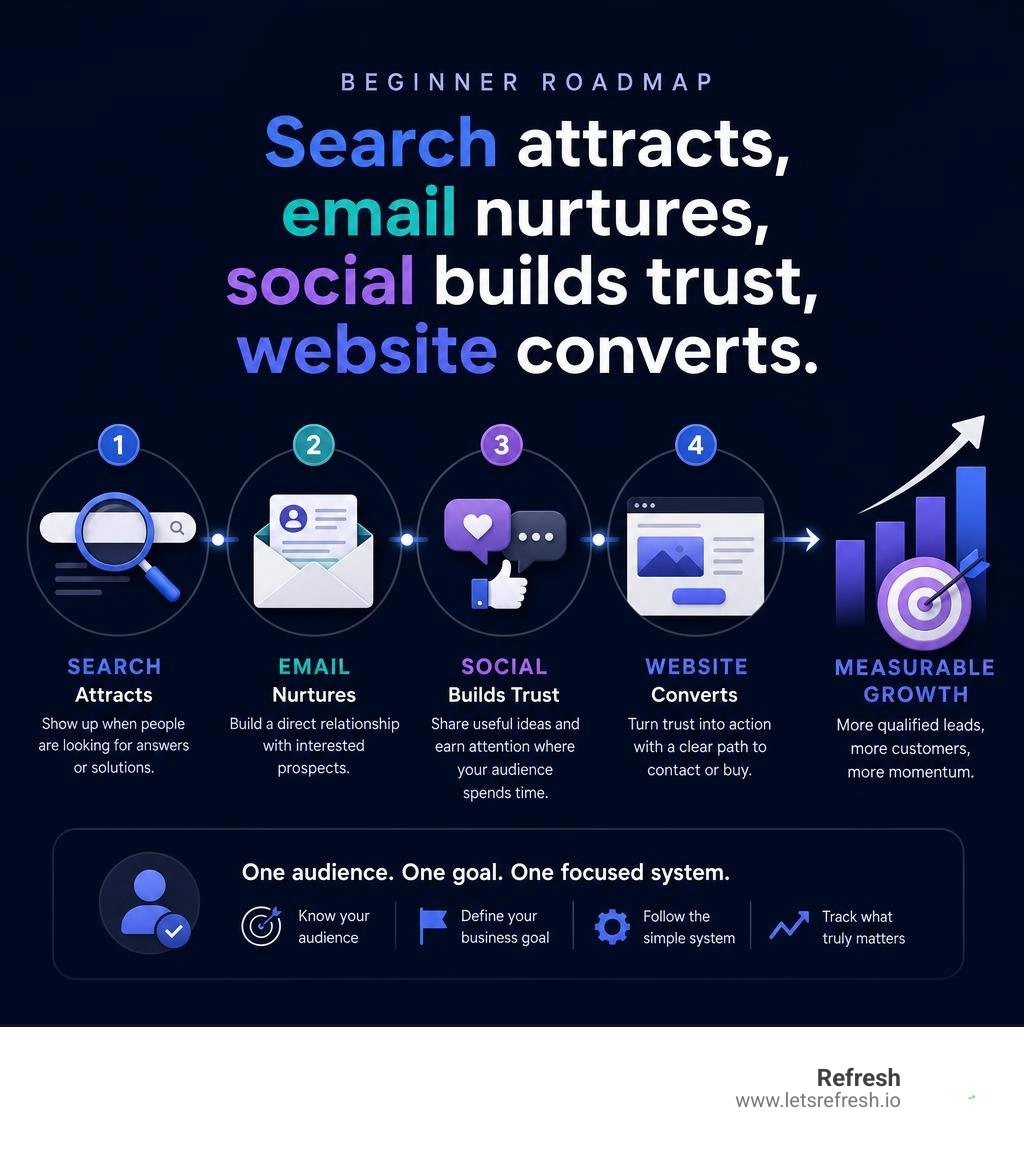
The best way to digital marketing is to start with one clear audience, one business goal, and a simple system for helping people find, trust, and contact your brand.
- Use search to reach people looking for answers or solutions.
- Use email to build a direct relationship with interested prospects.
- Use social media to share useful ideas and earn attention where your audience already spends time.
- Track meaningful actions, such as qualified leads, demo requests, sales, and repeat visits - not just likes or pageviews.
This approach matters because organic search still drives 53% of trackable website traffic, while email remains one of the strongest channels for return on investment. For a growth-stage startup, the goal is not to be everywhere. It is to create a focused digital foundation - ideally on a fast, flexible Webflow website - that turns visibility into measurable business growth.
Modern search is changing, too. AI-generated answers can reduce clicks to traditional search results, which makes helpful, expert-led content and Generative Engine Optimization (GEO) increasingly important. The companies that win will make it easy for people and AI-powered search tools to understand what they offer, who they help, and why they are credible.
I am Alexander Palmiere, Founder and CEO of Refresh Digital Strategy, where I have helped launch more than 200 websites and build digital strategies for small and midsized businesses. My work on the best way to digital marketing combines Webflow development, SEO, branding, and targeted campaigns to help growing companies attract the right customers without losing focus on their core operations.
Quick best way to digital marketing definitions:
- best online marketing strategies
- digital and social media marketing strategy
- digital marketing expert seo
Understanding the Best Way to Digital Marketing Success
When business owners and ambitious professionals ask us about the best way to digital marketing execution, they are usually feeling overwhelmed by an endless stream of tactics. Every week brings a new platform, a trending algorithm shift, or a shiny tool claiming to revolutionize lead generation. However, digital marketing is not an endless checklist of social networks or daily posting quotas; it is an interconnected strategy designed to guide potential buyers seamlessly through their customer journey.
At Refresh, we believe that sustainable marketing success begins by cutting through the noise. Rather than spreading your resources thin across ten different networks, the most effective entry point utilizes a streamlined strategy centered on Search, Email, and Social media. Search brings high-intent prospects to your virtual doorstep, email nurtures direct ongoing relationships on platform assets you truly control, and social media creates community and brand advocacy.
To explore how these channels interact within a mature corporate strategy, explore our Digital Marketing Strategies Ultimate Guide 2026.
The Best Way to Digital Marketing for Complete Beginners
For complete beginners entering the space with minimal upfront capital, finding the best way to digital marketing success comes down to practical execution rather than passive reading. Theoretical knowledge only takes you so far; real expertise comes from launching live projects, writing genuine copy, and watching how real human beings interact with your published assets.
If you are starting from zero experience, the simplest framework involves three straightforward steps:
- Learn Core Terminology: Master the foundational vocabulary across major pillars, including search engine optimization, content creation, email delivery metrics, and analytics.
- Build an Independent Sandbox: Launch a self-managed website or niche blog—preferably built on Webflow for superior design control and technical SEO infrastructure—to practice live content publishing and indexing.
- Execute Micro-Campaigns: Practice hands-on skills by running personal experiments, setting up basic email newsletter workflows, or assisting local businesses in markets like Pittsburgh, PA, Cleveland, OH, or Charlotte, NC.
By taking immediate action on self-owned digital assets, you eliminate the fear of failure and build immediate, verifiable skills.
Selecting the Right Core Channel for Fast Results
A common mistake made by new marketers is attempting to launch simultaneous initiatives on every available platform. Selecting the right primary channel depends heavily on your business category, resource bandwidth, and target market demographics.
For instance, business-to-business (B2B) organizations typically find faster traction by prioritizing organic search and direct networking channels like LinkedIn, where decision-makers actively seek logical solutions to operational challenges. Conversely, business-to-consumer (B2C) brands selling visual products often yield immediate validation through short-form video on channels like TikTok or Instagram.
To understand how custom strategy design aligns with your organization's specific operational needs, consult our comprehensive Digital Marketing Solutions Guide.
The Simple SES Framework for Beginner Marketing
To make online growth manageable, we align our client strategies with the SES framework (Search, Email, Social). Originally conceptualized as a way to simplify digital planning, this framework categorizes all online initiatives into three workhorse pillars mapped to specific funnel stages:
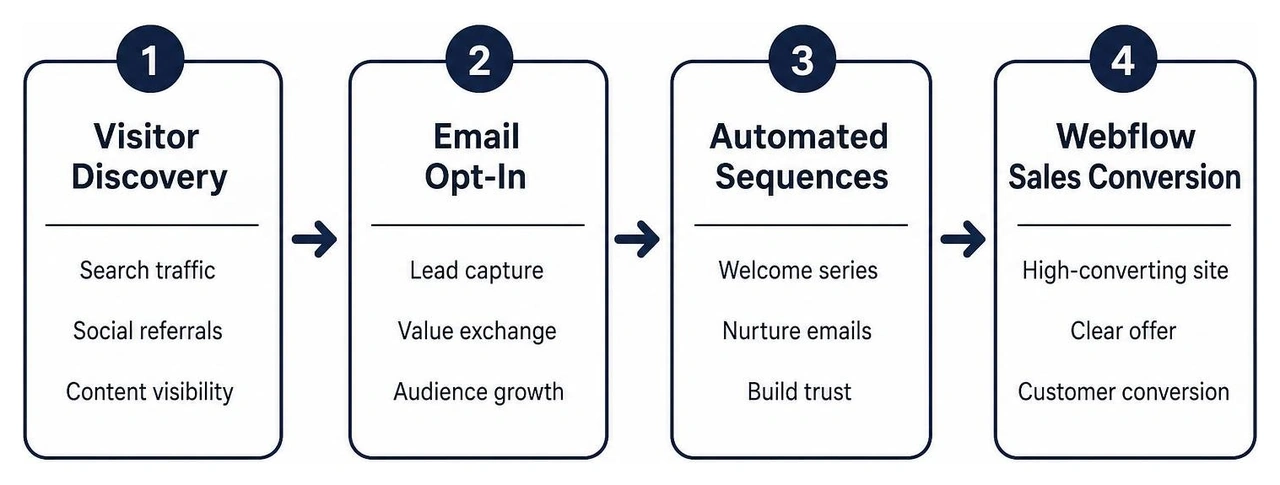
- Search (Discovery): Captures high-intent prospects who are actively searching for answers, products, or localized services.
- Email (Nurturing & Ownership): Builds a direct line of communication with interested leads on media platforms you genuinely own, insulated from algorithm changes.
- Social (Community & Advocacy): Establishes human connections, showcases brand personality, and encourages customer loyalty.
Why the SES Framework Is the Best Way to Digital Marketing Structure
The SES framework represents the best way to digital marketing clarity because it establishes a strategic balance between rented reach and owned media assets. Social media networks and search engines are immensely powerful for driving initial awareness, but they represent rented real estate. A single search update or social algorithm modification can dramatically alter your organic reach overnight.
By configuring search engine traffic and social media engagement to drive traffic back to your central Webflow website—where visitors enter an email sequence—you build an owned database of prospective customers. Email marketing consistently delivers an extraordinary return on investment, returning roughly $36 for every $1 invested.
For deeper insights into combining search and social touchpoints into a unified marketing architecture, review the strategic concepts detailed in Digital Marketing Strategy: The Simple SES Framework .
Capturing Search Traffic with Modern SEO and GEO
Search Engine Optimization (SEO) has always been a primary engine of digital visibility, as organic search drives 53% of all trackable website traffic. With nearly 5.9 million daily searches on Google, appearing on search results pages remains vital for customer acquisition.
However, in 2026, modern SEO requires a broader perspective that includes Generative Engine Optimization (GEO). Modern search engines increasingly display direct, AI-generated synthesized answers directly above traditional search results. Research indicates that when an AI summary appears, users click a traditional organic link only 8% of the time, compared to 15% when no AI summary is present.
To capture search traffic in this evolving environment, we focus on both foundational SEO and Generative Engine Optimization (GEO) tactics:
- Comprehensive Intent Satisfaction: Write exhaustive, authoritative content that answers customer questions thoroughly so AI summary engines digest and cite your material as a primary reference.
- Structured Information Architecture: Build clean, semantic site structures using Webflow's native CMS, allowing both traditional search bots and generative models to extract content hierarchy easily.
- Demonstrated First-Hand Expertise: Provide original research, proprietary data, real-world case studies, and clear author credentials that conversational AI systems favor.
To align your site structure with modern organic algorithms, learn more in our detailed guide on How to Use SEO in Your Digital Marketing Strategy.
Essential Digital Marketing Tools and Skill-Building Tactics

Executing high-performing campaigns does not require enterprise-level software budgets. Modern marketing tools offer entry-level access tiers, enabling growing teams and beginner marketers to manage analytics, creative design, and email delivery efficiently.
To establish a complete operational tech stack, beginners should focus on three foundational tool categories:
- Web Analytics and Search Diagnostic Tools: Google Analytics and Google Search Console provide real-time performance data, tracking user conversion pathways, technical indexing issues, and referral traffic.
- Visual Content and Copy Creation Platforms: Intuitive visual design suites enable non-designers to create sharp social graphics, while modern writing assistants streamline headline generation and outline structuring.
- Marketing Automation Software: Email marketing software allows teams to build contact lists, segment audiences, and deploy automated welcoming sequences. Today, 88% of professional marketing organizations leverage automation software to streamline lead nurturing.
| Marketing Channel | Primary Strategic Role | Key Performance Indicators (KPIs) | Strategic Advantage |
|---|---|---|---|
| Organic Search (SEO/GEO) | High-Intent Customer Discovery | Organic Clicks, Keyword Rankings, AI Citations | Compounding long-term traffic with high conversion intent |
| Email Marketing | Audience Nurturing & Sales Conversion | Open Rate, Click-Through Rate, Lead Conversion | Direct channel control with an average $36 to $1 ROI |
| Social Media | Brand Awareness & Community Building | Engagement Rate, Shares, Audience Retention | High potential for viral reach and human brand building |
Building Hands-On Skills Without a Big Budget
Building practical skill sets quickly requires real-world application. Rather than endlessly taking theoretical courses without practical implementation, we recommend three actionable avenues to accelerate your digital experience:
- Launch a Personal Project: Create a niche content website, local guide, or passion blog. Managing your own domain forces you to tackle domain configuration, content layout in Webflow, metadata writing, and performance measurement.
- Support Local Business Initiatives: Partner with a local small business or non-profit organization in your immediate community (such as Charlotte, NC, Cleveland, OH, or Pittsburgh, PA). Managing their active social channels or updating their local business citations provides immediate hands-on practice.
- Pursue Accessible Industry Credentials: Earn entry-level certifications offered by recognized industry leaders like Google and HubSpot. These structured curricula establish core competence in search advertising, analytics usage, and content strategy.
Role of Affiliate Marketing as a Low-Barrier Entry Point
Affiliate marketing serves as one of the most practical learning models for individuals looking to gain immediate performance marketing experience. In an affiliate model, a marketer promotes third-party products or services using personalized tracking links, earning a performance commission when a sale or lead occurs.
Because major e-commerce platforms and digital software brands provide readily accessible affiliate programs, you can learn copywriting, audience targeting, search engine optimization, and conversion layout without needing to develop your own physical products, manage inventory, or handle customer support. This creates a low-risk environment where you can directly observe how content design and user intent translate into measurable digital revenues.
Common Beginner Pitfalls and How to Avoid Them

The path toward digital marketing mastery is filled with easily avoidable mistakes. Many beginners struggle not due to a lack of effort, but because they focus on the wrong metrics or burn out trying to maintain an unsustainable presence everywhere at once.
To ensure your campaigns remain effective and sustainable, watch out for these primary pitfalls:
- Chasing Vanity Metrics Over Revenue: High impression counts, video views, and social media likes feel rewarding, but they do not pay operational bills. Focus primary measurement on concrete conversions: form completions, email signups, consultation bookings, and actual sales volume.
- Platform Overload and Fragmented Focus: Attempting to publish original content across five social networks, maintain a weekly podcast, run paid search ads, and post daily blogs simultaneously leads directly to strategy fragmentation. Master one search channel and one social network before expanding your footprint.
- Failing to Adapt to Search Volatility: Search engine algorithms and AI summaries continuously evolve. Relying exclusively on single tactics without diversifying into owned email capture leaves your website vulnerable to traffic drops.
For a broader breakdown of operational mistakes made by growing companies, refer to our comprehensive SMB Digital Marketing Guide 2026.
Overcoming Platform Saturation and Burnout
The digital landscape is crowded, and attempting to act as a generalist who offers every possible digital service often leads to burnout. Whether you are an in-house marketer, a small business owner, or an independent consultant, the best way to digital marketing longevity lies in niche specialization and clear execution boundaries.
Specializing in a specific industry niche (such as professional services or B2B software) or mastering a specific technical skill (such as technical SEO or custom Webflow CMS architecture) allows you to stand out far faster than offering generic marketing support. Furthermore, set realistic operational schedules; maintaining a high-quality bi-weekly blog and an engaged email list creates far more long-term value than posting rushed, low-value updates across social channels daily.
To refine your overarching approach to channel selection and brand voice, dive into our framework on Digital and Social Media Marketing Strategy.
Frequently Asked Questions About Digital Marketing Strategies
What is the simplest way to start digital marketing with zero experience or budget?
The simplest starting point is to select one specific topic you understand well, set up a clean blog or portfolio site using Webflow's baseline publishing tools, and publish content that answers specific questions your target audience asks online. Practice writing compelling titles, structuring content for clear reading, and sharing your insights directly on a primary social network like LinkedIn or Instagram. Learn basic analytics tools to monitor how readers find your content and track which topics generate the highest reader interest.
How do beginners choose between SEO, social media, email marketing, and paid ads?
Beginners should base their primary channel selection on customer behavior and available operational bandwidth:
- Choose SEO and GEO if your potential customers actively search online to solve immediate problems or purchase specific products, and you have the bandwidth to build high-quality content for compounding long-term traffic.
- Choose Social Media if your product or service relies heavily on visual demonstration, lifestyle branding, community interaction, or rapid viral feedback.
- Choose Email Marketing as an essential secondary layer for every strategy, capturing traffic generated by search or social to build a predictable, owned sales conversion channel.
- Choose Paid Advertising once you have tested and validated your value proposition organically and wish to scale lead generation quickly with dedicated ad budgets.
How should a beginner measure success and iterate their strategy over time?
Measure success by establishing a handful of meaningful Key Performance Indicators (KPIs) tied directly to underlying business growth rather than surface-level attention metrics. Track qualified lead volume, cost per acquisition, email subscriber growth rates, and website conversion percentages.
Establish a cadence of quarterly performance reviews. Examine your analytics to determine which search terms, content pieces, or referral sources generated actual business inquiries. Double down on the top 20% of content topics driving 80% of conversions, while pruning or updating underperforming pages that fail to engage your target audience.
Conclusion
Mastering the best way to digital marketing growth does not require massive budgets, complex software suites, or attempting to be everywhere at once. By grounding your efforts in a clear, focused SES framework—combining high-intent search discovery, personalized email nurturing, and authentic social engagement—you create a resilient digital engine that reliably attracts and converts your ideal clients.
Modern digital strategy is a continuous process of learning and refinement. As search engines integrate Generative Engine Optimization (GEO) and AI summaries transform how users discover information online, businesses that publish clear, expert-led content on fast, well-designed Webflow websites will consistently maintain a competitive advantage. Focus on delivering genuine value to your audience at every touchpoint, measure the metrics that truly drive revenue, and refine your approach quarterly based on real performance data.
At Refresh, we partner with growing businesses across Pittsburgh, PA, Cleveland, OH, Charlotte, NC, and nationwide to design custom Webflow platforms, execute data-driven SEO strategies, and build scalable digital strategies that drive long-term business expansion. When you are ready to eliminate marketing overwhelm and turn your digital presence into a predictable growth engine, Elevate Your Growth Strategy with Refresh.


.avif)