Why Local SEO Strategies Matter for Your Business
Local SEO strategies are tactics businesses use to improve their visibility in location-based search results. Unlike standard SEO, which targets a broad audience, local SEO focuses on attracting customers in your specific geographic area. When someone searches for "dentist near me" or "best coffee shop in Charlotte," they're looking for a local solution with high purchase intent.
The numbers tell the story: 46% of all searches have local intent, and 80% of local searches on mobile devices lead to a conversion. When people search for local businesses, they're ready to take action—whether that's visiting your store, calling your office, or making a purchase.
For small businesses, local SEO levels the playing field. You don't need to compete with national brands for broad keywords. Instead, you can dominate your local market by showing up when nearby customers are actively searching for what you offer.
I'm Alexander Palmiere, founder of Refresh Digital Strategy. I've helped over 200 small to medium-sized businesses strengthen their online presence and have seen how the right local SEO strategies can transform a business into a local market leader.

Foundational Local SEO: Building Your Local Presence
Before you can dominate local search, you need to understand how Google decides which businesses to show. Google evaluates every local business using three core ranking factors: Relevance, Distance, and Prominence.
- Relevance measures how well your business matches a search query. If someone searches for "plumber in Pittsburgh," Google wants to show actual plumbers in that area.
- Distance considers how close your business is to the searcher's location. A search for "coffee shop near me" will prioritize the closest options.
- Prominence reflects how well-known and trusted your business is online, based on reviews, backlinks, and your overall digital footprint.
These factors determine whether you appear in the Google Map Pack—the block of three local business listings at the top of search results. Getting into the Map Pack is one of the most powerful local SEO strategies you can pursue, as it drives significant traffic, especially on mobile.

To learn more about leveraging this powerful tool, check out our guide on Why Google My Business is Essential for Your Company's Growth.
Optimize Your Google Business Profile (GBP)
Your Google Business Profile is the most important local SEO tool you have. It's often a customer's first impression of your business. Surprisingly, only 56% of local businesses have even claimed their Google Business Profile, leaving a huge opportunity for you.
Start by claiming and verifying your profile. Once verified, complete every single section. Businesses with complete profiles are 70% more likely to attract visits and 50% more likely to be considered for a purchase.
Choose your business name and categories carefully, with your primary category matching your main service. Add high-quality photos and videos to make your listing engaging. List your services and products in detail to help Google match you to specific searches, and keep your contact information and hours accurate.
Use Google Posts to share updates, promotions, and events directly on your profile. These posts keep your listing fresh and provide another touchpoint with customers. Always follow Google Business Profile guidelines to keep your listing in good standing.
Master Local Citations and NAP Consistency
Your business information appears across hundreds of online directories and review sites. These mentions are called citations, and they are a critical piece of your local SEO foundation.
At the heart of every citation is your NAP—your business Name, Address, and Phone number. The golden rule is consistency: your NAP must be identical everywhere. Even small differences can confuse search engines and hurt your rankings. In fact, 63% of consumers say incorrect business information would stop them from using a local business.
Structured citations are formal listings in directories like Yelp or Yellow Pages. Ensure your business is listed accurately on top directories relevant to your industry and location.
Unstructured citations are informal mentions on blogs, news articles, or social media. These are also valuable for establishing your legitimacy.
One common problem is duplicate listings with outdated information, which can harm your local SEO. Regular audits to find and remove these conflicting listings are essential. Building a strong, consistent online presence takes time, but it's foundational to your success. For more on this, read our article on Small Business Online Presence.
On-Site Local SEO Strategies for Your Website
Your website is your digital storefront, and for local SEO strategies to work, it must be informative and fast. Google primarily uses the mobile version of your site for ranking, so a mobile-first design is essential. With more than half of search traffic coming from mobile devices, your potential customers are searching on the go. A seamless mobile experience is critical, as 76% of consumers who search for "near me" visit a business within a day.
Page speed is equally important. A slow website frustrates users and hurts your rankings. Fast load speeds keep users engaged and prevent them from bouncing to a competitor. This is why we advocate for Webflow, which excels at creating fast, mobile-responsive websites with a great user experience. To learn more, read our comparison: Webflow vs WordPress: Why Webflow is the Better Choice for Your Business. A strategic redesign can also boost your local SEO; our Website Redesign Local Guide can show you how.

Conduct Local Keyword Research
To show up in local search, you need to know what your customers are typing into Google. Local keyword research helps you identify the specific phrases people in your service area use.
Think like a customer. A heating company in Cleveland might target "AC repair Cleveland." "Near me" searches are powerful indicators of purchase intent. You don't optimize for the phrase itself, but for the intent behind it by creating strong location-specific content.
Geo-modifiers are your best friends here. These are city names, neighborhoods, or regions that signal your location, like "best pizza Pittsburgh" or "chiropractor Charlotte NC." Use Google's autocomplete suggestions to find real searches, and analyze competitors with tools like Semrush to uncover keyword opportunities. For a deeper dive, check out our guide: The Role of Keywords in SEO and How to Use Them Effectively.
Develop Effective Local SEO Strategies for Content
Once you have your keywords, weave them into compelling content that resonates with your community. This is where your local SEO strategies come to life.
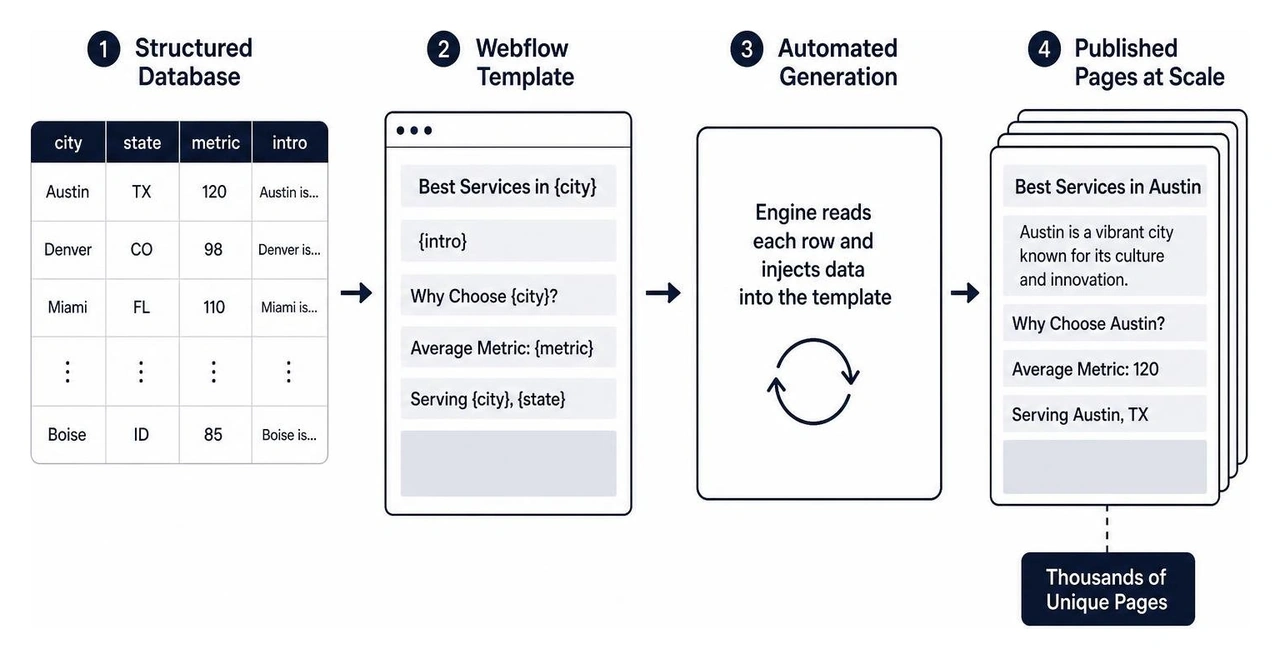
- Create location-specific pages: If you serve multiple areas, each deserves a dedicated page with unique content. A cleaning service could have pages for "commercial cleaning Pittsburgh" and "residential cleaning Cleveland."
- Develop city and service pages: Combine a service with a location, like "wedding photographer Downtown Pittsburgh." These highly targeted pages capture customers who know exactly what they want.
- Write blog posts about local events: Show your community connection by blogging about local happenings. A Cleveland bakery could write about "Best Fall Festivals in Northeast Ohio."
- Showcase local case studies: Reinforce your local presence with success stories from your service areas. This builds trust and provides social proof.
- Optimize title tags and meta descriptions: These are the headlines and summaries in search results. Include local keywords to attract clicks. A well-maintained blog is an excellent platform for this content. Learn more in our guide: Why Your Business Needs a Blog: The Untapped Potential of Blogging.
Implement Local Business Schema Markup
Schema markup is structured data that gives Google a clear fact sheet about your business. For local businesses, implementing LocalBusiness schema is like handing Google a detailed dossier on who you are, where you are, and what you do.
Schema can help your business appear in "rich results" with star ratings or hours, making your listing stand out and increasing click-through rates. It also future-proofs your SEO for voice and AI search. Essential properties include your Name, Address, Phone Number, URL, Hours, and Geo-coordinates. These give search engines a complete picture of your business. You can refer to the official documentation at LocalBusiness schema and test your implementation with Google's Rich Results Test.
Off-Site Authority: Reviews, Links, and Reputation
Your website and Google Business Profile tell your story, but what others say about you online is where the real magic happens. Building off-site authority through reviews, backlinks, and a stellar reputation transforms a good local SEO strategy into a great one.
Consider that 97% of consumers investigate a company's online presence before visiting, and 99% of consumers read reviews. They are actively looking for reasons to trust you. Furthermore, 92% now consider business owner responses to reviews as part of high-quality customer service. Your local SEO and online reputation are inseparable. For more on connecting with your audience, see our article on Social Media Customer Engagement.
Encourage and Manage Online Reviews
Reviews are one of the most powerful tools in your local SEO arsenal. Google analyzes review signals like quantity, quality, and recency to determine Map Pack rankings. Beyond rankings, reviews directly influence your bottom line: research shows that every additional one-star Yelp rating can increase a business's revenue by as much as 9%.
So, how do you build a strong review presence? It starts with asking for reviews. Most satisfied customers are happy to leave feedback if you make it easy for them. We help businesses create simple systems to request reviews with direct links to their Google Business Profile.
Responding to reviews is equally crucial. Google has confirmed that replies strengthen your local presence. As local search expert Miriam Ellis notes, ignoring reviews is a failure to engage your customers and gain valuable business intelligence. In fact, not replying can hurt you more than a 1-star review.
When negative reviews happen, turn them into opportunities. Address negative feedback constructively by acknowledging the issue and proposing a solution. A thoughtful response can build more trust than a dozen unanswered positive reviews. Your GBP is central to this, as detailed in our Google My Business guide.
Advanced Local SEO Strategies: Link Building and PR
Backlinks are digital word-of-mouth. When other websites link to yours, they vouch for your legitimacy and trustworthiness. For local SEO, these endorsements are powerful signals.
Local link building focuses on community connections. While national brands chase major publications, local businesses can build meaningful relationships in their own backyard. Local backlinks build visibility, trust, and community connections.
- Support local events: Sponsoring a charity run in Pittsburgh or a festival in Cleveland often earns you a valuable backlink from the event's website.
- Partner with complementary local businesses: A Charlotte gym could team up with a health food store, with each business linking to the other.
- Join local business organizations: Memberships in your Chamber of Commerce or local associations provide authoritative backlinks.
- Guest post on local blogs: Position yourself as a community expert by writing for a local news site or industry blog, earning a quality backlink in the process.
- Leverage local PR: Pitch compelling stories to local journalists. A feature in the Cleveland Plain Dealer or Charlotte Observer brings a powerful backlink and immense credibility.
These efforts work best when integrated into your broader marketing strategy. Learn how in our guide on Digital PR and SEO.
Measuring Success and Choosing the Right Tools
You've implemented your local SEO strategies—now it's time to see the results. We track several key performance indicators (KPIs) to measure success for our clients.
Key metrics include your Map Pack rankings (are you in the top 3 for local searches?) and your organic local rankings for website pages. Beyond rankings, we monitor website traffic from local searches and, most importantly, the conversions that matter: phone calls and form fills from local customers. These actions are the true measure of success.
Setting realistic expectations is important. While some quick wins are possible, most local SEO strategies require patience. Meaningful results typically appear within three to six months, with benefits compounding over time. Learn more in our article: The Timeline for SEO Success: When to Expect Results.
Monitoring Local SEO Performance
We rely on several powerful tools to monitor local SEO performance.
- Google Search Console: This free tool shows which keywords drive traffic, identifies technical issues, and reveals how your site appears in search. Access it here: Google Search Console.
- Google Analytics: This tool shows what happens after a click—where traffic originates, which pages are popular, and whether visitors are converting. It's available at Google Analytics.
- Google Business Profile Insights: This dashboard shows how customers find your profile, what actions they take (calls, direction requests), and how your photos perform.
- Keyword Rankings: We monitor rankings at a granular level, tracking performance in specific neighborhoods like Tremont in Cleveland or South End in Charlotte, as results vary by location.
Key Features in Local SEO Software
While free tools are a great start, dedicated local SEO software can amplify your efforts, especially in competitive markets.
- Listing Management: These tools maintain NAP consistency across hundreds of directories from a single dashboard, saving time and reducing errors.
- Review Monitoring: Get instant alerts for new reviews on any platform, allowing for quick responses. As noted, 92% of consumers value these responses.
- Rank Tracking: Advanced tools show how you rank for keywords at specific zip codes or geographic coordinates, offering precise geotargeting.
- Reporting and Analytics: Comprehensive dashboards consolidate data into actionable insights, providing a clear picture of your local SEO performance.
For a deeper dive into software options, explore our guide: Best SEO Tools for Small Businesses.
Frequently Asked Questions about Local SEO
How long does it take to see results from local SEO?
While it depends on your industry's competitiveness and your starting point, you can typically expect noticeable results from a consistent local SEO strategy within 3-6 months. Some quick wins, like optimizing your GBP, might show an impact sooner, but substantial growth requires patience and persistent effort. The real benefits compound over time.
How is local SEO different from traditional SEO?
While both aim to improve search visibility, their focus differs. Traditional SEO targets a broad, often national audience. Local SEO hones in on a specific geographic area, like Pittsburgh, Cleveland, or Charlotte. Local SEO also relies on unique ranking signals like Proximity, Relevance, and Prominence, and aims for placement in features like the Google Map Pack, whereas traditional SEO focuses on standard organic blue links.
How does local SEO impact online reputation?
Local SEO and online reputation are inextricably linked. Customer reviews are a major ranking factor for local SEO, influencing your prominence in the Map Pack. Your Google Business Profile acts as a reputation hub where managing reviews is crucial for both SEO and public image. Furthermore, consistent Name, Address, and Phone number (NAP) across all platforms signals trustworthiness to both search engines and customers.
Dominate Your Local Market
We've covered the essential local SEO strategies that help businesses connect with customers in their community. When someone in Pittsburgh, Cleveland, or Charlotte searches for what you offer, you want to be the business they find and the obvious choice.
Effective local SEO makes this possible. By optimizing your Google Business Profile, ensuring NAP consistency, creating localized content, and earning genuine reviews, you show customers that you're a valued part of their neighborhood, not just another company.
Local SEO isn't a one-time project; it's an ongoing commitment to your community and online presence. The businesses that succeed are those that stay consistent, monitor performance, and adapt to their customers' needs.
At Refresh, we build long-term partnerships with small to medium-sized businesses in Pittsburgh, Cleveland, and Charlotte, helping them grow sustainably. The digital landscape evolves, but local customers will always want to find businesses they can trust. When you focus on these fundamentals, rankings and revenue follow.
Ready to take your local presence to the next level? Let's talk about how a custom local SEO plan can help you Drive More Leads. Contact us to learn more about our SEO services and find what's possible with the right partner.


.avif)