
Why Your Website Needs Monthly SEO Maintenance

Monthly SEO maintenance is the process of reviewing, updating, and improving your website every month to protect your rankings, fix technical issues, and stay competitive in search results.
Here is a quick overview of what it typically includes:
| Task | Why It Matters |
|---|---|
| Review Google Search Console | Catch crawl errors and indexing issues early |
| Check organic rankings | Spot drops before they become serious |
| Fix broken links | Prevent poor user experience and lost link equity |
| Refresh outdated content | Regain rankings faster than publishing new pages |
| Audit title tags and meta descriptions | Improve click-through rates from search results |
| Monitor Core Web Vitals and site speed | A 1s to 3s load time increase raises bounce rate by 32% |
| Evaluate backlink profile | Remove toxic links, track growth |
| Review mobile usability | Over 60% of global traffic comes from mobile devices |
SEO is not a one-time project. Search engines update their algorithms constantly. Your competitors are publishing, building links, and improving their sites every single month. If your site stays static, your rankings slowly erode — often before you even notice.
The good news? A consistent monthly routine prevents most of that damage before it starts.
I'm Alexander Palmiere, Founder and CEO of Refresh Digital Strategy, where I've helped over 200 businesses improve their online visibility through tailored SEO strategies — including building and maintaining the kind of monthly SEO maintenance systems that keep rankings stable long-term. In this guide, I'll walk you through exactly what to do each month to keep your site healthy, competitive, and growing.
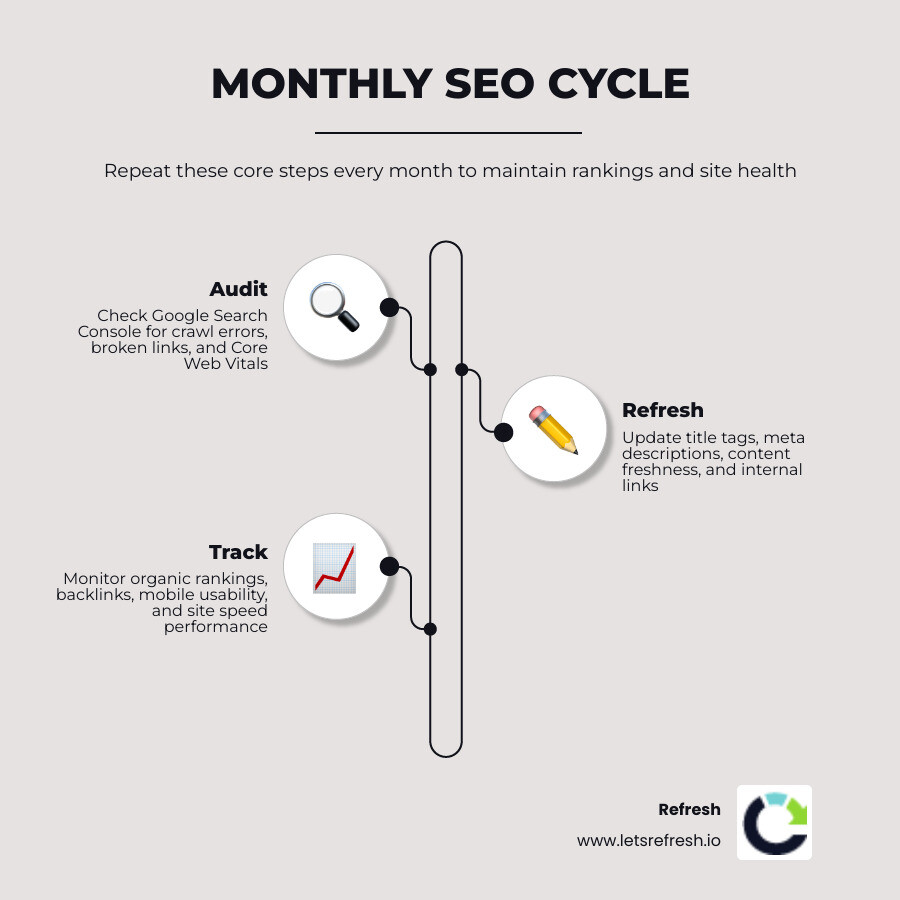
Simple monthly seo maintenance glossary:
Why Monthly SEO Maintenance is Essential for Long-Term Success
Think of your website like a high-performance vehicle. You wouldn't drive a car for three years without an oil change and expect it to win a race, right? Monthly SEO maintenance is the "oil change" for your digital presence. It ensures that the momentum you’ve built through initial optimization doesn't stall out due to neglect.
The search landscape is incredibly volatile. Google rolls out core algorithm updates frequently, and user behavior shifts just as fast. Without a disciplined framework for year-round tasks, your site health can erode silently. For instance, a plugin update might accidentally slow down your page speed, or a competitor in Pittsburgh or Charlotte might suddenly start outranking you for a high-value keyword.
By committing to a monthly routine, we achieve:
- Ranking Stability: We catch "ranking decay" early. If a page drops from position 2 to position 6, we can investigate and fix it before it falls off the first page entirely.
- Adaptability: Search engines are moving toward Generative Engine Optimization (GEO). Monthly checks allow us to pivot our content to meet these new AI-driven search patterns.
- Better ROI: It is far more cost-effective to maintain a ranking than it is to claw your way back up after a massive drop.
- User Trust: Broken links and outdated stats make your business look unprofessional. Consistent updates keep your brand's reputation fresh.
For small to medium-sized businesses, having a clear SEO strategy for small business is the foundation, but maintenance is the scaffolding that keeps the structure standing.
The Difference Between Maintenance and Long-Term SEO Strategy
We often see business owners confuse "maintenance" with "strategy." While they work together, they are two different animals.
SEO Strategy is your roadmap. It’s the "big picture" plan that identifies your target audience, selects your primary keywords, and decides which pillar pages you need to build. It’s about proactive growth and expansion.
Monthly SEO maintenance, on the other hand, is about tactical upkeep and technical stability. It’s the day-to-day (or month-to-month) work of ensuring the strategy is actually working.
| Feature | SEO Strategy | Monthly SEO Maintenance |
|---|---|---|
| Focus | New growth and expansion | Protecting existing rankings |
| Activity | Keyword research for new topics | Fixing broken links and crawl errors |
| Goal | Increasing market share | Maintaining site health and UX |
| Timeline | 6–12 months | 30-day cycles |
Understanding the timeline for SEO success is crucial here. While strategy helps you reach the top over several months, maintenance ensures you stay there. Maintenance allows for "agile adjustments"—if we notice that organic traffic to a specific service page in Cleveland is dipping, we can adjust our tactics immediately rather than waiting for a quarterly review.
Your Complete Monthly SEO Maintenance Checklist

To keep your site in top shape, we recommend a structured approach. You don't need to do everything at once, but following a consistent checklist prevents things from falling through the cracks. It’s a common problem: around 35% of sites have duplicate titles and 30% have duplicate meta descriptions. These small errors confuse search engines and hurt your click-through rates.
Here is the checklist we use at Refresh to keep our clients' sites performing:
1. Technical Health Check
- Review Google Search Console for "Coverage" errors.
- Check for broken internal and external links (404 errors).
- Test site speed and Core Web Vitals (LCP, FID, CLS).
- Verify sitemap and robots.txt functionality.
2. Content & On-Page Audit
- Identify pages with declining traffic and plan a refresh.
- Check for duplicate title tags and meta descriptions.
- Optimize on-page SEO elements like H1-H3 tags and image alt text.
- Add internal links from new blog posts to older, high-value pages.
3. Backlink & Authority Monitoring
- Monitor for new backlinks and identify any "toxic" or spammy links.
- Check for "lost" backlinks that were previously providing value.
- Evaluate your competitors' link-building activities.
4. Local SEO (For Pittsburgh, Cleveland, and Charlotte locations)
- Update Google Business Profile (GBP) with new photos or posts.
- Respond to all new customer reviews.
- Ensure Name, Address, and Phone (NAP) consistency across directories.
Prioritizing Technical Health in Monthly SEO Maintenance
Technical SEO is the foundation of your house. If the foundation is cracked, it doesn't matter how beautiful the wallpaper (your content) is; the house won't stand. We always prioritize technical fixes first because search engines cannot rank what they cannot crawl.
Using Google Search Console is non-negotiable. Every month, we look for indexing issues. Did a recent update accidentally add a "noindex" tag to an important page? Are there mobile usability errors that make the site hard to use on a smartphone? 60% of global traffic is mobile; if your site fails the mobile-friendly test, you’re invisible to more than half your audience.
At Refresh, we prefer building on Webflow because of its superior hosting performance and clean code. However, even on the best platforms, things happen. We check:
- Site Speed: If your page load goes from 1 second to 3 seconds, the probability of a bounce increases by 32%. We use tools like PageSpeed Insights to ensure our clients' sites remain lightning-fast.
- Broken Links: These are "dead ends" for both users and search engine crawlers. We scan the site to ensure every link leads exactly where it should.
- Security: We verify that HTTPS certificates are active and that there are no security vulnerabilities flagged by Google.
Optimizing Content During Monthly SEO Maintenance
Creating new content is exciting, but refreshing old content is often more effective. Research shows that 53% of marketers saw higher engagement after updating old content, and 49% saw increased traffic.
Why? Because existing pages already have some "authority" in the eyes of Google. By updating a blog post from 2023 with fresh 2025 statistics, new internal links, and a better understanding of keyword usage, you can often jump from page two to page one much faster than by starting a new post from scratch.
We recommend a "several times a week" posting schedule for maximum impact, but if that’s not feasible, consistency is more important than frequency. Websites that follow a regular posting schedule get significantly more traffic.
During your monthly content audit:
- Check Search Intent: Does the page still answer the question the user is asking?
- Update Titles and Metas: If a page has high impressions but low clicks, your title tag or meta description might be the problem.
- Improve Internal Linking: Look for opportunities to link your new content to your "money pages" (services or products).
Essential Tools and Metrics for Tracking Performance
You can't manage what you don't measure. To run effective monthly SEO maintenance, you need the right toolkit. While there are hundreds of options, we believe in keeping it streamlined and effective.
The Refresh Toolkit
- Google Search Console: The gold standard for technical health and keyword performance.
- Google Analytics 4 (GA4): For tracking organic traffic patterns and user behavior.
- Webflow Analytics: For site-specific performance and hosting health.
- Ahrefs or Semrush: Essential for backlink monitoring and competitor analysis. You can find more options in our guide on best SEO software for small business.
- SurferSEO or Clearscope: For content optimization and ensuring you hit the right semantic keywords. Check out our AI SEO tools guide for more on this.
Key Metrics to Track Monthly
When we generate reports for our clients in Pittsburgh, Cleveland, and Charlotte, we focus on these "North Star" metrics:
- Organic Traffic Growth: Are more people finding you through search engines than last month?
- Keyword Rankings: Are your primary keywords moving up or down?
- Click-Through Rate (CTR): Are your search listings enticing enough to get clicks?
- Conversion Rate: Is that organic traffic actually turning into leads or sales?
- Anomaly Detection: We look for sudden dips. A sharp drop in traffic usually points to a technical error or a manual penalty.
We also keep a close eye on Generative Engine Optimization (GEO) trends. As search engines like Google and Bing integrate more AI-generated answers, we monitor how our clients' content is being cited in these "AI Overviews."
Common Mistakes to Avoid During Your Monthly Audit
Even with the best intentions, it's easy to make mistakes during monthly SEO maintenance. Here are the pitfalls we see most often:
- Keyword Stuffing: This isn't 2005. Adding your keyword 50 times to a single article will get you penalized, not ranked. Focus on natural variations and search intent.
- Ignoring User Experience (UX): Google cares about how users interact with your site. If your page speed is slow or your navigation is confusing, your rankings will suffer regardless of your keywords.
- Tool Over-Reliance: Tools are great, but they don't replace human judgment. A tool might tell you to add a certain keyword, but if it makes the sentence sound robotic, don't do it.
- Neglecting Local Consistency: For businesses with physical locations, local SEO services for small business are vital. A common mistake is having different phone numbers or addresses listed across the web (NAP inconsistency). This confuses Google and hurts your local map rankings.
- Forgetting to Track Changes: If you update ten titles this month, keep a log. If your rankings drop next month, you need to know exactly what you changed so you can revert it if necessary.
Frequently Asked Questions about SEO Maintenance
How long does monthly SEO maintenance typically take?
For a standard small business website on Webflow, a thorough monthly check usually takes between 5 to 10 hours. This includes the technical audit, content refreshes, and reporting. If you have a massive e-commerce site with thousands of pages, that time commitment will naturally increase. The key is to break it down: spend 2 hours on technical, 4 hours on content, and 2 hours on backlinks and reporting.
Should I update every blog post on my site every month?
Absolutely not! That would be a waste of time. Instead, use your data. Focus on your "Top 10" most important pages—the ones that drive the most leads or sales. Then, look for "declining stars"—pages that used to get traffic but have started to slip. Refresh those first. Most of your evergreen content only needs a check-up once or twice a year.
How does local SEO maintenance differ for physical storefronts?
If you have a storefront in Pittsburgh, Cleveland, or Charlotte, your monthly SEO maintenance has an extra layer: Google Business Profile (GBP) management. You need to treat your GBP like a social media account. Post updates, upload new photos of your team or office, and—most importantly—respond to every review. Google rewards active profiles with better visibility in the "Local Map Pack."
Conclusion
At Refresh, we believe that SEO is a marathon, not a sprint. Success comes from the cumulative effect of small, smart actions taken month after month. By following this monthly SEO maintenance guide, you aren't just "fixing things"—you're building a resilient digital asset that grows in value over time.
Whether you are a small business in Cleveland looking to dominate local search or a growing brand in Charlotte aiming for national reach, consistency is your greatest competitive advantage. Agile planning, technical expertise, and a commitment to quality content will always outperform "quick fix" tactics.
Ready to take the guesswork out of your search strategy? Explore our comprehensive SEO services and let us help you build a long-term partnership that keeps your rankings—and your business—fresh.


.avif)