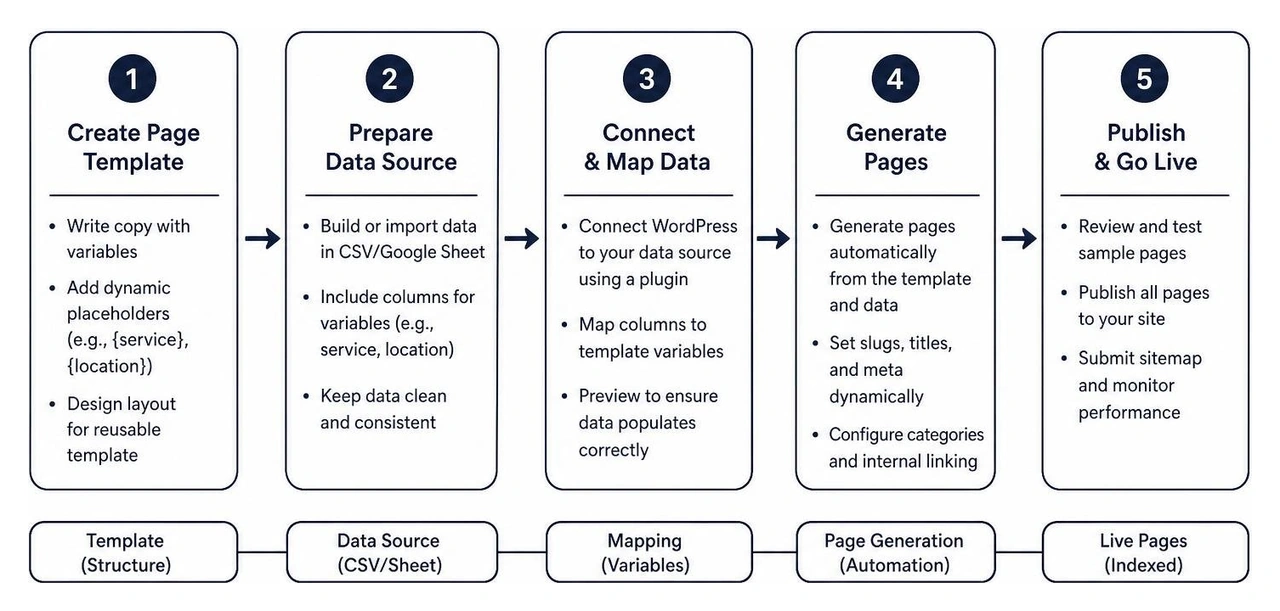

What Is Programmatic SEO Automation Software?

Programmatic SEO automation software is a category of tools that helps businesses generate hundreds or thousands of optimized web pages at scale — using structured data, reusable templates, and automated workflows instead of manual writing.
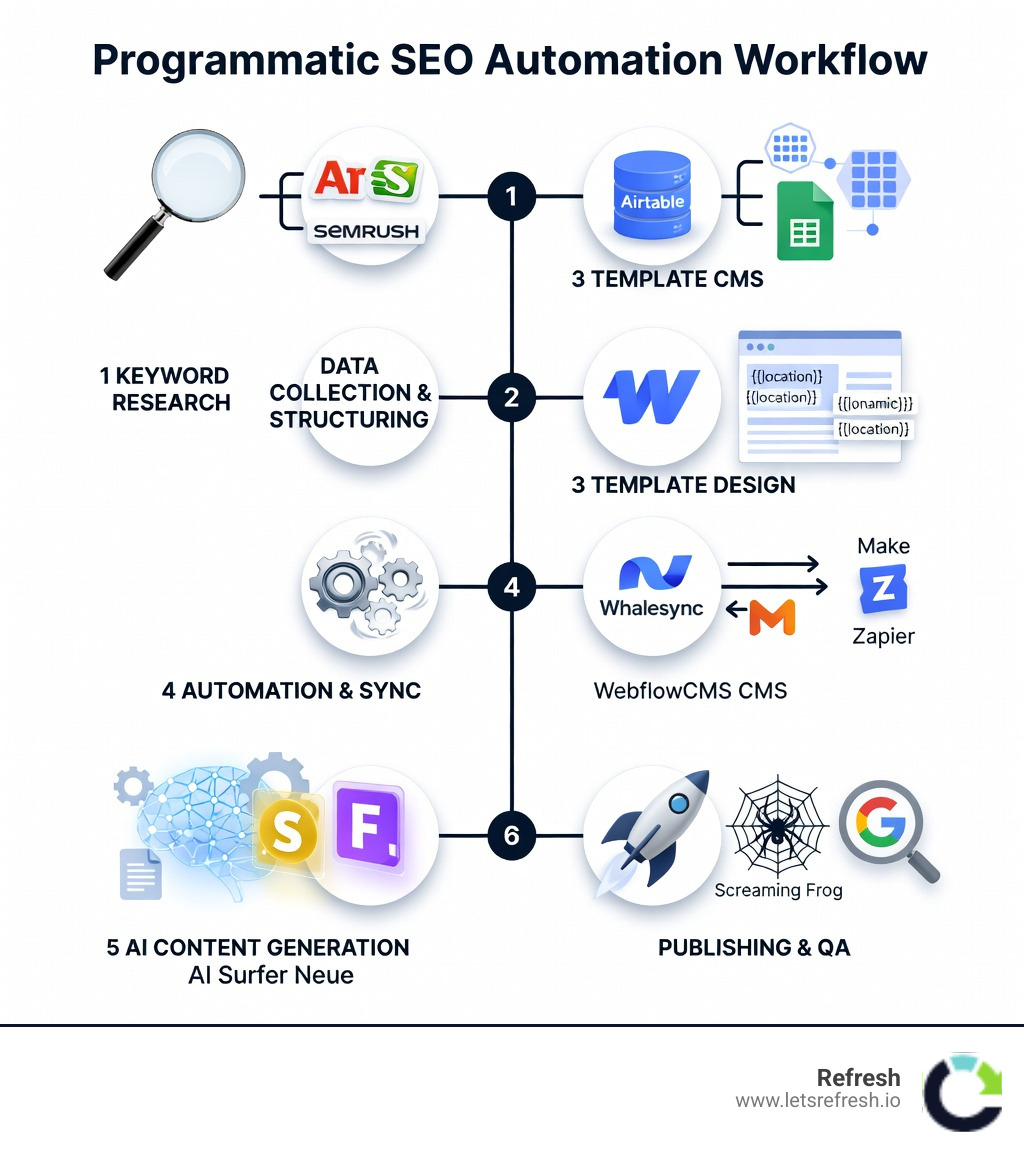
Here are the most widely used tools in a modern programmatic SEO stack:
| Tool | Primary Role |
|---|---|
| Airtable | Structured data management |
| Webflow CMS | Dynamic page publishing |
| Whalesync | Two-way database-to-CMS sync |
| Make / Zapier | Workflow automation |
| Surfer SEO / Frase | AI-assisted content optimization |
| Ahrefs / SEMrush | Keyword research and auditing |
| Screaming Frog | Technical SEO and QA crawling |
These tools work together as a stack — not in isolation. The goal is to take a dataset (think: cities, products, or services) and automatically turn it into hundreds of unique, search-optimized pages without writing each one by hand.
This matters because scaling content manually just doesn't work at a certain point. One SaaS business using programmatic page generation saw those pages account for 34% of all site traffic within just two months — with notably high lead quality.
I'm Alexander Palmiere, Founder and CEO of Refresh Digital Strategy, where I've helped over 200 businesses build scalable digital presences — including programmatic SEO automation software workflows built on Webflow. In this roundup, I'll walk you through the tools that actually move the needle.
Why Businesses are Shifting to Programmatic SEO Automation Software
In the past, if you wanted to rank for "best plumber in Pittsburgh," "best plumber in Cleveland," and "best plumber in Charlotte," you had to hire a writer to manually craft three separate pages. Now, imagine you need to do that for 5,000 cities. The manual labor alone would bankrupt most small to medium-sized businesses.
This is why we are seeing a massive shift toward programmatic seo automation software. By leveraging structured data and smart templates, businesses can achieve a lower marginal cost per page. Once your system is built, adding the 5,001st page is significantly more cost-effective than the first.
The primary driver here is search volume—specifically long-tail keywords. While everyone is fighting over high-volume "head" terms, programmatic strategies allow us to capture thousands of hyper-specific queries. For instance, one project generated up to 6,000 clicks a day simply by creating variations of landing pages with different keywords in the H1 tags.
Whether you are building a marketplace, a directory, or a SaaS platform, how programmatic SEO works is all about data-driven results. It allows smaller teams to compete with industry giants by being more agile and covering more ground. However, quality remains king. As noted in scientific research on AI content quality and Google rankings, Google rewards original, high-quality content that demonstrates expertise and trustworthiness (E-E-A-T), even if it is generated with the help of automation.
The Ultimate No-Code Stack for Scalable Content
Building a programmatic engine doesn't require a computer science degree anymore. We prefer a "no-code" stack because it allows marketing teams to move fast without waiting on developers. At Refresh, our preferred platform is Webflow because of its robust CMS and design flexibility.
To build a high-performing system, you need four main components:
- The Database: Where your "truth" lives (Airtable).
- The Frontend: Where your pages live (Webflow CMS).
- The Bridge: How data moves between them (Whalesync).
- The Glue: How you automate logic and triggers (Make or Zapier).
| Feature | Manual Content Creation | Programmatic Automation |
|---|---|---|
| Speed | Weeks/Months for 100 pages | Days for 1,000+ pages |
| Consistency | High risk of human error | Centralized rules and templates |
| Cost at Scale | Increases linearly with volume | Decreases as volume grows |
| Updates | Must be done page-by-page | Update the database, sync everywhere |
Using programmatic SEO on Webflow gives you "pixel-perfect" control. Unlike old-school "spun" content sites that look like spam, a Webflow-based programmatic site looks and feels like a premium, hand-crafted experience.
Data Management and Programmatic SEO Automation Software
Your programmatic strategy is only as good as your data. If your spreadsheet is messy, your website will be too. Airtable has become the gold standard for programmatic seo automation software databases because it handles relational data so well.
Unlike a flat Google Sheet, Airtable allows you to link records. For example, you can have a "Cities" table linked to a "Services" table. When you combine them, you automatically generate "Service in City" combinations. This centralized data management ensures that if you change the price of a service in one spot, it updates across all 500 city pages instantly.
However, be mindful of record limits. While Airtable is powerful, massive projects with millions of rows might eventually require more technical solutions like SQL. For most SMBs in Pittsburgh or Charlotte, Airtable’s "Team" or "Business" plans provide more than enough horsepower.
AI-Driven Content and Programmatic SEO Automation Software
The "magic" happens when you layer AI on top of your structured data. We use AI not to write the whole page, but to enrich specific fields. This is part of Generative Engine Optimization (GEO)—ensuring your content is structured so that both traditional search engines and new AI search tools can understand it.
Tools like Bloggr AI are excellent for creating on-brand, structured templates. By using programmatic SEO and AI integration, you can generate unique meta descriptions, FAQs, and introductory paragraphs for every single page.
To maintain E-E-A-T, we recommend "content guardrails." Don't just tell an AI to "write a blog post." Instead, use your programmatic seo automation software to feed the AI specific data points—like local weather, population, or specific service features—so the output is factually grounded and unique to that specific page.
Best Practices for Ranking and Avoiding Penalties
Scaling fast is great, but scaling poorly will get you penalized by Google. The biggest risk in programmatic SEO is "thin content"—pages that don't actually help the user.
To stay in Google's good graces, follow these rules:
- Unique Value: Every page must have data that isn't just a copy-paste of the others. Use specific stats, local maps, or user-generated reviews.
- Internal Linking: Use your automation tools to create a "web" of links. If you have a page for "Webflow Development in Cleveland," it should naturally link to "SEO Services in Cleveland."
- Real-Time Updates: Use Whalesync for two-way syncing. If a product goes out of stock in your database, it should disappear from your SEO pages immediately to avoid a bad user experience.
- Technical Audits: Regularly run Screaming Frog to check for broken links or duplicate titles. It can crawl over 100,000 URLs, which is essential when you're managing a large-scale build.
Frequently Asked Questions about Programmatic SEO
Can programmatic SEO automation replace manual content creation entirely?
In our experience at Refresh, the answer is no. While programmatic seo automation software handles the "heavy lifting" of creating thousands of bottom-of-funnel pages, you still need human writers for high-level strategy, thought leadership, and creative storytelling. Think of programmatic SEO as your foundation and manual content as your skyscraper. You need both to dominate the SERPs.
Which business types benefit most from programmatic automation?
Any business with a large dataset or repeatable location/service patterns will see massive ROI. This includes:
- Ecommerce: Generating pages for thousands of SKUs and categories.
- Real Estate: Creating landing pages for every neighborhood and property type.
- Directories: Job boards, travel sites (like TripAdvisor or Nomad List), and local service directories.
- SaaS: Comparison pages ("Our Tool vs. Competitor") and integration directories.
How do you ensure programmatic pages avoid "thin content" labels?
The secret is "data enrichment." Don't just swap out the city name. Use your programmatic seo automation software to pull in unique data points like local zip codes, neighborhood names, specific regional pricing, or even AI-generated summaries of local reviews. The more unique variables you have in your template, the less likely Google is to see your pages as duplicates.
Conclusion
The era of manual labor for basic SEO is coming to an end. By adopting the right programmatic seo automation software stack—centered around Webflow and Airtable—businesses can scale their organic reach further and faster than ever before.
At Refresh, we specialize in helping small to medium-sized businesses in Pittsburgh, Cleveland, and Charlotte navigate these complex technical waters. We don't just build websites; we build scalable growth engines that work while you sleep. Whether you're looking to dominate a local market or scale a national SaaS, we're here to be your long-term partner.
Ready to stop the manual grind? Start your programmatic journey with Refresh today and let's build something that scales.


.avif)