
Protect Search Visibility With Ongoing SEO Maintenance Plans
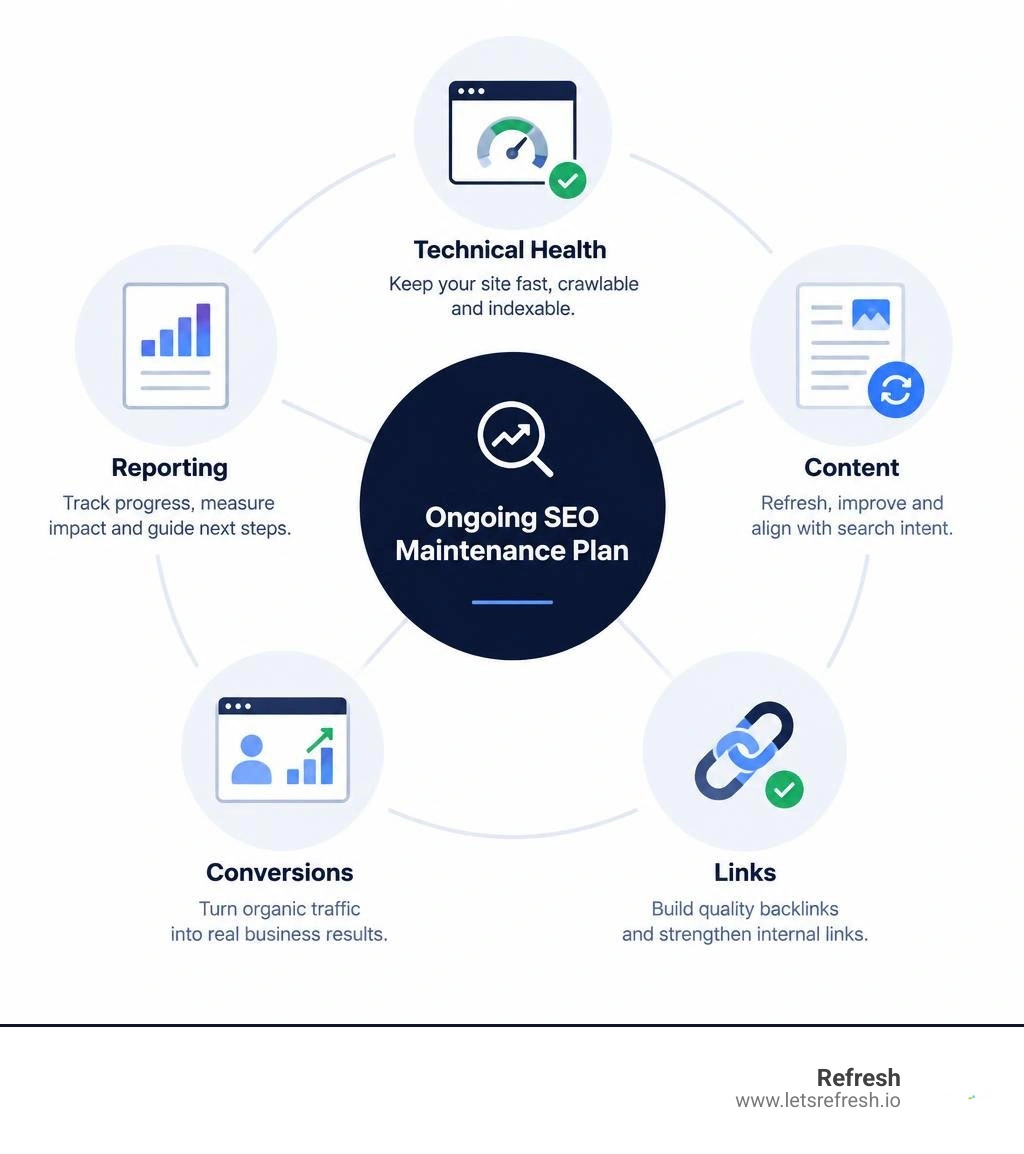
Ongoing SEO maintenance plans help businesses maintain search rankings by finding and fixing issues before they reduce visibility or conversions. A useful plan should regularly monitor technical health, refresh important content, review backlinks, track organic conversions, and respond to changes in search results. For broader context on how search engines evaluate sites, Google’s Search Essentials outline the core technical and quality requirements that underpin sustainable visibility.
For a growth-stage startup, this work keeps an older website from becoming a drag on marketing. Website maintenance handles items like updates, security, and backups. SEO maintenance adds the search-focused work: crawlability, page speed, indexation, keyword intent, internal links, content quality, and the signals that help people and search engines find your brand.
The right plan is not a vague monthly checklist. It has clear deliverables, a practical schedule, transparent reporting, and priorities tied to traffic, qualified leads, and revenue.
I am Alexander Palmiere, Founder and CEO of Refresh Digital Strategy, where our team has launched more than 200 websites and helps small and midsized businesses improve their digital presence. Through Webflow development and digital strategy work, I have seen how ongoing SEO maintenance plans protect visibility while letting founders stay focused on running their businesses.
Handy ongoing seo maintenance plans terms:
What Are Ongoing SEO Maintenance Plans and Why Do They Matter?
Search engines do not stay static, and neither do your competitors. An ongoing SEO maintenance plan represents a structured, proactive system designed to protect your existing keyword positions, maximize crawling efficiency, and continually expand your digital footprint. Without regular attention, even a beautifully engineered website can suffer from natural algorithmic decay, outdated information, and broken user journeys.
Most business leaders understand that building a website is not a one-and-done project. However, many underestimate the effort required to preserve its organic standing. When search engines update their ranking systems, pages that were once top performers can slip down the results page simply because newer, better-optimized resources emerged. Investing in dedicated small business SEO services gives your site the regular care needed to stay competitive in evolving markets across Pittsburgh, PA, Cleveland, OH, and Charlotte, NC.
SEO Maintenance vs. Standard Website Maintenance
It is easy to confuse general website maintenance with search-focused maintenance, but they address different operational needs:
- Standard Website Maintenance: Focuses on server stability, hosting uptime, CMS framework patches, plugin security, and routine database backups. Its primary mission is keeping the site online and secure.
- SEO Maintenance: Focuses on Core Web Vitals, organic search visibility, internal architecture, metadata relevance, index coverage, and content quality. Its primary mission is attracting, engaging, and converting organic search traffic.
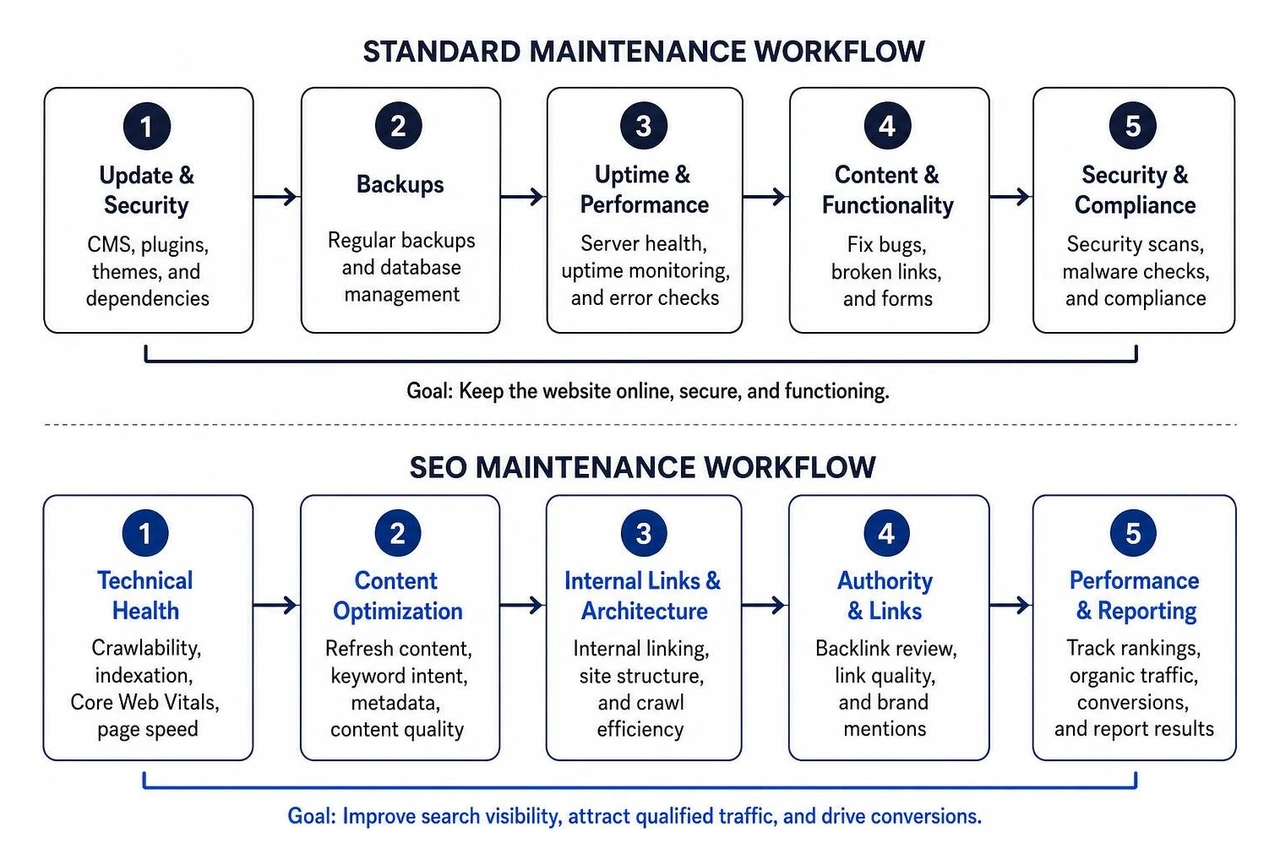
While a standard maintenance plan ensures your digital storefront opens its doors every morning without crashing, an SEO maintenance plan ensures customers can actually find the front door when searching online.
The Hidden Costs and Risks of Neglecting Search Rankings
Neglecting routine digital upkeep carries tangible business costs. In fact, comprehensive web and software maintenance can cost up to 9 times more than the initial build price when accumulated technical debt leads to sudden system failures or deep indexing penalties.

When organic visibility drops, customer acquisition costs rise because businesses often compensate by pouring budget into paid search ads. The common consequences of ignoring search maintenance include:
- Indexation Bloat and Crawl Errors: Obsolete URLs, unmanaged redirects, and soft 404s waste search engine crawl budgets, preventing new pages from being indexed.
- Accumulated Link Rot: Broken internal and external links frustrate users and signal poor technical upkeep to search algorithms.
- Algorithmic Obsolescence: Missing major core updates can quietly erase high-intent keyword rankings that took months or years to establish.
- Revenue Loss: When top-of-funnel search traffic drops, pipeline inquiries, quote requests, and direct e-commerce sales follow suit.
Core Components of an Effective Search Maintenance Strategy
A complete search maintenance program balances technical reliability, high-performing content, and clean link profiles. Instead of arbitrary tweaks, modern maintenance plans use data-driven tasks that support search visibility.
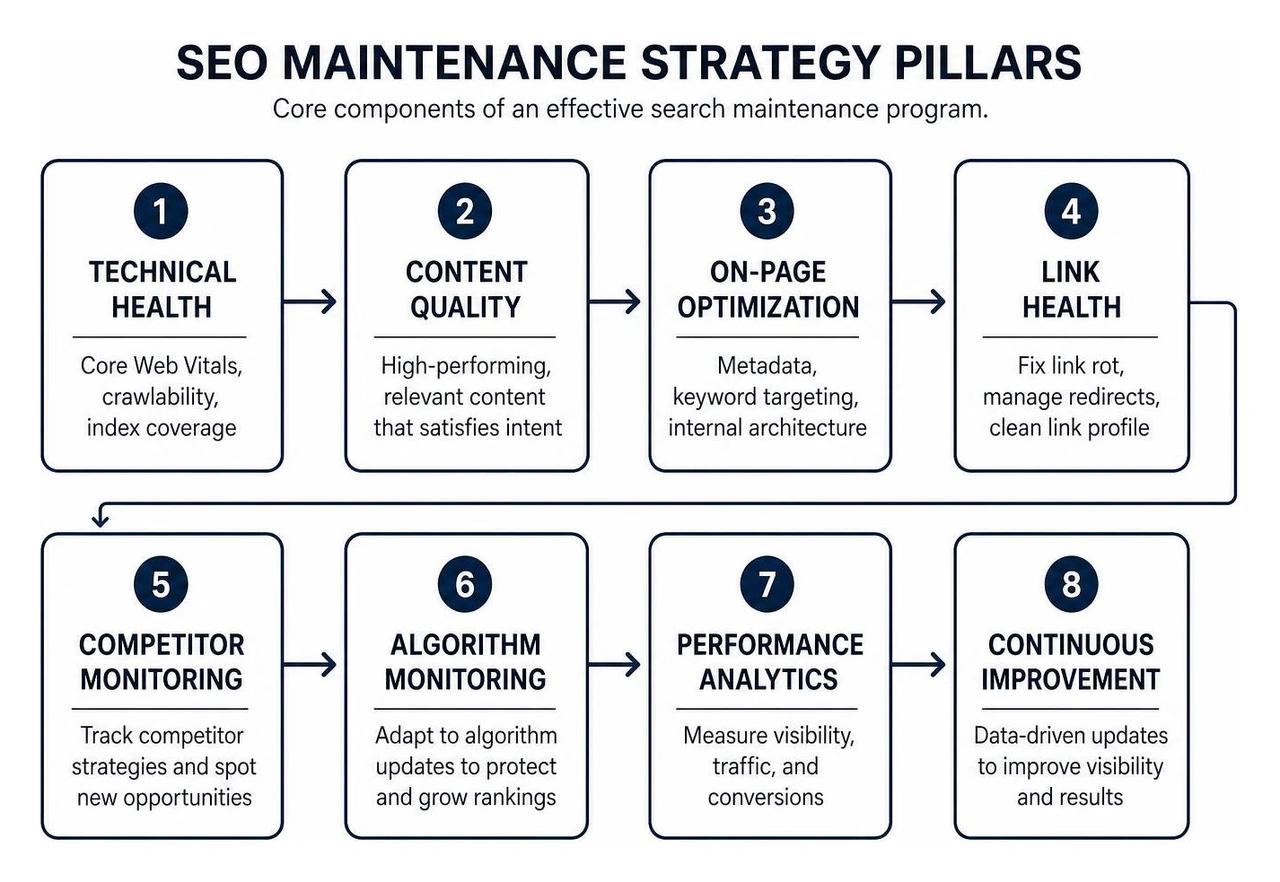
A vital part of this routine is performing regular competitive SEO analysis to spot shifts in competitor strategies, uncover new content opportunities, and quickly reclaim declining search positions.
Technical Audits and Platform Health on Webflow
At Refresh, we prefer Webflow as the modern platform for clean, fast, and scalable websites. Webflow produces lightweight, semantic HTML, CSS, and JavaScript that search engines can easily read. However, keeping a site running at peak efficiency still requires ongoing technical audits.
Technical maintenance on Webflow includes:
- Schema Markup Validation: Ensuring structured data across organization, local business, service, and article schemas is error-free.
- Asset and Script Optimization: Reviewing image compression, font-loading behaviors, and third-party scripts to keep Core Web Vitals within target thresholds.
- Redirect Management: Setting up clean 301 redirects whenever pages are retired or URLs change to protect authority.
- Mobile Usability Verification: Checking responsive design breakpoints across devices to maintain a seamless mobile experience.
Content Refreshing, Link Profiles, and Generative Engine Optimization
Search intent evolves. A piece of content that answered user questions two years ago may now be outdated. Effective maintenance schedules regular content updates to refresh statistics, expand explanations, and adjust headings to match current query habits.

Modern maintenance also incorporates Generative Engine Optimization (GEO). By structuring content with clear entities, direct definitions, structured tables, and authoritative answers, we make it easy for AI engines to extract and cite your brand as a source in generative search summaries.
Alongside content improvements, regular backlink profile audits help identify and clean up toxic links while finding high-value opportunities to earn new industry references.
Evaluating Structure and Tiers in Ongoing SEO Maintenance Plans
Not every business requires the same scope of maintenance. Selecting the right support tier depends on your website's size, your competitive landscape, and your internal growth targets. Reviewing structured small business SEO packages helps you pick an engagement model that matches your business scale.
Payment Models for Ongoing SEO Maintenance Plans
Budgeting for website and search health works best when expenses are predictable. Pay-as-you-go arrangements often leave critical preventative maintenance by the wayside until something breaks.
Businesses typically choose between these models:
- Monthly Retainers (Recommended): A fixed monthly investment that reserves dedicated specialist hours for technical audits, optimizations, content refreshes, and reporting.
- Tiered Support Allocations: Structured packages tailored to specific website sizes and goals, giving you clarity on exact deliverables each month.
- Hourly Support Banks: Flexible buckets of hours used as needs arise, though they lack the structured preventative cadence of a dedicated retainer.
Exploring affordable SEO packages allows companies to choose predictable pricing structures that maintain steady progress without unexpected invoices.
Typical Cost Tiers for Ongoing SEO Maintenance Plans
Monthly website and SEO maintenance plans generally range from $100 to $2,000+ per month, depending on site complexity, support hours, and the scope of work:
| Maintenance Tier | Monthly Cost Range | Included Support Hours | Core Deliverables & Focus | Best Suited For |
|---|---|---|---|---|
| Tier 1: Essential | $100 – $249 / mo | 1 – 3 hours | Basic uptime monitoring, monthly security scans, core Webflow CMS checks, broken link fixes | Small local brochure sites, early-stage startups |
| Tier 2: Professional | $250 – $749 / mo | 3 – 5 hours | Everything in Tier 1 plus technical SEO crawls, keyword tracking, monthly content refreshes, UX audits | Growing service businesses, regional brands |
| Tier 3: Industry-Leading | $750 – $2,000+ / mo | Up to 10 hours (+ 1–2 emergency hours) | Complete technical audits, deep content optimization, backlink monitoring, GEO enhancements, conversion tracking | E-commerce platforms, multi-location companies, competitive spaces |
Implementation Schedules and Measuring Long-Term ROI
A consistent schedule keeps maintenance predictable and measurable. Working with reliable monthly SEO maintenance services turns search optimization into a continuous flywheel that drives consistent organic inquiries.
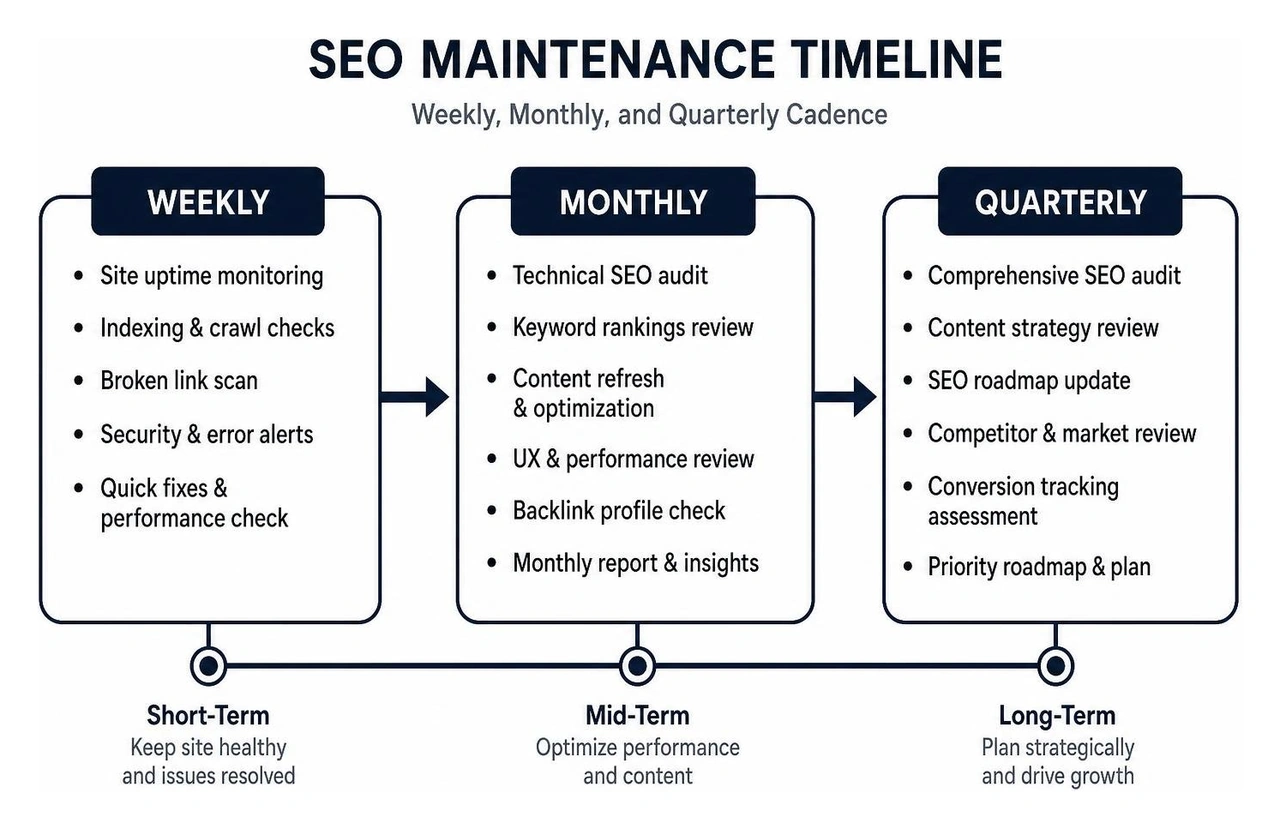
Recommended Cadence: Weekly, Monthly, and Quarterly Tasks
Dividing tasks into distinct cadences ensures both immediate operational issues and long-term strategic projects receive proper focus:
- Weekly Intervals
- Review Google Search Console for sudden crawl errors or index drop-offs.
- Monitor site uptime, core page speed metrics, and form submission pathways.
- Track keyword rank fluctuations across primary service categories.
- Monthly Intervals
- Conduct a full technical site crawl to resolve 404 errors, redirect loops, or missing metadata.
- Update and expand 1–2 priority content assets with fresh examples, internal links, and current year data.
- Review organic conversion data, goal completions, and traffic trends.
- Quarterly Intervals
- Perform a comprehensive competitor analysis and SERP landscape review.
- Audit the site structure, navigation hierarchy, and overall internal link distribution.
- Review and optimize schema markup for Generative Engine Optimization across top landing pages.
- Prune or consolidate thin, outdated, or duplicate content.
Tracking Performance Metrics and Conversion Impact
The ultimate value of search maintenance is protecting and growing business revenue. Ranking gains are encouraging, but the real measure of success lies in bottom-line pipeline growth.
Understanding the timeline for SEO results helps set realistic expectations as technical improvements and content updates compound over time.
Key performance indicators to track in monthly reviews include:
- Organic Conversions: Qualified form submissions, consultation bookings, and inbound telephone calls originating from organic search.
- Organic Click-Through Rate (CTR): Improvements in SERP snippet engagement resulting from updated title tags and meta descriptions.
- Crawl Efficiency & Index Status: Steady increases in valid indexed URLs alongside zero critical server errors.
- High-Intent Keyword Visibility: Ranking stability and gains across transactional and commercial queries.
Frequently Asked Questions About SEO Maintenance
What is the difference between web maintenance and SEO maintenance?
Web maintenance focuses on keeping your site operational, secure, and technologically current through server checks, CMS updates, and backups. SEO maintenance focuses on how search engines and users find and interact with your site, optimizing crawlability, page speed, metadata, content relevance, and organic conversion paths.
How long does it take to see results from regular SEO updates?
Technical fixes (such as resolving crawl blocks or correcting broken redirects) can produce indexing improvements within days to weeks. Broader content refreshes and ranking gains typically take 3 to 6 months to mature as search engines recrawl pages, evaluate behavioral signals, and reward consistent quality.
How do I choose the right partner for my business?
Look for a partner that offers transparent deliverable scopes, clear communication, and proactive reporting tied to revenue metrics. Our guide on how to choose an SEO company covers the questions and portfolio considerations to review before signing an agreement.
Conclusion
Maintaining strong organic search rankings requires steady, deliberate care. Search algorithms, competitors, and customer preferences evolve continuously. A structured maintenance plan keeps your technical foundation solid, your content relevant, and your conversion funnels clear.
By investing in proactive maintenance, you safeguard your hard-won search rankings, avoid costly technical rebuilds, and build a reliable engine for sustainable business growth.
Ready to secure your search visibility and keep your organic growth on track? Explore how our team at Refresh builds, refines, and manages high-performing Webflow websites that win in search.