
Build Search Visibility That Compounds
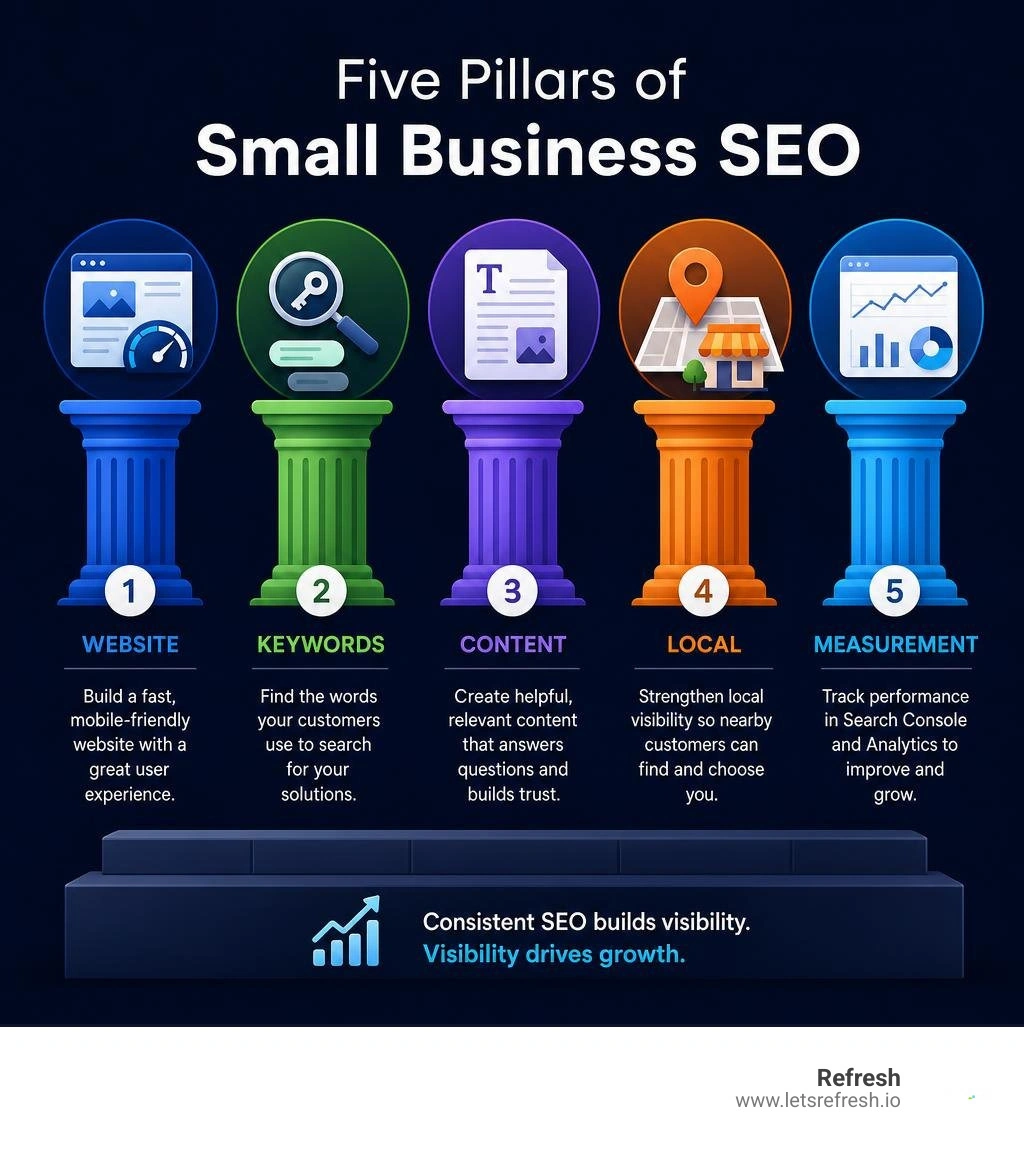
SEO for small businesses starts with five practical moves: build a fast, mobile-friendly website, identify the words customers use to search, improve each key page's titles and content, strengthen local visibility where it matters, and track results in Google Search Console and Google Analytics 4.
This work helps your company show up when people are actively looking for your solution. That matters because organic search accounts for a major share of web traffic, while a 2025 Backlinko report found that only 0.63% of Google users clicked results on page two. Visibility near the top is not a vanity metric. It is a customer acquisition channel.
For a growth-stage startup, the goal is not to publish more pages for the sake of it. It is to create a clear, credible Webflow website that answers real buyer questions, proves your expertise, and makes the next step easy. Modern SEO also includes Generative Engine Optimization (GEO): making your best information clear, original, structured, and reliable enough to be understood and cited by AI-powered search experiences.
I am Alexander Palmiere, Founder and CEO of Refresh, where our team has launched more than 200 websites and helped growing companies improve their digital presence. This guide shares the practical SEO for small businesses approach we use to connect better websites with stronger search visibility.
Understanding the Core Fundamentals of SEO for Small Businesses
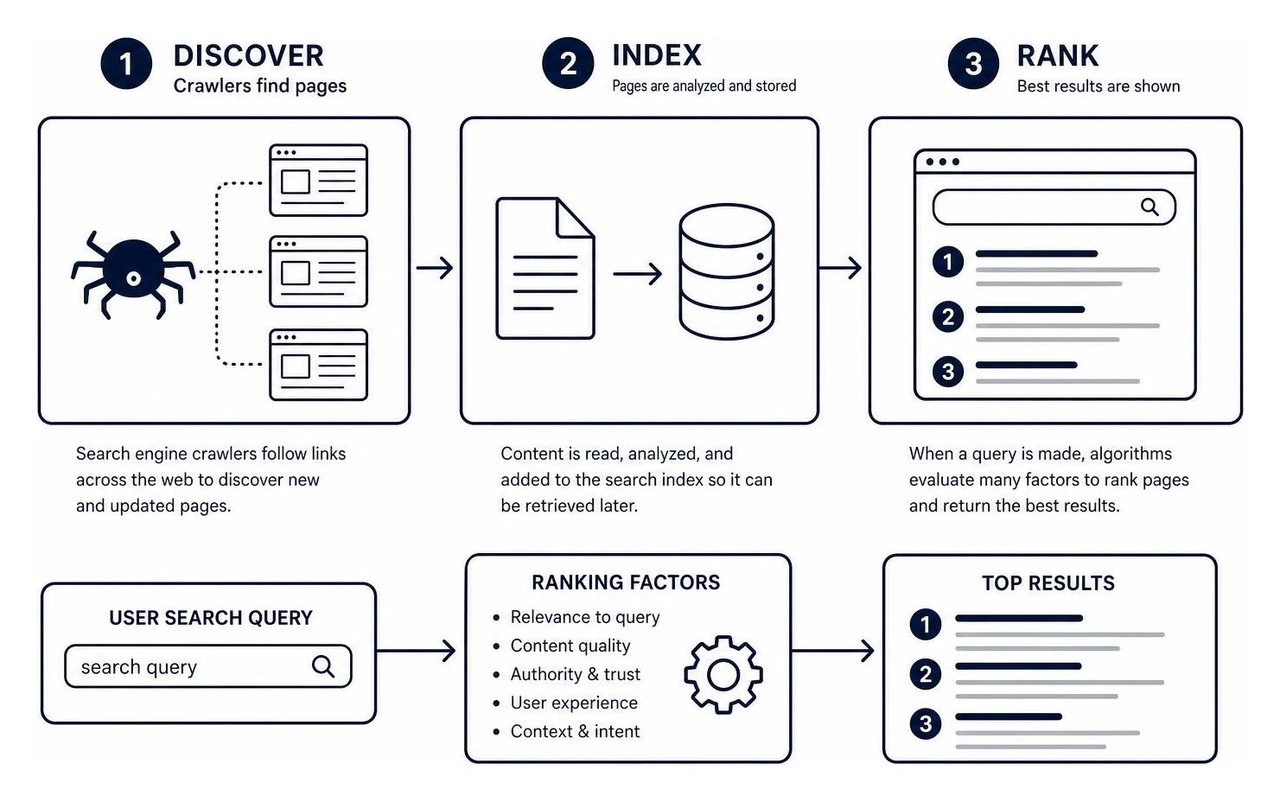
Search engines exist to provide users with the most relevant, reliable answers to their questions. To do this, search engines use automated crawlers to discover web pages, read their code and copy, and index the information. When someone types a search query, complex algorithms evaluate hundreds of ranking factors to serve the best organic positioning in milliseconds.
Organic search is the cornerstone of modern web discovery. Across the web, 53.3% of all website traffic comes from organic searches, and a March 2025 Statista report highlights that Google accounts for 89.62% of internet queries. Furthermore, 90.55% of global traffic originates across Google Search, Google Images, and Google Maps.
Modern search mechanics focus heavily on user intent—what a user actually wants to accomplish when typing a phrase. Search engines recognize four distinct types of intent:
- Informational: Searching for answers, tutorials, or guides (e.g., "how to fix a leaky pipe").
- Navigational: Searching for a specific brand or destination page (e.g., "Refresh contact page").
- Commercial: Researching solutions before purchasing (e.g., "best project management software for contractors").
- Transactional: Ready to complete an action or hire a service (e.g., "hire Webflow designer").
Aligning your website with the right intent ensures that visitors find exactly what they expect, turning standard page views into qualified leads.
SEO vs. Local SEO: Finding the Right Focus
Understanding whether to prioritize national or regional visibility depends entirely on your business model. Standard search engine optimization focuses on broad topics, targeting queries regardless of where the searcher is physically located. In contrast, local optimization targets geographic-specific search queries.
| Feature | Standard National SEO | Local SEO |
|---|---|---|
| Primary Goal | Rank for non-geographic, industry-wide keywords | Dominate regional map packs and localized searches |
| Target Audience | Nationwide or global customers | Customers within a specific driving radius or service area |
| Key Assets | Deep blog content, industry backlinks, technical health | Google Business Profile, local citations, review signals |
| Core Intent | Informational research, digital products, national services | Immediate in-person visits, local service calls |
If your brand operates storefronts or provides on-site services, partnering with specialized local SEO services for small business helps you capture customers in your immediate area. Conversely, if you offer nationwide consulting or software, your energy is best invested in establishing broad topic authority.
Why Local SEO for Small Businesses Drives Immediate Foot Traffic
Local search queries carry immediate commercial intent. In fact, 76% of people who search on their smartphones for something nearby visit a business within a day, and 28% of those searches result in a purchase.
To capture these high-intent buyers, your business must maintain clean and accurate Name, Address, and Phone Number (NAP) citations across directory listings. An optimized Google Business Profile acts as your digital storefront on Google Maps, displaying operating hours, customer reviews, service offerings, and direct contact options. Consistently earning authentic positive reviews builds credibility with potential buyers while sending strong trust signals to search algorithms.
Step-by-Step Strategy to Implement Search Engine Optimization
Developing a structured SEO strategy for small business requires establishing a clean technical base before creating high-value content.

A strong technical foundation starts with website architecture. Search engine crawlers prefer clean, logical page hierarchies where every critical page is accessible within three clicks of the homepage.
At Refresh, we build client websites on Webflow because it natively delivers clean code structure, blazing-fast hosting, seamless responsive design, and intuitive control over technical metadata without cumbersome third-party plugins. Meeting Core Web Vitals standards—such as Largest Contentful Paint (LCP) and Cumulative Layout Shift (CLS)—ensures visitors enjoy an instantaneous, smooth experience on mobile and desktop devices alike.
Essential On-Page SEO for Small Businesses
On-page optimization tells search engines precisely what your content covers while helping users navigate your site effortlessly. As you optimize each page using the best SEO tools for small businesses, focus on these core elements:
- URL Structure: Keep URLs short, clear, and descriptive. Use hyphens to separate words and include your primary keyword (e.g.,
/services/web-design). - Title Tags: Craft unique titles under 60 characters that place the primary keyword near the beginning, followed by your brand name.
- Meta Descriptions: Write compelling summaries between 140 and 160 characters that summarize the page topic and include an action-oriented call to action.
- Header Hierarchy: Organize body text logically using a single H1 tag for the main title, followed by structured H2 and H3 tags for subtopics.
- Image Alt Text: Add concise descriptive alt text to all visual assets, helping visually impaired users and search crawlers understand the media.
Content Creation and Demonstrating E-E-A-T
Search engines evaluate content credibility through the lens of E-E-A-T: Experience, Expertise, Authoritativeness, and Trustworthiness. To stand out in competitive search spaces, your content must show industry knowledge rather than generic overviews.
Explore our small business SEO ultimate guide to see how structured content architectures systematically build domain authority. When crafting articles:
- Demonstrate Firsthand Experience: Share direct case studies, project examples, and proprietary workflow insights.
- Showcase Author Credentials: Include clear author bios highlighting professional certifications and industry background.
- Structure for Readability: Break up dense information with scannable headers, bullet points, comparison tables, and visual callouts.
- Answer Real Questions: Address specific pain points your customers raise during discovery calls.
Non-Paid Link-Building Tactics for Small Businesses
Backlinks—links from external websites pointing to yours—function as algorithmic votes of confidence. Earning links from respected, authoritative websites signals to search engines that your content is trustworthy.
Small businesses can build powerful backlink profiles through natural relationship-building, as detailed in this The Complete Guide to SEO for Small Businesses (2025):
- Supplier and Vendor Listings: Ask your product suppliers, tool providers, and distributors to add your website to their authorized dealer or partner directories.
- Local Business Associations: Secure directory links from regional organizations such as your local chamber of commerce.
- Partner Testimonials: Provide written testimonials or case studies for vendors and software platforms you use in exchange for a partner feature.
- Digital PR & Community Engagement: Share expert insights with journalists covering your niche to earn contextual editorial mentions.
Navigating AI Search: Generative Engine Optimization (GEO), AEO, and AIO
Search engine technology is evolving rapidly with artificial intelligence. The rise of conversational AI and automated answer summaries is shifting how prospective buyers find answers online.

To stay visible across both traditional search engines and AI-assisted search platforms, small business owners must understand three emerging optimization frameworks:
- Generative Engine Optimization (GEO): The practice of structuring website content and digital brand signals so generative AI platforms (such as ChatGPT, Claude, and Gemini) readily cite your business as a primary source.
- Answer Engine Optimization (AEO): Formatting direct, factual answers—typically in 50 to 60 words—to capture voice search queries, instant answer cards, and featured snippets.
- Artificial Intelligence Optimization (AIO): The broader discipline of optimizing content accessibility, schema metadata, and multi-format assets across all artificial intelligence discovery applications.
Optimizing for AI Overviews, GEO, and Answer Engines
Generative engines select sources that deliver unambiguous, structured, and factual answers. You can position your website for AI citation by adopting specific content habits:
- Include Direct Answer Summaries: Place concise, 50-word answer summaries directly below major headings before diving into detailed explanations.
- Implement Structured Data Schema: Use JSON-LD schema markup (such as FAQ, Organization, and LocalBusiness schema) so AI models can parse your business details without ambiguity.
- Build Unlinked Brand Authority: Generative engines evaluate web-wide sentiment; active participation in industry discussions and PR mentions strengthens your citation probability.
Measuring Performance, Agency Hiring, and Common Pitfalls
Continuous tracking is essential to understand how your search optimization translates into actual revenue. Rather than guessing, review our affordable small business SEO packages to see how transparent analytics reporting ties organic search milestones directly to pipeline growth.
Track these core metrics monthly in Google Search Console and Google Analytics 4:
- Total Organic Impressions: How often your pages appear in search results for relevant queries.
- Organic Click-Through Rate (CTR): The percentage of searchers who click your listing after seeing it.
- Keyword Position Movement: How your primary and secondary keyword rankings climb over time.
- Goal Conversions: Phone inquiries, contact form submissions, and booked consultations originating from organic search visitors.
When to Hire an SEO Agency vs. Managing In-House
While small business owners can manage foundational keyword research and local profile updates, there comes a point where professional execution yields significantly higher returns.
If you are planning a complete site redesign, struggling with persistent technical indexing errors, or lacking the internal bandwidth to consistently produce content, working with an experienced team can accelerate your growth. Review our guides on how to choose an SEO company for your small business and exploring the best SEO services for small business to determine the right collaborative model for your goals.
Common SEO Pitfalls to Avoid
Steer clear of these frequent mistakes that can harm your search visibility:
- Keyword Stuffing: Repeating the same search phrase unnaturally throughout the text.
- Thin or Duplicate Content: Publishing short, low-effort pages that offer no unique insight.
- Neglecting Mobile Usability: Failing to test how pages render on mobile screens.
- Purchasing Low-Quality Links: Buying bulk links from spam networks, which risks manual algorithmic penalties.
- Ignoring Site Architecture: Leaving orphaned pages on your site that search crawlers cannot discover.
Frequently Asked Questions About Small Business Search Optimization
What tools are essential to start optimizing a small business website?
Every business should configure Google Search Console to monitor crawl health, Google Analytics 4 to evaluate user engagement, Google Business Profile to capture local search visibility, and Bing Webmaster Tools for extended search engine reach.
How long does it take to see results from search engine optimization?
Search engine optimization is an investment in long-term, compounding growth. While technical fixes and local profile updates can yield positive movement within weeks, competitive keyword rankings typically mature over three to six months as search engines recognize your topical authority and backlink profile.
Is search engine optimization worth the investment compared to paid ads?
Yes. While paid advertising stops generating traffic the moment you pause ad spend, search engine optimization creates an appreciating digital asset. High-ranking organic content continues attracting qualified prospective buyers month after month without paying for individual clicks. Learn more about our approach through our comprehensive small business SEO services.
Conclusion
Building lasting search visibility requires patience, technical excellence, and a commitment to providing real value to your audience. By establishing a modern Webflow website, targeting the search terms your buyers use, maintaining your local profiles, and structuring content for Generative Engine Optimization (GEO), you position your business for consistent organic growth.
At Refresh, we help growing brands design high-performing Webflow websites backed by data-driven search strategies across Pittsburgh, PA, Cleveland, OH, and Charlotte, NC. Ready to scale your organic visibility? Schedule a consultation with Refresh today.


.avif)