What Is Programmatic SEO and How Does It Work?
Understanding SEO Programmatic Architecture
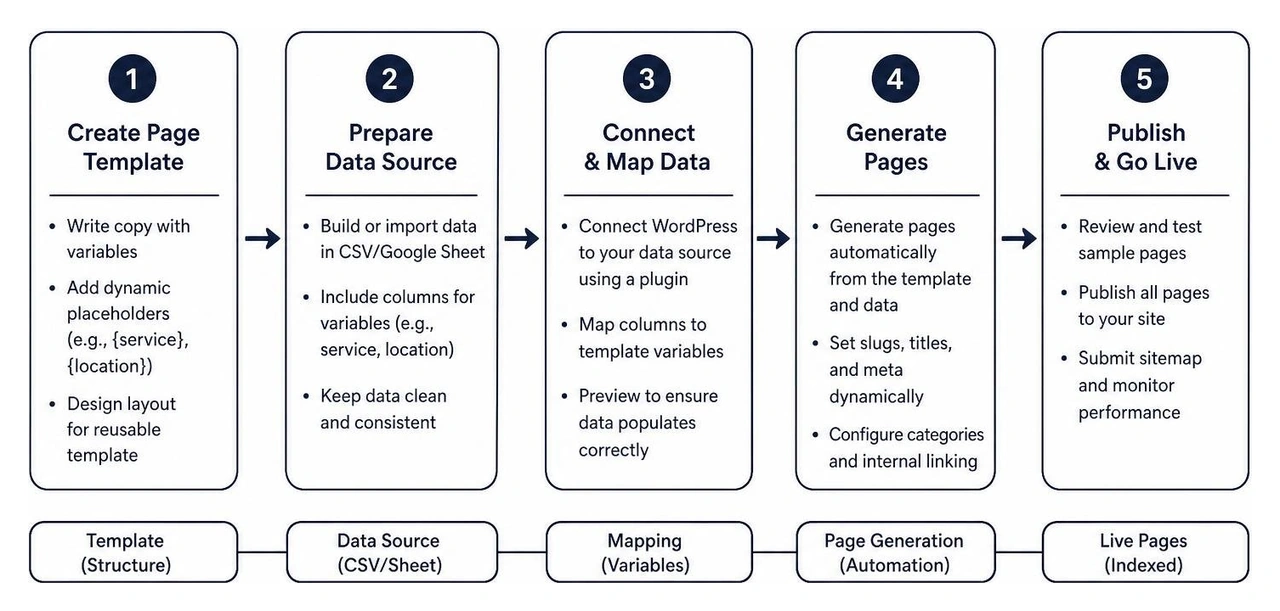
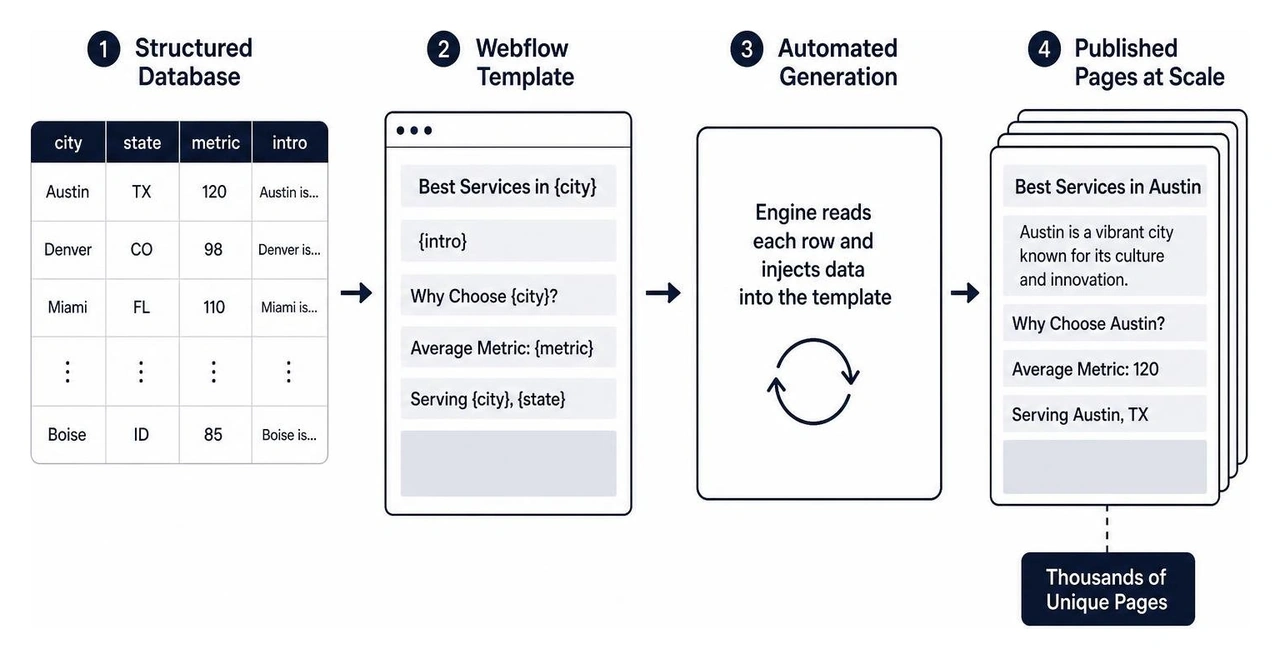
At its foundation, seo programmatic architecture bridges structured data assets with customizable website publishing pipelines. Instead of opening a content editor to write individual articles line by line, you design a single master page layout containing dynamic variable placeholders. These placeholders map directly to columns in a relational database, CSV file, or external API feed.
When your engine runs, the system loops through every row in your dataset, injecting specific data points into your pre-designed layout to produce distinct, published landing pages. To learn the underlying mechanics of how these components communicate, check out our guide on How Does Programmatic SEO Work.
A stable programmatic engine rests on three critical technical pillars:
- The Dataset (Data Layer): A structured database storing entity records, variable attributes, uniquely written introductions, numerical values, and custom meta tags.
- The Dynamic Template (Presentation Layer): A wireframed page layout built inside a modern Content Management System (CMS) featuring fields mapped directly to database columns.
- The Synchronization Pipeline (Automation Layer): A middleware tool, API integration, or native database plugin that automatically streams row items into individual CMS collection items.
Key Differences Between Traditional and SEO Programmatic Approaches
Traditional SEO relies heavily on manual editorial creation. A content strategist conducts keyword research, assigns individual briefs to human writers, and publishes articles one by one. This approach yields comprehensive editorial coverage, but it struggles to scale across thousands of highly specific long-tail search queries due to prohibitive production costs and slow delivery speed.
By contrast, seo programmatic methodologies reverse this dynamic. Rather than spending dozens of hours manually writing unique pages for every variations of a search phrase, you invest significant effort upfront to build a robust database, engineer modular templates, and establish data pipelines.
| Metric / Dimension | Traditional SEO | SEO Programmatic |
|---|---|---|
| Content Creation | Manual copywriting per page | Database-driven template generation |
| Publishing Speed | 1 to 5 articles per week | Hundreds of validated pages per batch |
| Target Keyword Focus | High-volume, competitive head terms | Highly targeted, low-competition long-tail modifiers |
| Cost Efficiency | High manual cost per individual URL | Significantly reduced average cost per page at scale |
| Tech Stack Focus | Standard text editors and basic CMS platforms | Relational databases, CMS collections, and sync APIs |
This fundamental structural shift allows lean marketing teams to capture massive search visibility by aggregate long-tail volume. To explore how these frameworks compare across various business models, read our overview of Programmatic SEO.
Benefits, Risks, and Business Suitability
Primary Benefits and Business Use Cases
The primary commercial advantage of programmatic page generation lies in conversion efficiency and bottom-of-funnel capture. Target terms often represent highly specific search intent—such as a user searching for precise software integration details, localized service rates, or niche item specifications.
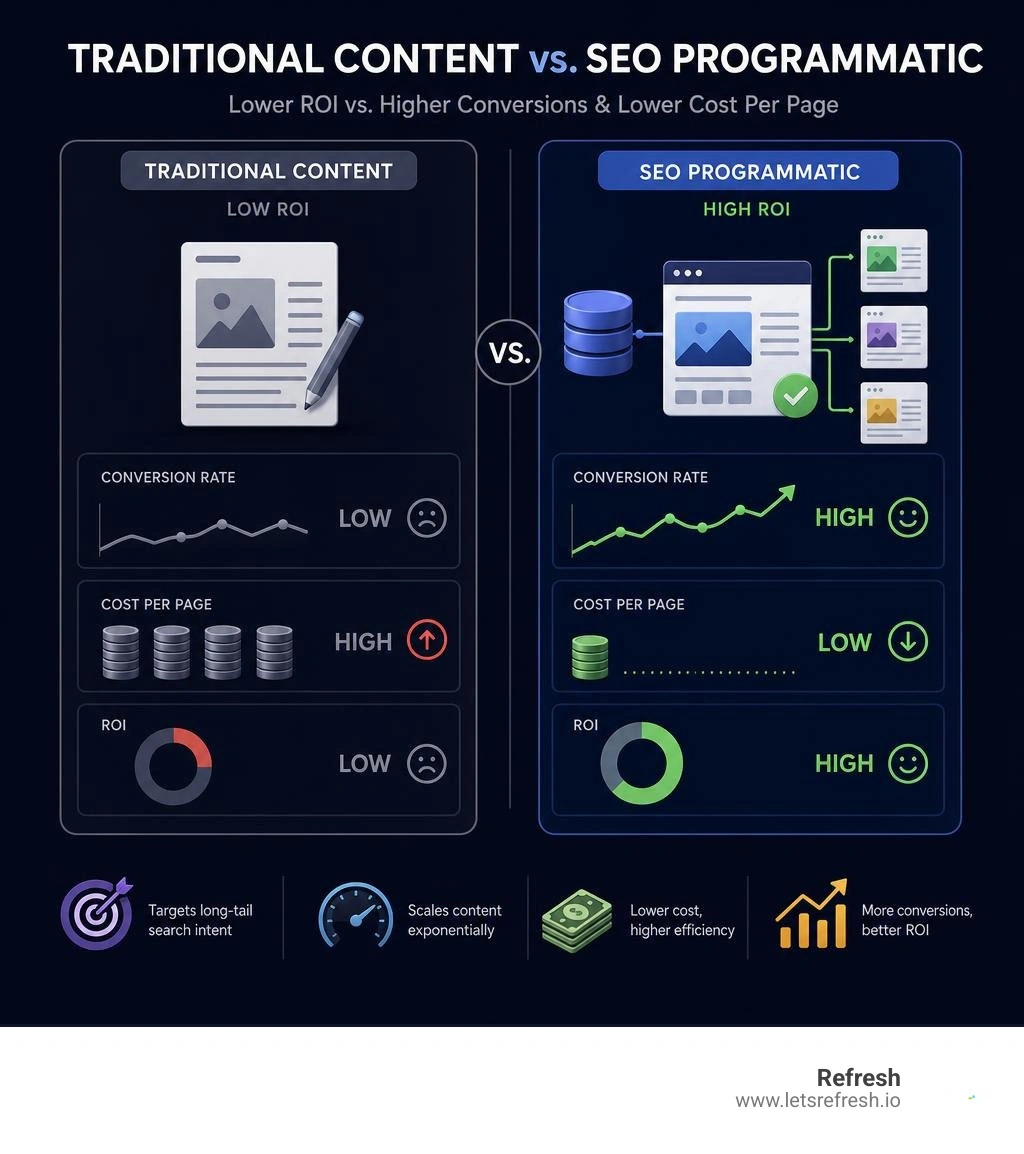
Industry studies demonstrate that programmatic landing pages often convert at rates up to 3x higher than standard top-of-funnel informational blog posts. Because individual pages target specific user scenarios, the copy aligns directly with immediate intent. Additionally, once template infrastructure and data pipelines are configured, the cost to deploy each additional page decreases significantly compared to traditional writing workflows.
A wide array of digital business models benefit directly from this programmatic framework:
- SaaS & Software Directories: Deploying integration pages (e.g., "[App A] + [App B] Integration") or alternative comparison hubs.
- Service Marketplaces: Building local service pages across multiple geographic locations (e.g., "[Service] in [City, State]").
- E-Commerce Platforms: Creating multi-attribute search filtering pages (e.g., "[Color] [Material] [Product Category]").
- Data Aggregators & Directories: Formatting public or proprietary statistics into accessible report pages.
To explore real-world brand executions across these sectors, view our detailed analysis of Programmatic SEO Examples.
Potential Risks and Indexation Challenges
Deploying thousands of web pages simultaneously introduces real technical and search quality risks. The most common threat is receiving quality demotions or de-indexing due to duplicate or thin content.
When search engine web crawlers evaluate large page sets, they assess whether each URL delivers genuine information gain—meaning new, helpful facts not found elsewhere on your site or across the web. Swapping a single city name or keyword modifier across identical static paragraphs fails this test, potentially triggering Google's scaled content abuse policies.
Key technical challenges to manage include:
- Crawl Budget Limits: Search bots allocate finite resources to crawling your site. Deploying low-quality pages wastes this budget, delaying the discovery of high-value pages.
- Indexation Drops: Search engines may discover your URLs but choose not to index them if your templates lack structural differentiation or unique row data.
- Internal Link Dilution: Automatically linking thousands of subpages without a clear hierarchy can result in inefficient page rank distribution across your domain.
Step-by-Step Implementation of SEO Programmatic Strategies
Scalable Keyword Pattern Mining
Successful programmatic programs begin by identifying logical, repeatable keyword structures. Instead of gathering individual search terms randomly, you map out "head terms" paired with logical "modifiers."
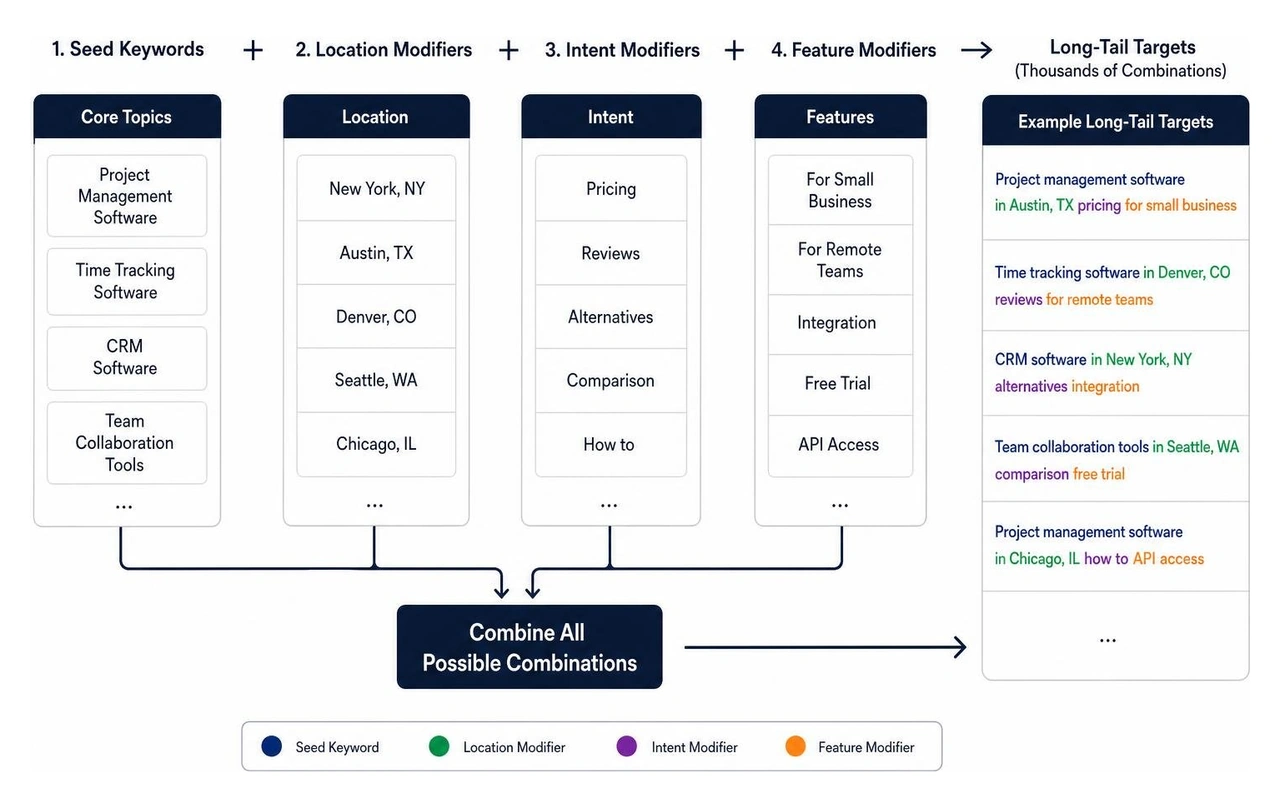
A functional programmatic keyword equation combines core seed topics with categorical variables:
[Head Term] + [Modifier A] + [Modifier B]
For example, a B2B financial software platform might map:
- Head Term:
Invoicing Software - Modifier A (Industry):
for Construction/for Independent Contractors/for Restaurants - Modifier B (Location):
in Pennsylvania/in Ohio/in North Carolina
This single pattern creates hundreds of hyper-targeted query variations. Individual long-tail search volumes may appear low—ranging from 10 to 500 searches per month—but when aggregated across hundreds of unique variations, they generate significant, high-intent conversion traffic.
To master discovering and validating these scalable patterns, dive into our resources to Learn Programmatic SEO.
Data Sourcing and Dataset Enrichment
Once you identify target keyword patterns, you must gather structured data to populate every dynamic placeholder on your programmatic template.
Common reliable sources for populating programmatic databases include:
- Proprietary Internal Data: Customer usage metrics, internal feature inventories, review aggregates, or pricing databases that competitors cannot duplicate.
- Third-Party APIs: Live connections to mapping, weather, public census, or real-time pricing databases that refresh programmatically.
- Structured Web Scraping & Research: Compliant extraction of structured public specifications, directories, or feature list comparisons.
Raw data collected from external feeds is rarely ready for publishing immediately. You must clean, normalize, and enrich dataset attributes. This involves standardizing numerical fields, verifying data accuracy, and using structured language models to convert raw data rows into readable summaries or comparison highlights.
For strategies on enhancing dataset quality using modern intelligence tools, read our breakdown on Programmatic SEO AI.
Dynamic Template Architecture and Design
To build durable programmatic pages that rank consistently, avoid generic template layouts. Modern search engine systems and Generative Engine Optimization (GEO) standards favor deeply structured pages enriched with verified facts, clear comparison tables, and dynamic content blocks.
We recommend deploying a variable-depth template architecture to ensure complete page uniqueness:
| Template Tier | Content Type | Operational Implementation |
|---|---|---|
| Tier 1 (Entity-Specific) | Unique Primary Data | Variable titles, customized entity summaries, custom quantitative stats, and dynamic charts |
| Tier 2 (Conditional Data) | Dynamic Features & Tables | Conditional feature tables, local map embeds, filtered FAQs, and relevant user reviews |
| Tier 3 (Boilerplate Data) | Standard Structural Copy | Methodological disclosures, trust badges, standard category footers, and global call-to-actions |
In corporate environments where Generative Engine Optimization (GEO) dictates visibility across AI answer engines, structural markup is essential. Integrating schema markup (such as FAQPage, Product, or LocalBusiness) ensures AI discovery engines easily parse your entity data and cite your programmatic landing pages.
Building and Deploying Programmatic Pages Without Code
No-Code Tools and Automation Infrastructure
Building an enterprise-level programmatic engine no longer requires custom database development or complex back-end code. A modern stack built on accessible no-code tools allows lean growth teams to construct, validate, and launch dynamic publishing systems efficiently.

A modern no-code programmatic software stack typically includes:
- Database Layer (Airtable or Google Sheets): Serves as your central relational data store, organizing unique row records, content fields, dynamic image URLs, and SEO meta tags.
- Sync & Middleware Layer (Whalesync or Make): Manages continuous two-way automated data flows between your database entries and your CMS collection fields.
- AI Enrichment Plugins: Generates dynamic text summaries, meta descriptions, and localized introductions directly inside spreadsheet cells prior to publishing.
Using dedicated software solutions ensures database updates sync to published pages automatically. Explore the top software tools available today in our guide to Programmatic SEO Automation Software and discover broader growth approaches in our breakdown of Search Engine Optimization Automation.
Publishing on Webflow and Modern CMS Platforms
When evaluating CMS platforms for scaling programmatic content, Webflow stands out as the ideal platform for modern teams. Its native CMS Collection architecture, granular design freedom, clean code generation, and powerful native database limits make it the premier web builder for executing programmatic strategies seamlessly.
To launch programmatic pages using Webflow, follow this proven implementation workflow:
- Setup CMS Collections: Establish your primary CMS collection schema with custom fields corresponding to dataset columns.
- Design Dynamic Layouts: Construct page layouts using bindable text, dynamic image elements, and conditional visibility rules.
- Connect Middleware: Integrate automated syncing connectors to push populated rows into published CMS items.
- Audit and Release: Run quality tests across content samples before triggering full publishing workflows.
By releasing initial page batches in controlled cohorts (e.g., 50 to 100 pages), you can monitor indexing performance, fix broken links, and audit Core Web Vitals before expanding across your entire database set.
For step-by-step guidance on setting up dynamic Webflow collections, consult our full tutorial on Programmatic SEO Webflow.
Avoiding Pitfalls and Managing Long-Term Maintenance
Preventing Scaled Content Abuse Penalties
Recent Google algorithm updates have significantly raised search quality thresholds regarding scaled content abuse. Search engines intentionally demote sites that launch thousands of repetitive pages generated from minimal dataset inputs.
To insulate your site from algorithmic quality demotions, apply the "Remove the Variable" test: if you strip the custom programmatic variable from your page template, does the remaining body copy still offer unique value? If the answer is no, your page risks being flagged as thin content.
Protect your site quality by enforcing these operational standards:
- Human-in-the-Loop QA: Ensure human subject matter experts audit data samples, template copy, and dynamic fields prior to batch deployment.
- Information Gain Scoring: Supplement base dataset variables with original commentary, internal survey data, or aggregated customer reviews.
- Custom Meta Logic: Craft variable formulas for meta titles and meta descriptions that read naturally rather than looking like automated keyword inserts.
Ongoing Monitoring and Performance Refinement
Launching your programmatic pages is only the beginning of your growth campaign. Sustaining long-term organic visibility requires continuous site health monitoring, indexing audits, and dataset updates.
Track these critical metrics in Google Search Console and analytics dashboards:
- Index Coverage Rate: Calculate the percentage of submitted programmatic URLs that Google successfully indexes. Target an indexation coverage rate of 80% or higher.
- Impression Growth Velocity: Monitor long-tail keyword impressions during the first 30 to 90 days after deployment.
- Conversion & Engagement Rates: Audit bounce rates and session durations to confirm page design satisfies user intent.
If specific page clusters show low indexation or declining traffic, prune underperforming pages or enrich underlying dataset rows with fresh information. To discover how our team helps small and medium-sized businesses manage technical performance and scale organic growth, explore our tailored SEO for Small Business Packages.
Frequently Asked Questions About Programmatic SEO
How long does programmatic SEO take to show search results?
Initial long-tail search impressions usually appear within 2 to 4 weeks following batch publication. However, achieving established rankings and consistent conversion traffic typically requires 3 to 6 months. Search engines require time to discover new URL structures, evaluate page quality across template clusters, and index pages systematically based on domain authority signals.
Is programmatic SEO considered search engine spam?
No. Programmatic SEO is an established distribution strategy used by major platforms worldwide. Search engines do not penalize automated publishing models inherently; they penalize low-quality, thin content created without user utility. So long as your programmatic templates deliver clear value, satisfy search intent, and incorporate rich entity data, your pages comply fully with search quality guidelines.
What search volume threshold should I target for programmatic keywords?
Unlike traditional editorial SEO—which often prioritizes high-volume keywords—programmatic SEO excels at targeting low-volume queries, including terms with search volumes between 10 and 500 searches per month. Because production effort per page is drastically reduced once templates are configured, aggregating hundreds of low-competition keywords creates a reliable, high-converting organic funnel.
Scaling Organic Growth with Strategic Programmatic SEO
Executing a successful seo programmatic campaign requires balancing data engineering, intuitive template design, and strict quality control. By combining structured relational datasets, modern Webflow dynamic collections, and refined human editing workflows, your business can build scalable search engine authority that captures high-intent customers cost-effectively.
At Refresh, we specialize in helping growth-minded businesses design and execute high-impact digital strategies. As a dedicated Webflow agency, we build scalable website architectures and performance-driven search programs built for long-term business success.
Ready to build your company's scalable organic search engine? Partner with our expert team at our Programmatic SEO Agency or explore our complete Programmatic SEO Guide to transform your search engine visibility today.


.avif)