
Why Your Startup Marketing Strategy Determines Whether You Grow or Fail
A strong startup marketing strategy is the difference between a business that scales and one that quietly disappears. Consider this: 22% of startups fail specifically because of marketing problems — not bad products, not poor timing, but ineffective marketing.
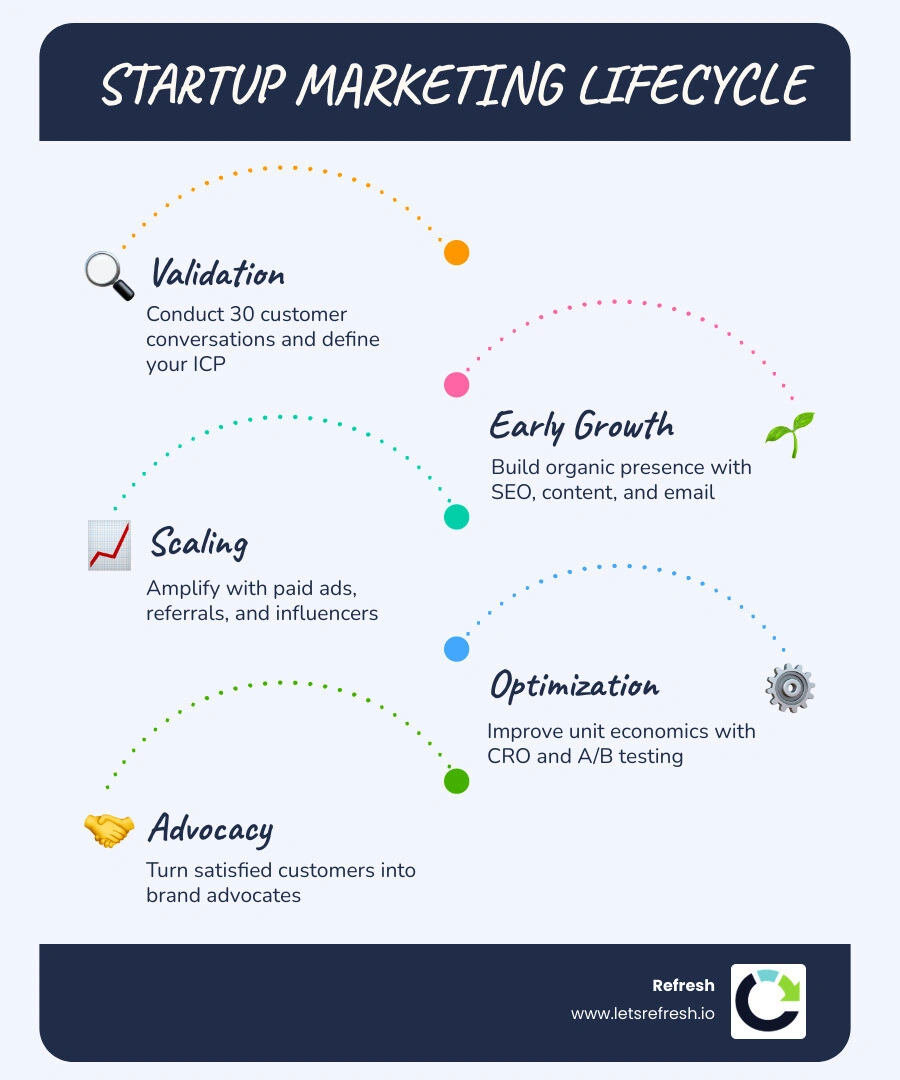
Here is a quick overview of what an effective startup marketing strategy looks like in May 2026:
| Stage | Priority | Key Actions |
|---|---|---|
| Validation | Understand your customer | 30 customer conversations, message testing, ICP definition |
| Early Growth | Build organic presence | SEO, content marketing, email list, 1-2 social channels |
| Scaling | Amplify what works | Paid ads, referral programs, influencer partnerships |
| Optimization | Improve unit economics | CRO, A/B testing, LTV:CAC tracking |
The pressure on startup founders is real. You are building a product, managing a team, and trying to get customers — all at once. Marketing often gets treated as an afterthought, or founders copy tactics from larger companies that simply do not apply to an early-stage business.
That approach does not work.
What does work is a focused, stage-appropriate strategy that builds compounding growth over time — through brand clarity, organic content, smart channel selection, and data-driven decisions.
Marketing also creates something most founders overlook: brand advocates. Satisfied customers who talk about your product are one of the most cost-efficient growth levers available to any startup.
I'm Alexander Palmiere, Founder and CEO of Refresh Digital Strategy, where I've helped over 200 businesses develop and execute digital strategies — including guiding growth-stage startups through the exact startup marketing strategy challenges covered in this guide. Let's walk through everything you need to build a strategy that actually drives growth.
Easy startup marketing strategy word list:
Building the Foundation of Your Startup Marketing Strategy

Before we spend a single dollar on ads or write a single blog post, we must build a foundation. Many startups rush into "performance marketing" because they want immediate sales, but performance tactics fail without a clear Branding Strategy for Startups. Your brand is not just a logo; it is the emotional connection you forge with your audience.
A winning startup marketing strategy begins with defining your Ideal Customer Profile (ICP). We need to know exactly who we are talking to, what their specific pain points are, and how our product enables a "better way" of living or working. For founders in hubs like Pittsburgh, PA, or Charlotte, NC, standing out requires more than just being "better"—it requires being different. This is where Startup Marketing and Branding becomes your competitive moat.
We recommend using a simple positioning formula: For [ICP] who [pain point], [Product Name] is a [Category] that [Key Benefit] unlike [Competitor] because [Differentiator].
To bring this brand to life, your digital home must be top-tier. At Refresh, we believe Webflow is the gold standard for startups. It allows for custom, high-performance designs that are easy to manage as you scale, ensuring your brand consistency remains intact across all channels.
| Feature | Brand Marketing | Performance Marketing |
|---|---|---|
| Goal | Long-term awareness & trust | Short-term leads & sales |
| Metric | Sentiment, recall, reach | CPA, ROAS, conversion rate |
| Duration | Continuous & compounding | Campaign-based & immediate |
| Function | Tells the "Why" | Focuses on the "Buy" |
Defining Your Target Audience and Market Position
To win, we must understand the size of the prize. We look at three layers:
- TAM (Total Addressable Market): The total market demand for your product.
- SAM (Serviceable Addressable Market): The portion of the TAM within your reach.
- SOM (Serviceable Obtainable Market): The portion of the SAM you can realistically capture.
Instead of just looking at demographics, we use the "Jobs to Be Done" framework. Customers don't buy a quarter-inch drill; they buy a quarter-inch hole. What "job" is your customer hiring your product to do? Understanding this allows us to create buyer personas that reflect real human motivations.
We also conduct a deep competitor analysis. We don't just look at what they do well; we look for where they are failing. This allows us to re-segment the market and target specific niches they’ve overlooked. This level of detail is a core part of The Importance of a Strong Digital Strategy for Small to Medium Sized Businesses.
Setting SMART Goals and Startup Marketing Strategy Budgets
Vague goals like "get more customers" lead to wasted spend. We use SMART goals: Specific, Measurable, Achievable, Relevant, and Time-bound. For example: "Acquire 500 new monthly active users by September 2026 with a Customer Acquisition Cost (CAC) under $45."
When it comes to budgeting, most SaaS startups should allocate between 8% and 15% of their revenue to marketing. If you are pre-revenue, we suggest a testing budget of $1,000 to $3,000 per month to validate your channels. The key is to track your Lifetime Value (LTV) to CAC ratio—aiming for at least a 3:1 or 4:1 ratio for sustainable growth.
Exploring Small Business Digital Solutions can help you find cost-effective ways to manage these metrics over 90-day milestones.
High-Impact Tactics for Organic Growth

Organic growth is the holy grail of a startup marketing strategy. While paid ads stop the moment you stop paying, organic content builds an asset that compounds. In 2026, we follow the Startup Marketing Strategy 2026: The Founder's Playbook by focusing on "systems, not heroics."
Content marketing should focus on topic clusters and pillar pages. Instead of writing random blog posts, we create one massive, authoritative "pillar" page about a core topic and surround it with 10–20 supporting articles. This builds topical authority that search engines love. By integrating storytelling and user-generated content (UGC), we move beyond selling features and start building a community. This is a primary focus in any Digital Marketing Company Startup Guide.
Mastering SEO and GEO for Startup Visibility
The search landscape has shifted. In May 2026, standard SEO is only half the battle. We now optimize for Generative Engine Optimization (GEO). With AI Overviews appearing on nearly half of all Google queries, your content needs to be structured so AI models can easily parse and cite it.
To rank, we focus on:
- E-E-A-T: Experience, Expertise, Authoritativeness, and Trustworthiness. AI search rewards content written by people with real-world experience.
- Semantic Search: Using natural language and answering long-tail keywords that mimic how people actually talk to AI assistants.
- Technical SEO: Ensuring your Webflow site is lightning-fast and mobile-responsive.
Leveraging Social Media and Email Marketing in a Startup Marketing Strategy
For B2B startups, LinkedIn is non-negotiable—it generates roughly 80% of B2B social leads. However, personal profiles get significantly more reach (up to 561% more!) than company pages. Founders should be the face of the brand.
Meanwhile, email marketing remains the highest ROI channel, driving an average of $36 for every $1 spent. We recommend starting your list from day one. Use personalized subject lines and automated nurture sequences to move prospects through the funnel. For those transitioning From Solo to Success, mastering these automation tools is the key to scaling without a massive team.
Scaling with Paid Media and Strategic Partnerships
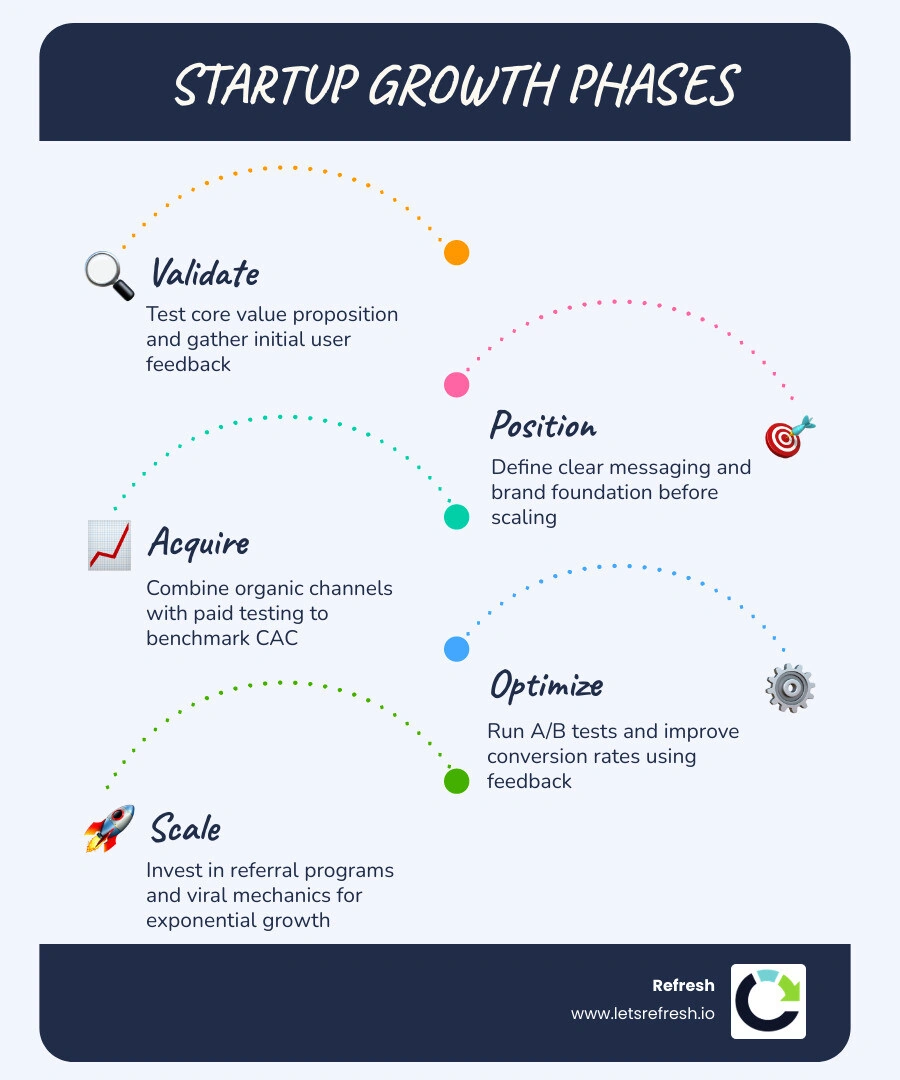
Once we have validated our messaging through organic channels, it’s time to add fuel to the fire. Paid advertising (PPC) on Google or Meta can provide immediate validation and help us establish CAC benchmarks. The 10 Essential Marketing Strategies for a Startup emphasize that paid media should be used for research as much as acquisition.
Strategic partnerships and micro-influencer collaborations are also vital. In Pennsylvania and Ohio, local networking can lead to powerful cross-promotion opportunities. Partnering with a business that shares your target audience but offers a non-competing product is a low-cost way to expand your reach instantly. Check out Marketing Strategies From Successful Pennsylvania Startups for local inspiration.
Implementing Referral Programs and Viral Mechanics
The most successful startups build marketing into the product itself. This is measured by the viral coefficient—the number of new users each existing user generates. If your coefficient is above 1.1, you have exponential growth.
We implement tiered referral incentives (like Dropbox or Morning Brew) to turn users into advocates. Word-of-mouth is free, credible, and highly effective. Working with an Affordable Digital Marketing Agency can help you set up the technical infrastructure to track these referrals accurately.
Conversion Rate Optimization and Growth Hacking
Growth hacking is about rapid experimentation. We don't guess; we test. Using tools like Hotjar for heat maps and running A/B tests on landing pages allows us to optimize for our "North Star Metric"—the single key indicator of growth.
Because we use Webflow, we can iterate on landing pages in minutes, not days. We focus on removing friction in the user journey, ensuring that every click brings the customer closer to the value proposition. Customer feedback loops are essential here; listening to why people don't buy is often more important than hearing why they do.
Frequently Asked Questions about Startup Marketing
Why do most startups fail at marketing?
Most startups fail because they rush to scale before they have "product-market fit" or a clear brand foundation. 22% fail due to marketing issues like poor positioning, lack of demand, or spending their entire budget on "spray and pray" tactics without a cohesive startup marketing strategy.
How much should a startup spend on marketing in 2026?
We generally recommend an allocation of 8–15% of revenue. For seed-stage companies, focus on high-ROI organic channels first. As you hit Series A and beyond, you can scale that budget to 20% or more to dominate your category.
Should I focus on SEO or paid ads first?
SEO should almost always come first because it builds a compounding asset. Paid ads are great for immediate validation of your messaging, but they stop working the moment you stop paying. A balanced startup marketing strategy uses paid ads to "test" and SEO to "build."
Conclusion
Building a startup marketing strategy is not a one-time event; it is an evolving process of testing, learning, and scaling. In 2026, the startups that win are those that combine human storytelling with AI-driven optimization and a technical foundation built on excellence.
At Refresh, we specialize in helping small to medium-sized businesses in Pittsburgh, Cleveland, and Charlotte navigate this journey. From expert Webflow development to comprehensive Digital Marketing Company Startup Guides, we are here to ensure your marketing is a growth engine, not a cost center. Success requires consistency, a deep understanding of your customer, and the right partners by your side. Let's build something remarkable together.


.avif)