
Why a Strong Branding Strategy for Startups Determines Who Wins

A solid branding strategy for startups is one of the most important investments you can make as a founder — and most get it wrong by starting too late.
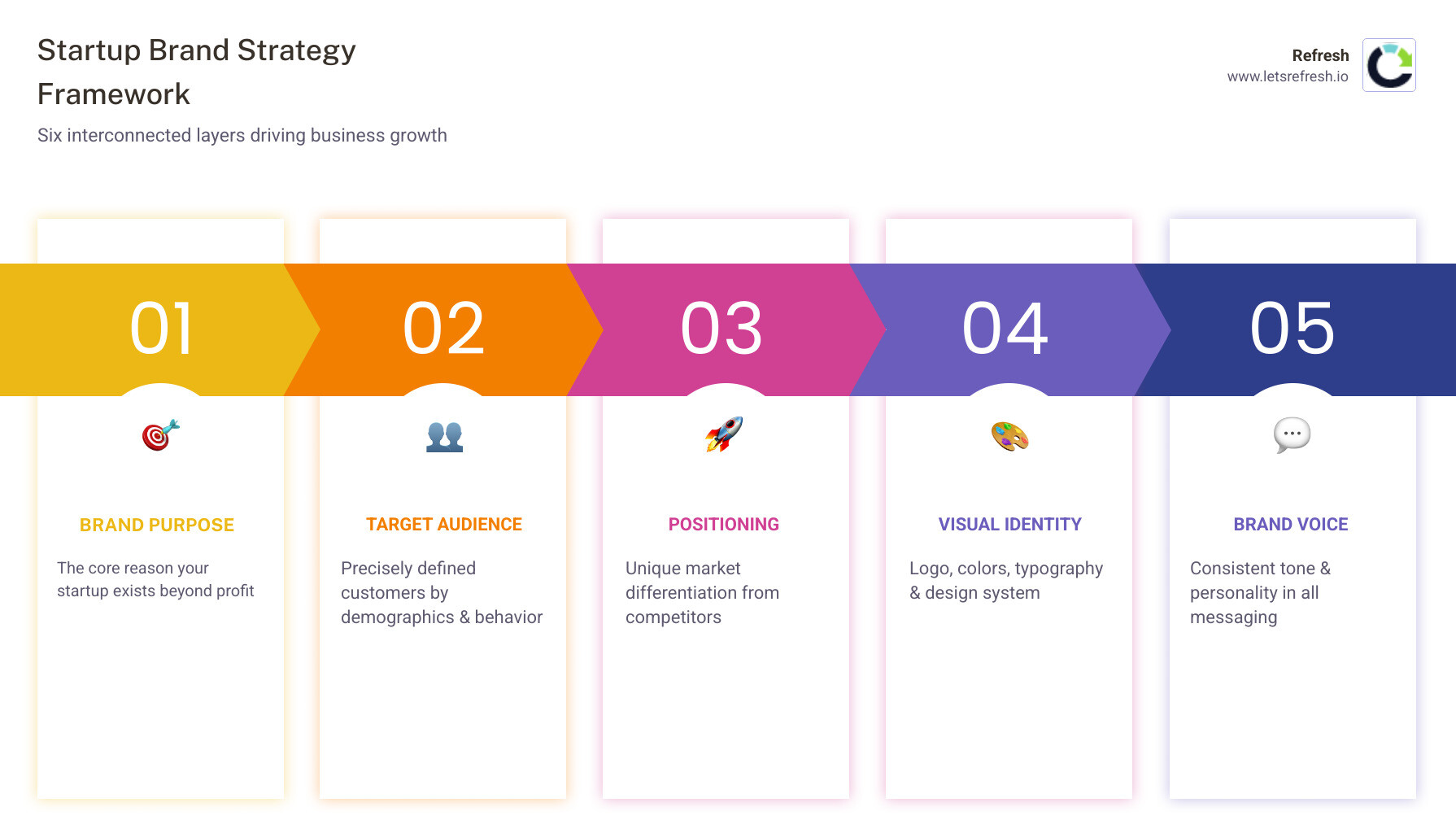
Here's a quick-reference overview of what a startup brand strategy involves:
| Component | What It Means |
|---|---|
| Brand Purpose | Why your company exists beyond making money |
| Target Audience | Who you serve, defined by demographics and behavior |
| Positioning | How you're different from competitors in your market |
| Visual Identity | Logo, colors, typography, and design system |
| Brand Voice | The tone and personality behind all your messaging |
| Brand Promise | What customers can consistently expect from you |
| Communication Toolkit | Website, pitch deck, one-pagers, and press materials |
Your brand is not just a logo. It's the emotional experience customers have every time they interact with your company. According to Seth Godin, a brand is "the set of expectations, memories, stories and relationships that account for a consumer's decision to choose one product or service over another." That definition matters, because it means your brand is being built right now — whether you're intentional about it or not.
The stakes are real. Research shows that 68% of businesses reported that consistent branding contributed between 10% and 20% or more in revenue growth. And 50% of customers say they're more likely to buy from a brand whose logo they recognize. These aren't vanity metrics — they're growth levers.
Yet many founders treat branding as something to figure out after product development, after fundraising, after finding customers. That's a costly mistake. A deliberate brand strategy built early reduces customer acquisition costs, sharpens your product-market fit signals, and gives your whole team something to rally around.
I'm Alexander Palmiere, Founder and CEO of Refresh Digital Strategy, and I've spent years helping growth-stage companies develop and execute a branding strategy for startups that translates into real digital results — including launching over 200 websites with measurable impact on traffic, engagement, and conversions. This guide walks you through everything you need to build a brand that wins.
The Fundamentals of a Branding Strategy for Startups
Many founders in Pittsburgh or Cleveland fall into the trap of thinking their technology is the brand. We often see brilliant engineers who believe that if the code is clean or the hardware is revolutionary, the market will naturally follow.
However, as the University of Wisconsin–Madison points out, your startup is more than just a discovery or technology. While your tech provides the engine, it doesn’t always translate into the business world on its own. The secret to bridging that gap is a branding strategy for startups.
Defining Your Brand Identity and Values
A brand is an organizational commitment. It starts with deep introspection: What problem are we solving? Why does our innovation matter? If our brand were a person, what would they be like?
At the core of this identity are your values. These aren't just words for a "Mission" page on your website; they are the guardrails for every decision you make. When defining these, we look toward frameworks like the Harvard Business Review: The Elements of Value, which breaks down what customers actually care about—from functional benefits like "saves time" to emotional ones like "reduces anxiety."
Your brand story should resonate emotionally. We call the alternative "Ugly Baby Syndrome"—the founder's belief that everyone will instantly love their "baby" idea just because it exists. In reality, you have to craft a narrative that makes the customer the hero and your startup the guide. This creates authenticity, which is the ultimate currency for a new company. When your internal team in Charlotte or Pittsburgh is aligned with these values, they become your most effective brand ambassadors.
Crafting a Unique Selling Proposition (USP)
Your USP is the "source code" of your competitive advantage. To find it, you must look at the intersection of what your customers need, what you do exceptionally well, and where your competitors are failing.
It’s easy to confuse strategy with tactics. To keep your team focused, we use a simple mental model:
| Brand Strategy (The "Who" and "Why") | Marketing Tactics (The "How" and "Where") |
|---|---|
| Defining your market category and "enemy" | Running LinkedIn or Google Ad campaigns |
| Crafting your core messaging pillars | Writing weekly blog posts or newsletters |
| Establishing your visual design system | Designing a specific landing page |
| Determining your long-term brand promise | Hosting a one-time launch event |
A strong USP identifies a market gap and fills it with a promise that is hard for incumbents to replicate. It’s not just about being "better"—it’s about being different in a way that matters to your specific audience.
Building Your Startup’s Visual Identity and Communication Toolkit
Once the strategy is set, it’s time to make it tangible. This is where many startups stumble by hiring a low-cost designer for a logo and calling it a day. A professional branding strategy for startups requires a cohesive visual system.

Developing a Consistent Visual Branding Strategy for Startups
Visual consistency isn't just about looking "pretty." It’s about building trust. When a potential investor sees your pitch deck, then visits your website, and finally checks your LinkedIn, they should feel like they are interacting with the same entity every time.
According to research by the Nielsen Norman Group: UX and Brand Consistency, consistent user experiences influence brand perception and usability. If your buttons look different on every page, or your colors shift between your app and your marketing site, you create "cognitive friction." This makes you look disorganized and unreliable.
To solve this, we recommend building a system of design tokens and component libraries. For our clients in Cleveland and beyond, we prefer Webflow as the foundation for this. Webflow allows us to create a "Single Source of Truth" for your brand. By using global classes and variables, we can update a brand color or font across an entire site in seconds. This modular approach ensures that as your startup scales, your brand doesn't break.
Remember the stats: 50% of customers buy from recognizable logos, and 68% of businesses see massive revenue growth from consistency. Your visual identity is your silent salesperson.
Essential Items for Your Communication Toolkit
You don’t need a 50-page brand book on day one, but you do need a toolkit that makes you look like a "real" company to stakeholders. Your toolkit should include:
- A High-Performance Webflow Website: Your website is your digital headquarters. It must be optimized for Generative Engine Optimization (GEO) to ensure AI search engines can easily parse your value proposition.
- The Investor Pitch Deck: This should follow the "10-20-30 rule" (10 slides, 20 minutes, 30-point font) and align perfectly with your visual identity.
- One-Pagers and Sales Collateral: Clear, concise summaries of your USP for partners and early customers.
- A Messaging House: A document that outlines your core taglines, elevator pitches, and responses to common objections.
Positioning and Launching Your Brand in a Competitive Market
Positioning is the act of "owning" a specific spot in your customer's mind. You cannot be everything to everyone. In fact, for a startup, being "everything" is a death sentence.
Conducting Competitor Research and Audience Definition
Effective positioning starts with listening. We often point founders toward the NSF I-Corps methodology, which encourages deep customer discovery before building. You need to understand your audience’s psychographics—what keeps them up at night?—not just their demographics.
Use the "Jobs-to-be-Done" framework. Customers don't buy a "product"; they "hire" a solution to do a job. For example, a customer doesn't "buy" a project management tool; they "hire" a way to feel in control of their chaotic workday.
Conduct a differentiation mapping exercise. Plot your competitors on a graph based on two axes (e.g., Price vs. Innovation, or Speed vs. Reliability). Find the "White Space" where no one else is playing. That is your category to own.
Executing a Successful Brand Launch Strategy for Startups
A launch isn't a single day; it's a sequence. Successful startups build hype before the "big reveal."
- Build Excitement: Use teasers, behind-the-scenes content, and "coming soon" pages to capture emails.
- Leverage Social Proof: Even if you’re new, you can show "social proof" through advisor endorsements, pilot program results, or waitlist numbers.
- Community and Influencers: Don't just blast ads. Partner with micro-influencers in your niche who already have the trust of your target audience.
- Experiential Marketing: For startups in hubs like Pittsburgh or Charlotte, local events or "unbranded" pop-ups can be a capital-efficient way to test your brand hypotheses in the real world.
Measuring Success and Scaling Your Brand on a Budget
The biggest myth in branding is that it’s "unmeasurable." While you can't always track the exact moment someone "fell in love" with your brand, you can absolutely track the impact of brand-led growth on your bottom line.
Tracking ROI through CAC and Retention
Branding is a lever for your most important metrics. Consider these real-world outcomes from integrated brand work:
- 18% Reduction in Paid CAC: Clearer messaging and positioning reduce the friction in your ad funnels.
- 22% Improvement in Onboarding: When a brand promise is clear, users know exactly what to do when they enter your product, reducing drop-offs.
- 30% Faster Production: Using a Webflow-based component library allows your team to spin up new landing pages for experiments nearly a third faster than manual coding.
We track the "Brand-Led Growth Funnel," which monitors how awareness flows into activation, and eventually, into long-term retention. A 5% increase in 90-day retention can have a multiplier effect on the Lifetime Value (LTV) of your customers.
Building Community and Loyalty on a Limited Budget
You don't need a Super Bowl budget to build a brand. You need Thought Leadership. By creating educational content that highlights inefficiencies in your industry and offers your solution as the "new way," you build authority.
Encourage user-generated content (UGC). When your early adopters share their success stories, it carries ten times the weight of a paid ad. In the rollercoaster world of startups—where exhilarating highs and "eek" moments are guaranteed—your community is what keeps the momentum going during the dips.
Frequently Asked Questions about Startup Branding
Is branding necessary before product-market fit?
Yes. Branding is not just aesthetics; it is the process of defining who you are and who you serve. Doing this early actually accelerates product-market fit because it makes your marketing experiments more interpretable. If you don't know who you're talking to, you won't know why your product is failing (or succeeding).
How long does it take to see results from branding efforts?
While perception shifts can take 3–6 months, tactical branding changes—like a messaging overhaul on a Webflow landing page—can show a lift in conversion rates and a reduction in CAC within 30 to 60 days.
Can a strong brand strategy reduce customer acquisition costs?
Absolutely. A strong brand creates "pull" instead of just "push." When customers recognize and trust your brand, your click-through rates (CTR) go up and your cost-per-acquisition goes down. It’s the difference between cold-calling a stranger and walking into a room where everyone already knows your name.
Conclusion
Building a branding strategy for startups is a journey of continuous adaptation. It’s about taking your core innovation and dressing it in a narrative that the world can understand, trust, and get excited about. Whether you are operating out of Pittsburgh, PA, Cleveland, OH, or Charlotte, NC, the principles remain the same: be consistent, be authentic, and be bold.
At Refresh, we specialize in these long-term partnerships. We don't just hand you a logo and walk away; we provide expert Webflow support and strategic alignment to ensure your brand evolves as your company scales. We help you move from "just another tech company" to a category-defining brand.
Ready to turn your startup into a household name? Start your branding journey with Refresh today. We’ll help you build the foundation so you can focus on changing the world.


.avif)