Why Google Adwords for Agencies Is a Growth Multiplier in 2026
Google Adwords for agencies is the practice of managing Google Ads campaigns on behalf of client businesses — and it comes with a dedicated partner program, structured tools, and a tiered recognition system built specifically for agencies.
Here's what agencies need to know at a glance:
| Topic | Quick Answer |
|---|---|
| What is it? | Managing Google Ads accounts for clients through a Google Manager Account |
| Partner program | Three tiers: Member, Partner, Premier Partner |
| Premier Partner | Top 3% of agencies in your country |
| Average ROI | $8 returned for every $1 spent on Google Ads |
| Badge delivery | Within 24–48 hours of meeting requirements |
| Key services | Search, Display, Shopping, Remarketing, Performance Max |
The opportunity is real. Google Ads delivers an average return of $8 for every $1 spent. Retargeted audiences are 70% more likely to convert. And Google Shopping spend is up 40% year over year.
But most agencies leave serious money on the table — for themselves and their clients — by skipping the Google Partners program, misstructuring campaigns, or leaning too hard on automation without the manual foundation that drives results.
This guide covers everything: how to join the program, how to structure campaigns, what to track, and how to price your services.
I'm Alexander Palmiere, Founder and CEO of Refresh Digital Strategy, where I've helped over 200 businesses grow through tailored digital marketing — including google adwords for agencies and their clients. The sections ahead pull directly from that hands-on experience, so you can build or scale your agency's Google Ads practice with confidence.
Simple google adwords for agencies word guide:
Navigating the Google Adwords for Agencies Partner Program
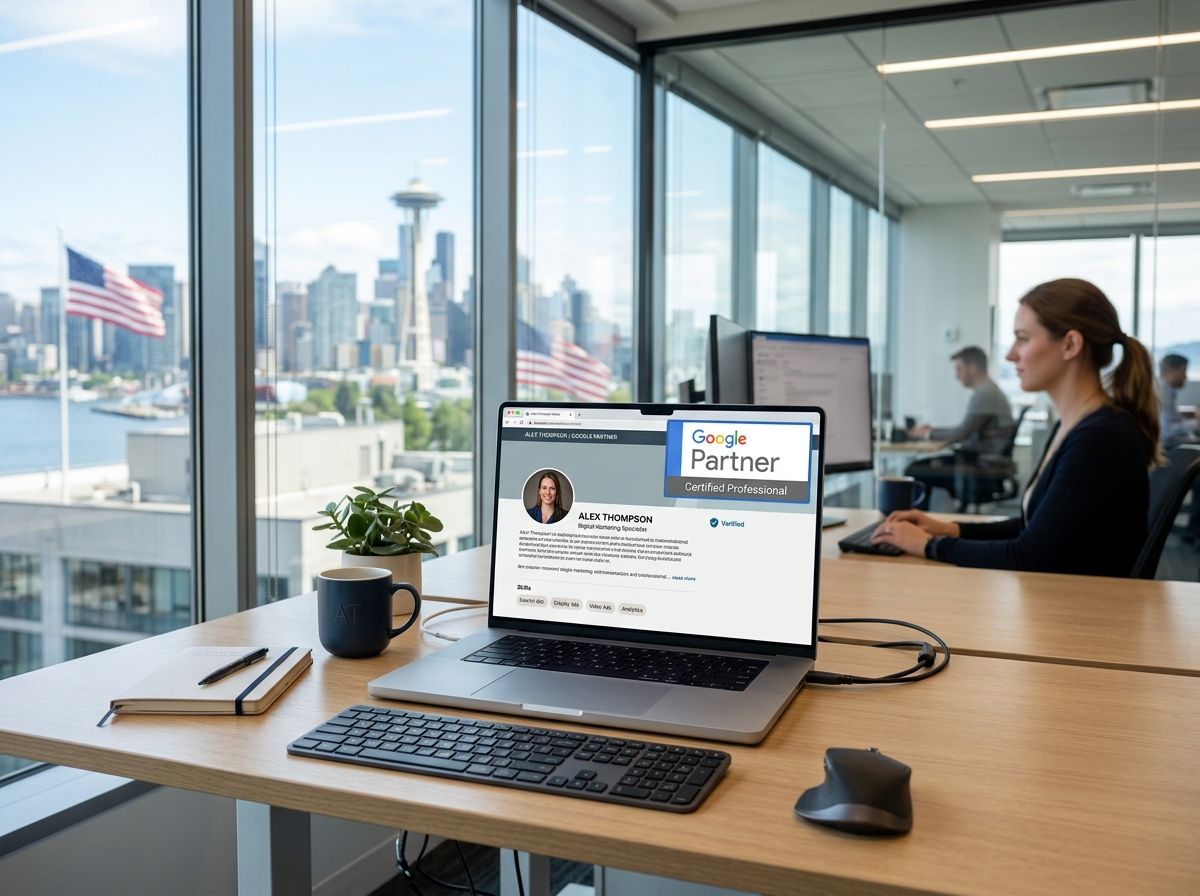
If we want to be taken seriously in google adwords for agencies, the first step is joining the official Google Partners program. This isn't just a vanity project; it’s a gateway to resources that help us manage client accounts more effectively.
To get started, we need a Google Ads manager account (MCC). This is the "umbrella" account that allows us to see all our client accounts in one dashboard without sharing login credentials. When we sign up for Google Partners, we must ensure we have admin access to this manager account.
Once signed up, we need to pay close attention to our notification settings. We recommend switching "Newsletters," "Performance reporting," and "Account updates" to "Receive all" in the notification settings. This ensures we don't miss out on beta opportunities or critical account health alerts.
To earn the badge, our agency must meet three specific pillars:
- Certifications: At least 50% of our account strategists must be certified in Google Ads via Skillshop.
- Spend: We need to maintain a 90-day spend of at least $10,000 across our managed accounts.
- Performance: We must maintain a minimum optimization score of 70%.
As a Google Ads Certified Agency, we’ve found that staying on top of these requirements naturally forces us to follow better management habits, which ultimately benefits our clients.
Understanding the Google Adwords for Agencies Tier System
The program isn't one-size-fits-all. It’s structured into three distinct tiers:
- Member: This is the entry level. We get access to the Google Partners portal and basic training, but we don't get a badge to show off on our website yet.
- Partner: Once we meet the Partner requirements regarding spend, performance, and certification, we earn the Google Partner badge. This grants us a listing in the Google Partners directory and access to strategic account resources for new clients.
- Premier Partner: This is the "Ivy League" of the program. Premier status is reserved for the top 3% of participating companies in a given country. Google evaluates this annually based on client growth, retention, and product diversification.
Benefits of Becoming a Google Partner
Why jump through these hoops? Because the perks are substantial. Beyond the professional credibility of the badge, we gain access to strategic insights and education that non-partners simply don't see.
We get consumer insight reports, advanced product training, and—most importantly—technical support that can be a lifesaver when an account gets flagged or a campaign underperforms. For us at Refresh, these insights allow us to be proactive rather than reactive, keeping our clients one step ahead of their competitors in markets like Pittsburgh, Cleveland, and Charlotte.
Essential Google Ads Services and Campaign Structures
Structuring an account is where most agencies win or lose. A messy account structure leads to budget misallocation, where "vanity" keywords eat the budget meant for high-intent converters.
When we handle Google Ads campaign setup, we follow a strict hierarchy:
- Account Level: Centralized billing and high-level settings.
- Campaign Level: This is where we set budgets and goals (Sales, Leads, or Traffic).
- Ad Group Level: We group highly related keywords here.
- Ad Level: We use Responsive Search Ads (RSAs), filling out every available headline and description field to give Google's AI the best chance to find a winning combination.
We also never launch a campaign without a full suite of ad extensions. Sitelinks, callouts, and location extensions aren't optional; they increase the physical "real estate" our ad takes up on the screen and significantly improve Click-Through Rate (CTR).
As part of our digital advertising solutions, we emphasize "audience layering." By adding demographics and "in-market" audiences in observation mode, we can see who is actually clicking and adjust bids accordingly.
Leveraging Performance Max and AI Max
The biggest shift in google adwords for agencies recently is the move toward AI-driven campaigns. Performance Max is now the gold standard for cross-channel reach. It uses Google’s AI to find customers across Search, YouTube, Display, and Discover from a single campaign.
But there’s a new "power-up" on the block: Google AI Max. Following its rollout in 2025, AI Max has become a vital opt-in upgrade for Search campaigns in 2026. Unlike Performance Max, which is its own campaign type, AI Max overlays generative AI on existing Search campaigns. It helps with smarter query matching and dynamic ad generation.
For our SMB clients, this is a game-changer. It allows smaller businesses to achieve enterprise-level results by using AI to uncover new audiences that were previously too expensive or complex to target manually. However, we always maintain human oversight. AI is a great co-pilot, but it still needs a human at the controls to ensure brand consistency and conversion quality.
Advanced Google Adwords for Agencies Strategies
To truly dominate, we have to look beyond basic search ads.
- Remarketing: People who see retargeted ads are 70% more likely to convert. We use display remarketing to stay top-of-mind for users who visited a client's Webflow site but didn't take action. This is one of the most effective online advertising tactics for lowering overall Cost Per Acquisition (CPA).
- Google Shopping: With spend in this category increasing by 40% year-over-year, ecommerce agencies must master the Merchant Center.
- Feed Optimization: We don't just "set and forget" a product feed. We A/B test keyword-optimized titles. For example, changing a product title from "Blue Running Shoe" to "Men's Lightweight Blue Running Shoe - Size 10" can dramatically increase visibility in Shopping results.
Optimizing Performance and Client Reporting
At the end of the day, our clients care about one thing: ROI. On average, companies earn $8 for every $1 spent on Google Ads. If we aren't hitting those benchmarks, we need to look at our optimization strategy.
Effective digital ad campaign management requires a balance. While Google pushes for broad match and full automation, we've found that manual optimization—especially in the first 45 days—outperforms pure automation. We prioritize Exact Match and Phrase Match keywords because they typically yield a lower CPA and higher conversion rate than Broad Match.
Key metrics we track and report include:
- Impression Share: What percentage of the market are we actually capturing? We aim for 80% in high-intent categories.
- Absolute Top Position: How often are we the very first result?
- Quality Score: By ensuring the landing page (ideally a high-performance Webflow page) matches the ad copy and keyword, we can lower our CPC.
As a paid search advertising agency, we use these metrics to prove our value every month.
Technical Integrations and Tracking
In 2026, standard browser-based "pixel" tracking is no longer enough. Privacy changes have created gaps in reporting. To solve this, we implement server-side tracking. This allows us to capture conversions that browsers might miss, giving us a much clearer picture of our actual ROI.
We also integrate Google Ads data with CRMs like HubSpot and Salesforce. This "closed-loop" reporting allows us to see not just which keyword generated a click, but which keyword generated a sale. For our clients in Cleveland or Charlotte, this level of detail is what separates a "marketing expense" from a "growth engine."
Since we specialize in Webflow, we ensure all google ad operations are seamlessly integrated with the site's forms and tracking scripts, providing a frictionless path from click to conversion.
Common Pitfalls and Agency Pricing Models
Even the best agencies make mistakes. One of the most common is budget misallocation—letting a single campaign with high volume but low intent eat 90% of the daily budget. Another is "landing page friction," where a great ad sends a user to a slow, generic homepage instead of a dedicated, high-converting landing page. These are similar to common Facebook ad mistakes we see across the industry.
When it comes to pricing google adwords for agencies, we see three main models:
- Percentage of Ad Spend: Usually 10% to 20%. This is great for scaling but can sometimes create a conflict of interest if the agency pushes for higher spend without higher returns.
- Flat Management Fee: A set monthly rate based on the number of campaigns or ad groups. This provides predictable costs for the client and predictable margins for us.
- Tiered Pricing: A hybrid model where the fee increases as the client moves into higher spend brackets.
For smaller businesses, digital ad campaigns for SMB usually fall into the $1,000 to $10,000 per month range. We focus on "margin protection" for our agency by ensuring our management fees cover the intensive research and weekly optimizations required to keep these accounts profitable.
Frequently Asked Questions about Agency Management
How long does it take to get the Google Partner badge?
Once you meet all the performance, spend, and certification requirements, the badge is typically awarded within 24–48 hours. You can then immediately download the badge assets for use on your website, email signatures, and marketing materials.
What is the average ROI for Google Ads?
According to the Google Economic Impact report, the average ROI is $8 for every $1 spent. However, this varies by industry. Lead generation for high-ticket services (like senior care or B2B tech) often sees even higher returns when campaigns are optimized correctly.
Can agencies manage multiple client accounts from one place?
Yes, using a Google Ads Manager Account (MCC). This allows us to link multiple client accounts under one login. We can manage billing, view cross-account performance, and control access levels for our team members without needing the client's personal login details. The client always retains ownership of their account; we are simply granted access to manage it.
Conclusion
Dominating google adwords for agencies isn't about "setting and forgetting" campaigns. It’s about a commitment to the Google Partners program, a mastery of new AI tools like Performance Max and AI Max, and a relentless focus on ROI.
At Refresh, we don't just manage ads; we build growth engines. By combining our Google Ads expertise with our specialized Webflow development, we create a seamless experience that turns clicks into long-term partnerships. Whether you are in Pittsburgh, Cleveland, or Charlotte, we are here to provide the expert support your business needs to scale.
Ready to see what a high-performance Google Ads strategy can do for your revenue? Start your journey with Refresh today.


.avif)