
Why Your Content SEO Strategy Is the Foundation of Organic Growth
A strong content SEO strategy is no longer optional — it's the difference between a website that compounds traffic over time and one that publishes endlessly without results.
What is a content SEO strategy?
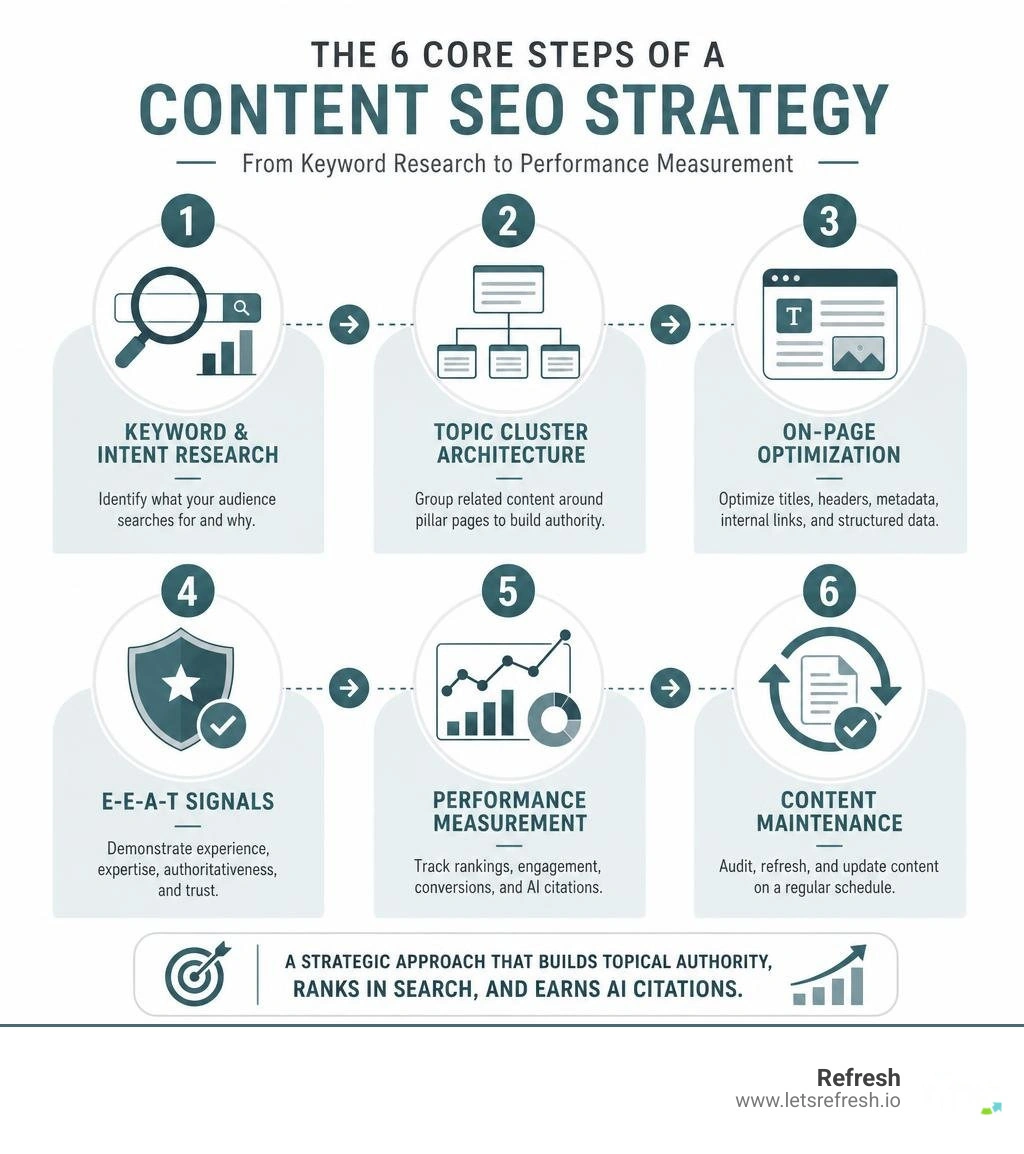
A content SEO strategy is a documented plan for creating, organizing, and optimizing content so it ranks in search engines, attracts the right audience, and drives real business outcomes. It includes:
- Keyword and intent research — understanding what your audience is searching for and why
- Topic cluster architecture — grouping related content around pillar pages to build authority
- On-page optimization — titles, headers, metadata, internal links, and structured data
- E-E-A-T signals — demonstrating experience, expertise, authoritativeness, and trust
- Performance measurement — tracking rankings, engagement, conversions, and AI citations
- Content maintenance — auditing, refreshing, and updating content on a regular schedule
Here's the hard truth: 94% of published content earns zero organic traffic. The reason is almost always the same — no documented strategy behind it.
And in 2026, the stakes are higher. Google still drives nearly 93% of web traffic, but AI-powered search features are reshaping how that traffic gets distributed. Thirteen percent of Google searches now surface AI Overviews. Websites with well-structured topic clusters are cited approximately three times more often in AI-generated responses than sites with scattered, disconnected content.
That means your strategy needs to work on two levels at once: ranking on traditional search and earning citations from AI engines like ChatGPT, Perplexity, and Google's AI Overviews.
The old approach — pick a keyword, write an article, repeat — simply doesn't build the kind of topical authority that search engines and AI platforms reward today.
I'm Alexander Palmiere, Founder and CEO of Refresh Digital Strategy, and I've spent years helping growth-stage businesses build content SEO strategies that drive lasting visibility — not just short-term traffic spikes. Across more than 200 website launches and ongoing digital strategy engagements, I've seen what separates content that compounds from content that gets ignored.
Content SEO strategy terms you need:
What is a Modern Content SEO Strategy?

A modern content SEO strategy is not just about matching letters on a page to queries in a search bar. It is a holistic, user-first blueprint designed to satisfy human search intent while making your site's architecture entirely legible to automated crawlers and AI synthesis models.
Historically, search engine optimization was treated as a secondary layer. Marketers would write an article and hand it off to an SEO specialist to "add keywords." Today, that workflow is a recipe for failure. To rank in 2026, SEO must be baked directly into the planning stage before a single word is drafted. This integration is what we call the content experience - where user experience (UX) meets structured information.
As search engines shift from simple index-and-retrieve systems to answers-first platforms, the traditional boundaries of content marketing are evolving. To understand how to position your brand, it helps to look at What is SEO Strategy in Digital Marketing to see how search acts as your primary organic acquisition channel. While a general content marketing strategy focuses on brand storytelling across multiple channels (such as email, social media, and podcasts), your search-focused strategy targets organic search as its primary engine of growth.
The transition to AI-assisted search means we must optimize for both traditional search engine results pages (SERPs) and conversational answer engines. Traditional search still commands roughly 80% of search activity, but AI-driven interfaces now handle more than 40% of high-intent, complex queries. This dual landscape highlights the need for structured, easily extractable information to ensure your brand remains visible across all search modalities.
By prioritizing the user's content experience - ensuring your site has clean navigation, fast load times, and clear topical pathways - you establish a foundation that satisfies both humans and search algorithms. For smaller organizations, understanding this intersection is crucial; you can explore What is Content Marketing and Why is it Important for Small Businesses to see how strategic content matches local customer needs and builds long-term relationships without requiring enterprise-level ad budgets.
The Core Pillars of an AI-Ready Content Architecture
To survive and thrive in an era of generative search, your website cannot exist as a collection of isolated blog posts. It must be built as an interconnected library of authoritative resources. AI engines do not evaluate pages in a vacuum; they look at your entire domain's topical footprint to determine if you are a credible source.
To achieve this, we transition from keyword-centric publishing to a topic cluster model. This architectural shift is contrasted below:
| Traditional Keyword Model | Topic Cluster Model |
|---|---|
| Focuses on individual, high-volume keywords | Groups keywords into semantic themes and topics |
| Creates separate, often redundant pages | Builds a single authoritative pillar page supported by subtopics |
| Leads to keyword cannibalization and internal competition | Uses organized internal linking to pass authority |
| Hard for AI crawlers to map relationships | Nested structure makes site relationships clear to LLMs |
Building this architecture requires a deliberate, multi-step framework. By implementing a structured approach like the 7-Step AI Search Framework, you can define your topical territory, map intent paths, and ensure your content remains highly visible across both Google and generative platforms. This structured methodology allows you to turn raw data into organized organic visibility.
Mapping Keywords to the Buyer Journey in a Content SEO Strategy
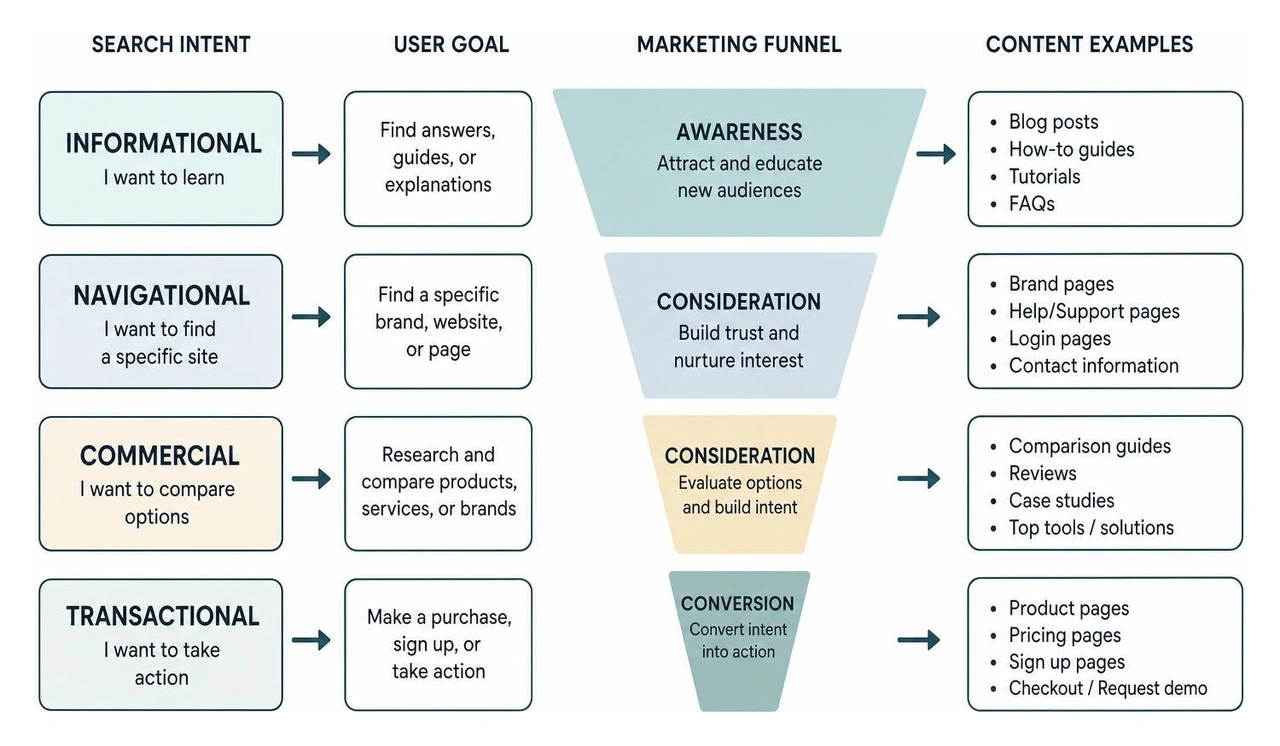
An effective content SEO strategy maps every target keyword to a specific stage of the marketing funnel. If you target informational keywords with transactional sales pitches, or vice versa, users will immediately bounce, signaling to Google that your page does not satisfy their query.
We classify search intent into four primary categories:
- Informational Intent: The searcher is looking for answers, guides, or explanations (e.g., "how does a topic cluster work"). This aligns with the awareness stage of the buyer journey.
- Navigational Intent: The user is trying to find a specific website or brand (e.g., "Refresh Webflow support").
- Commercial Intent: The searcher is researching products, services, or brands to compare options (e.g., "best Webflow development agency"). This represents the consideration stage.
- Transactional Intent: The user is ready to make a purchase or sign up (e.g., "hire Webflow developer Charlotte").
To organize these keywords effectively, we recommend mapping them in a master spreadsheet that aligns search volume, difficulty, and business value with the appropriate funnel stage. Understanding The Role of Keywords in SEO and How to Use Them Effectively will help you avoid the trap of simply chasing high-volume terms that fail to convert, allowing you to focus on long-tail opportunities that attract ready-to-buy clients.
Building Topical Authority with Webflow-Optimized Clusters
For businesses using Webflow, building and managing these topic clusters is remarkably efficient. Webflow's CMS (Content Management System) allows us to create dynamic relationships between pillar pages and supporting cluster articles, ensuring clean internal linking and a logical site structure.
When organizing your clusters in Webflow, keep these structural principles in mind:
- One Pillar, Multiple Spokes: Create a comprehensive, high-level pillar page (typically 2,500+ words) that introduces the broad topic. Then, build 5 to 15 highly focused spoke articles (1,000 to 1,500 words) that dive deep into specific subtopics.
- Bidirectional Linking: Every spoke article must link back to the main pillar page using descriptive anchor text, and the pillar page must link out to each spoke.
- Clean URL Directories: Organize your URLs logically (e.g.,
/blog/seo-strategyas the pillar, and/blog/seo-strategy/keyword-mappingas a spoke). - Nested Schema Markup: Implement structured data programmatically across your Webflow templates. By nesting related schema blocks (like Article, FAQPage, and BreadcrumbList), you make it 40% easier for AI engines to crawl and synthesize your content relationships.
This clean, crawlable setup is essential for local visibility. If you are operating in our primary service areas - such as Pennsylvania, Ohio, or North Carolina - tailoring your clusters to local search behavior is a powerful differentiator. Aligning your Webflow CMS structure with strategic copy helps you dominate regional search results and capture local intent effectively.
To make sure your technical foundation is solid, check our guide on On-Page SEO Search Engine Optimization to learn how to configure your Webflow templates for maximum crawlability.
On-Page Optimization and Content Experience for Modern Search

Once your content architecture is in place, page-level execution dictates whether your pages will actually rank. Modern on-page optimization is not about keyword density; it is about creating an exceptional content experience.
Google’s Helpful Content system and Quality Rater Guidelines heavily penalize sites that disrupt the user experience with intrusive ads, poor formatting, or slow load times. To rank in 2026, your pages must load quickly, adapt seamlessly to mobile devices, and present information in a highly readable format.
Structuring Content for AI Extraction and Featured Snippets
Because AI Overviews and answer engines now handle a massive portion of search queries, we must write our content to be easily "extractable." Traditional writing often buries the main point under paragraphs of fluff to increase dwell time. Modern SEO requires the opposite: answer-first formatting.
To optimize your content for both Google's featured snippets and AI synthesis models, apply these formatting rules:
- Lead with Claim-Shaped Sentences: Open every major section with a single, clear, and direct sentence that answers the heading's question. AI engines can easily extract these sentences verbatim.
- Keep Definitions Concise: When defining a concept, provide a 40-50 word summary in the first paragraph immediately following an H2 or H3 heading.
- Use Structured Lists and Tables: Data presented in bulleted lists or clean HTML tables is 40% more likely to be cited in AI search results.
- Implement FAQ Schema: Apply FAQPage JSON-LD schema to any page containing direct questions and answers, making your content highly eligible for rich snippets.
Executing On-Page Best Practices within Your Content SEO Strategy
A successful content SEO strategy relies on consistent, repeatable on-page habits. Before publishing any page, run through this technical checklist to ensure it is fully optimized:
- Title Tags: Keep titles under 60 characters, place your primary keyword in the first 3-4 words, and include your brand name at the end.
- Header Hierarchy: Use exactly one H1 tag per page. Organize the rest of the content logically with H2 and H3 tags.
- Meta Descriptions: Keep descriptions between 150-160 characters. Write them as compelling calls-to-action, even though Google rewrites them roughly 68% of the time.
- Image Optimization: Compress all images to keep file sizes under 200KB. Use modern formats like WebP or AVIF, and write descriptive, hyphenated, lowercase file names with helpful alt text (e.g.,
content-seo-strategy-dashboard.webp). - DateModified Hygiene: Keep your publish and modification dates honest. Only update the
dateModifiedtag when you have made substantial changes to the content. Falsely updating dates to trick crawlers will eventually cause search engines to ignore your freshness signals entirely.
To see how these on-page tactics fit into your broader marketing efforts, read our guide on How to Use SEO in Your Digital Marketing Strategy.
Measuring Success Beyond Traditional Organic Clicks
As search engines evolve to answer queries directly on the SERP, traditional metrics like organic clicks and pageviews no longer tell the whole story. If a user gets their answer from an AI Overview citing your website, your traditional click-through rate might drop, but your brand reach and authority have actually increased.
To measure the true ROI of your content SEO strategy in 2026, you must look at a broader mix of metrics:
- AI Citation Share: The frequency with which your brand and content are cited in AI-generated responses (such as ChatGPT, Perplexity, and Google AI Overviews) for your target keyword clusters.
- Brand Mention Frequency: How often your brand is mentioned across the web — including on social media, forums like Reddit, podcasts, and trade publications — even without a direct backlink. AI engines use these off-domain entity signals to build their confidence in your authority.
- Engagement Rate and Dwell Time: Tracked via Google Analytics 4 (GA4), these metrics tell you if users are actually consuming your content or bouncing immediately.
- Conversions and Assisted Conversions: A blog post might not drive a direct sale on the first visit, but it often acts as a critical touchpoint in the customer journey. Use multi-channel funnel reports in GA4 to track how your content assists conversions down the line.
Evaluating these metrics as an interconnected system rather than looking at individual pages in isolation is key to long-term growth. To build a dashboard that tracks what truly matters to your business, explore our guide on SEO Digital Marketing Content Strategy.
Frequently Asked Questions about Content SEO Strategy
How does Generative Engine Optimization (GEO) differ from traditional SEO?
Generative Engine Optimization (GEO) is the practice of optimizing your content to be found, understood, and cited by AI-powered search engines and large language models (LLMs) like ChatGPT, Perplexity, and Gemini.
While traditional SEO focuses on ranking factors like keyword placement, backlink quantity, and URL structure to win clicks on a search results page, GEO focuses on content structure, information extractability, and off-domain entity signals. AI engines rely heavily on nested schema markup, structured data, and clear, claim-shaped sentences to synthesize answers. GEO is about winning the citation, whereas traditional SEO is about winning the click.
How long does it take to see results from a modern content SEO strategy?
SEO is a long-term investment, but a modern, cluster-based strategy typically delivers compounding results faster than traditional, unorganized publishing. Here is a realistic timeline:
- Days to Weeks: Technical optimizations, schema updates, and content refreshes can show indexing signals and initial ranking movements almost immediately as search crawlers re-index your pages.
- 3 to 6 Months: You will begin to see meaningful organic traffic gains and improved rankings for low-to-mid competition keywords within your target topic clusters.
- 6 to 12 Months: Your primary pillar pages will begin to rank for higher-competition terms, and your AI citation share will grow as LLMs update their retrieval indexes.
- 12 Months+: The compounding effects of your content library become visible, driving sustainable, high-value traffic and conversions at a fraction of the cost of paid advertising.
Why is content experience and E-E-A-T critical for ranking in 2026?
E-E-A-T stands for Experience, Expertise, Authoritativeness, and Trustworthiness. While it is not a direct, algorithmic ranking factor, Google uses this conceptual framework to evaluate the overall quality of your website's content experience.
With the massive influx of generic, automated AI content on the web, search engines have heavily updated their systems to prioritize original, human-led insights. To demonstrate E-E-A-T, your content must feature real author bios, cite trustworthy external sources, present original data or case studies, and offer a clean, uncluttered reading experience. If your content looks like a generic rewrite of your competitors' pages, search engines and AI models will simply ignore it.
Conclusion
Building a modern content SEO strategy is a continuous process of planning, optimization, and measurement. In a search landscape shaped by both traditional search algorithms and generative AI, success belongs to businesses that prioritize structured, authoritative, and user-first content.
At Refresh, we specialize in helping small to medium-sized businesses navigate this evolving digital landscape. As a full-service digital marketing and Webflow website development agency, we combine strategic SEO, cohesive branding, and expert Webflow support to build websites that rank, capture search intent, and drive measurable business growth. We focus on long-term partnerships, ensuring your digital presence continues to compound in value over time.
Ready to turn your website into a high-performing organic growth engine? Explore our Refresh SEO Services today to see how we can help you build an AI-proof content strategy tailored to your business.


.avif)