
Is Your Business Invisible to AI Search? Here's What to Do
A generative AI SEO agency helps businesses get cited and recommended inside AI-powered search tools like ChatGPT, Google AI Overviews, Perplexity, and Gemini — not just ranked on traditional Google search pages.
Here's a quick overview of what to look for:
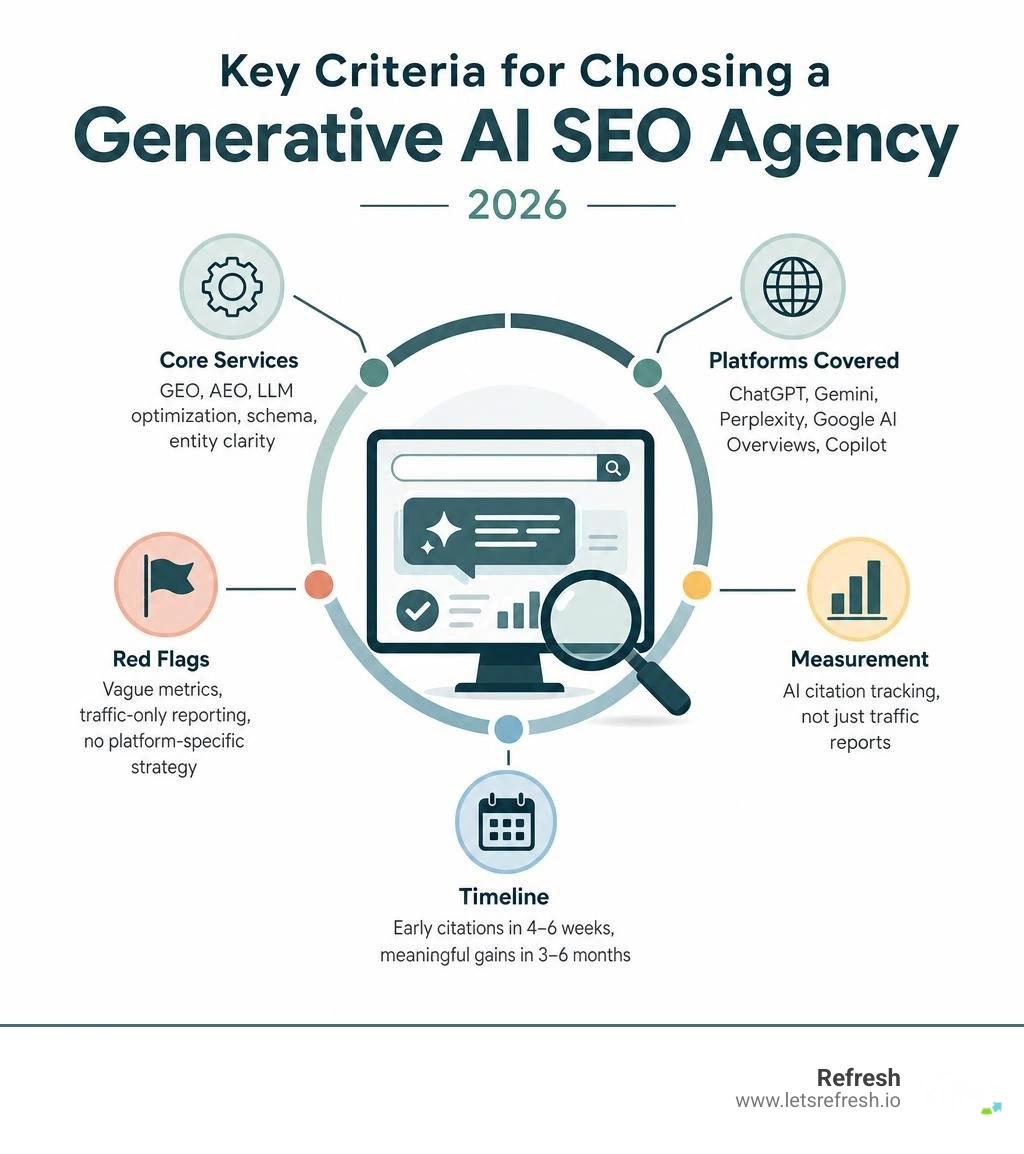
| What to Evaluate | What Good Looks Like |
|---|---|
| Core services | GEO, AEO, LLM optimization, schema, entity clarity |
| Platforms covered | ChatGPT, Gemini, Perplexity, Google AI Overviews, Copilot |
| Measurement | AI citation tracking, not just traffic reports |
| Red flags | Vague metrics, traffic-only reporting, no platform-specific strategy |
| Timeline | Early citations in 4-6 weeks, meaningful gains in 3-6 months |
Search has fundamentally changed. Over 65% of Google searches now trigger an AI Overview. An estimated one-third of consumers start product research directly inside ChatGPT or Perplexity. And 58.5% of US Google searches end without a single click to any website.
Your traffic numbers might look fine. But clicks are quietly disappearing.
The businesses winning right now aren't just ranking on page one — they're being cited as the trusted source inside AI-generated answers. That requires a completely different strategy from traditional SEO.
I'm Alexander Palmiere, Founder and CEO of Refresh Digital Strategy, where I've helped growth-stage businesses build stronger digital foundations through SEO, Webflow development, and now generative AI SEO agency strategy. In this guide, I'll walk you through exactly how to find the right partner to make your brand visible where buyers are already looking.
What is a Generative AI SEO Agency and How Does It Work?

A generative AI SEO agency is a specialized digital marketing partner that optimizes your online footprint so that Large Language Models (LLMs) and generative search engines recommend your brand.
Unlike traditional agencies that focus solely on climbing Google's classic "ten blue links," these agencies understand the underlying mechanics of machine learning, neural networks, and Retrieval-Augmented Generation (RAG). They treat AI platforms not just as tools for writing content, but as the new search engines where your buyers are making purchasing decisions.
When you partner with a forward-thinking artificial intelligence marketing agency, the workflow shifts from basic keyword stuffing to deep semantic alignment. AI models do not search the web the way humans do; they crawl, synthesize, and extract structured facts to form a single, cohesive answer. A generative AI SEO agency ensures your website's technical and content infrastructure is perfectly tuned to be digested, trusted, and cited by these models.
Traditional SEO vs. Generative Engine Optimization (GEO)
Traditional SEO was built for a world where search engines pointed users to a list of external websites. The goal was simple: rank in the top three positions, earn the click, and convert the user on your landing page.
Generative Engine Optimization (GEO), on the other hand, is built for a zero-click economy. Because AI platforms synthesize answers directly within their chat interfaces, users often get exactly what they need without ever clicking through to a website.
To understand how this shift impacts your marketing, let's look at how the search process has evolved:
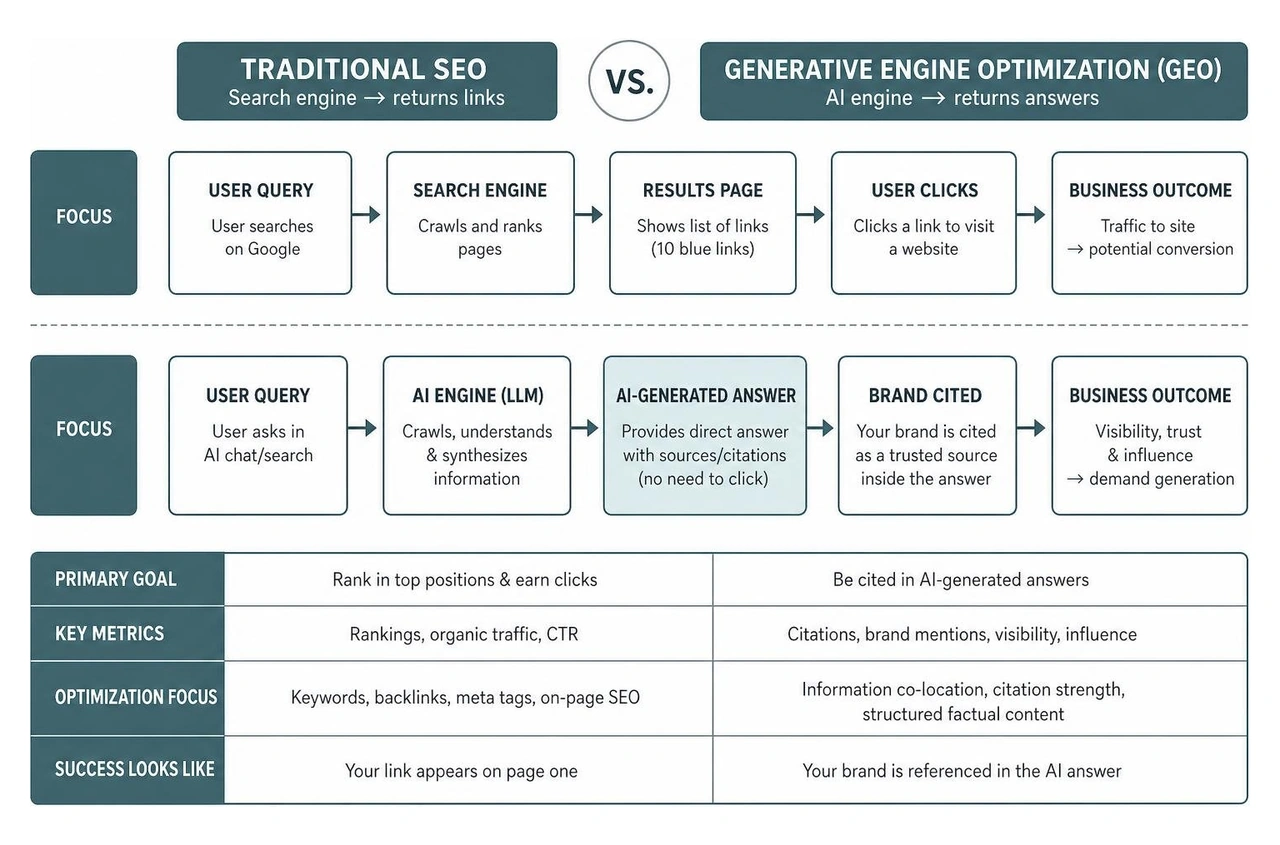
While traditional SEO focuses on keyword density, backlink volume, and meta tags, GEO focuses on:
- Information Co-location: Placing answers and supporting evidence in close proximity so LLM crawlers can easily parse the relationship.
- Citation Strength: Building a digital footprint across authoritative third-party sites so AI models repeatedly encounter and recommend your brand.
- Structured Factuality: Presenting data in highly extractable, machine-readable formats.
By implementing generative engine optimization, businesses ensure they don't get left behind as search engines transition from discovery directories to direct answer engines.
Why Your Business Needs a Generative AI SEO Agency in 2026
In 2026, relying solely on traditional SEO is a high-risk strategy. Studies show an estimated 18% to 64% decline in organic clicks due to the rise of generative search. Many business owners have already reported a 20% to 40% decrease in search traffic since Google fully integrated AI Overviews.
If your target audience is asking ChatGPT, Gemini, or Perplexity for recommendations, and your brand isn't appearing in those synthesized answers, you are functionally invisible. This is especially true for local service providers and high-growth companies in our core service areas like Pittsburgh, PA, Cleveland, OH, and Charlotte, NC.
For instance, if a buyer in Pennsylvania asks an LLM for the best service provider, they expect a highly personalized, structured recommendation. To capture this local demand, businesses are leveraging targeted regional strategies:
- Businesses looking to capture search share in Pennsylvania utilize specialized Pittsburgh AI SEO Services and localized Generative Engine Optimization (GEO) Services in Pittsburgh to ensure local relevance.
- In Ohio, brands are adopting Cleveland AI SEO Services | Jason Shaffer Group (JSG) alongside dedicated AI SEO: GEO & AEO Services in Cleveland, Ohio to dominate local AI recommendations.
- Across the Carolinas, companies are implementing Charlotte AI SEO Services | Jason Shaffer Group (JSG) and working with an established SEO, AEO & GEO - Digital Marketing Agency in Charlotte to secure their spot in regional conversational answers.
With ChatGPT closing in on a billion weekly users, optimizing for these platforms is no longer a futuristic luxury—it is a modern operational necessity.
Core Services Offered by Modern AI Search Agencies

A modern generative AI SEO agency provides a highly technical, multi-layered suite of services designed to maximize your brand's "share of model." This goes far beyond basic content writing. It involves restructuring your entire digital ecosystem so that both human searchers and autonomous AI agents can easily find and verify your business.
To scale these efforts efficiently, agencies utilize advanced search engine optimization automation to handle technical audits, track citation fluctuations across multiple platforms, and run continuous prompt-testing workflows.
Generative Engine Optimization (GEO) and Answer Engine Optimization (AEO)
The foundation of modern AI search visibility rests on two pillars: GEO and Answer Engine Optimization (AEO).
AEO is the practice of optimizing content to answer highly specific, conversational user queries. Instead of targeting abstract keywords like "CRM software," AEO targets complex, situational questions like "how do I sync my sales pipeline with my customer support data when using a small team?"
To win these queries, agencies use passage-level optimization. This involves structuring your articles so that the direct answer to a question is placed immediately below a clear heading, followed by supporting statistics and authoritative citations. This structure allows AI models to easily lift your content and present it as a direct answer in search results.
LLM Optimization for ChatGPT, Gemini, and Perplexity
Different AI engines rely on distinct data sources and ranking signals to generate their recommendations. A skilled agency will tailor your optimization strategy depending on which platform your buyers use:
- ChatGPT: Relies heavily on Bing Search APIs to pull real-time information, authoritative citations, and user reviews. Optimizing for ChatGPT requires strong off-page digital PR, active directory listings, and highly crawlable web pages.
- Google Gemini: Leverages Google's proprietary Knowledge Graph and places a massive premium on E-E-A-T (Experience, Expertise, Authoritativeness, and Trustworthiness). Optimizing for Gemini requires clear author profiles, structured schema markup, and verifiable entity relationships.
- Perplexity: Prioritizes content freshness, direct citations, and structured academic or journalistic sources. Winning on Perplexity requires an active content refresh cycle and earned media mentions.
By understanding these platform-specific nuances, an agency can build a diversified strategy that secures citations across the entire AI landscape.
How to Evaluate and Choose a Generative AI SEO Agency
As the demand for AI search visibility grows, many traditional marketing firms are rebranding themselves as AI specialists overnight. Choosing the wrong partner can result in wasted budget and missed opportunities during a critical transition period.
To make an informed decision, you need to understand how to evaluate an agency's actual capabilities and workflow. If you want to explore the space yourself first, you can read our guide on what are the best ai seo tools for small businesses to understand the software these teams rely on.
Key Criteria for Choosing the Best Generative AI SEO Agency
When interviewing a potential generative AI SEO agency, look for these three essential capabilities:
- Conversation Analysis over Keyword Research: The agency should explain how they analyze real-world discussions—from Reddit forums and community boards to sales calls and customer support tickets—to map the actual conversational queries your buyers ask AI tools.
- Multi-Engine Citation Tracking: They must have a reliable method for measuring your brand's visibility across ChatGPT, Gemini, and Perplexity. Ask them how they track "share of voice" inside LLM responses. Platforms like MiraiSage — Be found by AI are excellent examples of the specialized diagnostic tools required for this work.
- Entity and Knowledge Graph Building: They should have a clear strategy for establishing your brand as an "entity" in the eyes of AI models, ensuring your business details are consistent across all digital touchpoints.
Red Flags and Pitfalls to Avoid When Hiring
Keep an eye out for these common warning signs during your agency search:
- Promises of Quick, Guaranteed Rankings: AI algorithms are highly dynamic and personalized. Any agency promising "guaranteed #1 spots in ChatGPT" does not understand how generative search works.
- Traffic-Only Reporting: If an agency only reports on traditional website clicks without tracking AI citations, brand mentions, or pipeline attribution, they are simply selling rebranded traditional SEO.
- Purely Automated Content Farms: Watch out for agencies that use basic AI writing tools to churn out hundreds of low-quality, generic blog posts. This type of commodity content is actively ignored by modern LLM crawlers.
Technical and Content Strategies for AI Search Visibility
To win in the AI search era, your technical foundation must be as strong as your content strategy. If AI crawlers cannot easily read, parse, and verify your website's data, they will simply skip your brand and cite a competitor.
For a complete breakdown of the technology driving this space, check out our ai seo tools complete guide.
Schema Markup and Machine Extractability
The secret to being cited by LLMs is machine extractability. You must make it incredibly easy for an AI crawler to understand exactly what your business does, who you serve, and why you are credible.
This is achieved through advanced structured data and JSON-LD schema markup. By implementing detailed Organization, Product, FAQ, and Local Business schemas, you feed direct, structured facts into the AI's data retrieval system. This builds a clear entity graph, helping search models connect your brand name with specific services, locations, and expertise.
Webflow as the Preferred Platform for Technical AI SEO
At Refresh, we build exclusively on Webflow because it is the absolute best content management system (CMS) for modern, technical AI SEO.
Webflow produces exceptionally clean, semantic HTML code and boasts lightning-fast rendering speeds. This is crucial because AI crawlers are highly sensitive to crawl efficiency; if your site is bogged down by messy code, heavy plugins, or slow load times, AI bots will abandon the crawl.
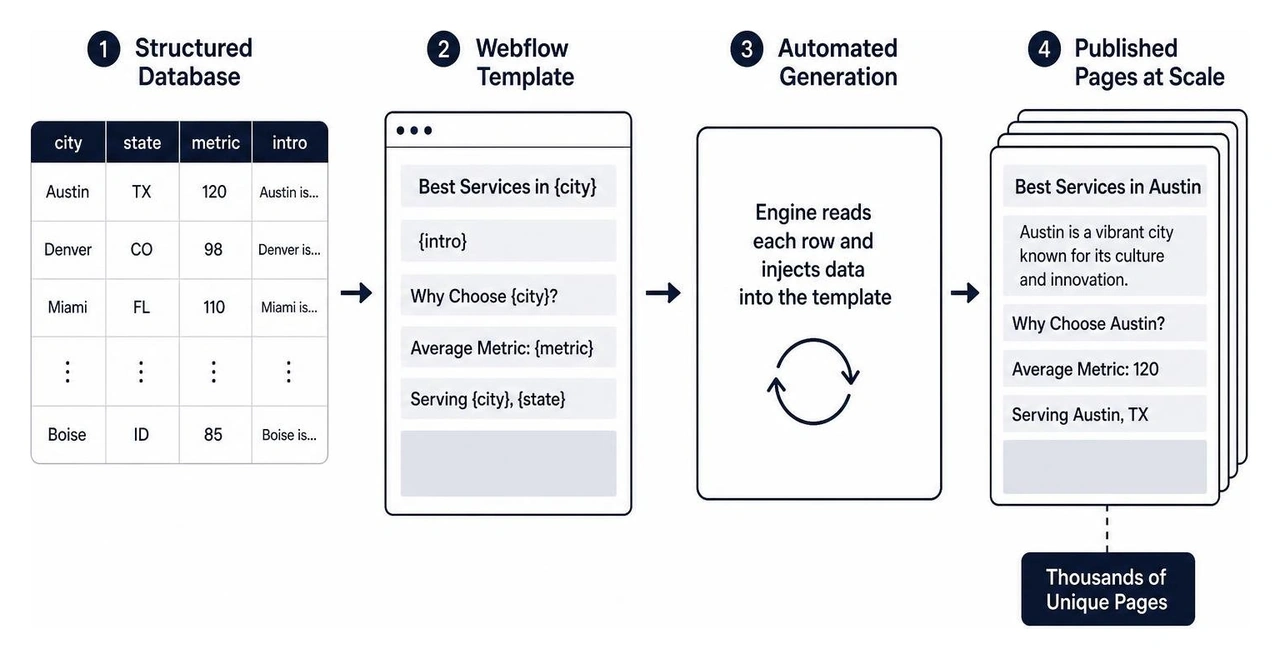
Furthermore, Webflow's structured CMS allows us to build highly scalable, custom content frameworks. This is incredibly valuable when executing advanced strategies like programmatic seo or building automated content pipelines.
If you want to understand how modern web design intersects with AI capabilities, you can read about the role of ai and chatbots in modern website development to see how these technologies work together to create seamless user experiences.
To help you scale your organic footprint even further, we also specialize in advanced automated structures:
- For businesses looking to scale their landing pages and target hundreds of conversational queries simultaneously, partnering with a programmatic seo agency is a game-changer.
- By combining programmatic seo ai with high-performance programmatic seo automation software, we can build thousands of highly structured, machine-readable pages that satisfy both human searchers and LLM crawlers.
Frequently Asked Questions about Generative AI SEO
What is the typical cost and timeline for seeing GEO results?
Because AI search optimization relies on how models crawl and synthesize web data, results happen in stages. Early citations and updates inside real-time search engines (like Perplexity or ChatGPT Search) can often be seen within 4 to 6 weeks of publishing optimized content and schema.
However, achieving broad, consistent recommendation share across all major LLMs typically takes 3 to 6 months. This timeline allows models to complete their training cycles and fully integrate your brand's updated entity signals. Most specialized agencies operate on structured monthly retainers to support this continuous optimization, testing, and reporting process.
How do you measure success and ROI for generative AI SEO campaigns?
Because AI search often keeps users within the chat interface, traditional traffic metrics like clicks and impressions are no longer the sole indicators of success. Instead, modern agencies measure ROI through:
- AI Visibility and Citation Share: Tracking how often your brand is cited as a source or recommended in response to target buyer prompts.
- Brand Sentiment Tracking: Monitoring how AI models describe your business, services, and reputation compared to your competitors.
- Pipeline and Revenue Attribution: Tracking direct conversions, demo bookings, or sales that originate from users who discovered your brand via an LLM recommendation.
How can businesses prepare their website before engaging an agency?
Before partnering with a generative AI SEO agency, you can lay a strong foundation by ensuring absolute consistency in how your brand, locations, and services are described across the web. AI models aggregate signals from directories, social media, and press releases; if your business details are inconsistent, the AI's confidence in recommending you drops.
Additionally, start structuring your existing website content to lead with clear, factual answers, and audit your technical setup to ensure your site is fast, responsive, and easy to crawl.
Conclusion
The transition from traditional search engines to generative AI answers is the most significant shift in digital marketing since the invention of search itself. If you are not actively optimizing your brand to be found, trusted, and cited by LLMs, you risk becoming invisible to a massive and fast-growing audience of buyers.
At Refresh, we combine expert Webflow development with cutting-edge digital marketing strategies to build fast, structured, and machine-readable websites that both humans and AI models love. We believe in building long-term partnerships that help growth-stage businesses adapt, scale, and thrive in an ever-changing digital landscape.
Ready to secure your brand's future in AI search? Explore our specialized GEO services and let's build a digital presence that keeps your business at the center of the conversation.


.avif)