
Search Is Changing — Here's What Generative Engine Optimization (GEO) Means for Your Business
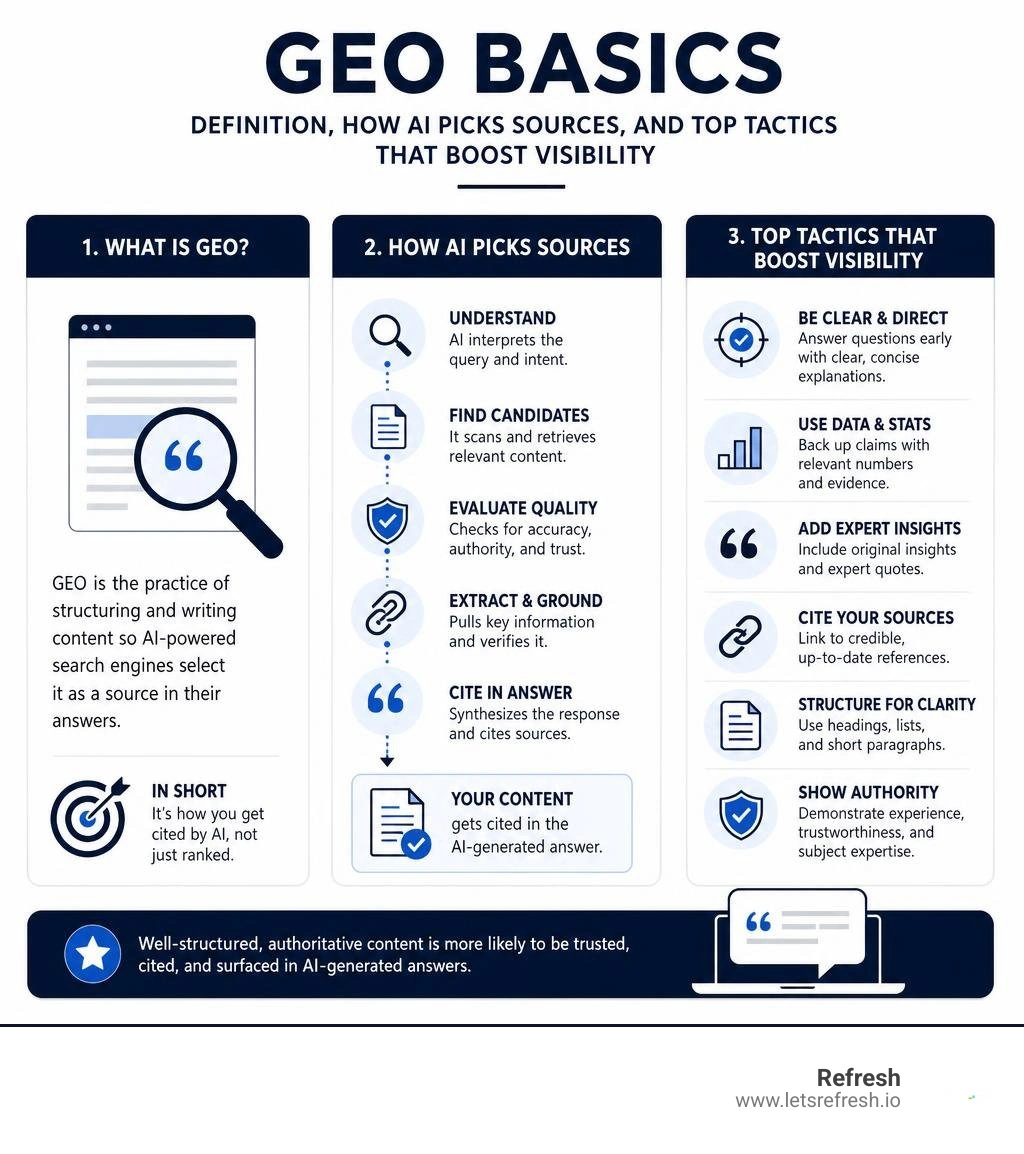
Generative Engine Optimization (GEO) is the practice of structuring and writing your content so that AI-powered search engines — like Google AI Overviews, ChatGPT, and Perplexity — select it as a source when composing their answers.
In short: it's how you get cited by AI, not just ranked by Google.
Quick definition:
| Traditional SEO | Generative Engine Optimization (GEO) | |
|---|---|---|
| Goal | Rank in a list of blue links | Be cited inside an AI-generated answer |
| Success metric | Click-through rate and rank position | Citation rate, brand mentions, share of voice |
| Key tactics | Keywords, backlinks, page speed | Statistics, expert quotes, inline citations, fluency |
| Who benefits most | High-authority domains | Any well-structured, authoritative source |
Search behavior is shifting fast. People are increasingly turning to generative AI tools to get direct answers — and skipping the traditional list of links entirely. Google's AI Overviews now reach billions of users each month. Zero-click searches rose from 54% to 72% when an AI overview appears on a results page. That means your content either gets quoted by AI, or it gets passed over entirely.
The good news? Academic research confirms that targeted content changes can boost your visibility in AI-generated answers by up to 40% — and lower-ranked websites often benefit the most.
I'm Alexander Palmiere, Founder and CEO of Refresh Digital Strategy, where I've helped over 200 businesses build stronger digital presences — and increasingly, that means navigating the rise of Generative Engine Optimization (GEO) alongside traditional SEO. In this guide, I'll break down exactly what GEO is, what actually works, and what to ignore.
What is Generative Engine Optimization (GEO)?
Generative Engine Optimization (GEO) represents the next structural shift in search engine strategy. Broadly defined, GEO is the process of optimizing web pages and overall online presence so large language models (LLMs) and conversational search systems can easily retrieve, ground, and attribute your content within synthesized AI answers.
Where classic search engines act as indexes that point users to external websites via ten blue links, generative engines behave as synthesis machines. When a user submits a prompt, an AI search engine does not simply output a list of URLs. Instead, it reads through web pages, extracts pertinent passages, and weaves a single cohesive text response. GEO focuses on making your brand the trusted source behind that generated response.
The technical mechanism driving this is known as a Retrieval-Augmented Generation (RAG) pipeline, combined with backend processing like query fan-out.
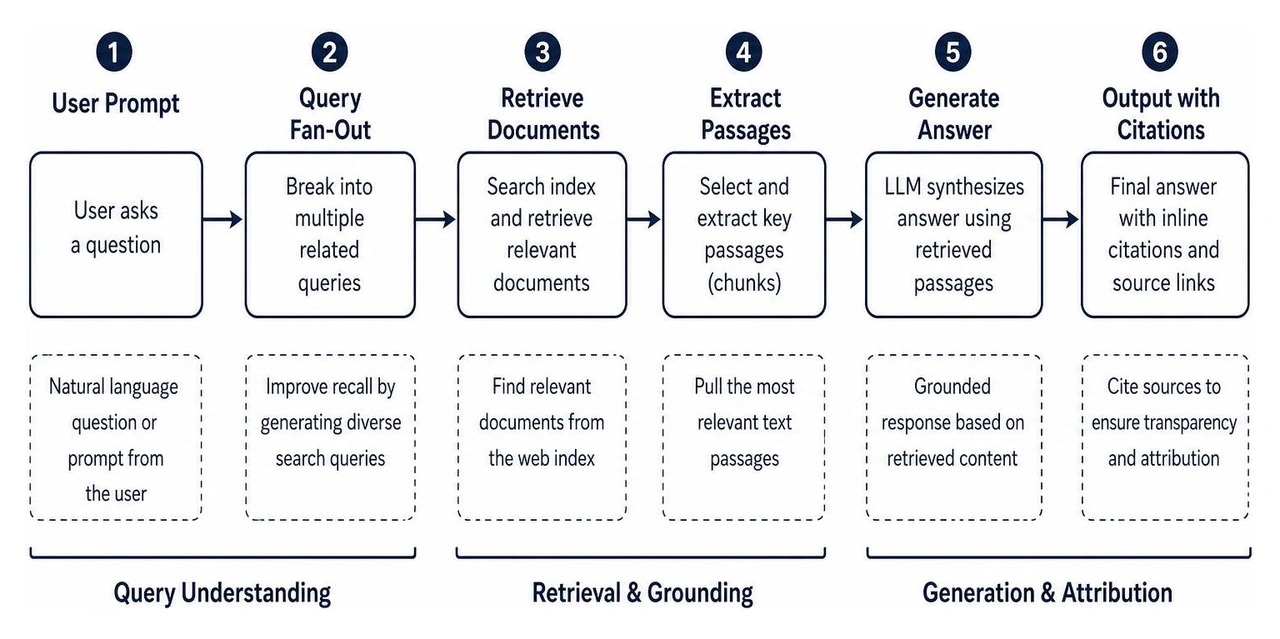
When a query enters a generative engine, the backend architecture breaks the prompt into multiple search queries, fetches candidate pages from a core web index, extracts key chunks, and hands them to the language model. The model then synthesizes an answer while attaching inline hyperlinked citations to credit the sources.
To understand how this landmark methodology was proven, you can read the foundational Research paper on GEO, which established early benchmarks for content citability across generative engines.
| Feature / Dimension | Traditional SEO | Generative Engine Optimization (GEO) |
|---|---|---|
| Primary Interface | Search Engine Results Pages (SERPs) | Conversational AI overlays, chat interfaces, AI Overviews |
| Core Architecture | Crawler-based index and link-graph ranking | Retrieval-Augmented Generation (RAG) and Query Fan-out |
| Output Format | Ordered list of organic snippets and URLs | Single synthesized block of prose with embedded inline citations |
| User Interaction | Query to Click link to Read landing page | Prompt to Read synthesized summary to Optional citation click |
| Primary Visibility Goal | Position #1–#3 organic ranking | Inclusion as a cited source or brand recommendation |
Core Differences Between Traditional SEO and Generative Engine Optimization (GEO)
While traditional SEO and GEO build on similar technical foundations, their end objectives and optimization metrics diverge significantly.
- SERP Ranking vs. AI Citations: In traditional SEO, success means earning the highest numerical position on a SERP. In GEO, there is no single "rank." An AI engine synthesizes answers dynamically based on prompt nuances, meaning victory is defined by being included as a cited source within the generated answer block.
- Organic Clicks vs. Zero-Click Search: Organic SEO relies on searchers clicking through to your landing page. In AI search, zero-click behavior is dominant. Users often get complete answers directly on the search interface. GEO optimizes for brand visibility, authority attribution, and user consideration within that answer space, regardless of whether an immediate click occurs.
- Keyword Matching vs. Semantic Extraction: Traditional search historical models relied on exact-match or topical keyword targeting. Generative models utilize high-dimensional vector embeddings and semantic context. They analyze whether a specific passage directly answers a complex, multi-part prompt.
- Whole-Page Authority vs. Passage Extractability: SEO evaluates domain authority, overall page layout, and complete backlink profiles. GEO places massive weight on passage-level extractability — clear, complete sentences containing verifiable facts, direct expert quotes, and explicit data points.
How Generative Engines Retrieve and Cite Sources
Understanding how platforms like Google AI Overviews, Perplexity (including Perplexity.ai), and ChatGPT choose their sources requires looking at the mechanics of information retrieval and grounding frequency.
When a user enters a nuanced search query, generative platforms execute query fan-out. For instance, if a user asks, "How do I restore a damaged Webflow site after a failed deployment?", the engine internally generates multiple backend searches:
- "Webflow site restore from backup steps"
- "Webflow enterprise backup history manual recovery"
- "Troubleshooting published Webflow CMS errors"
The search engine retrieves candidate documents for each fan-out query from its live index. Once candidate documents are retrieved, the engine measures semantic similarity between the user's intent and specific web passages using cosine similarity across vector embeddings.
The AI language model then performs grounding. To prevent hallucinations, the model is strictly constrained to synthesize statements supported by the retrieved web passages. When the engine pulls a factual claim from your site to ground its output, it generates an inline reference link. High grounding frequency means your content is repeatedly selected as the factual baseline for AI-composed answers.
Proven Strategies to Increase AI Search Visibility
Earning consistent citations in AI answers is not a matter of luck or prompt hacking; it is grounded in empirical research. Extensive testing across thousands of queries has proven that specific on-page interventions yield a massive visibility boost in generative engines.
In academic and field trials, applying targeted GEO techniques generated relative visibility improvements of 30% to 40% on the Position-Adjusted Word Count metric and 15% to 30% on Subjective Impression scores. On live platforms like Perplexity.ai, proper content optimization yielded visibility gains up to 37%.

Effective Tactics in Generative Engine Optimization (GEO)
To maximize your site's citation frequency, content teams should implement four primary optimization pillars:
- Statistics Addition (+34% Visibility Boost): Replacing broad qualitative assertions with explicit quantitative data significantly improves source selection. Instead of writing "Many businesses see traffic growth after redesigning their sites," write "Our client audits across Pittsburgh and Cleveland showed a 42% increase in organic session duration within 90 days of a Webflow migration."
- Quotation Addition (+22% to +41% Boost): Integrating direct, attributed quotes from named industry experts gives language models authoritative text anchors to pull into synthesized answers. Quotation addition recorded a 22% improvement over baseline performance on Perplexity.ai alone.
- Inline Citations & Reference Links (+29% Boost): Linking out to primary research, academic studies, and authoritative source material signals higher factual integrity. Generative models prioritize content that explicitly grounds its own assertions.
- Fluency Optimization: Writing in clean, confident, natural language without structural clutter makes text vastly easier for LLM parsers to process. In fact, combining Fluency Optimization with Statistics Addition outperformed any single GEO strategy by more than 5.5%.
To see how these tactics integrate into comprehensive digital campaigns, explore our detailed breakdown on Generative Engine Optimization.
Tailoring Content Across Niche Domains
GEO tactics do not operate uniformly across every topic. Academic benchmark testing shows that generative engines favor distinct optimization styles depending on the domain and user query type:
- Law & Government Queries: Highly sensitive to concrete statistics, primary case references, and explicit date tracking.
- History & Debate Queries: Perform best when written in an authoritative tone backed by direct quotes from historical figures or subject experts.
- Technical & Software Queries: Prioritize clean passage extractability, step-by-step resolution formatting, and concise code or platform documentation.
When measuring visibility across these varied domains, standard SERP rankings fall short. Researchers rely on Position-Adjusted Word Count — a metric that measures how many words in an AI response are directly attributed to your source material, weighted by how early your citation appears in the text.
Ineffective Tactics and Myths in AI Search Optimization
As interest in AI search has skyrocketed, so has misinformation regarding shortcut strategies. Many tactics championed on social media are not only useless — they can actively harm your search performance.
Google's official Search Essentials and spam guidelines make it crystal clear: automated shortcuts, low-quality content, and deceptive manipulation will trigger programmatic ranking downgrades. For an authoritative breakdown of verified concepts, consult the community-curated Generative Engine Optimization guide.
Why Keyword Density Fails in AI Models
In traditional search engines of twenty years ago, repetition was often rewarded. In modern generative engines, keyword stuffing is entirely counterproductive.
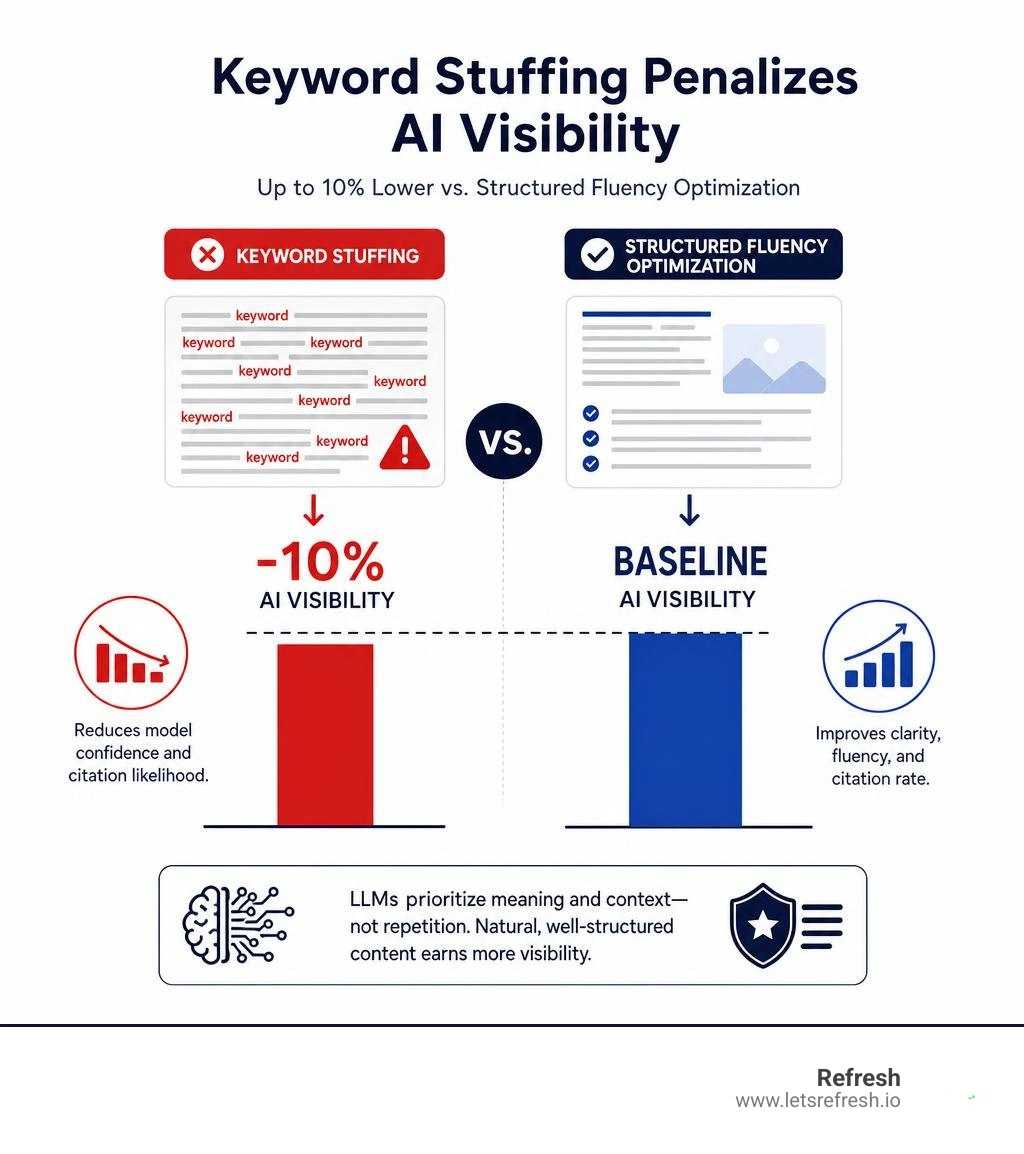
Research demonstrates that traditional keyword stuffing performs 10% worse than baseline content in generative search responses. Large language models process semantic context and intent vectoring, not raw term frequencies. Overloading content with forced keyword variations creates grammatical friction and destroys natural language fluency. This readability loss directly reduces the model's confidence score, decreasing your citation rate.
Common Misconceptions About AI Schema and Files

Several persistent myths continue to confuse site owners about technical GEO requirements:
- The
llms.txtMyth: Some marketers claim that placing anllms.txtfile in your root directory is required for AI engines to read your content. Google Search Central documentation explicitly confirms that Google AI features do not require or use customllms.txtfiles for generative retrieval. Standardrobots.txtand clean sitemaps remain the standard. - Special "AI Schema" Markup: E-commerce and organizational schema markup (Schema.org) are valuable for helping search bots understand entities, but there is no magic "AI schema tag" that guarantees an AI Overview citation. Search engines process standard semantic HTML markup effectively.
- Extreme Content Chunking: Breaking articles into tiny, disjointed 50-word pages under the belief that "AI only reads small chunks" damages context. Modern RAG architectures extract relevant passages naturally from comprehensive, well-structured long-form articles.
When building on modern web platforms — with Webflow as our preferred platform — focus on clean semantic HTML headers (<h1> through <h3>), clear paragraphs, and accessible server-side rendering rather than chasing artificial technical hacks.
Foundational SEO and Measuring Performance in Generative Search
Generative Engine Optimization is not a standalone discipline designed to replace standard search strategy; it is built on top of classical SEO. If your website cannot be crawled, indexed, and evaluated as authoritative by primary search engines, it will never enter the candidate retrieval pool for AI synthesis.
Technical fundamentals such as server-side rendering, fast page load speeds, secure HTTPS connections, and strong Experience, Expertise, Authoritativeness, and Trustworthiness (E-E-A-T) signals are table stakes.
For a broader look at software suites that help monitor technical health alongside AI metrics, check out our AI SEO Tools Complete Guide.
Tracking AI Visibility and Citation Rates
Measuring GEO success requires adding new metrics alongside classical click-through rates and organic ranking tables:
- Google Search Console Generative AI Reports: Search engines are continuously expanding analytics dashboards to show how often your site appears in generative search features, tracking impressions, clicks, and average citation position.
- AI Share of Voice (SoV): Calculated by sampling core conversational prompts in your industry and determining what percentage of generated answers cite your domain versus your competitors.
- Citation Rate & Mention Frequency: Tracking how many distinct inline links your domain receives across major engines like Perplexity, ChatGPT, and Google AI Overviews.
- Referral Traffic Tracking: Setting up custom analytics filters in platforms like GA4 to isolate web traffic coming from AI referrals (e.g.,
perplexity.ai,chatgpt.com).
Democratizing Search Visibility for Small Websites
One of the most remarkable discoveries in GEO research is that AI search levels the playing field for smaller, lower-ranked websites.
In classic Google search, a site sitting in the fifth organic SERP position receives a tiny fraction of user clicks compared to the top result. However, empirical studies reveal that applying the "Cite Sources" method generated a 115.1% visibility increase for websites ranked fifth in SERPs within generative responses. Meanwhile, the top-ranked organic result saw an average visibility decline of 30.3% as AI engines synthesized multi-source answers.
Because generative engines use query fan-out to pull niche sub-topics, lower-ranked domains that publish original research, specific statistics, and deep expert insights can displace generic high-authority market leaders inside AI answers.
To explore how smaller organizations can leverage these tools effectively, read our guide on What Are the Best AI SEO Tools for Small Businesses.
Agentic Search Trends and the Future of Discovery
As we navigate 2026, the AI search ecosystem is evolving from static text answers to agentic search experiences. Search engines are no longer just answering questions — they are executing workflows on behalf of users.
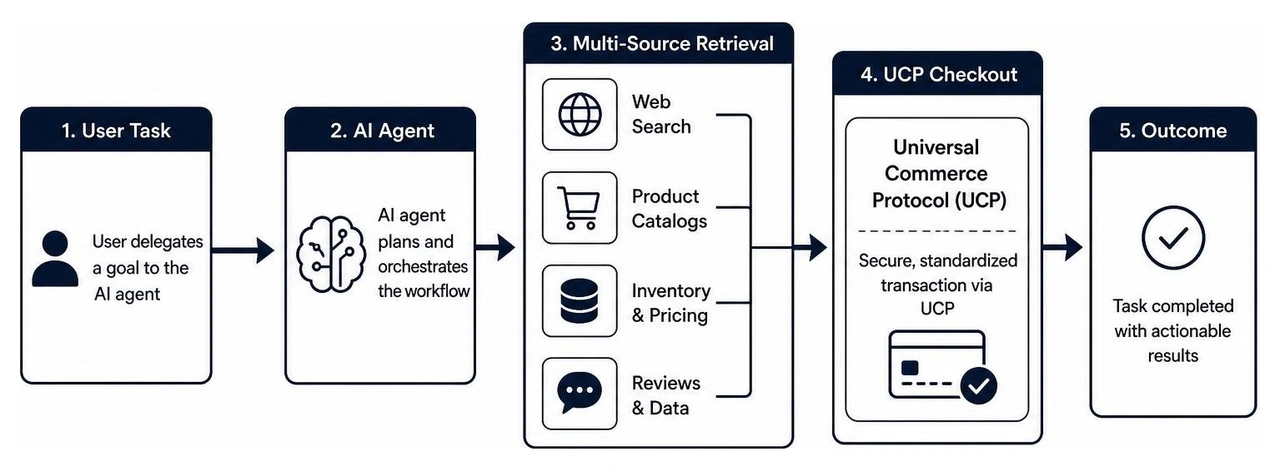
Browser agents and AI shoppers now interact directly with web interfaces to compare prices, verify inventory, book appointments, and complete purchases. Protocols like the Universal Commerce Protocol (UCP) allow generative AI agents to process transactions directly within the chat interface.
For digital marketers and web development teams, preparing for agentic experiences means:
- Maintaining accurate product feeds, clear structured schema, and explicit inventory metadata.
- Ensuring web infrastructure (especially fast, responsive Webflow builds) supports seamless automated data extraction.
- Authoring clear, factual conversion paths that AI booking agents can interpret without human intervention.
To understand how automated systems interact with content at scale, read our overview on Programmatic SEO and AI.
Frequently Asked Questions About Generative AI Search
How does GEO differ from Answer Engine Optimization (AEO)?
While industry terminology frequently overlaps, Answer Engine Optimization (AEO) originally developed around featured snippets, voice search assistants (like Amazon Alexa or Google Assistant), and direct answer boxes. Generative Engine Optimization (GEO) specifically addresses multi-source synthesis in large language model engines. In modern agency practice, the terms are often used interchangeably to describe optimizing for non-traditional conversational search interfaces.
How quickly can content interventions show results in AI citations?
Generative search engines exhibit a strong recency bias. Research indicates that cited sources in AI answers are, on average, 26% more recent than standard organic SERP links. When you update existing high-quality articles with fresh statistics, verified expert quotes, and explicit inline references, live-retrieval crawlers (such as PerplexityBot or OAI-SearchBot) can index those updates within days, leading to noticeable citation improvements in as little as two to four weeks.
Can lower-ranked websites win citations in AI search features?
Yes, absolutely. Because generative engines utilize query fan-out to resolve nuanced user prompts, they frequently retrieve content outside the standard top ten organic results. If a lower-ranked page contains precise quantitative data or a direct, well-attributed expert answer that directly matches an internal sub-query, the AI engine will extract and cite that specific passage, granting equal or superior visibility alongside major domain authorities.
Conclusion
The transition toward generative search does not spell the end of digital marketing — it marks an exciting evolution in how authority, trust, and helpful information are rewarded online. By grounding your digital strategy in verifiable data, expert perspectives, clean semantic structure, and strong technical foundations, your brand can maintain high visibility across both classic search engines and emerging conversational AI platforms.
At Refresh, we specialize in helping businesses across Pittsburgh, PA, Cleveland, OH, and Charlotte, NC adapt to the evolving digital landscape. From high-performance Webflow design and development to cutting-edge search strategies, we build long-term partnerships that drive sustainable growth.
Ready to optimize your online presence for the future of AI search? Explore Refresh GEO services today and discover how our expert team can elevate your brand's visibility.


.avif)