

How to Find the Best Low Cost Web Hosting (Without Getting Burned)

The best low cost web hosting options available right now include a range of providers that start as low as $1/month — but the right pick depends on your needs, how many sites you're running, and how long you plan to stay.
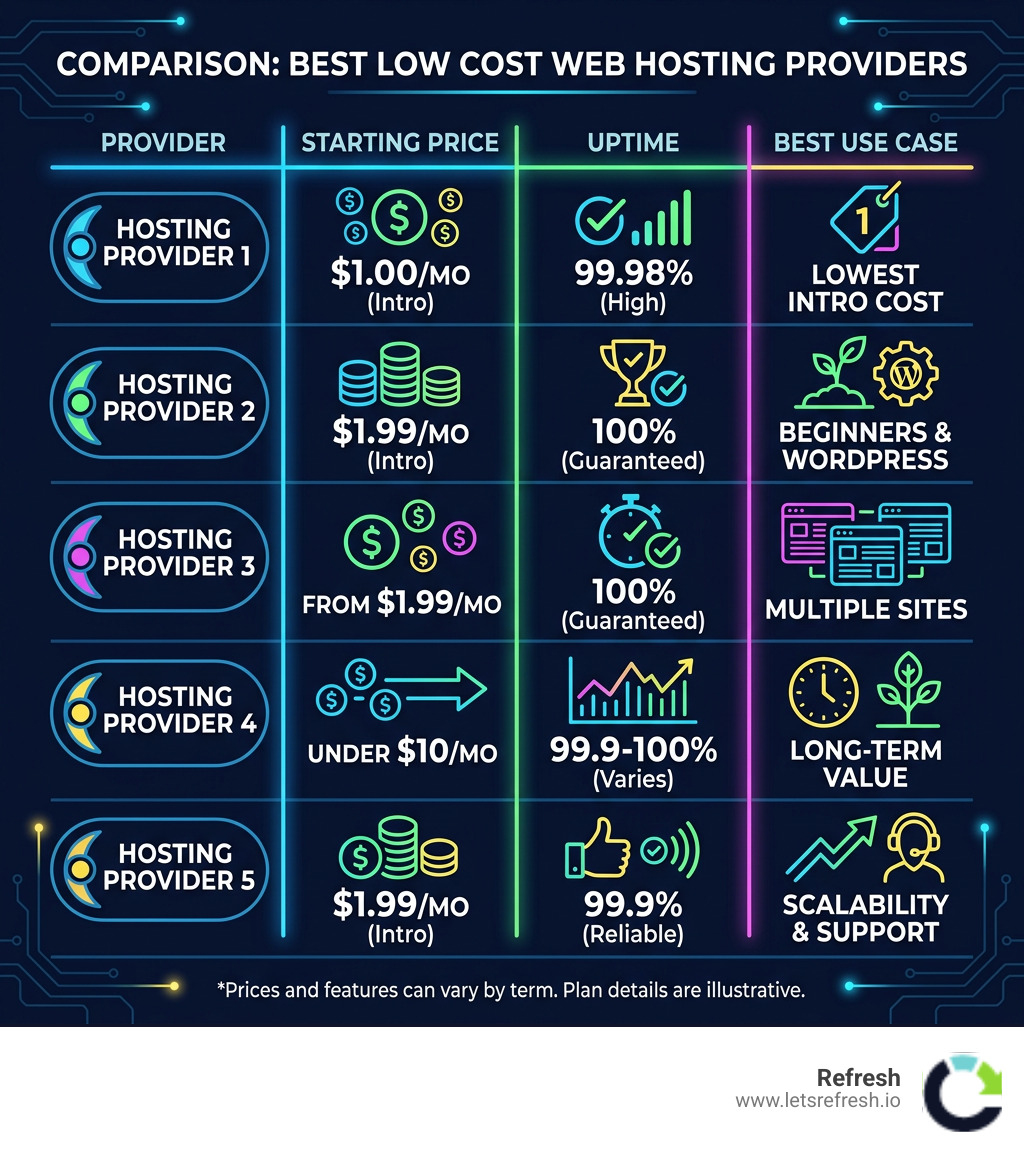
Here's a quick comparison to help you decide fast:
| Provider | Starting Price | Best For | Uptime |
|---|---|---|---|
| IONOS | $1.00/mo (first year) | Absolute lowest intro cost | 99.98% |
| Bluehost | $1.99/mo (3-year term) | Beginners, WordPress | 100% |
| Hostinger | From $1.99/mo | Multiple sites, long-term value | 100% |
| Namecheap | Under $10/mo | Cheapest over 5-10 years | 99.9-100% |
| Hosting.com | $1.99/mo | Scalability, support | 99.9% |
Note: Most intro prices apply to the first billing term only. Renewal rates are higher.
Cheap hosting is real — but the fine print matters. Many plans advertise $1/month, then jump to $8-$14/month at renewal. Knowing the difference between an introductory deal and a sustainable long-term cost is what separates a smart hosting decision from an expensive mistake.
I'm Alexander Palmiere, Founder and CEO of Refresh Digital Strategy, and over the course of launching 200+ websites for small and mid-sized businesses, choosing the best low cost web hosting has been one of the most frequent — and consequential — decisions I've helped clients navigate. In this roundup, I'll break down exactly which providers deliver real value, so you can make a confident choice from the start.
Best low cost web hosting terms to remember:
Introduction

When you are first launching a business in Pittsburgh, Cleveland, or Charlotte, every dollar counts. You want a professional online presence, but you don't want to overspend on resources you aren't using yet. Entering web hosting can feel like learning a new language. You’ll hear terms like "shared hosting," "VPS," and "managed WordPress," but at the end of the day, you just want your site to load quickly and stay online.
One of the first hurdles for beginners is understanding the difference between domain registration and web hosting services. Think of your domain as your street address (e.g., yourbusiness.com) and web hosting as the actual physical building where your website's files live. You need both to be open for business. While some of the best low cost web hosting plans provide a domain name for the first year as part of the package, others require you to purchase it separately.
Budgeting for your first site isn't just about the $1 or $2 you pay today. It’s about scalability. A plan that is perfect for a small portfolio might buckle under the pressure of a viral marketing campaign. We always recommend looking for "entry-level" plans that offer a clear path to upgrade as your traffic grows.
Evaluating the Best Low Cost Web Hosting for Long-Term Success
To find the cheap reliable web hosting that actually works, we have to look past the flashy "90% off" banners. The web hosting industry is famous for its introductory pricing. These are deep discounts designed to get you in the door, often requiring a 12, 36, or even 48-month commitment upfront.
For example, IONOS currently offers the absolute cheapest entry point at just $1.00 per month for the first year. That’s a total of $12.00 for an entire year of hosting. However, if you are planning for the long haul, Namecheap often comes out on top. Research shows that Namecheap provides the most competitive long-term pricing, costing approximately $280.56 for 5 years and $588.96 for 10 years.
Key Considerations for Evaluating Hosting Providers
When we evaluate the best low cost web hosting, we look at four main pillars:
- Performance Metrics: Does the site load in under 2 seconds?
- Support Quality: Can you reach a human at 2 AM when your site goes down?
- Scalability Options: Can you move from a shared server to a more powerful environment without migrating your whole site?
- Feature Sets: Are security certificates and backups included, or are they "hidden" upsells?
Understanding the Impact of Renewal Hikes
The biggest "gotcha" in budget hosting is the renewal rate. A plan that costs $1.99/month today might renew at $14.99/month three years from now. This is why price transparency is vital. Before you click "buy," always check the "Regular Price" or "Renewal Price" in the terms of service.
To manage your long-term budget, consider locking in the longest possible contract length (usually 3 or 4 years) at the introductory rate. This gives you the most "runway" before your costs increase.
Essential Features in Budget-Friendly Hosting Plans
Just because you are paying "peanut" prices doesn't mean you should settle for a subpar experience. Even an affordable website hosting guide will tell you that certain features are non-negotiable in 2026.
Modern budget plans should include NVMe SSD storage. Traditional hard drives are too slow for today's web. NVMe drives can be up to 10x faster, ensuring your WordPress dashboard doesn't lag. You should also look for unmetered bandwidth, which means the host won't shut your site down if you get a sudden spike in visitors.
Security is another essential. Most top-tier budget hosts now provide security certificates (SSL) for at least the first year as part of their service. Without an SSL, browsers like Chrome will mark your site as "Not Secure," which scares away customers. Finally, look for automated backups. HostGator, for instance, provides some backups but actually encourages users to seek third-party services for critical data—a reminder that you should always verify how your data is protected.
Maximizing Value with the Best Low Cost Web Hosting for CMS Platforms
If you are using a Content Management System (CMS) like WordPress, your hosting needs are specific. You'll choose between "Shared" hosting (where you share server resources with others) and "Managed" hosting (where the host handles updates and security for you).
Many budget hosts offer "one-click" installations, making it incredibly easy to get started. However, be aware of plugin restrictions. Some managed hosts block certain caching or security plugins because they already provide those features at the server level.
At Refresh, we often steer our clients toward Webflow. While this article focuses on traditional hosting, Webflow offers a preferred platform for integrated design and hosting that eliminates many of the "moving parts" (like updates and security patches) that come with budget WordPress hosts.
Resource Allocation for Multiple Websites
Are you a serial entrepreneur? If you plan on launching several small projects, look for plans that allow multiple websites. While the most basic plans usually limit you to one site, companies like DreamHost offer entry plans that support up to 25 websites for about $227.40 over five years.
Pay attention to "Inode counts"—this is a limit on the total number of files you can store. Even if you have "unlimited" space, a low inode limit can stop you from hosting multiple complex sites.
Performance Benchmarks: Speed and Uptime on a Budget
Speed is a ranking factor for Google and a conversion factor for your customers. In our research, Bluehost stands out with an average load time of 0.4 seconds and 100% uptime across global testing locations. That is impressive for a plan that starts at under $2.00/month.
Uptime is the percentage of time your website is accessible to the public. While many hosts offer a 99.9% Uptime SLA (Service Level Agreement), that 0.1% of downtime still equals about 9 hours of "darkness" per year.
Performance Benchmarks for the Best Low Cost Web Hosting
To truly compare the best low cost web hosting, we look at technical metrics:
- TTFB (Time to First Byte): How fast the server responds to a request.
- LiteSpeed Acceleration: A server technology that speeds up PHP execution (essential for WordPress).
- Global Latency: How fast your site loads for a customer in Charlotte versus someone in London.
Reliability and Customer Support Standards
When things go wrong, you need support. Most budget hosts offer 24/7 chat support, but the quality varies. For example, Hosting.com (A2) has maintained 100% uptime over recent months and boasts that 97% of its customers would recommend them. On the flip side, some budget providers have been noted for sluggish response times or "impossible" phone support. Always check recent user surveys—Namecheap and Hostinger recently scored 8.03/10 and 8.11/10 respectively in user satisfaction.
Strategic Hosting for Beginners and Small Businesses
For a small business in Cleveland or Pittsburgh, your website is your digital storefront. You need a user-friendly dashboard that doesn't require a computer science degree to navigate. This is where "Generative Engine Optimization" (GEO) comes into play. As AI search engines become more prevalent, having a fast, technically sound website—supported by the best web hosting guide for small businesses—is the foundation for being "found" by AI.
Avoiding Hidden Limitations in Cheap Plans
The "catch" with low-cost hosting usually hides in the limits. Watch out for:
- Storage Caps: 10GB sounds like a lot, but high-res images and videos eat it up fast.
- Email Limits: Some entry plans only give you one professional email address.
- Migration Fees: If you already have a site, check if the new host will move it for you. IONOS and Namecheap provide migrations as part of their standard service, while others might charge $100+.
- Domain Retention: If you get a domain bundled with your plan and cancel your hosting, you may have to pay a high fee to keep that domain name.
Scaling for Professional Growth
As your business grows, your hosting should too. The transition from a $2/month shared plan to a $30/month VPS (Virtual Private Server) should be seamless. This is why we value long-term partnerships. At Refresh, we help businesses navigate this professional growth. Whether you are using a budget host or a high-performance platform, our goal is to ensure your tech stack supports your sales.
Frequently Asked Questions about Affordable Hosting
What is the absolute cheapest way to host a site right now?
Currently, IONOS holds the title for the lowest entry price at $1.00/month for the first year. This is ideal for a new project where you want to keep initial overhead to the absolute minimum.
Do low-cost plans provide a domain name and security?
Many do, but usually only for the first year. For instance, Bluehost and Hostinger provide a domain name in their introductory periods as part of the subscription. Security features like SSL certificates are now standard on most reputable budget plans, though advanced malware removal may cost extra.
Can I host more than one website on a budget plan?
It depends on the plan. "Single" or "Starter" plans usually limit you to one website. If you need more, look for "Plus" or "Premium" tiers. AccuWeb Hosting and DreamHost are particularly well-known for allowing multiple sites on their more affordable tiers.
Conclusion
Finding the best low cost web hosting is about balancing your immediate budget with your future goals. While names like IONOS, Bluehost, and Hostinger offer incredible entry points, your website is an investment in your brand's future.
At Refresh, we specialize in helping small to medium-sized businesses in Pittsburgh, Cleveland, and Charlotte build high-performing digital presences. While we’ve explored many budget hosting options here, our preferred platform remains Webflow for its superior integrated design and hosting capabilities. We believe in long-term partnerships that help you scale from your first "peanut-priced" host to a professional-grade digital powerhouse. If you're ready to take the next step in your website hosting for small business journey, we're here to help.


.avif)