
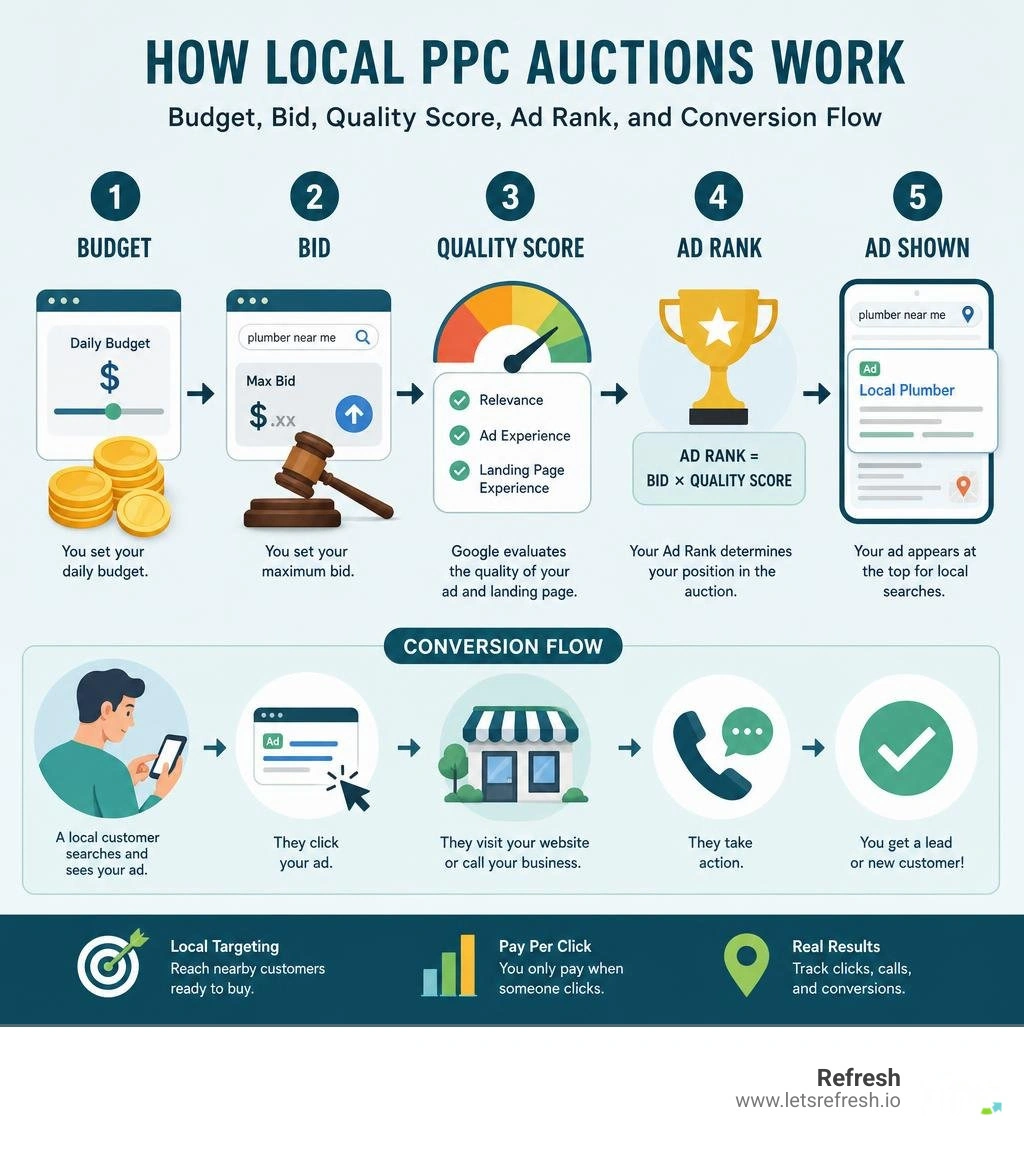
How PPC for Local Businesses Works (Quick Answer)
PPC for local businesses is a paid advertising model where you pay only when someone clicks your ad — and you control exactly who sees it, where they are, and when.
Here's how it works at a glance:
| Step | What Happens |
|---|---|
| 1. You set a budget | You choose a daily or monthly spend limit |
| 2. You pick keywords | You target searches like "plumber near me" or "dentist in Austin" |
| 3. Google runs an auction | Your bid + Quality Score determines your ad position |
| 4. A local customer clicks | Your ad appears at the top of search results |
| 5. You pay per click | You're only charged when someone actually clicks |
Most local businesses start seeing leads within the first few days of launching a campaign. Full optimization typically takes 4–6 weeks.
If you run a local business — a restaurant, a dental practice, an HVAC company, a boutique — the window to reach a nearby customer ready to buy is often just a few seconds. That customer types "emergency plumber near me" or "best coffee shop open now," and whoever shows up at the top of those results wins the call, the visit, or the booking. That's the core promise of local PPC: instant, targeted visibility at the exact moment someone is ready to act.
Unlike organic SEO, which can take six months or more to show results, a well-structured PPC campaign can put your business in front of local customers the same day it launches. And unlike traditional advertising — flyers, radio, local print — every dollar is trackable. You can see exactly which keywords drove calls, which ads got clicks, and what each new customer cost you.
But here's the problem: most local business owners either set up campaigns incorrectly, waste budget on the wrong keywords, or give up before the data has time to work. This guide is designed to fix that.
I'm Alexander Palmiere, Founder and CEO of Refresh Digital Strategy — a Webflow website development and digital marketing agency that has helped over 200 small and midsized businesses build smarter digital strategies, including PPC for local businesses that actually convert clicks into customers. In the sections ahead, I'll walk you through everything from setting your first budget to advanced geo-targeting tactics.
Ppc for local businesses vocab to learn:
Why PPC for Local Businesses Is Essential in 2026
_compressed.jpg?alt=media&token=23d8784a-121f-4d99-9cc4-125ff450bc07 "A close-up of a modern smartphone displaying local search results with map pins")
As of July 2026, the digital landscape is more crowded than ever. A staggering 47% of small business owners execute marketing campaigns entirely on their own, meaning your direct competitors are actively trying to figure out how to capture your market share. For a neighborhood boutique in Pittsburgh, a family dentist in Cleveland, or a roofing contractor in Charlotte, relying solely on foot traffic or word-of-mouth is no longer enough to sustain growth.
This is where pay-per-click (PPC) advertising comes in. To understand its true power, we must first look at how it intersects with search. While organic optimization is vital, understanding the PPC SEO Meaning reveals that these two strategies are designed to support one another, not compete.
PPC gives you immediate, guaranteed real estate at the top of search engine results pages (SERPs), while a robust SEO for Local Business strategy establishes your long-term organic authority. By running both, you dominate both the paid and organic sections of the search results, making it incredibly difficult for potential customers to miss you.
Comparing Paid Search and Organic Channels
Search engines frequently update their organic algorithms, which can cause sudden shifts in organic traffic. For a small business, a sudden algorithm change can feel devastating. PPC offers a reliable shield against this volatility. With paid search, your visibility is protected by your budget, your targeting parameters, and your ad relevance.
To help you decide where to focus your resources, here is a direct comparison of how these channels perform:
| Feature | Local PPC | Local SEO |
|---|---|---|
| Time to Results | Immediate (typically within 24–48 hours) | Long-term (typically 3 to 6 months) |
| Cost Structure | Pay-per-click or pay-per-lead | Upfront time or agency management fees |
| Algorithm Shield | High (immune to organic search updates) | Low (directly impacted by core updates) |
| Control | Precise control over messaging and landing pages | Organic search engines choose what text to display |
| Primary Goal | Direct lead generation and immediate sales | Long-term authority, brand awareness, and steady traffic |
Combining these channels is the ultimate goal. A comprehensive Local SEO Strategy ensures that you capture users who prefer organic listings, while your local PPC campaigns capture high-intent buyers who want to take action immediately.
Key Benefits of Hyper-Local Targeting
The true beauty of ppc for local businesses lies in its precision. National brands have massive budgets, but they cannot target a specific neighborhood with the same relevance and personal touch that you can.
When you leverage professional Local SEO Services and hyper-local PPC, you gain several distinct advantages:
- Minimized Wasted Spend: You only show ads to users within your specific service boundaries. If you are an HVAC technician based in Pittsburgh, you can block your ads from showing to users in towns that are too far away to service profitably.
- Captured Search Intent: You reach buyers at the exact moment of need. A resident searching for "emergency AC repair Charlotte" has immediate buying intent. Showing your ad at that exact second leads to incredibly high conversion rates.
- In-Store Foot Traffic and Phone Calls: Industry data shows that 73% of local business conversions happen via phone calls or physical store visits rather than online forms. Local PPC campaigns can be optimized specifically to drive clicks-to-call or map directions.
Understanding Google Local Services Ads vs. Standard Google Ads
For local business owners, Google offers two primary paid advertising channels: standard Google Ads and Google Local Services Ads (LSAs). While both appear at the very top of Google search results, they operate on completely different models. Understanding these differences is crucial for a successful Google Ads Campaign Setup.
How Google Local Services Ads Work
Google Local Services Ads are designed specifically for service-based businesses (like plumbers, electricians, locksmiths, and realtors). Instead of paying when someone clicks on your ad, you pay per lead. This means you are only charged when a customer calls, sends a text message, or books a service directly through the ad.
LSAs feature the prestigious Google Guaranteed or Google Screened badge, which immediately builds consumer trust. To earn this badge, businesses must pass a rigorous verification process, including background checks, license verification, and insurance reviews.
Once approved, your ad ranking is determined by your proximity to the searcher, your business's review rating, and how quickly you respond to customer inquiries. It is an incredibly effective way to Drive More Leads because customers feel secure booking with a Google-backed business.
When to Use Standard Google Ads
While LSAs are fantastic for quick, trust-backed phone calls, standard Google Ads (Search campaigns) offer a level of customization and control that LSAs simply cannot match. Standard Google Ads are highly recommended when you need:
- Granular Keyword Control: LSAs target broad categories of services. With standard Google Ads, you can bid on highly specific, long-tail search terms that show high buying intent.
- Custom Ad Extensions: You can add sitelinks, structured snippets, callout extensions, and location extensions that display your physical address, phone number, and unique selling points.
- Dedicated Landing Pages: Instead of sending users to a generic Google profile, you can direct them to a custom-built, high-converting landing page that highlights a specific promotion or service.
For most growing companies, a comprehensive strategy for PPC Management for Small Business involves running both LSAs and standard Google Ads simultaneously. They dominate the top of the search results together, leaving little room for your competitors to squeeze in.
Budgeting and Cost Factors for Local Paid Campaigns
One of the most common questions we hear is: "How much should we spend on local PPC?"
There is no single answer, but understanding the factors that influence your costs will help you build a highly profitable budget. Partnering with an affordable digital marketing agency can help you maximize every dollar of your ad spend.
Determining Your Initial Ad Spend
To build a realistic budget, you should work backward from your revenue goals rather than picking an arbitrary number. Here is a practical, five-step framework to calculate your initial budget:
- Calculate Customer Lifetime Value (CLV): How much is a customer worth to your business over time? For example, a dental patient in Cleveland might spend $200 per visit, visit twice a year, and stay with the clinic for five years, resulting in a CLV of $2,000.
- Establish Your Target Cost per Acquisition (CPA): How much are you willing to spend to acquire that customer? If their lifetime value is $2,000, spending $150 to acquire them is highly profitable.
- Estimate Your Conversion Rate: On average, local business websites convert between 5% and 15% of PPC traffic into leads. Let's assume a conservative conversion rate of 10% (one lead for every ten clicks).
- Research Local Keyword Costs: Use the Google Keyword Planner to check the average Cost-Per-Click (CPC) for your target keywords in your specific city.
- Calculate Required Traffic and Budget: If your average CPC is $5.00 and you need 10 clicks to get one lead, your Cost Per Lead (CPL) is $50. If your close rate on leads is 33%, you need three leads (costing $150) to acquire one paying customer.
Data shows that local businesses spending at least $2,000 per month on Google Ads see a 35% better cost-per-acquisition compared to those spending under $1,000. This is because search engine algorithms require a healthy volume of conversion data to optimize bidding patterns effectively. If you want to dive deeper into budget calculations, check out this comprehensive How to Use Local PPC to Get More Customers (Beginner's Guide).
Factors That Influence Local CPC
Your actual cost-per-click is not a fixed rate; it is determined by a live auction every time a search is performed. Several factors influence how much you pay:
- Quality Score: This is Google's rating of the quality and relevance of both your keywords and your PPC ads. A 2-point Quality Score improvement (from 5 to 7) typically reduces your CPC by 16% to 20%. Partnering with a specialist who understands Google AdWords for Agencies is one of the fastest ways to improve this score.
- Competitor Density: If multiple law firms in Charlotte are bidding on the keyword "personal injury lawyer Charlotte," the high competition will drive CPCs up.
- Geographic Location: Ad costs vary wildly by market. Running a campaign in a highly populated metro like Pittsburgh or Charlotte will naturally carry a higher CPC than running the same campaign in a smaller, rural town due to the volume of local competitors bidding on the same terms.
High-Converting Targeting and Optimization Strategies
To build a highly efficient campaign, you must move beyond basic settings and implement advanced targeting strategies. Working with a dedicated Paid Search Advertising Agency can help you implement these tactics seamlessly.
Choosing the Right Platforms for PPC for Local Businesses
Different platforms serve different user intents. Choosing the right mix is essential for maximizing your return on investment (ROI):
- Google Search Network: Unmatched for capturing active search intent. When someone searches for "furnace repair Cleveland," they have a problem that needs to be solved immediately.
- Meta Ads (Facebook & Instagram): Excellent for visual, interest-based, and demographic targeting. This is perfect for local boutiques, restaurants, or home remodelers who want to showcase beautiful visual transformations and build local brand awareness.
- Performance Max (PMax) Campaigns: Google's automated campaign type that runs ads across Search, Display, YouTube, Gmail, and Maps. While powerful, PMax is generally not recommended for local businesses until they are spending at least $5,000 per month and have a healthy stream of conversion data.
By utilizing diverse Digital Advertising Solutions, you can catch customers at every stage of the buying journey.
Advanced Geo-Targeting and Negative Keyword Tactics
Setting your location targeting incorrectly is one of the easiest ways to burn through your ad budget. Follow these best practices to keep your targeting razor-sharp:
- Use "Presence" Targeting: By default, Google targets "Presence or Interest" (people in, regularly in, or who have shown interest in your targeted locations). This means someone in another state looking for travel info could trigger your ad. Always change this setting to Presence: People in or regularly in your targeted locations.
- Implement Radius Targeting: Instead of targeting an entire county, target a tight radius (e.g., 5 to 15 miles) around your physical storefront or primary service area.
- Build a Relentless Negative Keyword List: Negative keywords prevent your ads from showing for irrelevant searches. From day one, add terms like "DIY," "jobs," "complimentary," "training," and "classes" to your negative keyword list to avoid paying for non-converting clicks.
Designing High-Converting Webflow Landing Pages
Driving traffic to your website is only half the battle. Your landing page must be built to convert that traffic into paying customers. This is why we specialize in Webflow development — it allows us to build lightning-fast, highly customized pages optimized for Effective Online Advertising.
When building your landing page, make sure to include these elements:
- Click-to-Call Buttons: Since most local searches happen on mobile devices, place a large, click-to-call phone number in a sticky header at the top of the page.
- Perfect Message Match: The headline of your landing page should exactly match the headline of the ad the user clicked. If your ad promises "Emergency Roof Repair in Charlotte," your landing page headline should say "Emergency Roof Repair in Charlotte" — not a generic "Welcome to Our Roofing Company."
- Strong Trust Signals: Feature real customer reviews, local business certifications, and photos of your local team or trucks to build immediate trust.
Common Pitfalls in Local Paid Advertising
Even with a healthy budget, simple mistakes can quickly derail your campaigns. Proper Digital Ad Campaign Management is key to keeping your ad spend profitable.
- Using Broad Match Keywords Without Restrictions: Broad match allows Google to show your ad for any search query it deems related to your keyword. This often leads to highly irrelevant, expensive clicks. Stick to Phrase Match and Exact Match keywords to maintain control.
- The "Set-and-Forget" Mistake: PPC campaigns are not static. They require weekly adjustments, search term reviews, bid optimizations, and ad copy updates to stay competitive.
- Failing to Set Up Proper Conversion Tracking: If you aren't tracking phone calls and form submissions back to the specific keyword that generated them, you are flying blind. You cannot optimize what you do not measure.
Best Practices for Managing PPC for Local Businesses
To keep your campaigns performing at their peak, follow a structured optimization checklist:
- Review Search Term Reports Weekly: Check exactly what queries triggered your ads and add irrelevant terms to your negative keyword list immediately.
- A/B Test Ad Copy: Always run 2 to 3 ad variations within each ad group. Test different headlines, calls-to-action, and local trust hooks to see which combination yields the highest click-through rate (CTR).
- Monitor and Improve Quality Score: Keep your landing pages fast, your ad copy relevant, and your click-through rates high to secure lower CPCs.
For a deeper dive into managing these campaigns successfully, check out our Digital Marketing Solutions Guide.
Frequently Asked Questions About Local PPC
How do local businesses measure the ROI of their PPC campaigns?
To measure your true return on investment, you must implement comprehensive conversion tracking. This includes setting up call tracking (using dynamic number insertion to track which keyword led to a phone call), form submission tracking, and tracking direct map directions. By integrating your PPC platform with your CRM, you can track a lead from the initial click all the way to the final invoiced sale. Well-optimized local campaigns typically achieve a 3:1 to 6:1 Return on Ad Spend (ROAS) on average.
Should a small business manage PPC in-house or hire an agency?
Managing PPC campaigns requires a significant time commitment and specialized knowledge. If you are spending under $1,000 per month, managing the campaigns in-house using basic search setups can be a practical starting point. However, once your monthly ad spend reaches $1,500 or more, hiring a professional agency or leveraging advanced marketing solutions pays for itself. Professional managers have the tools and experience to eliminate wasted spend, improve your Quality Scores, and significantly lower your cost-per-acquisition.
How does Generative Engine Optimization (GEO) impact local PPC?
Generative Engine Optimization (GEO) is the practice of optimizing your brand's digital footprint so that AI-powered search engines (like Google's Search Generative Experience, ChatGPT, and Claude) cite your business in their conversational answers. While GEO is transforming organic search, paid search ads remain the most reliable way to guarantee your business is prominently displayed at the absolute top of the search interface, ensuring your brand stays visible no matter how search technology evolves.
Conclusion
At Refresh, we don't believe in vanity metrics like impressions or clicks. We believe in building sustainable, high-performing marketing systems that turn search intent into real, measurable business growth. Whether you are looking to dominate the search results in Pittsburgh, Cleveland, or Charlotte, we are here to help you build a custom strategy that works.
We focus on building long-term partnerships, providing expert Webflow development, and delivering transparent, data-driven PPC campaigns that help your business thrive. Ready to stop guessing and start growing? Explore how we can help you Scale Your Local Campaigns and turn your ad spend into a predictable customer acquisition engine.


.avif)